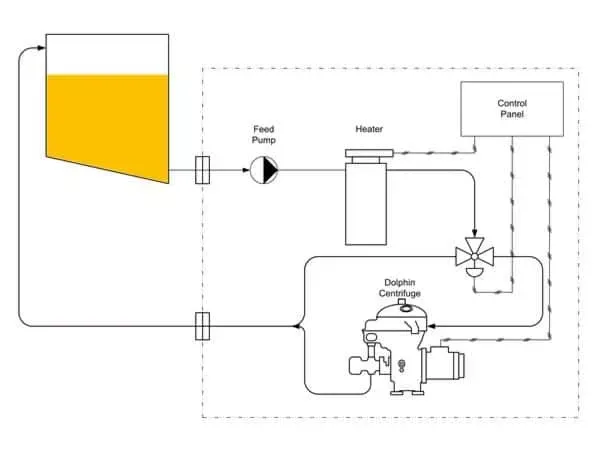
Dolphin Centrifuge supplies disc stack centrifuge systems for lube oil, hydraulic oil, and industrial lubricant purification. Operating at 5,000–8,000 G in continuous kidney-loop configurations, these systems remove wear metals, oxidation products, and water to extend oil life by 3–5x. Based in Warren, Michigan, Dolphin Centrifuge has 40+ years of industrial oil separation experience across turbines, compressors, hydraulic presses, and manufacturing equipment.
Why Centrifuges for Industrial Oils
Industrial oils — lubricants, hydraulic fluids, quench oils — degrade over time as they accumulate wear metals, oxidation products, water, and fine particulate. Traditional filtration captures particles down to ~10 microns, but sub-micron contaminants continue to cause valve sticking, bearing wear, and premature oil replacement.
A disc-stack centrifuge generates 5,000–8,000 G-force, removing particles below 1 micron and simultaneously separating free and emulsified water. The result: oil that meets or exceeds OEM ISO cleanliness codes, extended drain intervals, and dramatically lower unplanned downtime.
Lube Oil Purification
Kidney-loop lube oil centrifuge systems continuously side-stream lubricant from the reservoir, remove wear metals and oxidation byproducts, and return clean oil at 5–30 GPM. This extends lubricant life by 3–5x while keeping ISO cleanliness codes within OEM specifications.
Common applications include turbine lube oil systems, large diesel engine crankcases, compressor lubrication, and paper mill bearing oil. The DMPX-042 disc centrifuge is the most popular choice for medium-volume lube oil circuits.
Hydraulic Oil Cleaning
Hydraulic systems are highly sensitive to contamination — even a few particles can cause servo valve sticking, pump scoring, and catastrophic pressure loss. A hydraulic oil centrifuge maintains fluid cleanliness to NAS 6 or better, protecting extrusion presses, injection molding machines, and heavy mobile equipment.
Centrifuge cleaning eliminates the need for frequent filter cartridge changes and reduces hydraulic component replacement costs by 40–60%. Systems process 5–30 GPM and can be configured for continuous or batch operation.
Extrusion Press Case Study
A major aluminum extrusion facility installed a centrifuge on their hydraulic press circuit and achieved remarkable results: unplanned downtime dropped 98%, pump life extended 2–4x, and hydraulic oil replacement intervals went from 6 months to over 3 years.
The centrifuge paid for itself in under 8 months through reduced oil purchases, fewer pump rebuilds, and increased production uptime. This is a typical ROI timeline for industrial oil centrifuge installations.
Extend Your Oil Life by 3–5x
Kidney-loop centrifuge systems pay for themselves in 6–12 months through reduced oil purchases, fewer component replacements, and increased uptime. Send us your oil sample for a analysis.
How Oil Centrifuges Work
Disc-stack centrifuges use a high-speed rotating bowl containing a stack of conical discs. Oil enters the center of the disc stack, and centrifugal force drives heavy contaminants (metals, carbon, water) outward while clean oil flows inward to the outlet. The disc stack multiplies the effective settling area, enabling throughputs of 5–30 GPM in a compact footprint.
For a deeper explanation of the separation process, see our centrifuge technology overview. Dolphin Centrifuge offers both self-cleaning disc centrifuges (automatic sludge ejection) and manual-clean models for lower-volume applications like the DMPX-028.
Choosing the Right System
Selecting the correct centrifuge depends on oil viscosity, flow rate, contaminant type, and target cleanliness level. Key factors include:
- Flow rate: Match centrifuge capacity to your reservoir turnover requirement (typically 4–6x per day for kidney-loop systems).
- Viscosity: Higher-viscosity oils require larger disc stacks or heated inlet lines to achieve target separation efficiency.
- Contaminant type: Water-in-oil emulsions may require a three-phase separator; dry particulate loads can use a two-phase clarifier.
- Automation level: Self-cleaning models minimize operator intervention; manual-clean units have lower upfront cost.
Not sure which system fits your oil? Send us a sample — our engineers will test it and recommend the right centrifuge configuration for your specific application.
Frequently Asked Questions
How does a centrifuge extend industrial oil life?
A disc stack centrifuge generates 5,000–8,000 G-force to remove wear metals, oxidation products, water, and sub-micron particles from industrial oils. By continuously removing these degradants in a kidney-loop side stream, the oil stays within ISO cleanliness specifications longer — typically extending drain intervals by 3–5x compared to filtration alone.
What ISO cleanliness code can a centrifuge achieve?
Dolphin Centrifuge disc stack systems can achieve ISO cleanliness codes of 14/12/9 or better for lube and hydraulic oils. Hydraulic systems can reach NAS 6 or cleaner. The exact cleanliness level depends on the centrifuge model, operating flow rate, and oil viscosity — our engineers can confirm target cleanliness for your specific system.
What is a kidney-loop centrifuge installation?
A kidney-loop installation continuously draws oil from a reservoir or sump, passes it through the centrifuge for cleaning, and returns clean oil to the system. It operates in parallel with the main oil circuit — the centrifuge processes a side stream (typically 10–20% of total flow) 24 hours a day, continuously removing accumulated contamination.
Can a centrifuge handle turbine lube oil contaminated with water?
Yes. A three-phase disc stack centrifuge simultaneously removes both water and particulates from turbine lube oil. Water ingress is a common problem in turbines — centrifugal separation is the most effective method for removing both free and emulsified water without damaging the oil's additive package.
What size centrifuge do I need for lube oil purification?
For kidney-loop lube oil applications, size the centrifuge to process 4–6 reservoir turnovers per day. For a 500-gallon reservoir, a 5–8 GPM centrifuge is typically sufficient. For larger systems (5,000+ gallon reservoirs), the DMPX-042 at 20–30 GPM is a common choice. Dolphin Centrifuge engineers can confirm sizing based on your specific oil volume and contamination rate.
Stop Replacing Oil. Start Purifying It.
Industrial oil centrifuge systems that pay for themselves in under 12 months. Kidney-loop configurations for turbine lube, hydraulic, and compressor oil. Factory tested from Warren, MI.