Dolphin Centrifuge provides disc stack centrifuge troubleshooting for clogged bowl discs across all brands. Disc stacks operating at 5,000–10,000 G separate solids down to 0.5 microns but clog when sludge exceeds discharge capacity. DMPX self-cleaning systems auto-discharge every 10–60 minutes. Based in Warren, Michigan, with over 40 years of centrifuge diagnostics experience.
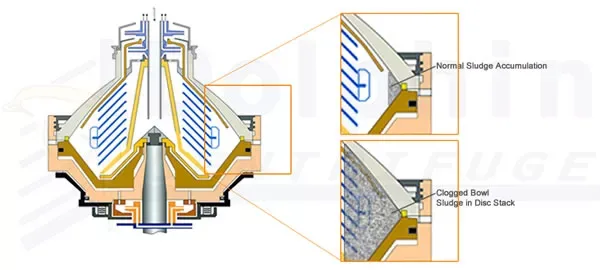
Excessive sludge can potentially clog the bowl discs in a disc stack centrifuge. If the sludge enters the inter-disc space, it blocks the passage for fluid to pass between discs. This condition is known as a clogged disc stack, drastically affecting the centrifuge performance. Clogged bowl discs can also be a safety issue and should be addressed immediately.
Causes of Clogged Bowl Discs
Multiple causes can cause a disc stack to clog. Some of these are operator-related, and some are process-related. The following is a list of the leading causes of disc stack clogging.
Excess Sludge in Process Fluid
Disc stack centrifuges cannot detect the percentage of sludge entering the bowl in the process fluid. Therefore, an unexpected surge of sludge in the process liquid can clog up the disc stack if the sludge ejection cycles cannot eject the solids promptly.
The most common reason for excess sludge is the process fluid coming from a settled tank. The sludge drops under gravity in storage tanks, and if the centrifuge is fed from the bottom of a settled tank, the disc stack can get clogged.
Sludge Discharge Timer Too Long
The sludge space within the bowl of the self-cleaning disc stack centrifuge is preset. The discharge timer activates the sludge discharge mechanism at preset intervals based on the percentage of sludge in the fluid.
If the operator inadvertently sets the time between discharges too long, the sludge accumulates beyond the holding space and clogs up the disc stack and the bowl.
Failure To Discharge Sludge
The self-cleaning centrifuge needs to discharge the separated sludge periodically. If the sludge discharge mechanism fails for some reason, the sludge accumulation will go beyond the sludge space and clog the bowl and disc stack.
Solids Lighter Than Process Fluid
The design of a disc stack centrifuge is based on the sludge being the heaviest phase of the three phases. If the solids in the process fluid are lighter than the heavy phase, the heavy phase liquid will displace the solids and move towards the center of the bowl.
The heavy phase pushes the solids towards the disc stack edge to clog the inner disc space.
Indications of Clogged Bowl Discs
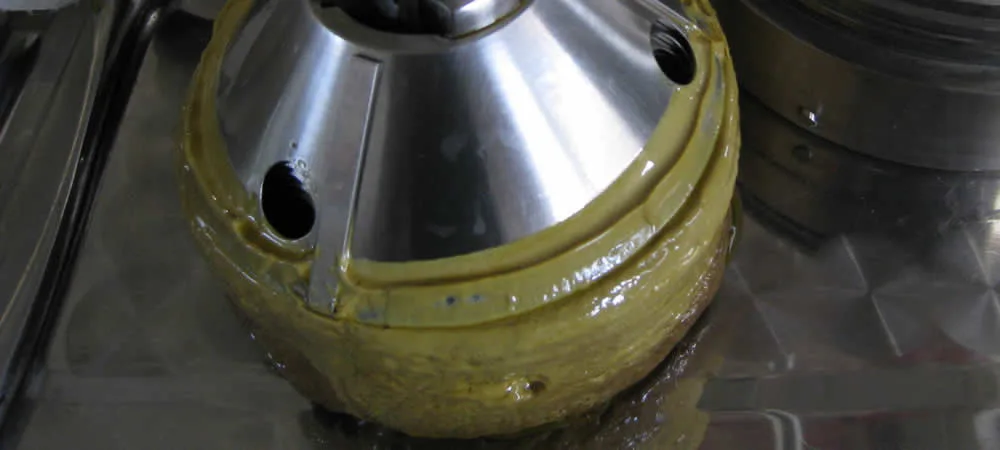
Disc Centrifuge Clogged Bowl
A disc centrifuge exhibits specific indicators as the disc stack or bowl begins to clog. The following are some of the signs of the solids clogging the bowl discs.
Centrate Flow Reduction or Stoppage
As the solids enter the gap between the discs, they obstruct the fluid flow path, which causes a reduction in process fluid flow through the centrifuge. Therefore, the unexplained flow rate reduction is the first sign of a possibly clogged disc stack.
Centrifuge Excessive Vibration
When the sludge fills up the sludge space within the disc centrifuge bowl, it enters other spaces that are free of solids during routine operations. The solids' extra mass causes the bowl to have higher vibration levels. Therefore, higher-than-usual vibrations are possibly associated with bowl clogging. See also: disc stack centrifuge vibration causes and solutions.
Degradation of Fluid Separation
When the bowl discs in a disc centrifuge clog with solids, the fluid pathway is restricted. This obstruction prevents the clean fluid from exiting the bowl. As a result, the light phase exits the centrifuge through the heavy phase outlet contaminating the heavy phase.
Therefore, the unexpected light phase mixed in with the heavy phase is a possible indication of a clogged bowl.
If the solids fill the sludge space, the heavy phase pathway blocks the heavy phase pathway. In such cases, the heavy phase exits the bowl with the light phase, contaminating the light phase.
Thus, disc stack or bowl clogging causes a degradation in centrifuge performance.
Clogged Discs Cleaning Methods
A clogged centrifuge bowl is ineffective and requires thorough cleaning before reuse. There are a couple of ways to clean the centrifuge disc stack and bowl that are listed below.
Complete Bowl Disassembly and Cleaning
The best way to clean clogged bowl discs and the centrifuge bowl is to stop and disconnect the centrifuge and disassemble the bowl. Then the operator should separate the entire stack of discs and clean each disc individually.
The sludge space within the bowl must also be cleaned thoroughly, especially the tiny crevices.
If the clogging of the disc stack is severe, the entire disc stack may be soaked overnight in a solvent such as diesel to loosen up the sludge.
Multiple Discharge Cycles With Clean Fluid
A sludge ejection cycle often has enough force to eject out the solids from the sludge space. Minor clogging of the disc stack can sometimes also clear up during a sludge ejection cycle.
Therefore, if a minor disc stack clog is suspected, multiple sludge ejection cycles can potentially remove some of the clogging sludge from the disc stack.
However, if there is no improvement in the centrifuge performance, stopping and thoroughly inspecting the centrifuge bowl is highly recommended.
Prevention of Bowl Discs Clogging
The centrifuge operator can prevent the disc stack and centrifuge bowl from clogging by following these recommendations.
Agitate Feed Tank
The most common cause of the centrifuge disc stack clogging is the feed fluid coming from a settled or unagitated tank. Disc stack centrifuges, like all industrial centrifuges, work best when the process fluid is homogenous.
Feeding a centrifuge from a settled tank causes the disc stack and sludge space to fill up with sludge before the self-cleaning cycle can discharge the sludge. This excess sludge clogs up the disc stack and bowl quickly.
We highly recommend the use of constantly agitating feed tanks to keep the sludge in suspension and thus prevent the centrifugal separator from clogging.
Monitor Process Fluid Periodically
A self-cleaning disc stack centrifuge discharges the separated sludge periodically based on a timer. The centrifuge system cannot automatically adjust the discharge timer if the sludge proportion in the feed fluid changes.
Therefore, it is essential to periodically check the sludge level in the feed liquid and make sure the solids content is not varying or too high for the disc centrifuge to handle.
Monitor Centrate Outlet Pressure
The first indication of a clogged disc stack or bowl is a reduced flow which causes a reduction in outlet pressure. Therefore, continuous monitoring of the clean fluid outlet pressure is essential.
A pressure sensor on the clean oil outlet is an excellent way to monitor the outlet pressure constantly. New centrifuge control systems from Dolphin Centrifuge have a feed shut-off valve interlocked with the pressure sensor.
Confirm Sludge Discharge Cycle Occurrence
The sludge discharge cycle is the process of the self-cleaning disc centrifuge purging itself of the accumulated sludge. This cycle can be interrupted or malfunctioned for multiple reasons, including operating water issues, operating water pressure or flow, control system malfunction, etc.
Therefore, it is crucial to ensure that the sludge discharge cycle occurs periodically or the operator activates it manually at the appropriate time.
Summary
A clogged disc stack in a self-cleaning or manual clean centrifuge happens for the reasons explained above. It is important to remedy a clogged disc stack condition immediately to avoid potential safety issues and centrifuge performance degradation.
Key takeaways for preventing and addressing clogged bowl discs:
- Prevention is always better than cure — agitate your feed tank constantly and monitor sludge levels
- Set discharge timers correctly — match the discharge interval to the actual sludge content of your process fluid
- Monitor centrate flow and pressure — install a pressure sensor with feed shutoff interlock for continuous protection
- Confirm discharge cycles are occurring — do not assume the self-cleaning mechanism is functioning without verification
- Act immediately when clogging is suspected — early intervention with discharge cycles may clear minor clogging; severe clogging requires full bowl disassembly
— Sanjay Prabhu MSME, Engineering Manager, Dolphin Centrifuge
Centrifuge Clogged or Not Discharging Properly?
Dolphin Centrifuge engineers can diagnose disc clogging issues remotely or on-site. Send us a process sample for testing or schedule a service inspection.
Frequently Asked Questions
What causes a disc stack centrifuge bowl to clog?
The most common causes are excess sludge in the process fluid (often from a settled feed tank), a sludge discharge timer set too long, failure of the sludge discharge mechanism, or solids lighter than the process liquid that migrate into the disc stack rather than the sludge space.
How do I clean a clogged disc stack centrifuge?
Two methods: (1) Complete bowl disassembly — stop the centrifuge, disassemble the bowl, and clean each disc individually (soaking in diesel overnight for severe clogging). (2) For minor clogging, run multiple timed discharge cycles with clean fluid to flush sludge out incrementally. If performance does not recover, full disassembly is required.
How can I prevent disc stack clogging?
Agitate the feed tank constantly to keep sludge in suspension, monitor process fluid sludge content regularly, install a centrate outlet pressure sensor with feed shutoff interlock, and verify that sludge discharge cycles are completing normally each shift.
What are the symptoms of a clogged disc stack centrifuge?
Unexplained reduction in centrate flow rate, higher-than-normal vibration levels due to unbalanced sludge accumulation, and degraded separation quality with phase cross-contamination — light phase in the heavy phase outlet or vice versa.
Can sludge discharge cycles clear a clogged disc stack without disassembly?
For minor clogging, running multiple timed discharge cycles with clean fluid can sometimes flush sludge from the disc stack incrementally. However, if separation performance does not recover within a few cycles, full bowl disassembly and manual cleaning of each disc is required. Attempting to operate a severely clogged centrifuge can cause vibration, safety hazards, and accelerated wear.
Related Troubleshooting Articles
- Disc Stack Centrifuge Vibration — Causes & Solutions
Diagnose and resolve excessive vibration in disc centrifuges.
- Disc Centrifuge Backpressure — Causes & Remedies
Understanding and managing centrifuge backpressure issues.
- Disc Centrifuge Friction Clutch — Maintenance & Replacement
Step-by-step friction clutch inspection, maintenance, and replacement guide.
- Remove Metals & Ash from Used Oil with Disc Stack Centrifuges
How centrifuges separate metal particles and combustion ash from used engine oil.
- Industrial Centrifuge FAQ
Frequently asked questions about centrifuge operation, maintenance, and applications.