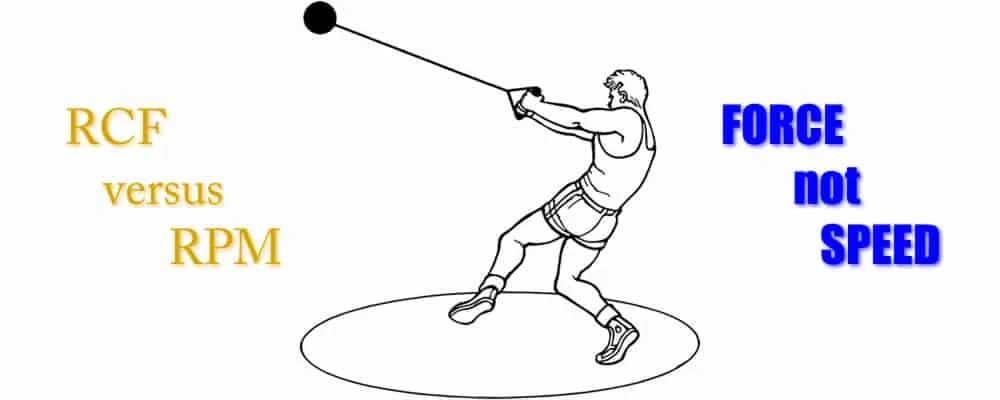
Dolphin Centrifuge supplies disc stack centrifuge systems with rated G-forces of 7,000+ RCF (DMPX series at 7,200–8,600 RPM) and decanter centrifuges at 2,000–4,000 RCF. Understanding the difference between RPM and RCF is essential for comparing centrifuge performance across different bowl sizes. Based in Warren, Michigan, Dolphin Centrifuge has over 40 years of experience in centrifugal separation engineering.
RCF and RPM are standard terms in the context of centrifuges. This article explains the difference between the two terms and why RCF is more relevant to centrifuges. Though the two terms are related mathematically, they are vastly different from the application's perspective.
What is RCF?
RCF stands for Relative Centrifugal Force. The force experienced by any mass (solid, liquid, or gaseous) that rotates around a fixed axis is known as the centrifugal force. RCF is this centrifugal force expressed in terms of gravity. In other words, RCF is the centrifugal force ratio to gravitational force. Therefore it is also referred to as g-force.
What is RPM?
RPM is the abbreviation for Revolutions Per Minute. It is a measure of the speed of rotation of any object. In a centrifuge, the RPM indicates the number of rotations the centrifuge bowl completes in one minute. RPM is a unitless number independent of any object's properties.
Difference Between RCF and RPM
Though RCF and RPM are units of measurement related to centrifuges, they are fundamentally different. The RCF of a centrifuge is the actual centrifugal force (or g-force) generated by the centrifuge bowl rotation.
While the RPM is the speed of rotation of the bowl, the RCF functions as the RPM and the rotating object's radius.
Why Use RCF and Not RPM?
The RCF measures the centrifugal force generated by the centrifuge. This force (g-force) is directly related to the efficiency of the centrifuge. This is because the RCF indicates the centrifuge force exerted, which defines the centrifuge's separation efficiency.
The centrifuge RPM merely indicates the bowl speed but does not define the centrifugal force. In conjunction with the RPM, the rotation radius determines the centrifugal force shown by the RCF formula below.
Example of RCF and RPM in a Centrifuge
For example, consider two centrifuge bowls rotating at the same speed, say 5,000 RPM. One bowl has a radius of 5 cm, while the other has a radius of 25 cm.
Based on the formula, the RCF for the first bowl is 1,400 g-force. However, for the same RPM, the RCF generated by the second (larger) bowl is 7,000 g-force!
The centrifuge's separation efficiency with the 7,000g RCF will be much higher than that of the centrifuge with the 1,400g RCF.
Therefore, if the user selected the centrifuge solely based on RPM, they would make the wrong choice based on centrifuge effectiveness.
Formula to Calculate RCF from RPM
The following formula calculates a centrifuge's Relative Centrifugal Force (RCF) based on the RPM and Centrifuge Bowl Radius. The diagram also illustrates the two terms, namely RPM and bowl radius (r), in the context of the centrifuge bowl.
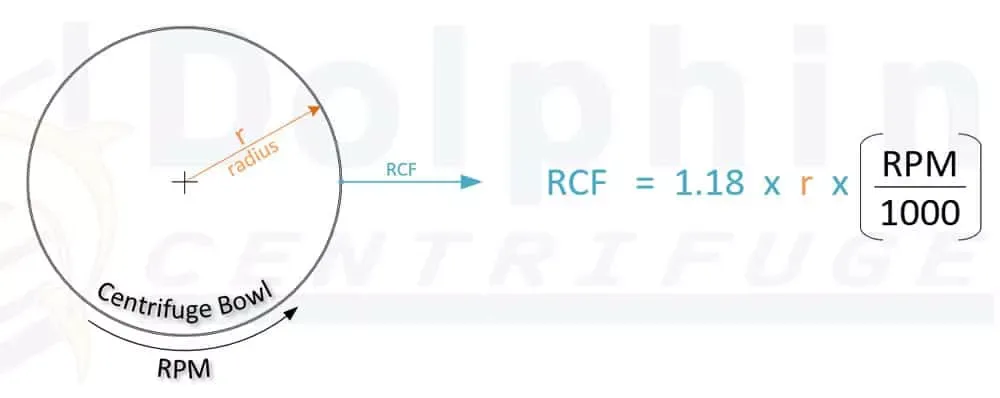
RCF = 1.118 × 10⁻⁵ × r × n2
Where: r = radius (cm) | n = rotational speed (RPM)
Variable Definitions
- RCF — Relative Centrifugal Force (dimensionless; expressed as ×g)
- r — Radius in centimeters from the axis of rotation to the point of measurement (typically the inner bowl wall for solids; the disc stack midpoint for liquid separation)
- n — Rotational speed in RPM
- 1.118 × 10⁻⁵ — Constant derived from converting RPM to rad/s and dividing by gravitational acceleration (9.81 m/s²)
Live RCF Calculator
Enter your centrifuge bowl radius and speed to instantly calculate RCF (g-force).
Centrifuge RCF Calculator
dolphincentrifuge.comTypical disc stack: 10–30 cm; decanter: 15–50 cm
Typical disc stack: 4,000–8,000 RPM
RCF Formula
1.118 × 10-5 × 20 × 6,0002
8,050
×g (RCF)
Suitable for lube oil & light fuel oil.
© Dolphin Centrifuge — reference only. Contact engineers for application-specific RCF requirements.
RCF in Disc Stack Centrifuge
The Relative Centrifugal Force (RCF) is the crucial factor differentiating a disc-stack centrifuge from other types of centrifuges.
A disc centrifuge generates a higher centrifugal force (g-force) than simple open-bowl or decanter centrifuges. This higher force allows the disc-stack centrifuge to have higher separation efficiency.
Therefore, these centrifugal separators can separate much smaller particles than other centrifuges. They can also separate immiscible liquids with small specific gravity differentials due to their high g-force.
RCF Reference Table
The table below shows calculated RCF values for five common disc stack centrifuge bowl radii at RPM steps from 4,000 to 8,000 RPM. Values are rounded to the nearest whole number.
| RPM | r = 15 cm | r = 17.5 cm | r = 20 cm | r = 22.5 cm | r = 25 cm |
|---|---|---|---|---|---|
| RCF (×g) | RCF (×g) | RCF (×g) | RCF (×g) | RCF (×g) | |
| 4,000 | 2,683 | 3,130 | 3,578 | 4,026 | 4,472 |
| 5,000 | 4,193 | 4,891 | 5,590 | 6,289 | 6,988 |
| 6,000 | 6,038 | 7,044 | 8,050 | 9,056 | 10,062 |
| 7,000 | 8,218 | 9,587 | 10,957 | 12,327 | 13,697 |
| 8,000 | 10,726 | 12,514 | 14,301 | 16,089 | 17,877 |
Values calculated using RCF = 1.118 × 10⁻⁵ × r × n2. Highlighted row (6,000 RPM) represents a common operating range for mid-size disc stack separators. r values are approximate bowl inner radii (in cm) for the relevant size class.
Practical Guidance: How Much RCF Do You Need?
- Light fuel oil (diesel, MDO): 3,000–5,000 ×g is generally sufficient for water and particulate removal.
- Heavy fuel oil (HFO, bunker): 6,000–9,000 ×g recommended due to high viscosity and small density differential between oil and water.
- Lube oil and gear oil: 5,000–8,000 ×g depending on contamination level and particle size.
- Beverage clarification (beer, wine): 6,000–10,000 ×g for removal of yeast, protein, and fine solids.
- Pharmaceutical liquids: 8,000–12,000+ ×g for sub-micron particle removal.
- Coolant and metalworking fluid: 4,000–7,000 ×g for tramp oil removal and metal fines separation.
These are general ranges. Actual RCF requirements depend on the density differential between phases, viscosity of the continuous phase, and required separation sharpness. Dolphin Centrifuge engineers can calculate the required G-factor for your specific application and recommend the appropriate centrifuge model.
Call (248) 522-2573 or email sales@dolphincentrifuge.com for application-specific RCF calculations.
Summary
RCF and RPM are commonly confused and interchanged terms in the centrifuge world. These two terms are significantly different, as explained above.
For the end-user, the RCF (aka g-force) is a crucial term because it defines the effectiveness of the centrifuge. The RPM is the bowl speed indicator, but the RPM does not convey any useful information for the application or the process.
Frequently Asked Questions
What is the difference between RCF and RPM in centrifuge specifications?
RPM (revolutions per minute) measures rotational speed, while RCF (relative centrifugal force, in × g) measures the centrifugal force at the bowl wall. Two centrifuges running at the same RPM produce very different RCF values depending on bowl diameter — larger bowls generate higher g-force at the same RPM.
Why is RCF more important than RPM for comparing centrifuges?
RCF directly determines separation performance — it governs whether particles of a given size and density will sediment within the available residence time. RPM alone is meaningless without knowing bowl radius. When comparing centrifuges for a separation application, always compare on RCF, not RPM.
How is RCF calculated from RPM and bowl radius?
RCF = 1.118 × 10⁻⁵ × r × N², where r is the bowl radius in centimeters and N is the speed in RPM. This gives the centrifugal force at the bowl wall as a multiple of gravitational acceleration (× g). Dolphin Centrifuge can provide RCF values for specific centrifuge models on request.
Related Articles
How to optimize g-force, throughput, and separation quality.
Disc Centrifuge DisadvantagesAn honest assessment of disc stack centrifuge limitations.
Bad Separation Troubleshooting6 causes of poor disc centrifuge separation and how to fix them.
Disc Stack Centrifuge FAQ101 frequently asked questions about disc stack centrifuges.
Disc Stack Centrifuge Overview
Types, models, and capacity
Need RCF Calculations for Your Application?
Dolphin Centrifuge engineers calculate required g-force for your specific fluid, particle size, and separation target — then recommend the right centrifuge model.