Dolphin Centrifuge configures decanter centrifuge pond depth from 5 mm to 50 mm via adjustable weir plates, balancing centrate clarity against cake dryness for each process. NX-314 bowl volume ranges from 2.3 to 4.9 gallons across eight indexed weir positions.
30-Second Summary Takeaway
In this article, you will learn more about the pond depth concerning a decanter centrifuge. We address the following typical questions related to pond depth.
- What is pond depth?
- How do you adjust it?
- How does it affect decanter centrifuge performance?
- How does the weir plate regulate pond depth?
- How does an adjustable weir plate work?
Decanter Centrifuge Pond Depth
The decanter centrifuge bowl rotation causes the fluid to form a concentric layer or pond on the bowl shell. The depth or thickness of this fluid layer is referred to as pond depth. The pond depth can be anywhere from 5 mm up to 50 mm for a conventional decanter centrifuge.
Adjusting the Depth
Weir plates (also known as Ring Dams) located on the decanter bowl's liquid discharge end are radially adjustable to move the liquid discharge opening position. The image below shows a weir plate installed on a decanter centrifuge bowl.
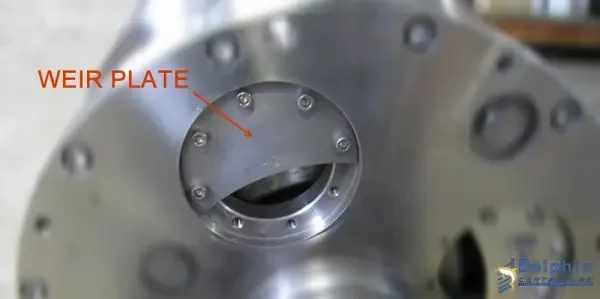
A weir plate with a shorter radius from the bowl rotation axis causes more liquid to be retained in the bowl leading to a deeper pond.
Conversely, a weir plate with a longer radius causes less liquid to stay in the bowl, causing a shallower pond.
Effects of Pond Depth on Decanter Performance
The pond depth directly affects the performance of the decanter centrifuge. Along with differential speed and other operating parameters, pond depth is one of the key variables in decanter centrifuge optimization. In the following sections, we delve into pond depth's effect on the separated phases.
Shallow Pond (Longer Weir Plate Radius)
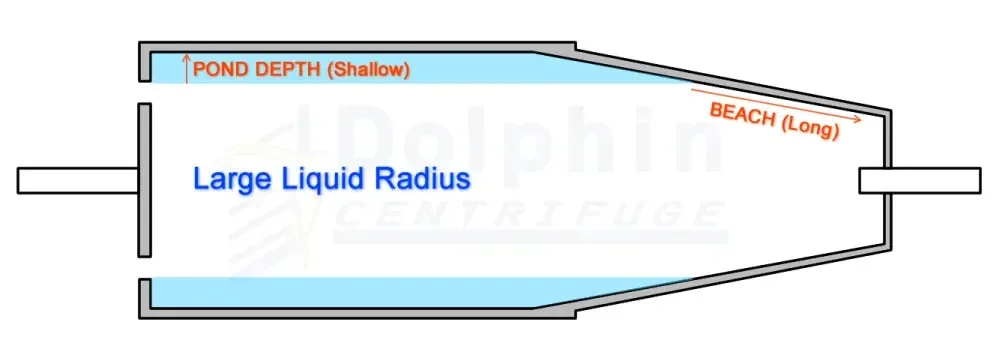
As shown in the illustration below, a shallow pond depth reduces the volume of fluid retained in the bowl while also exposing a longer beach at the solids discharge side.

Reduced liquid volume in the bowl implies lesser retention time in the bowl under the high centrifugal force. This reduced fluid and solids residence time within the bowl, subject to the high centrifugal force, limits the solid's separation. As a result, the separated fluid tends to have higher solids content.
On the other hand, the shallow pond depth exposes a long beach at the solids discharge end. The separated solids are pushed up this exposed beach towards the solid's discharge ports.
The prolonged exposure of the solids to the centrifugal force allows more liquid to separate from the solids leading to dryer solids.
Therefore a shallow pond depth leads to less clarity of the separated liquid phase and drier solids.
Deeper Pond (Shorter Weir Plate Radius)
The decanter centrifuge bowl cross-section with a deeper pond depth is shown in the diagram below. As seen, a deeper pond depth retains more volume of the process fluid with solids in the bowl. It also reduces the beach's exposed section at the solids discharge end.

The larger volume of process fluid in the bowl translates to longer residence time. This extended time allows for more separation of the solids from the fluid under the high centrifugal force. The better separation leads to clearer separated fluid.
The deeper pond depth also reduces the beach's exposed portion or drying zone in the decanter bowl. This reduction in the beach length does not allow the solids to separate from the liquid, effectively leading to wetter solids.
In other words, a deeper pond depth tends to produce clearer fluid and wetter solids.
Need the right weir plate for your decanter? Contact Dolphin Centrifuge engineers →
Correlation Graph Between Pond Depth and Decanter Performance
The following graph shows the typical effect of pond depth versus decanter performance parameters.
Pond Depth vs. Decanter Performance
dolphincentrifuge.comAs pond depth increases (deeper pond), centrate clarity improves and scroll torque drops slightly, but cake dryness decreases. Adjust weir plates to find the right trade-off for your process.
Bowl Liquid Volume as a Function of Weir Plate Radius
The following table shows the amount of liquid and solids volume for a specific decanter centrifuge. In this case, we are referring to the Alfa Laval NX-314 model. The table refers to various positions of the eccentric port weir plate, as shown below.
Alfa Laval NX-314-B31 Pond Depth and Bowl Volume
| Ring Position | Pond Radius (mm) | Bowl Volume (Gal) | Beach Length (mm) |
|---|---|---|---|
| 1 | 154 | 2.3 | 348 |
| 2 | 150 | 2.8 | 322 |
| 3 | 140 | 3.7 | 267 |
| 4 | 134 | 4.7 | 217 |
| 5 | 132 | 4.9 | 205 |
| 6 | 138 | 4.2 | 239 |
| 7 | 146 | 3.2 | 295 |
| 8 | 152 | 2.5 | 341 |
| Position 5 (highlighted) = deepest pond, maximum bowl volume 4.9 gal, shortest beach 205 mm. Position 1 = shallowest pond, maximum beach length for cake dewatering. | |||

Summary
The pond depth formed within a rotating decanter significantly affects the decanter's performance. Adjusting this depth allows the operator to balance the separated liquid's clarity versus the separated solids' dryness.
In other words, decanter centrifuge pond depth is the tool to control the trade-off between centrate clarity and cake dryness. Contact Dolphin Centrifuge engineers to get expert guidance on weir plate selection and optimal pond depth settings for your specific process.
by Sanjay Prabhu MSME, Engineering Manager, Dolphin Centrifuge
Frequently Asked Questions
What is pond depth in a decanter centrifuge?
Pond depth is the depth of liquid inside the rotating decanter bowl, the radial distance from the bowl wall to the liquid overflow weir. It is controlled by adjustable weir plates at the liquid discharge end. Greater pond depth means more liquid volume in the bowl and longer liquid residence time.
How does pond depth affect cake dryness?
Shallower pond depth (higher weir position) keeps solids on the dry beach longer, producing drier cake but may reduce centrate clarity. Deeper pond depth increases liquid residence time for better clarification but reduces the beach length available for dewatering, potentially producing wetter cake.
When should I increase or decrease pond depth?
Increase pond depth (lower the weir) if centrate turbidity is too high — the liquid needs more residence time to clarify. Decrease pond depth (raise the weir) if solids cake is too wet. Always adjust in small increments and allow the machine to stabilize before evaluating the result.
Expert Decanter Pond Depth Guidance
Dolphin Centrifuge engineers select the correct weir plate for your process — maximizing centrate clarity or cake dryness based on your application.