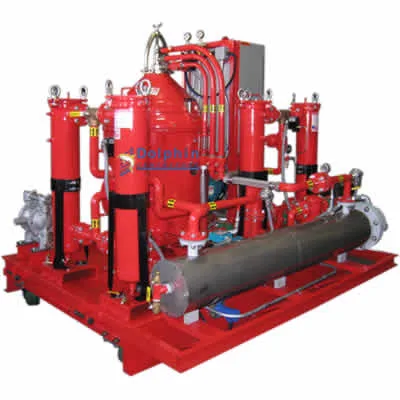
Dolphin Centrifuge supplies both decanter centrifuges (NX-314, NX-418, G2-40 series — up to 4,000 Gs for high-solids applications) and disc stack centrifuges (DMPX series — 7,000+ Gs for liquid-liquid and fine solids separation). Selection depends on solids concentration, particle size, and required separation quality. Based in Warren, Michigan, Dolphin Centrifuge has over 40 years of experience in both centrifuge technologies.
30-Second Take-Away
The main differences between a decanter and disc-stack centrifuge are:
- • A decanter centrifuge's axis of rotation is horizontal, whereas a disc-stack centrifuge bowl rotates around a vertical axis.
- • Decanter centrifuges typically exert around 3,000 Gs compared to 8,000+ Gs generated by a disc-stack centrifuge.
- • Sludge handling capacity is much higher for a decanter centrifuge compared to a disc-stack centrifuge. A decanter centrifuge can handle up to 50% sludge, while a disc-stack centrifuge is limited to 8% sludge by volume.
- • With a higher G-force, a disc-stack centrifuge can separate particles down to a 0.5-micron level. A decanter centrifuge typically separates particles 100 microns or larger.
This article compares the different technical aspects of decanter centrifuges and disc centrifuges. We will compare all the factors important to the end-user. These will include physical, operational, performance, and maintenance factors between these centrifuge types.
Overview of Decanter and Disc Centrifuge Operation
Decanter Centrifuge

Decanter Bowl Cross Section
A decanter centrifuge is an industrial machine designed to separate solids from liquids continuously. This process is also known as de-watering or sludge thickening.
Accelerated sedimentation is the key to the operation of all centrifuges. A decanter centrifuge exerts a force up to 4,000 times that of gravity to affect this settling. High-speed rotation is the cause of this force multiplier effect. This differential centrifugation is a widely used physical phenomenon.
As shown in the image above, the rapid rotation of the bowl causes a high centrifugal force in a radially outward direction, i.e., away from the rotating axis of the bowl. This force causes the denser solid particles to move towards the bowl wall (outward) while displacing the liquid inward.
The auger (also known as screw, scroll, or conveyor) rotates within the bowl at a speed different than that of the bowl. A planetary gearbox attached to the decanter bowl rotates the auger.
The auger scrapes or pushes the collected solids towards the tapered end of the decanter. Here the solids are pushed up the 'beach' and exit the bowl through the solids' discharge ports.
The path of the solids along the 'beach' is against the centrifugal force, which is directed radially outwards. This force causes the liquid to separate from the solids causing dry solids to exit the bowl.
The separated liquid(s) create a 'pond' inside the accumulated solids layer around the bowl periphery. Liquid discharge ports located at the far end of the bowl allow the separated liquids to exit the bowl.
A detailed writeup on decanter centrifuges is on our blog Decanter Centrifuge details, including uses, benefits, capacities, price-range, etc.
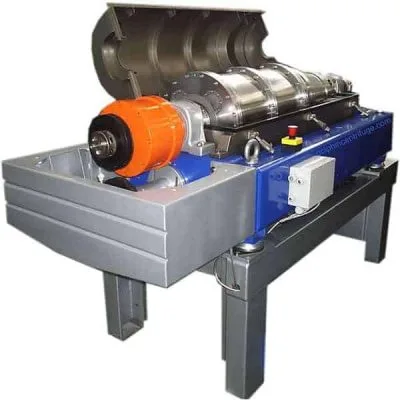
Decanter Centrifuge
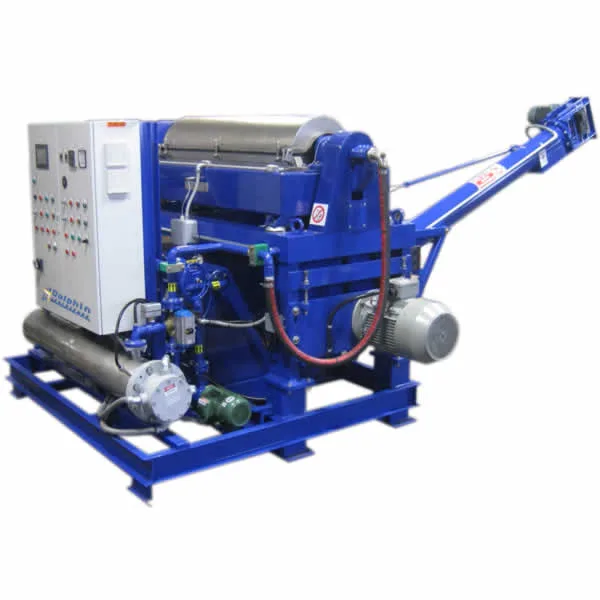
Alfa Laval NX-418 Decanter Centrifuge
Disc Centrifuge
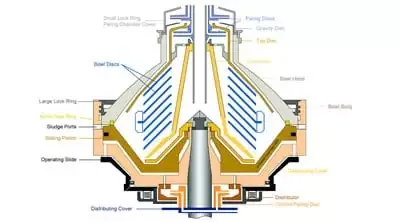
Alfa Laval Disc Stack Centrifuge Bowl Section
Similar to the decanter centrifuge described above, a disc centrifuge is an industrial fluid separating machine. It is designed to separate liquids from solids and liquids from liquid continuously.
A disc or disk centrifuge is also known as a conical plate, cone, disc bowl centrifuge. You can read more about disc centrifuges on Wikipedia.
Fast rotation of the disc centrifuge bowl generates very high centrifugal forces within the centrifuge bowl. These high centrifugal forces cause differential settling of the different liquid phases within the process fluid. A disc centrifuge can generate up to 10,000 times the force of gravity.
The disc centrifuge bowl cross-section shown above helps explain the operation of this type of centrifugal separator.
The bowl rotation causes a centrifugal force to act on the liquids and solids inside the bowl. This force acts in the horizontal direction away from the bowl axis of rotation.
As in the case of the decanter above, the solids are pushed towards the bowl wall. The lighter liquid phases are displaced inwards towards the center of the bowl. If two immiscible liquids are present, the denser liquid settles towards the solids replacing the lighter fluid towards the bowl center.
A disc centrifuge bowl has separate liquid discharge passages built into the bowl. The separated liquid phases flow through these passages to exit the centrifuge. This separation of liquids is a continuous process while the centrifuge is operating.
Self-cleaning disc centrifuges incorporate a moving part in the bowl bottom. A hydraulic mechanism causes this 'sliding piston' to move vertically. The downward movement of the sliding piston opens ports around the bowl periphery.
The high centrifugal force causes the accumulated solids to eject out through these ports. This solids ejection constitutes the sludge-ejection part of the self-cleaning bowl. One should note that the process of sludge ejection occurs while the bowl is rotating at operating speed.
A PLC-based control system triggers the sludge ejection process at predetermined time intervals.
Comparison of Decanter and Disc Centrifuges
In the following sections, we will compare the features, capabilities, and operating considerations of the decanter and disk centrifuges. We have summarized the factors in tables in each section below. This comparison should help the user select the right centrifuge, given the user's intended use and operating conditions.
Physical Characteristics
The basic physical characteristics of each centrifuge type give the user an idea of the overall sizing, weight, layout, etc. This should help envision the centrifuge in an existing plant layout or to plan a new application setup.
Orientation
There is a primary difference between the orientation of the decanter and the disc centrifuge. The orientation of the centrifuge influences the inlet & outlet connection locations as well as the footprint of the system.
Decanter Centrifuge Orientation
Decanter centrifuges are also known as horizontal centrifuges. The bowl of the decanter centrifuge rotates around a horizontal axis. The inlet-outlet on the centrifuge is, therefore, at either end of this rotating assembly. The horizontal orientation is the reason for decanters to have a long footprint and comparatively short vertical dimension or height.
Disc Centrifuge Orientation
Disc centrifuges are also known as vertical centrifuges. The bowl of the disc centrifuge rotates around a vertical axis. The inlet-outlet from and to the centrifuge is located at the top of the disc centrifuges. The vertical orientation is the reason for disc centrifuges to have a relatively smaller footprint compared to a decanter centrifuge of similar capacity.
Centrifuge Dimensions and Weights
It is important to note that the sizes and weights mentioned below are rough estimates and could vary considerably based on the manufacture, vintage, and accessories (if any) attached to the centrifuge.
Decanter Centrifuges – Dimensions & Weights
Due to their horizontal orientation, decanter centrifuges tend to have one long dimension and relatively shorter height.
- • Small (~5 GPM): 5' (L) × 2' (W) × 3' (H) — ~800 lbs
- • Large (~1,000 GPM): 18' (L) × 8' (W) × 6' (H) — over 20,000 lbs
Disc Centrifuges – Dimensions & Weights
Due to their vertical orientation, disc centrifuges tend to have a smaller footprint with a taller dimensional profile.
- • Small (~5 GPM): 3' (L) × 3' (W) × 5' (H) — ~1,000 lbs
- • Large (~300 GPM): 6' (L) × 5' (W) × 8' (H) — over 4,000 lbs
Centrifuge Power Ratings
Power ratings for centrifuges are based on the drive motor horsepower of the machine. Accessories such as inline electric heaters can add additional power load, often more than the centrifuge motor. For this comparison, we compare the main motor power between the two types of centrifuges.
Decanter Centrifuge Power
The smallest decanter centrifuge operates on a 10 HP motor. Large capacity decanters (municipal wastewater) are driven by motors rated over 500 HP. Like most industrial systems, these operate on 460 V, 3-phase power.
Disc Centrifuge Power
Disc centrifuges have smaller processing capacities as compared to the smallest decanter centrifuges. The smallest disc centrifuge (~2 GPM) has a 1.5 HP motor drive. Disc bowl centrifuges also operate on 460 V, 3-phase power.
For customer-specific needs, small disc centrifuges can be modified to be driven by low-voltage, single-phase motors. This adaptation requires centrifuge frame modifications.
Small decanters cannot be modified to operate on single-phase power.
Material of Construction (MOC)
The material of the centrifuge bowl is of primary concern to centrifuge users. The frame components are mostly made of cast iron or a carbon steel welded frame. The bowl parts are the ones in contact with the process fluid and are therefore of interest.
MOC of Decanter Centrifuges
Decanter centrifuges manufactured by reputed companies almost always have stainless steel bowls — typically 316L duplex stainless steel. The scroll (auger) is also made of 316L stainless steel. However, scroll flights are spray-coated with tungsten carbide hard-surfacing for erosion protection. Sludge discharge nozzles and other areas subject to wear have stellite or similar erosion resisting inserts installed.
MOC of Disc Centrifuges
Self-cleaning disc centrifuges also have 316L stainless steel as the main bowl material. The user needs to be aware that not all stainless steel is the same.
Some centrifuges have known instances of having bowls referred to as stainless steel, which could be technically correct. However, low-grade stainless steels are not suitable for centrifuges and corrode easily in use.
Disc centrifuges are also equipped with liners to protect the bowl parts, which are likely to erode. Replaceable bowl liners help protect high wear areas of the bowls.
Marine-grade centrifuges also have some bowl parts made of 'red metal', a copper alloy with a significant amount of tin to ensure durability.
The following table summarizes all the above-mentioned characteristics.
Summary of Physical Characteristics
| Physical Characteristic | Decanter Centrifuge | Disc Centrifuge |
|---|---|---|
| Axis of Rotation | Horizontal | Vertical |
| Footprint (Size) | 4′ × 2′ × 4′ (H) (Small 5 GPM) to 20′ × 5′ × 15′ (H) (1000 GPM Municipal) | 2′ × 2′ × 2′ (Small Diesel Unit) to 40′ Shipping Containers (multi-unit skids) |
| Drive Power | 5 HP (small 5 GPM) to 500+ HP (large municipal) | 1 HP (small unit) to 100 HP (large disc centrifuge) |
| Material of Construction | Frame: Cast Iron. Bowls: Stainless Steel with erosion protection of wear parts | Frame: Cast Iron. Bowls: Stainless Steel with some non-ferrous parts |
Separation Features and Capabilities
Particle Separation Efficiency
Particle separation efficiency is defined as the minimum particle size a centrifuge can separate under normal operating conditions. Of course, this efficiency changes with the residence time of the fluid inside the bowl. Higher residence time (i.e., lower flow rate) will lead to the separation of smaller particles. Lower fluid viscosity also will have a similar effect.

For this comparison, we will assume that all external factors are equal.
Decanter – Particle Separation Efficiency
Particle separation efficiency for a decanter centrifuge is in the range of 50 microns and above. This particle size is an approximate range suggested by the OEM. However, based on our field experience, the actual particle size separated by decanters seems to be in the 100+ micron range.
The largest particle size separated by the decanter is defined by the size of the internal fluid pathways and sludge ejection ports. The maximum particle size for the decanters is approximately 12 mm (½").
Disc Centrifuge – Particle Separation Efficiency
A disc centrifuge can separate metal particles down to a 0.5-micron level and organic and inorganic particles down to a 1-micron level based on OEM data. These separations are dependent on the fluid being processed, specifically the viscosity of the process fluid.
The largest particle size separated by a disc centrifuge is defined by the spacing between the conical plates (disk stack) in the centrifuge bowl. The solid particles pass through these discs, and therefore the particle size cannot be larger than the inter-disc spacing.
The particle limit recommended for the disc-stack centrifuge is around 250 microns. The typical inter-disc spacing is 500 microns in a disc centrifuge bowl.
Particles larger than the inter-disc spacing or close to the inter-disc spacing can cause the conical discs to be plugged with solids and make the centrifuge ineffective.
Feed Solids Concentration
Feed solids concentration refers to the amount of solids present in the incoming fluid feed. Different centrifuge types have varying abilities to handle solids loading. Solids concentrations allowable in the centrifuge feed are defined by the sludge ejection mechanism used in the centrifuge. Higher solids concentration requires a continuous sludge ejection mechanism, while intermittent ejections can handle smaller solids concentrations.
Decanter – Allowable Feed Solids
The decanter centrifuge has the auger pushing out the separated solids continuously through the sludge ports. This continuous evacuation of solids allows for the handling of high levels of solids concentration in the feed.
A decanter centrifuge can handle up to 50% solids concentration by volume. Other considerations that affect this limit include the type and density of solids. Denser, heavier solids create a higher resistance to the auger pushing the solids.
This resistance, in turn, causes higher torque on the gearbox, which has a defined torque limit. This means that the heavier solids should be at a lower concentration than lighter solids to prevent damaging the gearbox.
For example, a decanter may handle up to 50% concentration of light solids but not more than 15% concentration of very heavy solids.
Disc Centrifuge – Allowable Feed Solids Concentration
A disc centrifuge bowl has a pre-defined sludge holding space. Once this space gets filled up with separated solids, the sludge needs to be discharged. The separated solids are ejected intermittently by operating the sludge discharge mechanism.
The fixed sludge space and intermittent nature of the discharge imply that higher solids concentration leads to frequent sludge discharge cycles.
Each sludge discharge cycle is accompanied by:
- • A surge in the drive motor current.
- • Some process liquid loss (depending on the type of centrifuge).
- • Minute wear on the sealing gaskets in the bowl.
Based on the above factors, it is advisable to minimize the frequency of the sludge discharge cycles, limiting the allowable solids concentration. The maximum solids concentration allowable in a disc centrifuge is around 5% by volume in real terms.
If the anticipated concentration of solids is slightly higher, a larger capacity centrifuge may be better suited. A larger capacity centrifuge bowl has a larger sludge holding capacity, which reduces the sludge discharge frequency.
Phase Separation Capabilities
Liquid-Liquid Separation Applications
Phases are the different constituents of the process fluid. For example, fluid in a diesel storage tank has 3-phases: diesel fuel (liquid phase), water (liquid phase), and sludge (solid phase).
In the case of liquid-liquid separation, a disc centrifuge is recommended. This recommendation is because a disc centrifuge generates a much higher g-force (than a decanter), essential for liquid-liquid separation.
If the liquids have very similar specific gravities, the disc centrifuge can magnify this specific gravity differential to affect good separation.
A decanter centrifuge has limited applicability in liquid-liquid separation due to its lower centrifugal force. Especially if there are no solids or minimal solids, a disc centrifuge would be the obvious choice.
Liquid-Solid Separation Applications
In cases involving the separation of liquids and solids, centrifuge choice depends on the solids' concentration and particle size.
A high solids concentration (over 10%) rules out the standard 'self-cleaning' disc centrifuge, as explained above. In such cases, a decanter centrifuge is an obvious choice. Decanter centrifuges are often the only solution for high solids concentration fluids such as oil sludge.
However, if the solids concentration is within the disc centrifuge's allowable limits, the disc centrifuge would be recommended. This suggestion is due to the disc centrifuge's better separation efficiency, which will produce a much clearer centrate than a decanter centrifuge.
Liquid-Liquid-Solid Separation Applications
The separation of contaminated diesel fuel is an example of a liquid-liquid-solid application. Typically, the solids concentration is low in this application, and water could be as high as 50%. Since the disc centrifuge discharges the separated water continuously, high water levels do not impede a disc centrifuge.
In cases where the process fluid has a high level of solids, a 3-phase decanter (also known as a tricanter) is recommended. The tricanter is a decanter centrifuge with the addition of an additional liquid phase outlet.
As explained above, the tricanter has a lower centrifugal force leading to a lower liquid-liquid separation ability. The lower centrifugal force also allows smaller (< 100-micron level) particles to pass through the tricanter.
Therefore, it follows that in an ideal setup, a downstream disc centrifuge processes the centrate from the tricanter. The disc centrifuge separates the finer particles and clarifies the tricanter effluent under the higher g-force.
The following table summarizes all the factors mentioned earlier.
Summary of Separation Capabilities and Features
| Separation Capability | Decanter | Disc Centrifuge |
|---|---|---|
| Particle Separation Efficiency | From 50 µ to 10+ mm | From <0.5 µ to 1 mm |
| Feed Solids Concentration | Up to 50% (v/v) | Not > 8% (v/v) |
| Liquid-Liquid Separation | Somewhat Effective | Highly Effective |
| Liquid-Solid Separation | Effective for Bulk Solids | Effective for Small Particles |
| Centrifugal Force (RCF) | 2,500 Gs to 4,000 Gs | 7,000 Gs to 10,000+ Gs |
Operating Considerations
Prospective users of centrifuges will want to consider the following operating factors for each type of centrifuge. These factors play an essential role in further differentiating the decanter centrifuge from the disc centrifuge.
Separated Solids Discharge Mode
The solids discharge mode is the method by which a centrifuge ejects or discharges the separated solids. It is an essential consideration because it affects the process layout upstream and downstream of the centrifuge. Therefore it should be considered before finalizing the centrifuge and its placement in the overall process flow.
Decanter Centrifuge Solids Discharge
One of the main advantages of the decanter centrifuge is the ability to eject the separated solids continuously. The scroll (auger) scrapes and pushes the solids towards and out through the solids' discharge ports.
This specific feature allows installing the decanter centrifuge in the primary process loop in series with upstream and downstream equipment. Of course, it is always advisable to have a redundant (backup) unit in a parallel circuit to avoid process disruptions in machine breakdown or maintenance.
Disc Centrifuge Solids Discharge
A self-cleaning disc centrifuge has an intermittent solids discharge characteristic. This type of disc centrifuge accumulates the solids and periodically discharges them based on a programmable timer. The operator sets the sludge discharge time interval based on the incoming fluid solids concentration and bowl sludge capacity.
It is important to note that many self-cleaning disc centrifuges cannot process fluid during this sludge discharge cycle. Process flow needs to be interrupted during this period.
Therefore a disc centrifuge of this type (self-cleaning) cannot be installed in the primary process flow loop. It should be installed in a 'kidney loop' configuration or with pre and post centrifuge surge tanks to accommodate for the loss of flow during the discharge cycle.
Design Complexity
The basic design of the centrifuges involves several rotating parts. There are some intricacies involved in constructing these centrifuges, which are essential to their functioning. These design characteristics also add to the respective mechanical complexity of the machines.
Decanter Centrifuge Design Complexity
A decanter centrifuge has a more straightforward construction compared to the disc centrifuge. It is essentially a rotating drum with an internal rotating auger with relatively fewer parts and no moving interfaces between these parts.
The most complicated part of a decanter centrifuge is the planetary gearbox. Most of these gearboxes are 2-stage with sets of planetary gears on rotating hubs.
The more straightforward design of decanter centrifuges leads to more accessible and quicker service. It also means fewer replacement parts compared to disc centrifuges.
Disc Centrifuge Design Complexity
The 'self-cleaning' disc centrifuges have an added internal system that facilitates the sludge discharge process. This system is a hydraulic mechanism that uses water to operate the movement of the sliding piston shown in the section above.
This additional mechanism, which is not present in decanter centrifuges, adds a certain degree of complexity to the disc centrifuge. It also means that the bowl has extra serviceable parts.
Control Systems
Centrifuge control systems are essential for the reliable and efficient operation of centrifuges. Centrifuge design characteristics define these control systems. Some control features are application-specific and are applicable across different centrifuge types.
Decanter Centrifuge Control System
Basic controls for decanter centrifuges involve motor control and monitoring of field sensors. These are relatively simple controls without the need for a logic controller (PLCs). The essential operation of the decanter centrifuge is a simple sequence of motors. Some additional control logic may be added based on instrument and sensor feedback to prevent malfunction or system overload.
Disc Centrifuge Control Systems
A disc centrifuge control system is slightly more sophisticated as compared to the decanter control system. As previously mentioned, the disc centrifuge has an additional sub-system for sludge ejection. This system requires an extra water manifold to operate the hydraulically operated piston.
There is a sequence of operations associated with the sludge ejection system. A programmable controller (PLC) is the best option to operate this system.
Other functional and alarm systems, similar to the ones for the decanter centrifuge, are also incorporated into the disc centrifuge control system.
Auxiliary Systems
The addition of auxiliary systems enhances centrifuge performance. Such add-on systems include fluid heaters, filters, heat exchangers, etc. However, the operation of centrifuges requires some auxiliary systems. In this section, we discuss these 'required' systems briefly.
Auxiliary Systems for Decanter Centrifuges
Some decanter centrifuges need auxiliary systems for regular operation. These systems are essential for operating the centrifuge. These systems include hydraulic packs for decanter centrifuge back-drive control. Additionally, they need a lubrication system for decanter centrifuge bearings and an electric motor for auger speed control.
However, depending on the design, one can operate some decanter centrifuges without any auxiliary systems. In such cases, the bearings are grease lubricated, and the back-drive is 'locked' to give a fixed differential speed.
Auxiliary Systems for Disc Centrifuges
A disc centrifuge (self-cleaning type) requires a hydraulic system to operate the sludge ejection mechanism. A disc centrifuge cannot function without the operating water system controlled by this auxiliary system. Other auxiliary systems such as alarm systems, temperature and pressure indicators, etc. are useful but not essential for the operation of the disc centrifuge.
The following table summarizes all the factors mentioned above.
Summary of Operating Considerations
| Property | Decanter Centrifuge | Disc Centrifuge |
|---|---|---|
| Solids Discharge / Ejection | Continuous Mode | Batch Mode (Self-Cleaning type) |
| Design Complexity | Less Complex, Simpler Construction | More Complex, More Moving Parts |
| Control System | VFD Control for Main Drive Motors. Safety Devices Monitoring System. | PLC Based Control System with Operating Sequence Logic. |
| Auxiliary Systems Required | Lubrication Pack and Hydraulic Unit for Backdrive Control (large units) | Operating Water System (Self-Cleaning type) |
Operation and Maintenance Factors
The operation and maintenance (O&M) of centrifuges is an essential factor in return on investment (ROI) considerations of these capital-intensive machines. Lifespan, durability, ease, frequency, and maintenance cost are key factors to be considered.
Centrifuge Durability
Centrifuge equipment durability is an essential factor to consider when choosing centrifuges. A comparison of centrifuges with other forms of separation equipment is common. These include filters, filter presses, screw presses, belt presses, etc. Durability is the useful lifespan of capital equipment combined with the need and frequency of maintenance.
Decanter Centrifuge Durability
Decanter centrifuges are possibly some of the most durable processing equipment available. Some of the well-known manufacturers (Alfa Laval, Sharples, and Westfalia) are globally popular primarily due to the durability of their machines.
It is not uncommon to find a functioning decanter centrifuge which is over 50 years old! Decanter centrifuges from these manufacturers are well known for their heavy-duty design and unusually long service lives.
Disc Centrifuge Durability
Although disc centrifuges are more sophisticated in their construction than decanter centrifuges, they are equally durable and long-lasting. Disc centrifuges manufactured by established brands are known for their durability.
The durability of these machines is attributed to their design and material of construction. Amongst disc centrifuges, the older generation machines are even more durable than some of the newer versions. This durability is mainly due to the heavy-duty gear transmissions in the older disc centrifuges.
Users prefer gear-driven disc centrifuges despite their age. Their simple construction leads to a longer, dependable service life. In other words, they have a lesser number of parts compared to the newer disc centrifuges, which means less frequent breakdowns and longer up-time.
Maintenance Frequency and Expense
As with all mechanical systems, periodic maintenance is another crucial factor to consider during the selection process. We have summarized the scope and related expenses for the centrifuges of interest. Maintenance frequency is dependent on the use of the equipment. We intend to provide a summary of recommended maintenance under normal operating conditions.
Decanter Centrifuge Maintenance
The gearbox is one of the critical components of the decanter centrifuge. Preventative maintenance of the gearbox has an impact on trouble-free operation. Changing the oil is the best way to ensure the longevity of the gearbox and the equipment.
Lubrication (greasing) of the bearing housings on the decanter is the other crucial preventative maintenance to be performed regularly.
Replacement of the seals, gaskets, and bearings is typically required once every few years (2–3 years), depending on the severity of service duty. The maintenance cost for decanters is relatively meager, given there are no consumable parts or media to be replaced frequently.
Disc Centrifuge Maintenance
One of the keys to maintaining a disc centrifuge, similar to the decanter centrifuge, is to keep the transmission gearbox lubricant clean. A disc centrifuge has a soft-metal bull gear that wears and releases fine metal particles in the oil.
Changing the oil frequently ensures the longevity of the bearings. The recommended oil change frequency for many disc centrifuges is 1,000 operating hours after the first oil change.
It is worth noting that it is easy to replace the oil than to change bearings more frequently than necessary.
For disc centrifuges, it is recommended to perform a bowl service (replace all seals) on a set schedule, depending on the type of centrifuge and the service application. This period could be as frequent as every other week for abrasive fluids, or once every few months for benign applications.
The cost of maintenance parts for disc centrifuge is low, considering the fluid volume processed between servicing. Also, there are no filter media to be replaced, which helps lower maintenance costs.
The table below is a summary of all these factors to be considered.
Operation & Maintenance Factors
| Factor | Decanter Centrifuge | Disc Centrifuge |
|---|---|---|
| Durability | Highly Durable with Regular PM. 50+ Years Service Life Common. | Very Durable with Regular PM. 50+ Years Service Life Common. |
| Maintenance Cost | Very Low. Bearings Replacement Over Long Periods. | Low. Inexpensive Seal Kit Periodically Replaced. |
| Maintenance Scope | Grease Bearings, Replace Gearbox Oil. | Replace Bowl Seals & Oil in Gear Housing. |
Summary
Based on all the above-listed considerations, we can summarize the differences as follows.
Decanter centrifuges can handle fluids with high sludge content with large particle sizes. They are the first line of defense in any industrial fluid separation application with heavy sludge.
Disc Centrifuges can separate fluids with two immiscible liquids continuously. With a higher centrifugal force, a disc centrifuge is ideal for removing fine particles as well.
We should also mention that a decanter centrifuge can separate fine solids given enough retention time. In other words, a low flow rate. But the flow rate to achieve that level of separation defeats the purpose of the decanter centrifuge.
Need help choosing? See our guide on picking the right industrial centrifuge for your specific application.
Contact Dolphin Centrifuge to consult with our centrifuge experts to discuss your application. You can always call (248) 522-2573 to reach us.
Related Resources
Decanter Centrifuge Overview
Complete guide to decanter centrifuges — uses, benefits, capacities, and pricing.
Disc Stack Centrifuge Guide
Everything about disc stack centrifuges — how they work, applications, and selection.
Picking the Right Industrial Centrifuge
How to select the right centrifuge for your specific industrial application.
Disc Stack Centrifuge FAQ
20 frequently asked questions about disc stack centrifuges answered by experts.
Not sure whether a decanter or disc centrifuge is right for your application?
Send us a sample of your process fluid — we'll run a test on our pilot centrifuge and give you real separation data before you commit to any equipment.
Frequently Asked Questions
What is the main difference between a decanter centrifuge and a disc stack centrifuge? ⌄
The primary difference is particle size capability and solids handling capacity. Decanter centrifuges operate at 3,000+ Gs and can handle particles down to 100 microns and high solids volumes (up to 50% solids by volume) — they excel at sludge dewatering. Disc stack centrifuges operate at 7,000+ Gs and separate particles from 0.5 microns, but have much smaller solids-holding capacity and are better for liquid-liquid separation (oil-water) with low solids.
When should I choose a disc stack centrifuge vs. a decanter centrifuge? ⌄
Choose a disc stack centrifuge when: separating liquids of different densities (oil and water), the solids content is low (<1–2%), very fine particle removal is required (0.5–10 microns), or three-phase separation (oil/water/solids simultaneously) is needed. Choose a decanter when: dewatering high-solids sludge, handling slurries with >5% solids, large solids (>100 microns), or continuous solids discharge is required without stopping.
Which centrifuge generates higher G-force — decanter or disc stack? ⌄
Disc stack centrifuges generate significantly higher G-force — typically 7,000 to 10,000 Gs — compared to decanter centrifuges which typically operate at 2,000 to 4,000 Gs. The higher G-force in disc stack centrifuges enables separation of much finer particles and tighter liquid-liquid separation.
Can a decanter centrifuge separate oil and water? ⌄
Yes, decanters can perform three-phase separation (oil, water, solids) but are less efficient at liquid-liquid separation than disc stack centrifuges. Decanters require a larger density difference between the two liquid phases to achieve effective separation. They are commonly used for oily sludge and crude oil tank bottom recovery where high solids content makes disc stack centrifuges impractical.
Which centrifuge is easier to maintain — decanter or disc stack? ⌄
Decanter centrifuges have fewer components overall and simpler bowl design, but the auger wear liners and gearbox require periodic service. Disc stack centrifuges have more internal parts (disc stack, distributor, operating water system) but self-cleaning models require minimal operator intervention during normal operation. Both have similar maintenance intervals of 2,000–8,000 hours depending on application severity.
Need expert guidance on centrifuge selection for your application?
Dolphin Centrifuge supplies both decanter and disc stack centrifuges. Our engineers will help you select the right technology for your specific fluid, solids load, and throughput requirements.
(248) 522-2573 • sales@dolphincentrifuge.com • Warren, MI 48089