Dolphin Centrifuge explains the key disadvantages of disc stack centrifuges — limited to roughly 8% solids by volume, requiring pre-filtered feed below 1,500 microns, and needing auxiliary operating water. Over 40 years of centrifuge application experience. Warren, Michigan.
Though there are several advantages to the disc stack centrifuge, there are some equally important disadvantages. The following are the main disadvantages of disc stack centrifuges and corresponding workarounds. Understanding the limitations helps you avoid expensive mismatches and makes the case for disc centrifuges in applications where they genuinely belong.
1. High Capital Cost
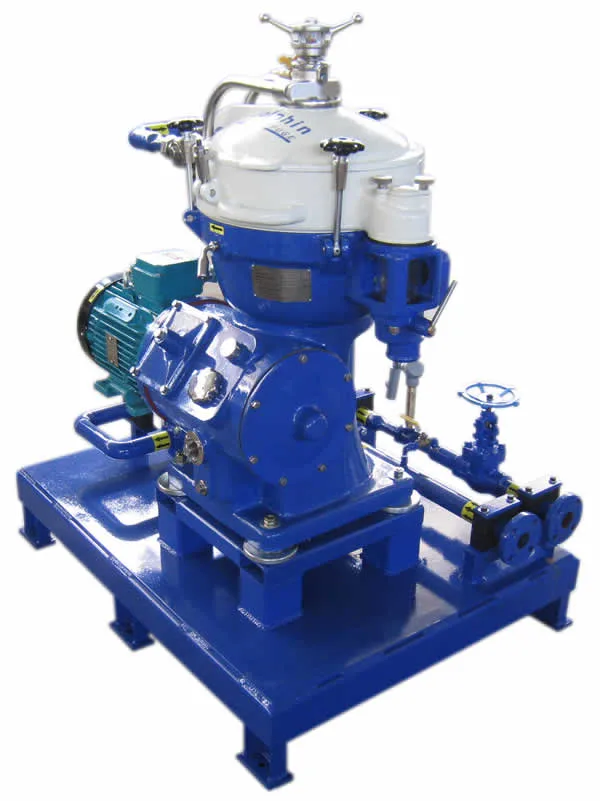
Disc stack centrifuges are precision machines machined to tight tolerances, assembled from high-grade stainless steel, and built to withstand enormous centrifugal forces at high RPM. This engineering quality comes at a cost.
A new mid-size disc centrifuge (10,000–30,000 L/hour capacity) typically ranges from $80,000 to $250,000 USD, depending on features, materials, and automation level. Larger or specialty models can exceed $500,000.
This capital cost is often justified by operating cost savings, but in low-throughput applications or where the separation requirement is modest, simpler alternatives — gravity tanks, hydrocyclones, bag filters — may achieve acceptable results at a fraction of the cost. The ROI calculation must support the investment before committing to disc centrifuge technology.
When to reconsider: If your throughput is under 1,000 L/hour and your separation requirement tolerates some imperfection, alternatives may offer better capital efficiency.
2. Limited Solids Handling Capacity
Unlike a decanter centrifuge that can handle up to 50% solids by volume, a disc stack centrifuge is limited to about 8% solids. This limits the application of disc centrifuges to fluids with low sludge content.
A decanter centrifuge continuously plows out the separated sludge with a scroll conveyor. A self-cleaning disc stack centrifuge ejects the separated sludge intermittently. Process liquids with high sludge volume require frequent sludge discharge cycles, which degrade centrifuge efficiency and can cause the drive motor to overload due to the current surge accompanying each discharge cycle.
Practical limits for continuous operation:
- Clarifiers (liquid-solids): typically effective up to 1–3% solids by volume in the feed. Above this, the sludge space fills too rapidly and discharge frequency becomes impractical.
- Purifiers (liquid-liquid-solids): typically handle even lower solids loads — 0.1–0.5% solids is typical — because the sludge space priority is maintaining the liquid-liquid interface, not solids accumulation.
Feeds with high, variable, or fibrous solids content cause rapid sludge space filling, frequent discharges, high product loss, and eventual blockage of the disc stack channels.
In process fluids with high sludge volume comprising large and small particles, a decanter centrifuge followed by a downstream disc stack centrifuge is recommended. This configuration allows the decanter to separate the large bulk solids before the disc stack centrifuge polishes the remaining small particles.
When to use a decanter instead: If your feed regularly contains more than 2–5% solids by volume, or if the solids are fibrous or stringy, a decanter centrifuge with its screw conveyor can handle continuous high-solids feeds that would overwhelm a disc centrifuge.
Sludge Buildup in the Bowl
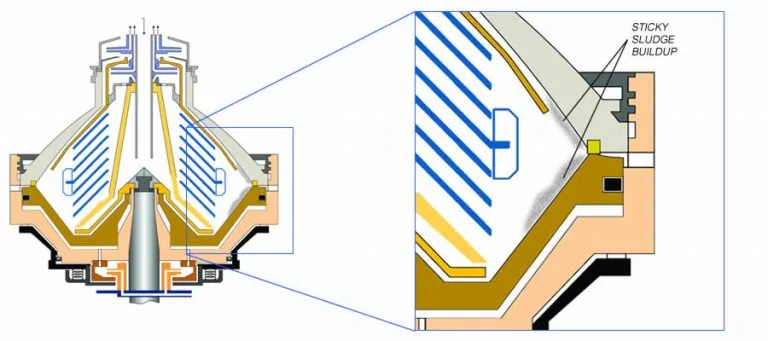
Unlike a decanter centrifuge that uses a scroll to push out the separated sludge, a disc stack centrifuge uses high centrifugal force to eject the accumulated sludge from the bowl. In rare cases, some sludge may stick to the bowl wall during ejection. This sludge can build up in the bowl to cause an imbalance or prevent subsequent sludge ejections.
In sticky-sludge applications, the user may periodically introduce a bowl rinse or cleaning cycle to wash out any buildup sludge. For example, diesel fuel is sometimes used as a solvent to periodically remove any paraffin buildup inside the bowl in a flush cycle in crude oil applications.
3. Requires Clean, Pre-Filtered Feed
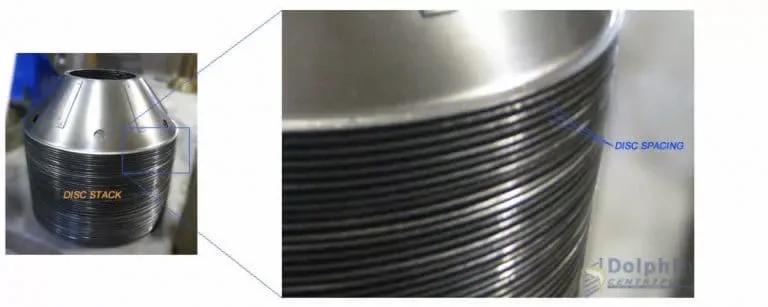
The stack of conical discs has a preset spacing between the discs, typically in the range of 500 to 1,500 microns. This spacing defines the largest particle size the centrifuge can handle. Particles bigger than the inter-disc space cannot pass through the discs and get stuck, causing a blockage in the flow path and centrifuge malfunction.
A clogged disc stack requires stoppage and manual cleaning of individual discs — a laborious and time-consuming process. Pre-straining the process fluid to a mesh size smaller than the disc spacing is the most common way to avoid blockage issues.
This means virtually all disc centrifuge installations require upstream pre-filtration or screening to protect the disc stack. Common requirements:
- Pre-strainer or basket filter: 200–500 micron, depending on disc spacing
- Softening or anti-scale treatment if the feed has high mineral content
- Demagnetizing if ferrous particles are present (these can accumulate on the discs and cause vibration)
The pre-filtration equipment adds capital cost, footprint, maintenance requirements, and an additional failure mode to the system. In plants with heavily contaminated or variable feed streams, maintaining adequate pre-filtration quality is a persistent operational burden.
4. Maintenance Complexity
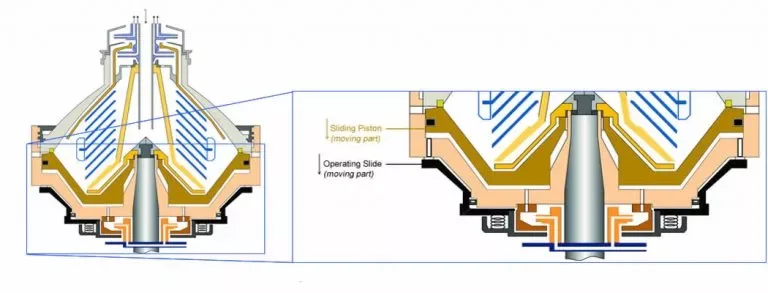
Disc centrifuges are sophisticated machines with many precision components. Routine maintenance requires specialized knowledge and tools that most general maintenance departments do not possess:
- Bowl disassembly: Requires specialized spanner wrenches for the bowl lock ring, proper torque sequences, and knowledge of disc stack orientation and numbering.
- Bearing replacement: Spindle bearings must be press-fitted to precise dimensions. Improper installation causes early failure or vibration.
- Operating system: Self-cleaning models have a hydraulic operating water circuit with solenoid valves, check valves, timing systems, and sliding bowl bottom seals — all requiring periodic inspection and replacement.
- Lubrication: Gear drives (on some models) require scheduled oil changes. Bearing housings require correct lubricant type and level. Over-lubrication is as damaging as under-lubrication.
- CIP and chemical cleaning: Scaling or biological fouling on discs requires periodic chemical cleaning with specific acids or alkaline cleaners — adding to the maintenance burden.
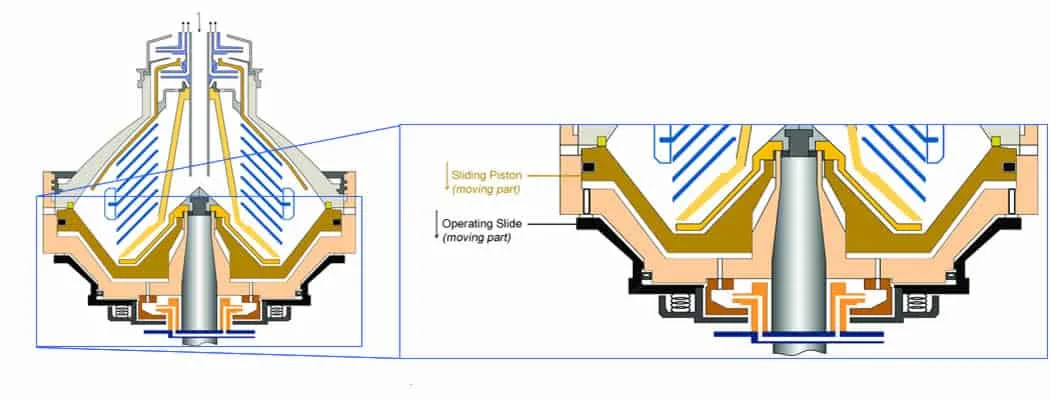
The internal moving parts within the bowl underbody use water to actuate. This mechanism is sensitive to mineral deposits due to water evaporation from these cavities over time. These buildups and part wear related to regular use can cause malfunctioning of the self-cleaning bowl's sludge ejection mechanism. The sliding piston and operating slide are particularly affected by mineral deposits.
Preventative maintenance of disc stack centrifuges is more important than that of a decanter or other types of centrifuges. Facilities without trained centrifuge technicians on staff should factor in service contract costs when evaluating total cost of ownership. Dolphin Centrifuge offers centrifuge lubrication guidance and service support.
5. Operating Water Requirement
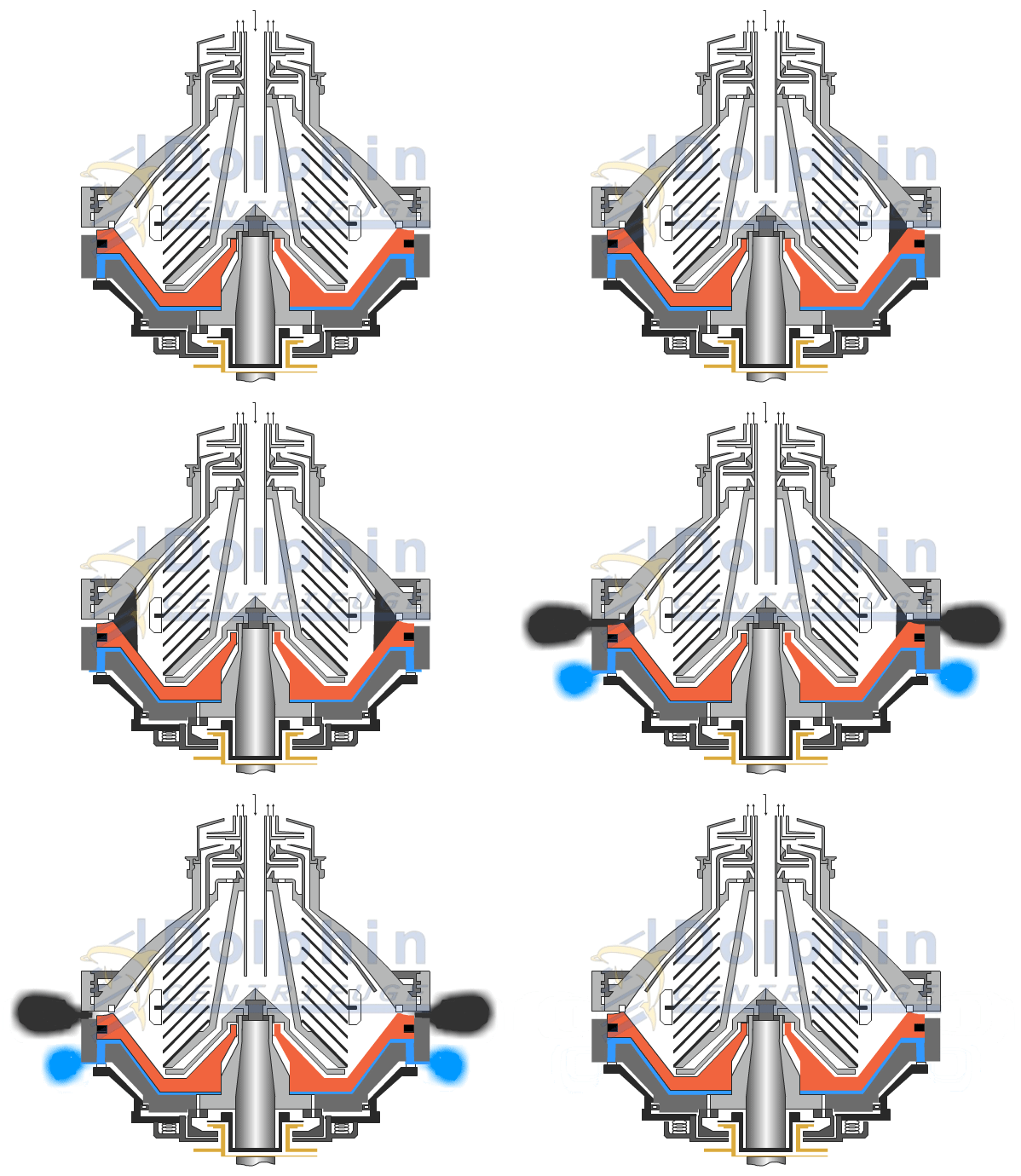
Self-cleaning disc centrifuges consume water for every discharge cycle. A typical medium-size machine uses 3–8 liters of operating water per discharge. At 4 discharges per hour over a 6,000-hour operating year, that is 72,000–192,000 liters of water per year — water that must be supplied, treated if needed, and disposed of with the sludge stream.
The requirement for clean, soft, filtered water is a disadvantage, especially in remote field locations where clean water may not be readily available. Though the operation can recycle the operating water under certain conditions, it is not always practical to do so. In facilities where water supply is limited, costly, or where the sludge discharge must remain dry for downstream handling, the operating water consumption is a real constraint.
6. Intermittent Sludge Discharge
Though all disc stack centrifuges feature continuous flow-through designs, self-cleaning centrifuges eject the separated sludge during a sludge discharge cycle. This cycle is automatically triggered by the centrifuge controller based on a timer.
Therefore, sludge ejection is an intermittent occurrence. In applications requiring a continuous discharge of sludge, the user may view this intermittent discharge as a disadvantage.
In the case of 'full discharge' centrifuges, the process flow must be stopped during the sludge ejection process. This flow stoppage is unsuitable for applications where the centrifuge is in the primary process flow path. A kidney loop installation on the fluid supply or storage tank is advisable for such applications.
7. Sensitivity to Feed Variations
A disc centrifuge optimized for a specific feed — set up with the correct gravity disc, discharge timing, and back pressure — performs well when the feed stays consistent. Real-world feeds are rarely perfectly consistent.
Factors that throw off a properly set centrifuge include:
- Changes in feed fluid density (seasonal temperature shifts, different batches, changes in upstream process)
- Sudden increases in feed solids concentration (upstream upsets, cleaning events, process changes)
- Changes in feed viscosity from temperature or composition changes
- pH changes that affect emulsion stability or solids characteristics
Each of these may require re-optimization of gravity disc selection, backpressure settings, discharge timing, or flow rate. Automated centrifuges with turbidity monitoring and adaptive control handle this better than manually operated machines, but they add to the initial cost. See also our guide on diagnosing bad separation when feed conditions shift.
8. High RPM Safety Requirements
Disc centrifuges operate at very high rotational speeds — typically 4,000–9,000 RPM, generating centrifugal forces of 5,000–15,000× gravity. The kinetic energy stored in the rotating bowl is enormous. A bowl failure — though rare with properly maintained equipment — would be catastrophic.
As a result, disc centrifuges require:
- Heavy-duty, interlocked safety enclosures that must not be bypassed
- Vibration monitoring systems with automatic shutdown on overload
- Bowl inspection programs including periodic non-destructive testing (NDT)
- Strict procedures for bowl assembly — incorrect assembly is a safety hazard
- Trained operators who understand the risks and follow shutdown procedures
These requirements are manageable but they add to operational overhead and mean disc centrifuges are not suitable environments for untrained operators.
When to Choose a Decanter Instead
A decanter centrifuge uses a horizontal bowl with an internal screw conveyor to continuously convey and discharge solids — making it a fundamentally different tool suited to different applications. Choose a decanter when:
- High solids content: Feeds with 5–40%+ solids by volume are handled continuously by a decanter; a disc centrifuge would need constant discharge cycles.
- Dry cake requirement: When the application requires a dry, stackable, or conveyable solids cake (sludge dewatering, mining tailings), the decanter's screw conveyor delivers solids at much higher dryness than a disc centrifuge discharge can achieve.
- Fibrous or coarse solids: Long fibers, coarse particles, or abrasive materials that would block a disc stack pass through a decanter's larger geometry without damage.
- High-volume liquid-solids separation: For applications primarily focused on dewatering large volumes of sludge (wastewater, food processing byproducts), a decanter is typically more cost-effective per unit of solids handled.
The two technologies are often complementary: a disc centrifuge for the primary liquid clarification stage, and a decanter handling the sludge concentrate from the disc centrifuge's discharge to achieve maximum dryness before disposal.
In summary, the disadvantages of the disc stack centrifuge should be considered, along with the advantages, before centrifuge selection. The workarounds to some of these limitations are equally important and can mitigate some of the disadvantages.
Not sure which centrifuge technology fits your application? Review our industrial centrifuge buying guide or contact Dolphin Centrifuge to evaluate your process parameters. Call (248) 522-2573 or email sales@dolphincentrifuge.com.
Not sure if a disc centrifuge fits your application?
Send us a fluid sample and our engineers will evaluate separation feasibility at no charge before you commit to equipment.
Frequently Asked Questions
What are the main disadvantages of disc stack centrifuges? ⌄
The primary limitations are: limited solids handling capacity (typically under 3–5% v/v), high capital cost compared to gravity separators, complex bowl maintenance requiring trained technicians, sensitivity to feed variations and solids surges, and inability to handle fibrous, stringy, or abrasive materials that damage the disc stack.
When should I use a decanter centrifuge instead of a disc stack centrifuge? ⌄
Choose a decanter centrifuge when solids content exceeds 3–5% by volume, when a dry or stackable cake discharge is required, when continuous solids discharge is needed without production interruptions, or when the solids are coarse, fibrous, or too abrasive for the disc stack. Decanters handle higher solids loads at lower G-forces.
Can a self-cleaning disc stack centrifuge handle high-solids feeds? ⌄
Self-cleaning disc stack centrifuges can handle feeds up to approximately 3–5% solids by volume. Above this level, the sludge space fills too quickly between discharge cycles, reducing separation effectiveness and increasing the risk of bowl clogging. For higher-solids applications, a decanter centrifuge or pre-filtration step is recommended.
Why do disc stack centrifuges require operating water? ⌄
Self-cleaning disc stack centrifuges use clean operating water to hydraulically actuate the sliding piston that opens the sludge discharge ports during each ejection cycle. This requires a supply of clean, soft, filtered water — typically 3–8 liters per discharge. In remote locations where clean water is scarce, this requirement is a significant disadvantage compared to decanters, which discharge solids mechanically without water.
What particle sizes can disc stack centrifuges handle? ⌄
The disc stack spacing (typically 500–1,500 microns) defines the maximum particle size the centrifuge can tolerate without clogging the disc channels. Particles larger than this spacing must be removed by upstream pre-filtration or straining. Very fine particles below the centrifuge's G-force capability (typically under 0.5 microns or with densities very close to the carrier fluid) may also pass through without separating. Pre-straining to 200–500 microns is standard practice before all disc centrifuge installations.
Ready to evaluate centrifuge options for your process?
Dolphin Centrifuge has 40+ years of application experience across oil, fuel, coolant, and industrial fluids. Call or get a quote today.
(248) 522-2573 • sales@dolphincentrifuge.com • Warren, MI 48089
Related Articles
When a decanter centrifuge handles high-solids feeds better than a disc stack.
Bad Separation Troubleshooting6 causes of poor disc centrifuge separation and how to fix them.
Centrifuge Lubrication GuideCorrect oil types, change intervals, and common maintenance mistakes.
Disc Stack Centrifuge FAQ101 frequently asked questions about disc stack centrifuges.