Dolphin Centrifuge provides expert guidance on disc centrifuge backpressure — the externally created pressure from discharge line restrictions that controls paring disc immersion, oil-water interface stability, and separation efficiency in 3-phase disc stack centrifuges operating at 5,000-10,000 G-force. Based in Warren, Michigan, with over 40 years of centrifugal separation experience.
What is Backpressure in Disc Centrifuges?
A paring disc pump within the disc centrifuge bowl converts the rotational momentum of the fluid into pressure. This pressure causes the liquid to discharge out of the bowl.
Any restriction in the discharge passage of the liquids exerts pressure on the bowl. This externally created pressure is known as centrifuge backpressure.
In this article, we discuss the benefits of centrifuge backpressure, methods to create backpressure, and the disadvantages of back pressure.
Benefits of Backpressure
Centrifuge backpressure enables higher separation efficiency and, therefore, better results. The backpressure also has some operational benefits to centrifugation.
Keeping the Paring Disc Immersed in Fluid
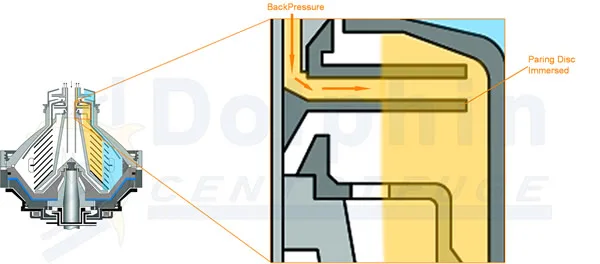
By applying backpressure, the discharge liquid in the outlet chamber accumulates. This accumulation of fluid causes a fluid layer within the paring disc housing area. The adequate depth of this fluid layer ensures immersion of the paring disc in the centrate.
Therefore, the paring disc pump can perform its function of pumping out the separated fluid.
Without the backpressure, an air gap might develop between the paring disc and fluid layer. This gap leads to the inconsistent flow of the separated fluid.
Stabilizing the Oil-Water Interface in 3-Phase Separation
Given the dynamic flow within the centrifuge bowl, the oil-water interface formed within the bowl is not always stable.
The back pressure on the liquid transfers to the oil side of the oil-water interface. This pressure has a stabilizing effect on the interface, which leads to better separation efficiency.
Enhancing Separation Efficiency by Pushing the Oil-Water Interface
The externally exerted backpressure transfers from the paring disc into the light liquid phase inside the bowl. This pressure helps the light phase liquid push the heavy phase (water) column radially outward.
The outward movement of the oil-water interface expands the light liquid column radially. The result is an increase in the diameter of the light fluid column. A larger diameter increases the centrifugal force acting on the liquid, leading to better separation.
Breakover Detection
As explained in our disc centrifuge breakover article, a liquid breakover occurs when the light fluid passes through the heavy fluid outlet.
Under normal conditions, the control system monitors the backpressure in the light fluid discharge line. In case of a breakover, this pressure drops to zero as there is no fluid flowing in the clean outlet. This pressure drop allows for the detection of the breakover condition.
Methods to Generate Backpressure
Disc centrifuges are flow-through type separation devices. The separated clean fluids discharge through different outlets from the centrifuge. A paring disc pump creates pressure, which causes the fluids to flow out.
Intentional Creation of Backpressure
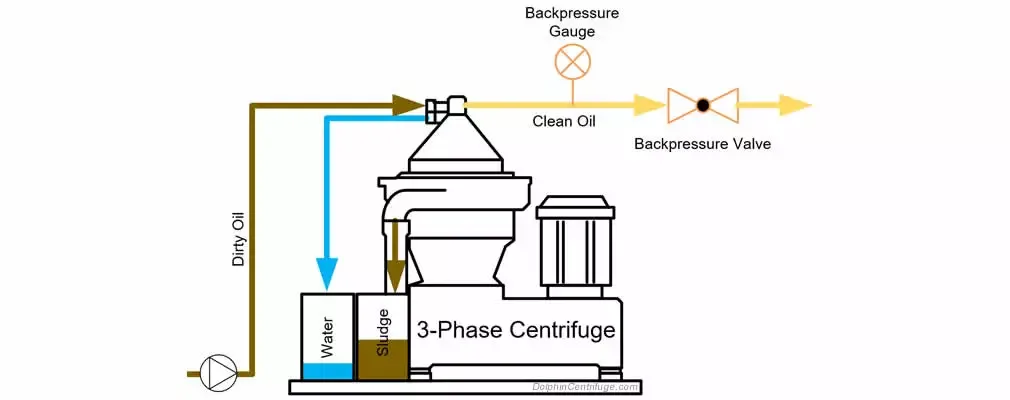
A flow control device, such as a valve, restricts the liquid's flow and builds pressure in the line. This pressure is known as back pressure.
Throttling of the valve in the liquid outlet discharge pipe causes the backpressure to increase. Conversely, opening the valve reduces the back pressure.
Unintentional Creation of Backpressure
We have encountered several centrifuge installations where the liquid discharge pipe connects to a far-away tank with elevation. The resistance in the pipeline and head pressure from the height causes inadvertent backpressure on the centrifuge.
In some cases, pipeline restrictions such as solids buildup can restrict the flow, which leads to back pressure. This source of pressure is not apparent and unexplained.
It is also important to note that increasing the centrifuge flow during operation (without adjusting the backpressure valve) will increase the backpressure. Conversely, reducing the flow without throttling the valve reduces back pressure.
Therefore, any flow adjustment of the centrifuge should accompany backpressure valve adjustment.
Need Help With Backpressure Setup?
Our engineers can help you diagnose backpressure issues and optimize your centrifuge discharge configuration for consistent separation results.
Disadvantages of Varying or Excessive Backpressure
Backpressure generated unintentionally has a direct effect on the centrifuge performance and functionality of the system. We explain some of these adverse effects below.
Breakover
Backpressure exerted on the centrifuge bowl causes the light phase liquid to push the heavy phase liquid. This phenomenon causes the oil-water interface to move radially outwards.
However, too much backpressure can push the interface beyond the top disc. This interface movement allows the light phase to discharge through the heavy phase outlet, and we have a breakover condition.
Reduced Flow-Rate
Any restriction in the discharge line of the centrifuge is a resistance to flow through the line. This resistance causes the flow to reduce.
Therefore, any backpressure, intentional or unintentional, causes the flow rate to decrease.
Reduced Centrifuge Efficiency and Bad Separation Results
Consider a setup where the centrifuge discharge pipe connects to the bottom of the clean liquid tank. As the liquid accumulates in the tank, the level in the tank rises.
The rising liquid level increases head pressure from the tank liquid, increasing the centrifuge discharge line's backpressure.
In this case, we have a situation where the backpressure on the centrifuge varies (increasing) as the centrifuge operates. Varying backpressure affects the position of the oil-water interface within the centrifuge bowl.
If this pressure exceeds the breakover threshold, the centrifuge will experience a breakover.
If the operator reduces the mechanically applied pressure to compensate for this increasing backpressure, the centrifuge will not operate at a consistent efficiency level. This changing efficiency leads to bad separation results.
Monitoring and Adjusting Backpressure
Based on the above discussion, centrifuge backpressure is an essential factor that affects centrifuge performance. Monitoring and controlling this pressure is crucial for the reliable operation of the centrifuge. The following are two ways to check and control backpressure in centrifuges.
Manual Method
The easiest and most efficient way to monitor backpressure is by installing a pressure gauge upstream of the valve.
The indicator will display the pressure in the discharge line. Manual opening of the control valve reduces the back pressure.
Automatic Method
Installing a pressure sensor on the outlet line automatically monitors the back pressure. The centrifuge controller has a preset pressure threshold.
When the line's pressure exceeds this level, the controller activates corrective action, such as triggering an alarm or adjusting a servo valve. The opening or closing of the valve regulates the backpressure.
In summary, a centrifuge operator should be aware of centrifuge backpressure, its importance in centrifuge performance, and ways to adjust it.
by Sanjay Prabhu MSME — Engineering Manager, Dolphin Centrifuge
Frequently Asked Questions
What is back pressure in a disc centrifuge?
A paring disc pump within the disc centrifuge bowl converts the rotational momentum of the fluid into pressure, causing the liquid to discharge out of the bowl. Any restriction in the discharge passage of the liquids exerts pressure on the bowl — this externally created pressure is known as centrifuge backpressure.
What are the benefits of centrifuge backpressure?
Backpressure keeps the paring disc immersed in fluid for consistent pumping, stabilizes the oil-water interface in 3-phase separation, enhances separation efficiency by pushing the oil-water interface radially outward (increasing centrifugal force on the liquid), and enables breakover detection through pressure monitoring.
How is centrifuge backpressure created?
Backpressure is created intentionally using a flow control valve that restricts liquid flow in the discharge pipe. It can also be created unintentionally by elevated discharge tanks, pipeline restrictions from solids buildup, or increasing flow rate without adjusting the backpressure valve.
What are the disadvantages of excessive backpressure?
Excessive backpressure can cause breakover (light phase discharging through the heavy phase outlet), reduced flow rate due to discharge line resistance, and reduced centrifuge efficiency from varying backpressure that shifts the oil-water interface position during operation.
How do you monitor and adjust centrifuge backpressure?
Backpressure can be monitored manually using a pressure gauge upstream of the valve, or automatically using a pressure sensor connected to the centrifuge controller with preset pressure thresholds that trigger alarms or adjust servo valves.
Related Guides
Purifier vs Clarifier
Understand the difference between purifier and clarifier disc centrifuges.
Liquid Seal Break
Causes and fixes for liquid seal loss in disc stack centrifuges.
Bowl Leaking Troubleshooting
Diagnose and fix disc centrifuge bowl leaking issues.
Disc Stack Centrifuge Overview
Complete guide to disc stack centrifuge types, specs, and applications.