Dolphin Centrifuge diagnoses disc stack centrifuges that fail to reach rated operating speed. Disc centrifuges should accelerate to full RPM within 3–8 minutes; startup beyond 10 minutes or a motor overload trip signals a correctable mechanical or electrical fault. Dolphin Centrifuge provides friction clutch replacement, drive belt service, and complete drive system rebuilds for all Alfa Laval and industrial disc centrifuge models, with 40+ years of service experience from Warren, Michigan.
Summary: Disc stack centrifuges typically reach rated speed within 3–8 minutes depending on model size. If the bowl is still accelerating after 10 minutes, or if the motor trips on overload during startup, something is preventing normal acceleration. This guide covers all 10 major causes with practical diagnosis steps. Operating a centrifuge below rated speed compromises separation quality and increases wear on the drive system.
Importance of Disc Centrifuge Operating Speed
A disc stack centrifuge uses the centrifugal force it generates to separate liquid from solid and liquid from liquid. The centrifugal force exerted is a direct function of the bowl's rotating speed. The design of a disc centrifuge assumes a specific bowl rotating speed (RPM) to perform its separating function.
Reduced Separation Efficiency
The operating speed of the centrifuge bowl primarily determines the centrifugal force needed for efficient separation of the fluids. Any degradation of the bowl speed has a detrimental effect on the centrifuge's separation efficiency.
Mechanical Bowl Function Issues
In self-cleaning centrifuges, the bowl operating speed is essential for keeping the bowl from opening during operation. The bowl RPM is also critical for the bowl's opening during the sludge ejection process.
How to Check Disc Centrifuge Bowl Speed
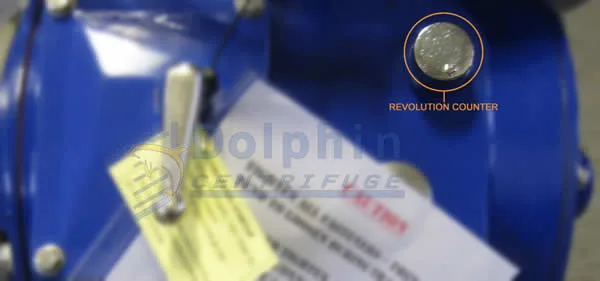
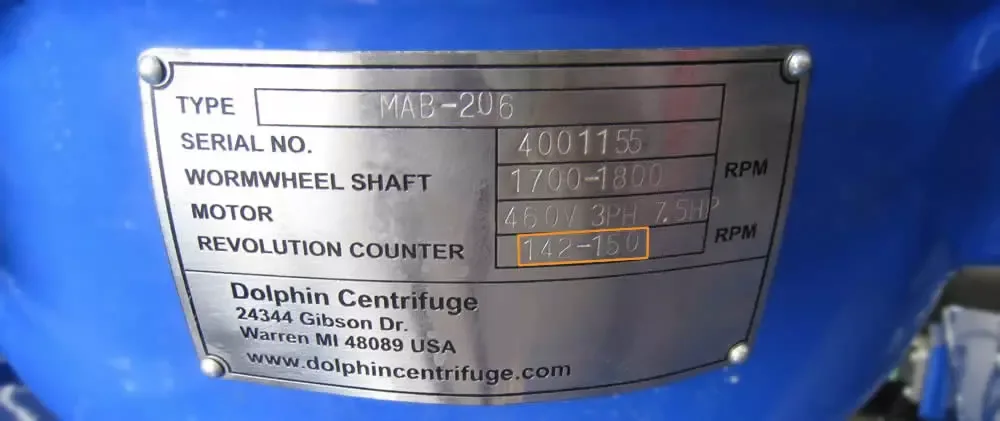
Alfa Laval disc centrifuges have a revolution counter (rotating disc) on the front of the lower frame. To check the speed of the disc centrifuge, the operator counts the rotation on the revolution counter and compares it to the revolution counter speed specified for the particular centrifuge type on the centrifuge nameplate. The revolution counter rotates between 72 and 150 RPM, depending on the centrifuge size.
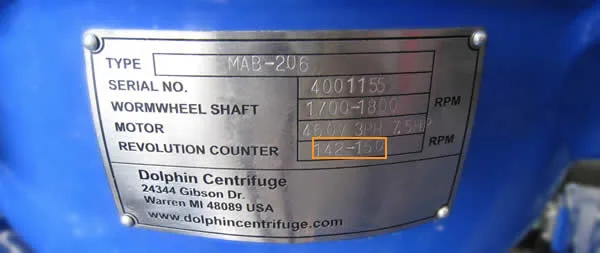
If the revolution counter is not rotating at the specified speed after the elapse of the ramp-up time, then the disc centrifuge is not operating at the design operating speed.
10 Steps to Check Operating Speed
- Start the centrifuge.
- Refer to the centrifuge manual for ramp-up time for your centrifuge model.
- Wait for the centrifuge to ramp up rotational speed (ramp-up time).
- Monitor the motor current for a quick drop-off (at speed indication).
- Refer to the centrifuge manual to ascertain the correct rotational speed of the revolution counter.
- Place a thumb on the rotating revolution counter disc.
- Count the RPM of the revolution counter.
- Wait for 2 minutes and recount the revolution counter RPM.
- Note any difference between the 2 consecutive readings.
- Compare the counted RPM to the recommended RPM in the centrifuge manual.
Centrifuge Brake is Engaged
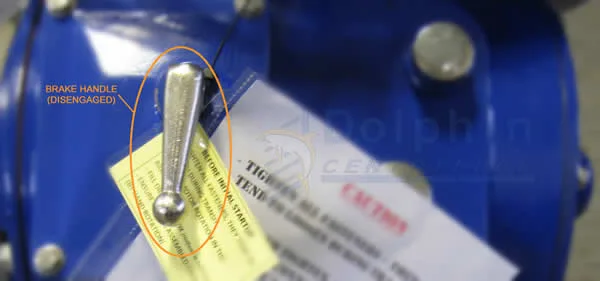
Failure mode: An engaged brake is the most common cause of slow centrifuge bowl speed. If the operator uses the mechanical brake on the centrifuge frame while stopping the centrifuge, the operator often starts the centrifuge without disengaging the brake. The brake prevents the drum and, therefore, the bowl from attaining full operating speed.
Fix: Checking and disengaging the brake (if engaged) before every startup is the fix to this cause. Make it part of the standard pre-startup checklist.
Friction Clutch Issues and Slippage
How the clutch works: The friction clutch is the crucial assembly that transfers the torque from the motor to the centrifuge transmission. Most disc centrifuges use a centrifugal friction clutch to couple the motor to the spindle during startup. The clutch allows the motor to accelerate first, then gradually engages the bowl load as the motor reaches its torque peak.
Worn friction pads: The friction pads are consumable parts in the friction clutch. Worn-out friction pads cannot transfer the motor torque to the centrifuge shaft, which causes the centrifuge not to reach its operating speed. As pads wear, their friction coefficient drops and slipping increases.
Glazed clutch drum: The friction clutch drum can get a very smooth, glossy surface due to previous metal-to-metal contact with totally worn-out friction pads. The friction pads slip on this smooth surface and cannot transmit the torque from the motor to the centrifuge shaft.
Diagnosis: Check the clutch pad thickness against the minimum specification in the machine manual. Worn pads may also produce a burning smell or fine metallic dust near the clutch housing during attempted startup.
Fix: Replace all friction pads periodically per the manufacturer's instructions, always as a matched set. Never replace only one pad or one shoe. If the drum surface is glazed, roughen up the inner surface to facilitate adequate friction between the pads and the drum. Dolphin Centrifuge stocks clutch components for all major disc centrifuge models.
Worn or Broken Drive Belts
Failure mode: Belt-driven centrifuges use multiple V-belts or a flat belt to transmit torque from the motor to the spindle pulley. A belt that is worn, glazed, or running loose slips under load, especially during the high-torque acceleration phase. A completely broken belt results in zero spindle rotation while the motor runs freely.
Diagnosis: With the machine shut down and locked out, open the belt cover and inspect all belts. Check for cracking, glazing (shiny inner surface), fraying, or loss of tension. A correctly tensioned belt should deflect approximately 10–15 mm per meter of span under moderate thumb pressure — consult the manual for exact specification.
Fix: Replace all belts in a matched set. Never mix old and new belts on the same drive — the old belt will carry disproportionate load and fail quickly. Verify belt alignment using a straightedge across both pulleys. Tension to the specified deflection value after installation.
Centrifuge Bowl Sludge Accumulation
Failure mode: The manual or automatic removal of sludge from the bowl is essential for proper and safe operation. If a centrifuge is shut down without completing an ejection cycle, solids remain packed in the bowl periphery. The bowl packs up with sludge causing the bowl mass to increase considerably. The power of the centrifuge motor may not be sufficient to rotate this added weight, preventing the centrifuge from reaching operating speed.
Diagnosis: Check the last shutdown procedure — was the bowl discharged before shutdown? Is the bowl heavier than normal? On some machines, the tachometer will show the actual speed curve during startup; a slower-than-normal curve suggests excess bowl loading.
Fix: The cleaning or purging of the bowl is the only way to fix this cause. If safe to do so, manually trigger a bowl discharge before initiating a full restart. Some situations may require a thorough manual cleaning of the centrifuge bowl, including the disc stack. Revise the shutdown procedure to always include a discharge sequence before stopping the feed and machine.
Motor Fault or Reduced Power Output
Motor phase drop: The majority of centrifuge motors are three-phase electric motors. If an electrical fault occurs and the motor loses one or two phases, it cannot generate the required torque or rotate at the desired speed. This high motor current draw accompanies this electrical malfunction and is thus easily detected.
Motor failure: The centrifuge motor can fail due to many reasons. Bad motor windings or bearing failures are common occurrences. A malfunctioning motor will directly cause low torque and therefore prevent the centrifuge from rotating at the specified RPM.
Diagnosis: Measure supply voltage at all three phases at the motor terminal block during the startup attempt. A significant voltage drop or imbalance between phases (more than 2%) indicates a supply or motor problem. Measure motor winding resistance with an ohmmeter — significant variation between phases indicates a winding fault.
Fix: A thorough electrical wiring check and troubleshooting are essential to identify the cause of the phase drop. Correct power supply issues at the source (check fuses, contactors, and supply cables). A motor with winding damage requires rewinding or replacement. Check motor cooling vents — a motor that has previously overheated may have degraded winding insulation.
Need help diagnosing a startup problem? Dolphin Centrifuge provides on-site commissioning support and complete drive system rebuilds for all disc centrifuge models. Call (248) 522-2573 or request a quote.
VFD (Variable Frequency Drive) Fault or Misconfiguration
Failure mode: Centrifuges fitted with VFDs for soft-start or speed control can fail to reach operating speed if the VFD has a fault code active, if the acceleration ramp time is set too short (causing overcurrent trip), or if the maximum frequency parameter has been incorrectly set below the rated operating speed.
Diagnosis: Check the VFD display for fault codes before and during startup. Review VFD parameters for maximum output frequency and acceleration time against the commissioning documentation. Log VFD output frequency and motor current during a startup attempt.
Fix: Clear fault codes and investigate their root cause before restarting. Restore VFD parameters from commissioning records. Extend the acceleration ramp time if overcurrent trips occur during startup. If the VFD is overheating, clean the cooling vents and verify ambient temperature is within the VFD's rated range.
Bearing Drag from Wear or Lack of Lubrication
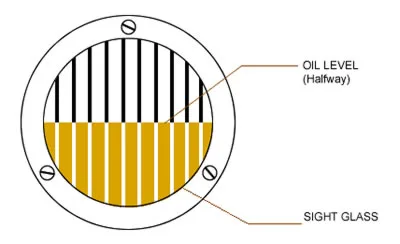
Failure mode: The failure of any bearing in the centrifuge will prevent the transmission components from free rotation. Worn bearings, bearings running on degraded oil, or bearings that have seized partially due to contamination add significant drag to the system. Bearing failure is often accompanied by an exceptionally high noise level and higher vibration amplitude. A total and thorough centrifuge rebuild is essential to fix any bearing failure-related issues.
Too much oil in gear housing: A disc centrifuge incorporates a gear housing in the bottom frame. Gear lubricating oil fills this housing to a predetermined level (halfway through the sight glass) to splash-lubricate the bearings and the gears. If the operator inadvertently fills too much oil in the gear housing, the thick oil resists the rotation of the gears, thereby slowing down the centrifuge speed.
Diagnosis: Check bearing oil level and condition through the sight glass. Discolored, milky, or contaminated oil indicates a problem. Measure bearing temperature with an infrared thermometer at full speed — temperatures above 80°C (175°F) suggest excessive friction. Listen for bearing noise during acceleration.
Fix: The operator needs to check the gear housing oil level regularly for too much or too little oil. Change the bearing oil immediately if contaminated. If bearings are worn or damaged, replace the complete bearing set. See the disc centrifuge lubrication guide for correct oil specifications and change intervals.
Bowl Imbalance or Incorrect Bowl Assembly
Bowl imbalance: An imbalanced bowl creates a vibration force that increases with speed squared. As the bowl approaches a critical speed, vibration amplitude peaks sharply. On some machines, the vibration alarm trips the machine before rated speed is reached because the vibration level exceeds the alarm setpoint.
Incorrect bowl assembly: Proper disc centrifuge bowl assembly is critical to safe and efficient operation. If there is a misalignment in the bowl parts, the rotating parts of the bowl make contact with the stationary centrifuge parts. This contact causes resistance to rotation, reducing the bowl speed. This contact between the rotating and stationary parts will cause considerable damage to the centrifuge parts, and the operator should avoid it. It is also a safety hazard.
Diagnosis: If the machine trips on vibration alarm during acceleration rather than overload, imbalance is the likely cause. Check whether the bowl was recently disassembled — incorrect reassembly is the most common source of sudden imbalance.
Fix: Disassemble the bowl and verify the disc count and orientation. Check for missing or damaged distributor vanes. Ensure all bowl components are correctly keyed or indexed. If imbalance persists after correct reassembly, the bowl may require professional balancing. Contact Dolphin Centrifuge for bowl balancing services.
Worn Worm Gear or Gear Drive
Failure mode: Some disc centrifuge models use a worm gear or helical gear drive between the motor shaft and the spindle. Worn gear teeth increase friction and reduce the mechanical efficiency of the drive, effectively reducing the torque available to accelerate the bowl. Heavily worn gears may slip or jump under the high-torque load of startup.
Diagnosis: Inspect gear teeth for wear, pitting, or plastic deformation of the tooth profile. Check gear lubricant for metal particles using a magnetic drain plug or oil sample. A high metal particle count indicates active gear wear. Listen for gear noise — worn gears typically produce a whirring or grinding sound that changes pitch with speed.
Fix: Worn gear sets must be replaced. Running worn gears accelerates wear exponentially and will eventually cause complete failure during operation. Drain the gearbox, replace gears, refill with the correct gear lubricant type and quantity, and verify gear mesh clearance to specification.
Centrifuge Rotation Reversal (Phase Reversal)
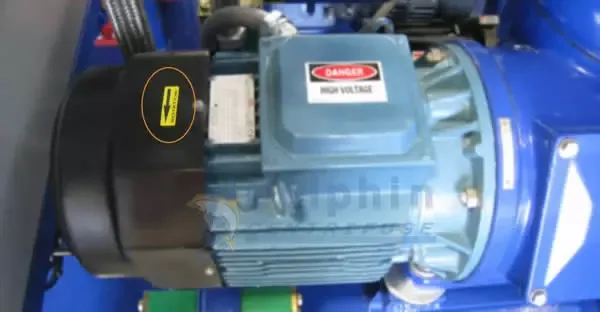
Failure mode: All disc centrifuges have a specific direction of rotation which is critical to the operation of the centrifuge. The direction of rotation is indicated by the arrow on the centrifuge frame and often on the motor. A phase reversal of the electric supply to the centrifuge drive motor will cause the centrifuge to rotate in the opposite direction.
Why this is dangerous: The friction clutch design only allows the torque transmission when it is rotating in the correct direction. A clutch rotating in the opposite direction cannot transmit the torque for the bowl to rotate at the specified speed. In addition, a reversal of rotation of the centrifuge will unlock the threaded parts of the bowl assembly (left-hand thread), possibly leading to catastrophic damage to the equipment and operators.
Fix: To prevent reverse rotation, the operator must check the motor rotation each time the motor is electrically disconnected or after any electrical systems service.
Additional Causes
Horizontal Shafts Out of Alignment
Sometimes during the service or replacement of the centrifuge motor, the motor shaft gets misaligned from the horizontal shaft. Incorrect motor assembly or a dent on the motor flange could be possible causes. This misalignment causes a transverse load on the horizontal shaft, causing the bearings to resist free rotation leading to incorrect or low bowl speed. A motor alignment issue usually accompanies a high motor current and is easily identified by monitoring the motor current draw after motor replacement or repair.
Cold Lubricant Viscosity (Cold Start Drag)
At low ambient temperatures, gear oils and bearing lubricants become significantly more viscous. Thick cold oil creates substantial churning and drag resistance in the gear housing and bearing housings, making it difficult or impossible to accelerate the bowl to rated speed until the oil warms up. This is particularly common in outdoor or unheated facilities during winter. Allow the machine to warm up before startup in cold conditions or use a lower-viscosity oil grade for winter operation if the machine manual provides a cold-weather oil specification.
Spindle or Frame Mechanical Damage
A bent spindle, damaged spindle bearings, or a distorted frame that causes misalignment between the motor, drive, and spindle creates mechanical drag and vibration that prevents reaching rated speed. Measure spindle runout with a dial indicator at the top of the spindle (above the bowl seat). Any runout exceeding the manufacturer's specification (typically 0.002" or 0.05 mm) indicates a bent or damaged spindle. A bent spindle must be replaced — straightening is not an acceptable repair for a component rotating at thousands of RPM. Contact Dolphin Centrifuge for a spindle replacement assessment.
Systematic Startup Diagnosis
- Check the trip log. What fault caused the last shutdown? Overload current, vibration, or temperature faults each point to different root causes.
- Verify the bowl is empty. Attempt a manual discharge before the next startup if the bowl may have retained solids.
- Check bearing oil level and condition before every startup. This takes 30 seconds and eliminates one of the most common causes.
- Inspect belts and clutch if the machine is belt-driven or has a friction clutch. These are the highest-wear startup components.
- Measure motor voltage and current during a startup attempt. Compare against commissioning baseline data.
- Review VFD fault log if applicable before clearing and restarting.
- Monitor the speed curve. Does the bowl accelerate normally until a certain speed and then plateau? Or does it not accelerate at all? The speed profile narrows down the cause significantly.
For persistent startup failures or if the bowl has never reached rated speed on a newly installed machine, professional commissioning support is required. Call (248) 522-2573 or email sales@dolphincentrifuge.com. Dolphin Centrifuge provides on-site startup support and drive system repairs across North America.
Centrifuge Still Not Reaching Speed After Diagnosis?
Dolphin Centrifuge provides friction clutch replacement, drive belt service, and complete drive system rebuilds for all disc centrifuge models. Our engineers diagnose startup failures fast.
Frequently Asked Questions
Why won't my disc centrifuge reach full operating speed?
The most common causes are a worn or slipping friction clutch, motor issues (under-voltage, single-phasing, or undersized motor), worn or damaged bowl bearings causing excessive drag, an imbalanced bowl assembly, or excessive feed flow during startup that overloads the drive.
How does a friction clutch affect centrifuge startup speed?
The friction clutch couples the motor to the bowl spindle during startup. A slipping or worn clutch cannot transfer enough torque to accelerate the heavy bowl to rated RPM. If startup takes longer than 15 minutes or the bowl never reaches rated speed, inspect and replace the clutch shoes.
What should I check if my centrifuge speed is lower than rated RPM?
Check: (1) brake is disengaged, (2) clutch condition and spring tension, (3) supply voltage and motor current draw, (4) bowl bearing temperature and noise, (5) bowl assembly balance, and (6) whether the bowl was recently disassembled and may have been reassembled incorrectly.
Can reverse rotation prevent a centrifuge from reaching speed?
Yes. A phase reversal of the electric supply causes reverse rotation. The friction clutch design only allows torque transmission in the correct direction, so the bowl cannot reach operating speed. Reverse rotation also unlocks threaded bowl parts (left-hand thread), which can cause catastrophic damage. Always verify motor rotation direction after any electrical work.
How long should a disc centrifuge take to reach operating speed?
Most disc stack centrifuges reach rated RPM within 3–8 minutes depending on model size. If the bowl is still accelerating after 10 minutes, or if the motor trips on overload during startup, a mechanical or electrical fault is preventing normal acceleration. Startup times consistently exceeding 10 minutes require immediate investigation of the clutch, bearings, drive belts, and motor.
by Sanjay Prabhu MSME, Engineering Manager, Dolphin Centrifuge