Dolphin Centrifuge provides expert guidance on disc stack centrifuge bowl troubleshooting — including bowls that won't open or close, incomplete sludge discharge, bowl leaks, and incorrect assembly sequences. Disc centrifuge bowls are precision assemblies that must be assembled in proper sequence to maintain balance and seal integrity at operating speeds of 3,000–8,000+ RPM. Dolphin Centrifuge provides bowl rebuild kits, service, and training for all Alfa Laval disc centrifuge models. Based in Warren, Michigan, with over 40 years of centrifuge bowl experience.
Synopsis
A self-cleaning disc stack centrifuge 'cleans' itself by ejecting the separated sludge from the bowl. The centrifuge bowl has to 'open' and 'close' to facilitate this ejection step. Therefore, the opening and closing of the bowl are critical steps in the disc centrifuge operation.
A bowl not opening or not closing is a common problem faced by users of self-cleaning centrifuges.
This article discusses the troubleshooting steps the disc stack centrifuge operator needs to take in cases where the bowl opening and closing functions are not working correctly. We discuss disc centrifuges based on Alfa Laval designs, but these principles apply to most disc-stack centrifuges from other manufacturers.
It might be beneficial to the reader to refer to our article about the different parts unique to disc centrifuges. It illustrates critical bowl parts with photographs.
Disc Stack Centrifuge Bowl Opening & Closing Operation
The following illustration shows the cross-section of a self-cleaning disc centrifuge bowl. We briefly explain the operation of the bowl opening and closing mechanism in the context of this diagram.
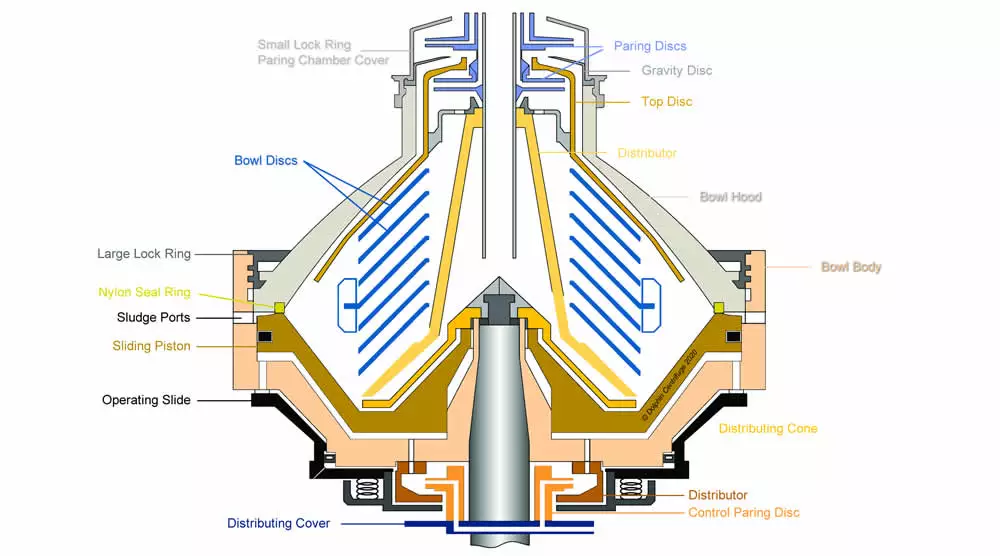
Bowl Closing Process
The Closing Water entering the Closing Water Chamber pushes the Sliding Piston upwards. The closing water force is higher than that of the process fluid above the sliding piston.
The Springs push up the Operating Slide, which carries the Drain Valve Plug up, closing the Closing Water Drain Channels.
The bowl is now closed, and the process fluid can enter the bowl processing space.
Bowl Opening Process (Sludge Ejection)
The purpose of the bowl opening sequence is to discharge the accumulated sludge in the sludge space. Therefore the feed to the centrifuge must be shut off before this step.
The bowl opening process starts with allowing the Opening Water into the chamber above the Operating Slide. The bowl Opening Water overcomes the Springs' upward force pushing the Operating Slide downwards.
This downward movement of the Operating Slide opens the Closing Water Drain Channels. The Closing Water escapes from under the Sliding Piston. The force of the process fluid above the Sliding Piston pushes it downward. This action opens the Sludge Ports, ejecting the accumulated sludge from the bowl.
For more on sludge ejection timing, see our ejection cycle timing guide.
Bowl Closing Process After Sludge Ejection
The system stops the Opening Water supply after the sludge ejection is complete. The water in the Opening Chamber drains through the Opening Water Drain Nozzle, and the Springs under the Operating Slide push it upwards. This movement closes the Closing Water Drain Channels by the Drain Valve Plugs.
At this point, the automatic system supplies the Closing Water. It enters the Closing Water Chamber under the sliding piston through the Closing Water Channels. This water pushes the Sliding Piston upwards. The bowl is now closed, and the sludge discharge cycle is complete.
Telltale Signs of Bowl Not Closing
Specific indications point to the bowl of the centrifuge not being closed.
- No flow through the water sight glass — If the priming water does not flow through the water sight glass after a reasonable amount of time, the bowl has likely not closed. Confirming the open bowl condition is the priming water flowing through the sludge outlet. The reader should also be aware that this condition can occur if the small lock ring is not tight and leaking.
- Motor current surge during priming — The other indicator of the bowl being open is a surge in motor current during the prime water supply. The open bowl leads to the prime water exiting the bowl at high velocity through the sludge ports. This escaping water creates resistance to the rotating bowl, exerting more load on the motor, causing the current to rise.
Reasons & Fixes: Bowl Not Closing (aka Fail to Close)
There are multiple possible reasons for the centrifuge bowl's inability to close. From our experience, it is often related to the operating water supply. We will discuss most operating water-related issues and how they relate to the centrifuge bowl closing issues.
1. Issues with the Closing Water System
A simple oversight such as shutting the operating water valve will prevent the bowl from closing due to lack of water. The fix is simple — open the operating water valve.
Electric solenoid valves control the bowl closing and opening water flow, and a defective solenoid valve will cause a lack of closing water to the bowl. This shortage of closing water will prevent the bowl from closing.
Manual activation of the solenoid valves and checking for water flow is the simplest way to root cause of this problem. Replacement or repair of defective valves will solve this problem.
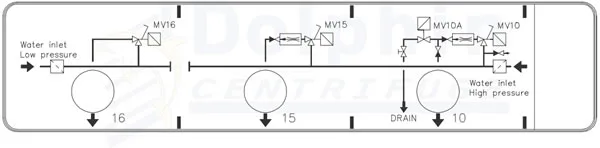
As shown in the diagram, two flexible hoses supply the opening and closing water to the centrifuge. Accidental switching of these two hoses is possible, especially after centrifuge service. After each service, the operator should verify the hose connections to the centrifuge to connect the opening and closing water hoses to the right ports.
2. Closing Water Flow Rate (Volume)
Yes, Volume! Not only pressure. All self-cleaning centrifuges have a specific flow rate of bowl closing water needed to close the bowl. We often find the flow rate too low even though the water is under the right pressure.
For a typical centrifuge, the closing water should flow at a minimum of 3 GPM at the designated pressure. For example, a 30 GPM capacity self-cleaning centrifuge bowl will struggle to close if the closing water supply is through a ½" pipe.
The closing water flow rate is easy to check. The operator can disconnect the closing water hose from the centrifuge and measure the flow rate into a 5-gallon pail.
3. Closing Water Pressure
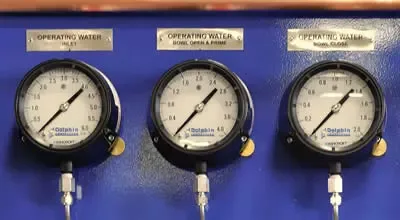
Closing water pressure is also a critical factor in bowl closing. Most self-cleaning centrifuges require a lower closing water pressure than the opening water.
Higher than designated pressure causes the closing water to overflow into the opening water passage, which can have the opposite effect. High-pressure closing water can instead cause the bowl to open because the operating slide can get pushed down, opening the closing water drain channels.
Fix: Verify closing water pressure against the manufacturer's specifications. Adjust the pressure regulator to the correct setting.
4. Condition of Drain Valve Plugs
As shown in the above drawing, the valve plugs prevent the closing water from escaping from the closing water chamber. Worn-out valve plugs fail to create the seal required to hold the closing water in the closing water chamber. Therefore it is essential to check the condition of the valve plugs if the bowl is not closing.
A simple tip is to flip the valve plugs in a bind if one surface is uneven or worn out. In other words, the opposing end of the valve plugs may have a smoother surface, which can temporarily fix the leak. However, it is also essential to check the height of the plugs. Short plugs can cause the same issue. Replace worn plugs at the earliest opportunity.
5. Condition of the Distributing Ring and O-Ring Around It
The distributing ring distributes the incoming closing water into the closing water chamber. In older, used centrifuges, one may find the circular slot crimped or crushed in the distributing ring. Attempted removal of the bowl body without first removing the three bolts holding the distributing ring causes the slot crimping.
Closing the gap in the slot prevents the water from entering the distributing ring. Most often, this condition cannot be repaired and requires the replacement of the distributing ring.
There may be one or two o-rings around the distributing ring. The presence and condition of this o-ring are also crucial for the bowl closing process. The operator should replace this o-ring at the slightest sign of wear or damage. We also recommend coating this o-ring(s) with the sealing lubricant.
For more information on disc stack centrifuge-specific parts, please read our Disc Stack Centrifuge Parts Glossary.
6. Gasket Under the Control Paring Disc is Worn or Damaged
The distributing cover conveys the water to the control paring disc, which jets the closing water into the above distribution ring slot. There is a thin, flat gasket between the distributing cover and the control paring disc.
If this gasket is dry-rotted or torn, it causes the closing water to leak. Therefore some or all of the closing water do not get to the closing water chamber preventing the bowl from closing.
Fix: Replacement of this gasket during routine maintenance can avoid this cause of the bowl not closing.
7. Centrifuge Bowl Speed Too Low
The centrifuge bowl speed issue is only related to centrifuges with a centrifugal clutch in the transmission.
Friction pads mounted on clutch shoes transmit the torque from the motor to the horizontal shaft. Over time these pads tend to wear and should be replaced as part of the regular maintenance. When the friction pads have excessive wear, the clutch cannot transmit the required torque to the bowl. This loss of power slows the bowl speed or RPM.
The closing water uses the centrifugal force generated by the bowl rotation to pressure the upward movement of the sliding piston. Low bowl speed leads to lower pressure, which prevents the bowl from closing. The timely replacement of the friction pads alleviates this problem.
Operating Signs of Bowl Not Opening (Fail to Shoot)
Like the bowl-not-closing condition, failure to open is also deducible via observations during the operation.
- No audible sound or vibration — An audible sound and short vibration spell accompany the bowl opening event. The operator easily observes these indicators. The absence of these signs at the anticipated bowl opening time is the first indication of the bowl failing to shoot. The operator should investigate such occurrences immediately.
- No sludge discharge visible — The operator can confirm the fail-to-shoot conditions by visually checking the sludge discharge through the sludge outlet during the sludge ejection cycle.
- No motor current spike — The bowl opening and sludge discharge event causes a momentary spike in the motor current draw. One of the fail-to-close indicators above explains the cause of this current draw increase. The absence of this surge in motor current at the expected time of sludge ejection is another indication of possible fail-to-shoot conditions.
- Steadily increasing vibration — Consistently increasing vibration level of the centrifuge through multiple discharge cycles is possibly caused by excessive sludge buildup in the bowl. This buildup is a direct result of the bowl being unable to open. The operator should root cause excessive centrifuge vibrations immediately.
Critical Safety Warning
Un-discharged sludge accumulation can cause severe damage to the centrifuge and possibly lead to catastrophic failure of the centrifuge. The user has to give paramount consideration to the potential for operator injury under such conditions. A bowl that repeatedly fails to open requires immediate shutdown and inspection — do not continue operating. See our guide on mechanical issues and fixes for additional safety guidance.
Causes & Fixes: Bowl Not Opening (aka Fail to Shoot)
As with the issues related to the bowl-not-closing, similar problems can prevent the bowl from opening during the sludge discharge cycle. However, the bowl not opening is more important than the bowl not closing because failure to discharge the sludge can cause excessive sludge accumulation in the bowl.
1. Issues with the Opening Water System
All the issues and relevant fixes mentioned above in the 'Issues with the Closing Water System' apply to the opening water system. Check valve positions, manually activate solenoid valves, verify hose connections.
2. Opening Water Flow-Rate (Volume)
All the abovementioned factors in the 'Closing Water Flow-Rate' section apply to the bowl opening issues. Measure the actual flow rate by disconnecting the hose and timing the flow into a container. Ensure piping is sized for the required volume.
3. Opening Water Pressure
The opening water pressure is essential for the bowl to open. Maintaining the correct opening water pressure is key to the bowl opening mechanism depending on the centrifuge.
Fix: Verify opening water pressure against manufacturer specifications. Adjust the regulator as needed. For more on operating water requirements, see our operating water guide.
4. Mineral Deposits in the Opening Water Chamber (Operating Slide)
Operating water is always present in the opening water chamber. Over time this water evaporates, which causes mineral deposits around the operating slide. These deposits hamper the free movement of the operating slide needed for the sludge ejection cycle.
Fix: A thorough cleaning of the operating slide and spring plate to remove any mineral deposits fixes this issue. This should be part of regular preventive maintenance.
5. Operating Slide Seal Ring
The operating slide has a seal ring (o-ring) around its outer periphery. This seal prevents the incoming opening water from escaping the opening water chamber. Any leaks from this seal ring will prevent the operating slide from moving downward, not allowing the bowl to open.
Fix: Replacement of this seal ring will fix this issue. Lubricating the replacement seal with the specific lubricant ensures the longevity of this part.
Automatic Detection of Bowl Not Closing or Bowl Not Opening
The above-mentioned telltale signs have physical characteristics (i.e., vibration, sound, current spike, flow or no-flow in passages, pressures, etc.), which are detected utilizing modern instrumentation.
Dolphin Centrifuge control systems have built-in features to monitor many of these signs and to alert the operator. Our control system can help the operator identify and fix it with a built-in troubleshooting guide based on the sensed parameters.
Summary
This detailed illustrated troubleshooting article should help our present and future customers handle these common, easily surmountable issues while using self-cleaning disc centrifuges.
Also, Dolphin Centrifuge customers can always call us to avail of our lifetime technical assistance. For bowl rebuild kits and hands-on service, see our centrifuge repair services.
by Sanjay Prabhu MSME, Engineering Manager, Dolphin Centrifuge
Bowl Not Opening or Closing? We Can Help.
Dolphin Centrifuge engineers diagnose and rebuild disc centrifuge bowl assemblies — operating slides, drain valve plugs, O-rings, and distributing rings. Get expert support fast.
Frequently Asked Questions
Why won't my disc centrifuge bowl open for sludge discharge?
Bowl failure to open (fail-to-shoot) is most commonly caused by: insufficient operating water pressure, blocked or worn operating water nozzles, calcium deposits in the operating slide passages, a failed solenoid valve, or a stuck operating slide. Always verify operating water pressure first before inspecting mechanical components.
Why won't my disc centrifuge bowl close properly after discharge?
Bowl failure to close after sludge discharge is typically caused by worn or damaged O-rings on the sliding bowl bottom, foreign material lodged in the bowl closing mechanism, low closing water pressure, or a damaged bowl body. Incomplete closure results in continuous process fluid leaking from the bowl during operation.
What are operating slides and why do they cause bowl problems?
Operating slides are small cylindrical valves inside the rotating bowl that control operating water flow to open and close the sliding bowl bottom. They become blocked by mineral deposits from hard operating water, process residue entering the water circuit, or corrosion. Blocked operating slides are one of the most common causes of discharge failure and require bowl disassembly and soaking to clear.
How do I prevent disc centrifuge bowl opening and closing problems?
Prevention: (1) use soft, filtered operating water (below 200 ppm hardness), (2) flush the circuit with clean water at every shutdown, (3) replace operating water O-rings and sliding bowl bottom seals at every scheduled overhaul, (4) verify operating water pressure at each startup, (5) inspect and clean operating slides during every major overhaul — do not wait for failure.
What happens if a disc centrifuge bowl repeatedly fails to discharge sludge?
Repeated fail-to-shoot events cause sludge to accumulate beyond the bowl's sludge space, entering the inter-disc space and clogging the disc stack. This results in reduced centrate flow, progressive vibration increase from bowl imbalance, and eventual loss of separation efficiency. In severe cases, the sludge mass can cause catastrophic bowl failure. Immediately investigate and resolve the opening water circuit issue — do not continue operating.