Dolphin Centrifuge provides expert troubleshooting for paring disc blockage in hermetic disc stack centrifuges operating at 5,000-10,000 RPM. Covers sludge buildup, bridging failure modes, back-pressure faults, and clearing procedures for all Alfa Laval separator models. Over 40 years of centrifuge service experience from Warren, Michigan.
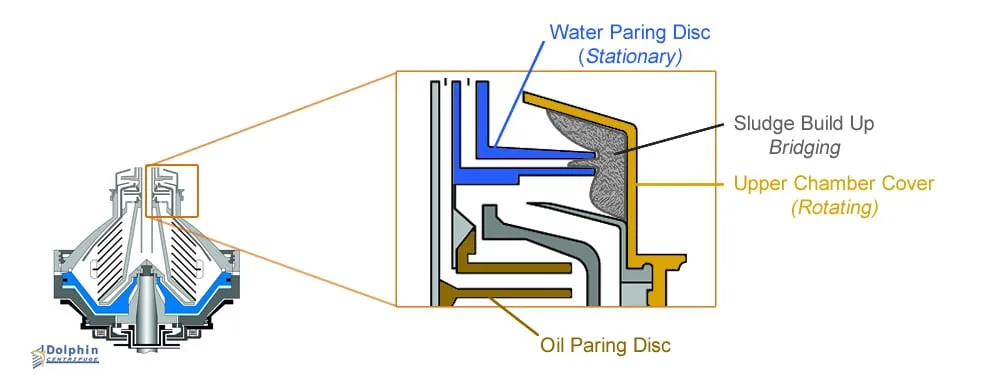
Summary: Paring disc blockage is a common but often misunderstood cause of lost product flow in hermetic disc centrifuges. Because the symptom (no discharge) resembles pump failure or feed problems, the paring disc is frequently the last thing checked — when it should be the first. This guide explains the paring disc's function, all causes of blockage, and proven methods to clear and prevent it across all major disc centrifuge applications.
What Is a Paring Disc?
A paring disc (also called a centripetal pump) is a stationary impeller located at the center of the centrifuge bowl in hermetic (pressure-tight) disc centrifuge designs. While the bowl spins at high speed, the paring disc remains stationary, partially immersed in the rotating liquid interface at the bowl's center.
The principle is simple but elegant: the rotating liquid's kinetic energy is converted to pressure as it flows over the stationary paring disc vanes, pumping the clarified product or light phase out of the bowl under pressure — without any external pump or mechanical seal.
Most hermetic disc centrifuges have two paring discs:
- Light phase (product) paring disc: Located at the inner liquid interface, pumps the clarified oil or light liquid out
- Heavy phase (water/serum) paring disc: Located at the outer liquid interface, pumps the separated water or heavy liquid out
The heavy phase paring disc impeller is located above the gravity disc inside the bowl, housed in a chamber within the upper chamber cover (small lock ring). As separated water accumulates in the water space, it gets pushed by incoming water through the space between the top disc and bowl hood into the upper chamber, where the rotating water enters the paring disc pump and is pressurized through its vanes before exiting through the upper water housing.
Some centrifuge designs also have a dedicated paring disc for the operating water circuit. All are subject to blockage.
Solids Buildup in the Paring Chamber
Cause: Fine solids that are not fully discharged during ejection cycles can migrate to the paring chamber and accumulate over time. There are crevices and ribs within the chamber cover where sludge particles tend to get stuck and build up. The vanes within the impeller have sharp corners where similar sludge particles can accumulate. Sticky, fibrous, or waxy process materials are particularly prone to this. In applications with proteinaceous fluids (edible oil, marine oils, dairy), protein fouling and coking can form a tenacious deposit inside the paring disc passage. If the process fluid contains microparticles below the centrifuge's separation capacity, the suspended solids tend to travel with the water and subsequently build up in the chamber cover and paring disc impeller.
Symptoms: Gradual reduction in product flow rate over days or weeks. Discharge pressure slowly increases as the paring disc fights a narrowing passage. Eventually, flow stops entirely. The machine continues to run normally in all other respects. On purifier-type machines, unexpected water in the clean oil phase is often the first sign of a restricted heavy-phase paring disc — the clogged disc cannot pump out all the separated water, which then builds up and escapes with the oil.
Fix: Shut down the machine, disassemble the paring disc chamber, and mechanically remove the blockage. For organic fouling, soak the paring disc and chamber in an appropriate alkaline cleaner (caustic soda solution, commercial CIP chemical) at elevated temperature. Use a soft brush to clean internal passages — never use metallic tools that can damage the precision surfaces.
Incorrect Back Pressure on the Discharge Line
Cause: The paring disc operates as a pump, but it has a fixed pressure-flow characteristic determined by the bowl speed and paring disc diameter. If the back pressure on the product discharge line is too high (due to a valve partially closed, a blocked filter downstream, or incorrect regulating ring adjustment), the paring disc cannot overcome the resistance and product flow slows or stops.
Symptoms: No product flow despite the machine running correctly. Flow resumes when back pressure is relieved. The machine may show elevated discharge pressure on the pressure gauge. This is a functional blockage, not a physical one.
Fix: Check all valves in the product discharge line for correct position. Inspect downstream filters, strainers, and heat exchangers for blockage. Verify the back pressure regulating valve setting against the machine manual. On purifier-type machines, verify the regulating ring size is correct for the product density being processed — a ring that is too large creates excessive back pressure on the light phase paring disc.
Insufficient Purge Cycles (CIP Neglect)
Cause: Disc centrifuges with CIP (Clean-in-Place) capability rely on regular cleaning cycles to flush the paring disc chamber and internal passages. If purge cycles are skipped, reduced in frequency, or the CIP chemical concentration is inadequate, deposits accumulate gradually until blockage occurs.
Symptoms: Blockage that develops over a period of weeks to months, correlating with reduced CIP frequency. Flow rate history shows a slow decline rather than sudden stoppage.
Fix: Perform a full CIP cycle at the recommended chemical concentration and temperature. For severe fouling, extend the CIP contact time or use a manual soak. Review and restore the CIP schedule to the frequency specified in the machine manual. Verify CIP chemical concentration is correct — diluted chemicals are a common cause of ineffective cleaning.
Liquid Seal Break (Air Ingress)
Cause: The paring disc requires a stable liquid interface to pump effectively. If the liquid seal in the bowl breaks (due to low feed rate, a sudden change in feed composition, or excessive ejection), air enters the bowl center and the paring disc loses its working medium. The paring disc cannot pump air — it simply spins in a vapor phase and produces no discharge.
Symptoms: Sudden, complete loss of product discharge. Machine sounds slightly different (lighter running tone). Operating parameters may appear normal. Flow restores when the liquid seal is re-established.
Fix: Re-establish the liquid seal by increasing feed flow to the minimum required rate. Do not discharge the bowl while the seal is broken. See the liquid seal break guide for complete procedures.
Damaged or Worn Paring Disc
Cause: The paring disc itself is a precision component with tight dimensional tolerances. Physical damage from a hard foreign object passing through the machine, erosion from abrasive solids, or corrosion from aggressive process fluids can damage the paring disc vanes or reduce the clearance between the paring disc and its housing.
Symptoms: Reduced or erratic product flow that is not resolved by cleaning. Unusual noise from the paring chamber area. Visible damage upon disassembly.
Fix: Inspect the paring disc and its housing for damage, corrosion, or wear. Check the axial and radial clearance between the paring disc and the regulating ring or paring chamber housing — incorrect clearance is a common cause of poor paring disc performance even without visible damage. Replace the paring disc if damaged. Contact Dolphin Centrifuge for genuine replacement paring disc components.
Bridging — Catastrophic Failure Risk
A blocked water-paring disc will prevent separated water from exiting the bowl through its designed path. The water then starts coming out with the separated oil phase, contaminating the clean product.
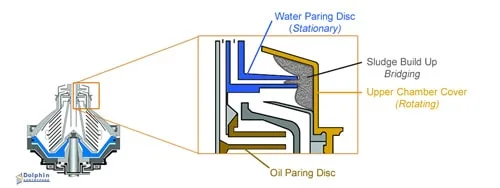
A much more severe consequence is 'bridging.' If the rotating chamber cover becomes packed with sludge, the built-up material can come into contact with the stationary water-paring disc. This creates instant resistance to the rotating bowl.
Mechanical symptoms of an upper chamber cover clogged with sludge include a noticeably longer startup time and higher current drawn by the centrifuge motor — a clear sign of resistance to bowl rotation. If the operator notices such indications, it is imperative to urgently investigate the cause. Mechanical symptoms may indicate severe sludge accumulation and need immediate attention.
It is conceivable for the entire transmission of the centrifuge to break apart during an extreme reverse torque event on the gear train caused by bridging. We have heard of catastrophic failure of centrifuges under such circumstances. Therefore, the operator needs to inspect the upper chamber cover periodically and consider changes to the process to eliminate the possibility of bridging.
Clearing a Blocked Paring Disc
To clear a blocked paring disc, the operator must stop the centrifuge and wait for it to stop completely. A proper lock-out procedure should prevent the accidental starting of the centrifuge during maintenance.
The operator must then open the upper chamber cover and extract the water-paring disc. Using a solvent or other dissolving agent to clean both parts is best. For organic fouling, soak the paring disc and chamber in an appropriate alkaline cleaner (caustic soda solution, commercial CIP chemical) at elevated temperature. Use a soft brush to clean internal passages — never use metallic tools that can damage the precision surfaces.
Verify the cleanliness of the paring disc by blowing compressed air through it. A thorough visual inspection to look for scratches due to surface contact is also highly recommended. Replace the paring disc if bent, cracked, or corroded. Contact Dolphin Centrifuge for genuine replacement paring disc components.
Preventing Paring Disc Blockage
- Maintain CIP frequency: Follow the manufacturer-recommended CIP schedule without exception. In high-fouling applications, increase frequency above the minimum recommendation.
- Monitor discharge flow rate: Install a flow meter on the product discharge. A downward trend in flow rate over days is the earliest warning of developing blockage, long before complete stoppage occurs.
- Keep discharge back pressure in range: Regularly verify that downstream piping, filters, and valves are clear. Verify regulating ring sizing at each new product or density change.
- Maintain correct ejection intervals: Proper ejection cycle timing keeps solids load in the bowl at a manageable level, reducing the amount of fine solids that can reach the paring chamber.
- Inspect during every major overhaul: Disassemble and clean the paring disc chamber at every scheduled overhaul, not just when blockage occurs. Replace worn paring discs proactively.
- Address colloidal solids in the water phase: Colloidal particles suspended in the water phase commonly cause water-paring disc blockage. In applications with such solids, routine checking of the water phase coming out of the centrifuge is essential. The presence of suspended solids in the water indicates a possible issue.
- Reduce feed flow for fine solids: If fine particles do not separate from the water in the centrifuge bowl due to low residence time, a reduced flow rate will increase the residence time, improving fine solids separation before they reach the paring chamber.
- Consider chemical flocculation: The introduction of chemicals can help the flocculation of colloidal solids. This remedy is worth considering if the process water has significant amounts of suspended solids.
Water-paring disc blockage due to sludge is an important issue and should promptly be handled by the centrifuge operator. Ignoring this problem can lead to severe damage to the centrifuge and harm the operator in case of a catastrophic failure.
Paring disc issues that persist after cleaning and adjustment typically indicate a more complex problem — an undersized paring disc, incorrect regulating ring, or damaged paring chamber. Call Dolphin Centrifuge at (248) 522-2573 or email sales@dolphincentrifuge.com for expert diagnosis. We also offer centrifuge sample testing to verify separation performance after maintenance.
Experiencing paring disc blockage or unexplained loss of centrate flow?
Dolphin Centrifuge provides expert remote diagnosis and on-site service for all Alfa Laval disc centrifuge models. Call us or send a sample — we'll identify the root cause fast.
Frequently Asked Questions
What is a paring disc in a disc stack centrifuge? ⌄
A paring disc (also called a centripetal pump or skimmer disc) is a stationary disc submerged in the rotating liquid ring inside the bowl that converts the liquid's rotational kinetic energy into pressure to discharge the separated liquid. Purifier (three-phase) centrifuges have two paring discs — one for the light phase and one for the heavy phase. Clarifier (two-phase) machines have a single paring disc.
What causes paring disc blockage? ⌄
Paring disc blockage is caused by solid particles or semi-solid sludge migrating into the paring disc chamber and solidifying. Common causes: feed with higher-than-expected solids causing carryover into the paring zone, operating temperatures that allow wax or asphaltene solidification, foam carryover into the paring area, and insufficient ejection frequency allowing solids to migrate upward in the bowl.
What are the symptoms of a blocked paring disc? ⌄
A blocked paring disc causes reduced or zero centrate flow from the affected outlet, increased back-pressure at the centrate port, accumulation of process fluid in the bowl hood, and potential flooding from the overflow. In purifier mode, a blocked light-phase disc causes oil breakthrough into the water outlet; a blocked heavy-phase disc causes water to back up into the oil outlet.
How do I clear a blocked paring disc? ⌄
To clear a blocked paring disc: (1) stop the centrifuge, (2) disassemble the bowl and remove the paring disc, (3) soak in appropriate solvent (diesel for oil-based blockages, hot water for wax, caustic for protein deposits), (4) clear orifices with a wire or compressed air, (5) inspect for physical damage — replace if bent, cracked, or corroded. Reassemble and commission with lower feed flow to prevent recurrence.
How can I prevent paring disc blockage from recurring? ⌄
To prevent paring disc blockage: maintain CIP schedules without exception; install a flow meter on the product discharge to catch declining flow trends early; verify downstream back pressure regularly; maintain correct ejection cycle intervals; and inspect and clean the paring disc chamber at every scheduled bowl overhaul. In applications with colloidal solids in the water phase, consider chemical flocculation or a reduced feed flow rate to improve fine solids separation before they reach the paring zone.
Need genuine paring disc parts or expert centrifuge service?
Dolphin Centrifuge stocks genuine replacement paring discs and provides full overhaul service for all Alfa Laval disc centrifuge models.
(248) 522-2573 • sales@dolphincentrifuge.com • Warren, MI 48089