Dolphin Centrifuge DMPX series disc stack centrifuges are rated at 4 to 108 GPM on diesel (1.5 cSt). Actual throughput on heavy fuel oil (380 cSt) can be as low as 15–20% of rated capacity. Dolphin engineers size each system for real-world process conditions — not just swallowing capacity. Based in Warren, Michigan with 40+ years of centrifuge sizing experience.
Disc stack centrifuge capacity is often confusing to first-time centrifuge customers primarily due to the wide range of capacities mentioned by used equipment sellers, online literature, and general users.
So, in this article, we will explain the difference between swallowing capacity, rated capacity, and actual real-world capacity of disc stack centrifuges.
We will also explain why a disc centrifuge could potentially have different processing capacities mentioned for the same application. For general questions, see our disc stack centrifuge FAQ.
Disc Stack Centrifuge Capacity Terminology
In the first section, we explain the various terms that people use to describe the capacity of an industrial centrifuge with a disc stack.
Swallowing Capacity
The swallowing capacity, also known as the hydraulic capacity, is the centrifuge passages' physical flow. This capacity is just a theoretical estimate often unrelated to the centrifuge's actual (real-world) capacity.
Rated Capacity
The rated capacity of a centrifuge is the flow rate the centrifuge can process of a low viscosity fluid such as distillate or water. This capacity is the maximum separation capacity of the centrifuge under optimum conditions.
Capacity on Specific Liquid
The actual capacity of the centrifuge is highly dependent on the physical properties of the process fluid. A specific centrifuge model has a recommended capacity table of flow rates for liquids of different viscosities.
The capacity of the centrifuge decreases as the viscosity of the process liquid increases. The examples below explain this phenomenon.
Range of Capacities for Specific Fluids
The following table shows the various capacities of a disc stack centrifuge for fluids with different viscosities. All flow rates are in GPM.
| Centrifuge Model | Diesel 1.5 cSt | Turbine Lube 2 cSt | HFO 100 cSt | HFO 380 cSt | HFO 600 cSt |
|---|---|---|---|---|---|
| Alfa Laval WHPX-405 | 16 | 15 | 11 | 6 | 2 |
| Alfa Laval WHPX-409 | 36 | 34 | 24 | 14 | 10 |
| Alfa Laval WHPX-513 | 71 | 68 | 47 | 28 | 19 |
Flow rates in GPM. Note how capacity drops sharply as viscosity increases from 2 cSt (turbine lube) to 380 cSt (heavy fuel oil).
Not sure which capacity you need? Ask a Dolphin Centrifuge engineer to size your system →
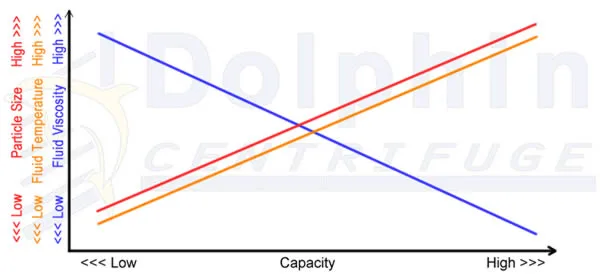
Factors Affecting Capacity
The physical properties of the centrifuge and those of the process fluid influence the processing capacity of the centrifuge.
Centrifuge Size
The bowl volume of a centrifuge is proportional to the physical size of the centrifuge. Larger bowl volumes allow a higher residence time for the fluid under the high centrifugal force.
Therefore, a physically large centrifuge has a higher processing capacity than a small centrifuge for the same process fluid.
Fluid Properties
The process fluid properties have a significant effect on the processing capacity of the centrifuge. The following is a list of fluid properties and their effect on the centrifuge capacity.
Viscosity
The formula below predicts the velocity of particles in a fluid and is known as Stokes' equation. The equation shows that the particle's velocity (separation efficiency) is inversely proportional to the fluid viscosity.
A reduced particle velocity implies a longer separation time which means viscous fluids require higher residence time for the particles to separate. Since the residence time is inversely proportional to the flow rate, viscous fluids reduce the centrifuge processing capacity.
In the case of an oil processing centrifuge, a thicker, more viscous oil will have a lower flow rate than a lighter, less viscous oil through the same oil centrifuge.
Temperature

The fluid viscosity is a crucial factor in centrifuge processing. The processing temperature of the fluid often reduces the fluid viscosity, which improves the separation. Therefore, when processing thick, viscous fluids, the temperature of the fluid reduces the viscosity and increases throughput capacity.
Sludge or Solids in Fluid
In the case of a self-cleaning disc stack centrifuge, the sludge discharge cycle interrupts the centrifuge processing. The percentage of solids is directly proportional to the frequency of sludge discharge cycles. And therefore, a higher solids percentage leads to more process interruptions which lead to lower processing capacity.
Particle Size
The particle size in the process fluid affects the capacity of the centrifuge. All other factors being equal, the centrifuge flow rate is directly proportional to the particle size separated. In other words, a lesser flow rate leads to longer residence time which allows for smaller particle size separation.
Therefore, the same centrifuge can separate smaller particles at a lower flow rate.
Solid Particle Density
Denser particles separate quickly from the fluid per Stokes' law. Therefore, a particular centrifuge can process a higher capacity for a fluid with denser particles than the same fluid with lighter particles.
For example, consider water with sand particles and water with organic particles. The disc stack centrifuge capacity on water with sand will be higher than the centrifuge capacity on the water with lighter, organic particles.
Desired Results
The process flow rate (capacity) is inversely proportional to the fluid separation efficiency. In other words, the lesser the flow rate, the better the separation.
Therefore, the operator can reduce the flow rate to achieve better results with the same centrifuge.
From the above example, it is clear that a disc stack centrifuge's capacity varies for the same application depending on the desired results.
Centrifuge Design
Disc stack centrifuges have design parameters specific to the original application. For example, a centrifuge to separate diesel from water has fluid pathways that allow a large proportion of the light phase (diesel) and small quantities of the heavy phase (water).
The processing capacity of this particular centrifuge degrades when the predominant proportion of the fluid is water with a small quantity of diesel. This degradation is because the water pathway does not allow the high volumes of water to exit the centrifuge fast enough, which degrades processing capacity.
Thus, the original design of the centrifuge plays a vital role in the centrifuge processing capacity for a particular application. Learn more about purifier vs clarifier centrifuge design differences and our centrifuge selection guide.
by Sanjay Prabhu MSME, Engineering Manager, Dolphin Centrifuge
Frequently Asked Questions
What is the difference between swallowing capacity and rated capacity?
Swallowing capacity is the maximum volumetric flow rate the centrifuge pump and piping can handle physically — it is not the separation-effective rate. Rated capacity is the manufacturer's specified throughput for a given fluid at standard conditions (typically diesel at 13 cSt). Actual capacity in real-world operation may be lower due to fluid viscosity, temperature, solids content, and the required separation quality.
How does fluid viscosity affect disc stack centrifuge capacity?
Higher viscosity directly reduces centrifuge throughput. As a rule of thumb: doubling the viscosity roughly halves the effective capacity. For example, a DMPX-028 rated at 25 GPM on diesel (13 cSt) drops to approximately 10–12 GPM on 100 cSt lube oil, and as low as 3–4 GPM on 700 cSt heavy fuel oil (HFO 380).
Does temperature affect disc stack centrifuge capacity?
Yes. Higher temperature reduces fluid viscosity, which increases centrifuge capacity. Most heavy oils are preheated to 190–210°F before centrifuge processing to bring viscosity down to the 30–100 cSt range where the centrifuge operates efficiently. Heating is often the most effective way to recover capacity on viscous fluids.
How do I select the right disc stack centrifuge capacity for my application?
Start with your required throughput in GPM, then identify your fluid viscosity at operating temperature. Apply the viscosity de-rating factor (from manufacturer tables) to the rated capacity to get effective capacity for your fluid. Add 20–30% buffer for flow surges and future expansion. Dolphin Centrifuge engineers can size the right DMPX model for your application — call (248) 522-2573.
Does solids content affect disc stack centrifuge capacity?
Yes. Higher solids content fills the sludge space faster, requiring more frequent bowl ejection cycles (for self-cleaning centrifuges) or more frequent manual cleaning (for solid-bowl types). In practical terms, high solids reduce effective throughput because the centrifuge must spend more time on cleaning cycles and less time on separation.
Need a Centrifuge Sized for Your Application?
Dolphin Centrifuge engineers size disc stack centrifuge systems for real-world viscosity, temperature, and solids conditions — not just swallowing capacity.