Dolphin Centrifuge provides disc stack centrifuge optimization expertise — including gravity disc sizing, flow rate calibration, and operating temperature tuning — to maximize separation quality on customer installations. These adjustments can increase effective centrifuge efficiency by 20–40% without hardware changes. Based in Warren, Michigan, Dolphin Centrifuge has over 40 years of experience optimizing industrial centrifuge performance.
Users of disc-stack centrifuges often ask about ways to increase the capacity or quality of the effluent from their centrifuge equipment. A handful of considerations have a big impact on centrifuge efficiency.
Disc Stack Centrifuge Efficiency
A disc stack centrifuge's efficiency is the centrifuge's effectiveness in separating the different phases in the process fluid. The centrifuge parameter settings and process fluid properties impact centrifuge efficiency. Optimizing these factors helps increase centrifuge efficiency and leads to better separation and higher throughput.
Rated Efficiency
The rated efficiency of a disc centrifuge indicates the maximum ability of the centrifuge to separate particles and fluids. For example, the efficiency of a typical disc-stack centrifuge is at 1-micron particle size, where the particle has a specific gravity of 3 or higher.
For liquid-liquid separation, a disc centrifuge can separate immiscible fluids whose specific gravity difference is less than 0.05. However, multiple factors affect efficiency, as discussed below.
Stokes' Law
Stokes' Law defines the velocity of a solid particle as it travels through a fluid medium. The application of Stokes' Law (shown below) helps us calculate centrifuge efficiency by calculating the terminal velocity of the particles.
V = gRp²(ρp – ρ) / 4.5μ
From the formula above, we can see that the particle's velocity in the liquid is directly proportional to the g-force, the difference in specific gravity, and particle size. It is inversely proportional to the viscosity of the fluid.
A disc stack centrifuge's efficiency is the centrifuge's effectiveness in separating the different phases in the process fluid. The centrifuge parameter settings and process fluid properties impact centrifuge efficiency. Optimizing these factors helps increase centrifuge efficiency and leads to better separation and higher throughput.
In practical terms, the goal of centrifuge separation is to remove the smallest particle possible quickly! This goal, in turn, means the higher the terminal velocity, the better the separation. The five critical factors listed below are directly related to the variables in Stokes' law above.
Struggling with centrifuge efficiency? Send us a fluid sample for testing →
Factors Affecting Centrifuge Efficiency
For a given centrifuge for a specific application, the primary physical attributes such as bowl speed (RPM) and, therefore, the RCF are fixed. The inherent fluid properties are also mostly predefined. The following factors affect centrifuge efficiency; some or all of them are adjustable by the centrifuge operator.
1. Flow Rate
The flow rate is not directly related to Stokes' equation above, but it is inversely proportional to the particles' residence time in the bowl. Based on the liquid and solid particle properties, the velocity is fixed. Therefore, a higher residence time gives the particles more time to reach the bowl wall and separate.
In real terms, a lower flow rate (GPM) lends to higher residence time, which means better separation. Conversely, a higher flow rate means lesser retention time, leading to worse separation results.
The following graph demonstrates the inverse relationship between a disc centrifuge's flow rate and solids separation efficiency.
The following table contains the actual data of this real-world test conducted by Dolphin Centrifuge.
| Real-World Test Data | |
|---|---|
| Centrifuge Type | Self-Cleaning Disc-Stack Centrifuge |
| Process Fluid | Wastewater with Suspended Solids Contamination |
| Original Sample Contamination (%v/v) | 3.2% |
| Solids @ 14 GPM | 0.98% |
| Solids @ 12 GPM | 0.93% |
| Solids @ 10 GPM | 0.90% |
| Solids @ 8 GPM | 0.85% |
| Solids @ 6 GPM | 0.79% |
| Solids @ 4 GPM | 0.72% |
| Solids @ 2 GPM | 0.62% |
2. Gravity Disc Selection
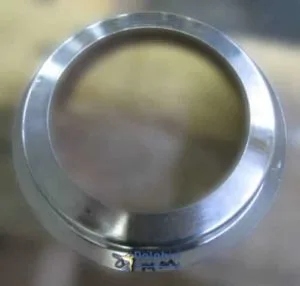
Optimization of the centrifuge is nothing more than adjusting the centrifuge physically to allow the centrifuge to exert maximum G-force on the particles, thereby increasing separation efficiency.
For example, in the case of clarification (liquid/solid separation), installing a clarifier gravity disc in the bowl fills the bowl with the fluid. A full bowl forces the particles to travel longer through the disc stack toward the bowl center. The extended path means more residence time for the same flow rate leading to higher separation efficiency.
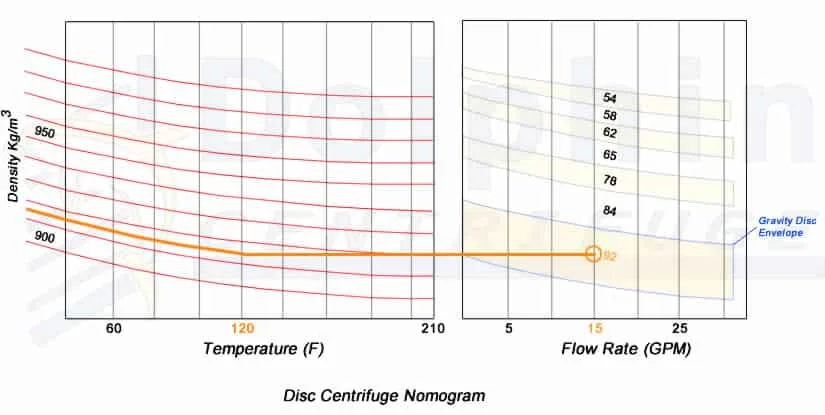
Selecting a gravity disc for a disc centrifuge involves using a nomogram (shown above). The typical process is to choose the curve representing the density ratio (left) of the two liquids (915 kg/m³). Then follow the curve to the process temperature vertical grid (120°F). At this point, draw a horizontal line towards the right into the gravity disc zones chart. The intersection of this horizontal line with the vertical grid representing the flow rate (15 GPM) defines the gravity disc size (92 mm).
It is worth noting that gravity discs come in size increments. In other words, there is one gravity disc for a range of fluid densities. To improve centrifuge efficiency, the operator can fine-tune this range by using custom gravity discs closer to the actual fluid properties.
3. Back Pressure
Following the limitations mentioned above of gravity disc availability in size increment, centrifuge back-pressure (on the light phase) comes into play. Increasing the back pressure on the clean fluid outlet (refer to the bowl cross-section diagram below) tends to push the oil/water interface outwards. This pressure adjustment can be seen as 'fine-tuning' the gravity disc size through back-pressure increase. The interface movement leads to higher g-forces acting on the oil, which leads to cleaner oil or higher centrifuge efficiency.
One should note that increasing the back pressure beyond a certain point can lead to the interface moving past the top disc. This condition leads to the light phase (oil) exiting the bowl through the water outlet and is called a 'break-over' condition and is not desirable.
4. Process Fluid Temperature

Fluid temperature is inversely proportional to the fluid viscosity of thicker or higher viscosity fluids. Increasing the liquid's temperature reduces viscosity, which helps increase the velocity per Stokes' law above. This factor goes back to the fluid properties discussed above.
In practice, higher process fluid temperature results in lower viscosity, which leads to better separation efficiency.
5. Operating Water Temperature
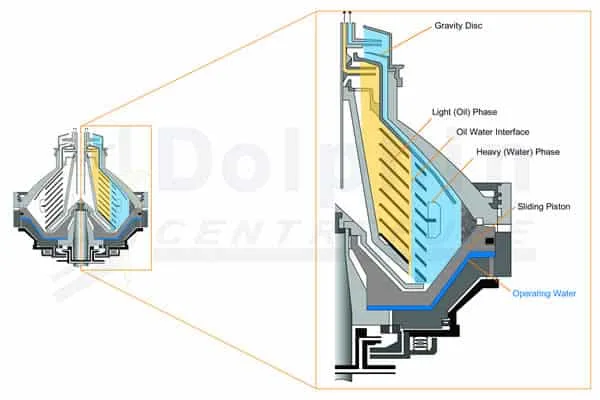
A 'self-cleaning' disc-centrifuge uses 'operating water' to operate the sludge discharge mechanism for automatic sludge ejection. The above bowl cross-section diagram shows the operating water chamber inside the bowl bottom. The process fluid is in the chamber above the operating water chamber and is separated by the sliding piston.
The fluid temperature is critical for efficient separation when viscous fluids are processed, as explained above in the 'Process Fluid Temperature' section. These fluids are processed at maximum processing temperature to get maximum separation efficiency.
If the operating water is cold, it has a cooling effect on the incoming hot process fluid. This effect is because the sliding piston (steel) loses heat to the cold operating water and cools down the process fluid.
Therefore, the operating water's temperature should be as close to the temperature of the process fluid as possible. This consideration leads to higher separation efficiency.
Summary
A disc centrifuge efficiency is optimized by tweaking some physical aspects of the centrifuge machine and controlling the process fluid parameters described above.
Under certain conditions, these centrifuge and process fluid adjustments can lead to dramatic increases in efficiency, which leads to higher throughput and better quality products.
by Sanjay Prabhu MSME, Engineering Manager, Dolphin Centrifuge
Frequently Asked Questions
What is the most effective way to improve disc stack centrifuge efficiency?
Reducing feed flow rate is typically the most effective single adjustment — lower flow means longer residence time in the disc stack, allowing finer separation. However, the best approach combines multiple factors: reducing flow rate, increasing fluid temperature (to reduce viscosity), selecting the correct gravity disc, and ensuring adequate operating water temperature. Together these adjustments can improve water removal efficiency from 60% to 95%+.
How does fluid temperature affect disc stack centrifuge efficiency?
Higher fluid temperature reduces viscosity, which dramatically improves centrifuge efficiency. As viscosity drops, the density difference between oil and water becomes more effective at driving separation. Most industrial centrifuges operate most efficiently when the feed oil is heated to 190–210°F. For every 20°F increase in temperature, separation efficiency can improve 10–30% depending on the oil type.
What is a gravity disc and how does it affect centrifuge efficiency?
The gravity disc (also called the interface disc or dam disc) controls the position of the oil-water interface inside the centrifuge bowl. Selecting the correct gravity disc diameter for your specific oil density is critical — too large a disc pushes the interface inward (water carry-over into oil), too small pushes it outward (oil loss into water). Matching the gravity disc to your fluid's specific gravity optimizes separation efficiency.
Does back pressure affect disc stack centrifuge efficiency?
Yes. Insufficient back pressure on the clean oil outlet allows the oil-water interface to shift outward, causing water contamination in the clean oil phase. Most disc stack centrifuges require 3–8 PSI of back pressure on the oil outlet to maintain proper interface position. Check that back pressure regulators are set correctly and not bypassed.
How does operating water temperature affect centrifuge efficiency?
Operating water triggers the bowl's self-cleaning ejection cycle. If operating water temperature is too low, it can cool the process fluid near the bowl's opening, increasing local viscosity and reducing efficiency. Operating water should generally be at a similar temperature to the process fluid — ideally 140–190°F — to maintain stable separation conditions.
Related Knowledge Articles
Improve Your Centrifuge Efficiency Today
Dolphin Centrifuge engineers diagnose and optimize disc stack centrifuge performance — flow rate, gravity disc, back pressure, and temperature settings — for your specific fluid.