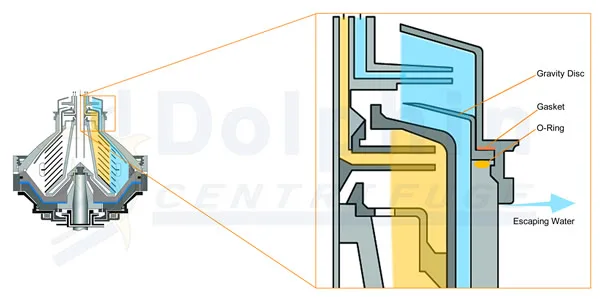
Dolphin Centrifuge provides expert troubleshooting for disc stack centrifuge liquid seal break — a failure mode where the heavy-phase water seal (maintained at 5,000-10,000 G) collapses, discharging oil through the water outlet. This guide covers 10 root causes, mechanical and electronic detection methods, and corrective measures for each.
What is Liquid Seal Break or Breakover in Disc Centrifuges?
During the normal 3-phase separation process in a disc-stack centrifuge, the heavy phase (typically water) forms a liquid seal around the periphery of the bowl.
Under certain conditions, the light phase pushes out the heavy phase and escapes through the heavy phase outlet. This operating condition is known as Liquid Seal Break or Break-Over.
This article discusses the common causes of liquid seal breaking and the respective corrective measure for each of these causes.
Is Liquid Seal Break the Same as Breakover?
A liquid seal break and breakover are the same condition in disc-stack centrifuge operation. These terms refer to the condition during which the light phase of the separating liquid 'breakover' or 'breaks the heavy phase liquid seal' and comes out through the heavy phase outlet.
Main Causes of Liquid Seal Break
The following is a list of causes of a 'liquid seal break' or breakover condition during the operation of disc-stack centrifuges. Corrective measures to fix the breakover for each cause are also included.
Incorrect Gravity Disc (Hole Too Big)
The gravity disc in the centrifuge bowl regulates the oil-water interface within the centrifuge. For best separation results, the oil-water interface should be closest to the bowl periphery without breaking the water seal.
This interface positioning allows maximum g-force exerted by the rotation to act on the separation interface (shown below).
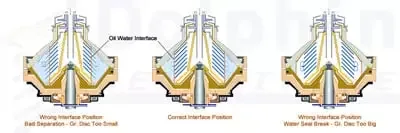
Disc Centrifuge Oil Water Interface Effects
A gravity disc with a larger hole diameter than the correct size (as determined by the nomogram) pushes the oil-water interface radially outwards. This incorrect interface positioning causes the light phase (oil) to be outside the top disc.
The light phase can now exit the centrifuge bowl through the heavy phase passage and out through the heavy phase outlet. This, by definition, is a broken liquid seal.
In this case, the process fluid (oil) comes out of the heavy phase (water) side causing fluid loss, which is highly undesirable.
Fix: The correct gravity disc with a smaller diameter hole (as indicated by the nomogram) will prevent the liquid seal from breaking. Using the gravity disc with a smaller hole diameter will remedy this cause of liquid seal breaking or breakover.
Process Fluid Temperature
The nomogram defines the correct gravity disc based on the specific gravity of the process fluid at a specific temperature. If the process fluid is not at the appropriate temperature, the gravity disc installed in the centrifuge bowl may cause the fluid interface to move radially outward beyond the top disc.
Under this condition, the light phase will exit the bowl through the heavy phase outlet (as explained above), causing a liquid seal break.
Fix: Maintaining the process fluid at the correct operating temperature throughout the process will prevent the liquid seal from breaking.
High Fluid Flow-Rate
The centrifuge bowl size limits the amount of fluid of a given viscosity to pass through the disc stack. If the process fluid flow rate exceeds the bowl's capacity, the process fluid will push the liquid seal out of the bowl. Subsequently, the light phase will escape the bowl through the heavy phase outlet causing a liquid seal to break.
Fix: Reducing the process fluid flow rate will allow the light phase through the disc stack and ensure proper separation.
Light Phase Outlet Valve Closed
In most centrifuge systems, a regulating valve is provided on the light phase outlet pipe to apply back pressure for optimum separation. If the light phase outlet valve is accidentally closed, the light phase fluid cannot exit the bowl through its designed outlet.
The light phase fluid will then push out the heavy phase liquid seal and exit the bowl through the heavy phase outlet. This causes a breakover.
Fix: The light phase outlet valve should be checked and opened if it is closed. A pressure sensor on the light phase outlet can be installed to detect excessive pressure on the light phase outlet to activate an alarm and prevent this from causing a breakover.
Priming Liquid Volume
The first step during the startup of a disc-stack centrifuge is the bowl's priming with the heavy phase liquid, which is often water. The centrifuge bowl should be fed with priming liquid till the heavy phase liquid comes out through the heavy phase outlet.
This heavy fluid exiting the centrifuge bowl indicates that the bowl's heavy phase space is filled with the priming liquid.
In an automated centrifuge system, the priming liquid is supplied to the bowl through a solenoid valve operated by a timer. If the water pressure or flow changes, the allocated time may not be sufficient to fill the bowl with an adequate amount of heavy-phase liquid.
In such cases, the light phase liquid will displace the heavy phase liquid and break the liquid seal.
Fix: Ensure the priming timer is set appropriately for the actual water pressure and flow. Verify that the bowl's heavy phase space is fully primed before introducing the process fluid.
Gasket at Gravity Disc or Small Lock Ring Defective
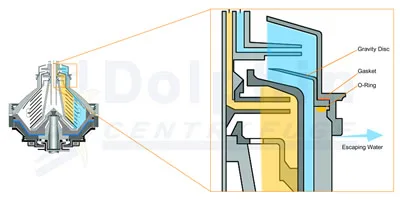
Disc Centrifuge Breakover — Leaking Gasket
The heavy phase's flow path goes from the outer bowl periphery, above the top disc, then under the gravity disc, then into the heavy phase chamber, and finally out of the bowl. A couple of sealing parts (gasket and O-Ring) prevent the heavy phase from leaking out of the bowl.
An O-ring situated under the gravity disc seals the interface between the gravity disc and the bowl hood. If this o-ring is damaged, the heavy phase will escape through this interface due to the extremely high pressure generated by centrifugal force.
This unintentional reduction in the heavy phase will cause the liquid seal to break.
Similarly, a flat gasket above the gravity disc seals the interface between the gravity disc and the small lock ring. If this gasket is damaged or torn, it will allow the liquid seal to escape causing a liquid seal to break.
Fix: These seals should be routinely checked and replaced (if damaged) to prevent breakover during operation.
Nylon Seal Ring is Worn, or Sliding Piston Lip Is Damaged
The nylon seal ring embedded in the bowl hood presses against the lip of the sliding piston to form the main bowl seal that prevents the process fluid from escaping the bowl during separation. The priming liquid (heavy phase) is adjacent to this seal between the nylon seal ring and the sliding piston.
If the nylon seal ring is worn out, it will allow the heavy phase (prime liquid) to escape the bowl. Similarly, if the mating lip seal on the sliding piston is damaged, gouged, or worn, it will have a similar effect. In either case, the unintentional exit of the prime liquid will cause the liquid seal to break.
Fix: The nylon seal ring is a sacrificial part and should be replaced periodically before it wears and causes breakovers and other operating problems. The sliding piston sealing lip should also be checked regularly to avoid such issues.
Please read our article about top mechanical issues and fixes related to disc centrifuges.
Disc Stack is Clogged with Sludge
In rare cases, if the process sludge builds up and enters the gap between the discs, it will block the light phase's passage towards the center of the bowl. This disc blockage will cause the light phase to displace the heavy phase and, as a result, cause a breakover.
Fix: Under clogged disc stack conditions, the centrifuge should be stopped immediately and the disc stack thoroughly cleaned to remedy this cause of liquid seal break (breakover).
Low Bowl Speed
The centrifuge bowl speed generates the centrifugal force, which helps close the bowl through the operating water pressure under the sliding piston.
If the centrifuge bowl speed is low due to a mechanical or electrical fault, the operating water pressure is insufficient to close the bowl properly. An improperly closed bowl allows the priming water to exit the bowl, which causes the liquid seal to break or breakover.
The revolution counter on the centrifuge frame indicates the bowl speed to the operator. This speed should be periodically monitored to identify lower bowl speed.
Fix: Ensuring the centrifuge bowl is rotating at the designed speed will prevent low bowl speed from causing the liquid seal to break or breakover.
Bowl Not Assembled Properly
The disc centrifuge bowl is designed and manufactured very precisely. It is quite easy for an untrained operator to assemble the bowl incorrectly, which can cause some seals not to compress and seal adequately. For example, if the small lock ring is not tightened properly, the priming liquid (heavy phase) will escape the bowl through this inadequate seal causing the liquid seal to break.
If the bowl hood is not positioned correctly on the sliding piston, the resulting uneven seal between the nylon seal ring and sliding piston will cause the heavy phase to escape, causing the liquid seal to break.
Fix: Proper bowl assembly is critical to prevent breakover from occurring and for the safe and reliable operation of the disc-stack centrifuge.
Detecting Liquid Seal Break
A liquid seal break is detected by monitoring the fluid flowing out of the centrifuge. When the liquid seal breaks, it interrupts the fluid flow in the light phase outlet.
It also causes a sudden excess fluid flow through the heavy phase outlet. Mechanical or electronic devices can detect either of these indicators.
Mechanical Detection
The routing of the heavy phase outlet of the centrifuge is through a collection tank. This tank has a bottom drain with an adjustable valve. The valve allows the typical volume of heavy phase to drain through it.
But, in case of a liquid seal break, the excessive light phase volume accumulates in this tank. This accumulation of the light phase causes the tank level to rise and activates a level switch mounted in the tank.
The change of state of the level switch triggers an alarm in the centrifuge control system, which activates corrective action.
Electronic Detection
As mentioned above, the liquid seal break stops the flow in the centrifuge's light phase outlet. During normal operation, a back-pressure valve maintains pressure in this line.
When a liquid seal break occurs, this pressure in the outlet line drops. A pressure sensor installed on this line senses the loss of pressure and thus detects the liquid seal break.
Based on this trigger, the centrifuge control system stops the flow and activates an alarm.
Summary
The liquid seal breaking is a common problem most disc centrifuge operators are familiar with. The primary causes and remedies mentioned above should help correct the vast majority of liquid seal breaks occurring in disc centrifuges.
As seen above, most of these causes can be eliminated by periodic centrifuge maintenance and replacement of critical gaskets on the first sign of wear or damage.
by Sanjay Prabhu MSME, Engineering Manager, Dolphin Centrifuge
Liquid Seal or Separation Problems?
Recurring liquid seal break problems despite correct settings and flow rates indicate a machine configuration issue that requires professional diagnosis. Dolphin Centrifuge provides technical support, gravity disc selection, and centrifuge repair and audit services to resolve persistent separation and liquid seal issues.
Contact us at (248) 522-2573 or sales@dolphincentrifuge.com.
Frequently Asked Questions
What is liquid seal break in a disc stack centrifuge? ⌄
Liquid seal break occurs when the rotating liquid ring that seals the centrifuge bowl collapses, allowing air to enter. This causes the separated light phase to be lost from the centrate outlet, process liquid to flood out of the machine, and immediate separation failure. The seal is maintained by the balance between feed flow rate, gravity disc size, and back-pressure.
What causes liquid seal break in a centrifuge? ⌄
Common causes: incorrect gravity disc size (too large reduces the seal), low feed flow rate (insufficient liquid to maintain the ring), high centrate back-pressure, feed interruption or pump cavitation, or incorrect operating water volume during startup. Density changes in the process fluid due to temperature swings can also destabilize the seal.
How do I detect liquid seal break? ⌄
Mechanical signs include: liquid flooding from the centrate outlet and bowl hood, a sudden drop in centrate flow, and phase mixing. Electronic detection uses centrate conductivity probes, flow meters on each outlet, and centrate back-pressure sensors. Turbidity probes can also detect liquid loss in the centrate stream.
How do I fix a liquid seal break? ⌄
To recover: (1) immediately stop feed flow, (2) maintain operating water supply to re-establish the liquid ring, (3) check that the gravity disc size is correct for current fluid density, (4) reduce centrate back-pressure by checking downstream valves and piping, (5) confirm feed flow rate is within rated range. If the break recurs consistently, re-evaluate gravity disc selection using the density difference calculation for your specific fluid phases.
How do I select the correct gravity disc to prevent liquid seal break? ⌄
Gravity disc selection is based on the density of the light phase (oil) and heavy phase (water) being separated. The OEM provides a nomogram or formula using the density difference to calculate the correct disc inner diameter. A larger disc diameter raises the liquid interface (reducing seal margin), while a smaller diameter lowers it (increasing seal margin but risking heavy-phase carryover into the oil). When in doubt, select a smaller disc diameter for a more stable seal, then widen to optimize separation quality.
Recurring liquid seal breaks or separation problems?
Dolphin Centrifuge provides gravity disc selection, remote diagnosis, and on-site service for all Alfa Laval disc centrifuge models. Call or send a sample — we'll resolve persistent issues fast.
(248) 522-2573 • sales@dolphincentrifuge.com • Warren, MI 48089
Related Articles
Disc Centrifuge Backpressure — Comprehensive Guide
How back pressure affects disc centrifuge operation, correct settings, and troubleshooting pressure issues.
9 Steps to Selecting the Right Industrial Centrifuge
A structured guide for evaluating and purchasing the correct industrial centrifuge for your application.
Centrifuge RCF and RPM | Difference & RCF Calculation
How to calculate RCF from RPM and why g-force matters more than bowl speed for separation performance.
Disc Stack Centrifuge Mechanical Issues & Fixes
Common mechanical problems in disc centrifuges including bowl speed, vibration, and seal wear — with solutions.
Disadvantages of a Disc-Stack Centrifuge | Illustrated Guide
An honest look at the limitations and drawbacks of disc stack centrifuges to help operators make informed decisions.