Dolphin Centrifuge provides expert disc stack centrifuge lubrication guidance covering ISO VG 220 gear oil specifications, splash-type lubrication working principle, oil change intervals (every 2,000 operating hours), oil volume tables for popular centrifuge models, and common mistakes that cause premature bearing failure.
Summary: Disc stack centrifuge lubrication is an essential part of the regular maintenance required to ensure the operating reliability of the centrifuge. Lubricating oil is the primary lubricant used in the disc centrifuge transmission housing. The most important considerations when changing the oil are the type of lubricant and the oil change frequency. This guide covers the splash-type lubrication working principle, oil specifications, change procedures, and common mistakes across all centrifuge applications.
Working Principle of Disc Centrifuge Lubrication
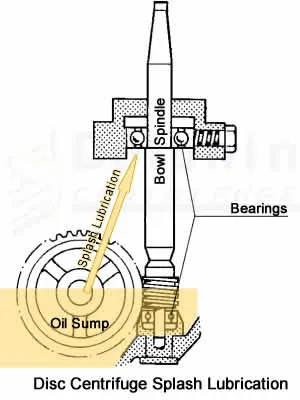
The disc centrifuge lubrication system uses an oil splash type method to lubricate the bearings. The large bull gear is partly submerged in the lube oil sump. The constant rotation of this gear splashes the oil into the bearings on the horizontal and vertical shafts. This splashing oil lubricates and cools the bearings.
A typical disc centrifuge has three main lubrication zones, each with different requirements:
Frame / Gear Drive
The main oil sump lubricates the gear drive (worm gear or helical gears) and the lower spindle bearing via splash lubrication from the bull gear.
Top Bearing
The upper spindle bearing is typically lubricated separately from the main sump, either by oil bath, forced lubrication, or grease (model-dependent).
Motor Bearings
The electric motor's drive-end and non-drive-end bearings require periodic greasing according to the motor manufacturer's specification.
Main Frame / Gear Drive Oil
Function: Lubricates the worm gear or helical gear drive, the lower spindle bearing, and (on some models) provides cooling for the gear drive assembly. This is the highest-volume lubrication point on the machine.
Oil type: The manufacturer recommends the type of lube oil for disc centrifuges. Alfa Laval recommends a viscosity grade VG 220 (ISO 3448/3104) with a viscosity index VI greater than 92 (ISO 2909). It is imperative for the user to refer to the manufacturer's recommendations for the correct oil type, as different manufacturers recommend different oils based on their centrifuge design and operating conditions.
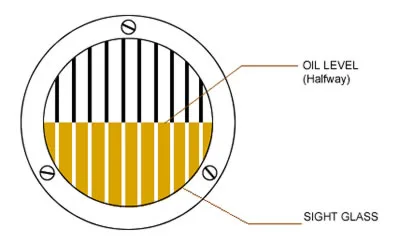
Oil quantity: The volume of lubricating oil required depends on the size of the centrifuge. Most disc centrifuges feature a sight glass on the bottom frame housing to show the level of lubricating oil in the gearbox. The oil level should be halfway in this sight glass after the lube oil replacement.
Change interval: The lubricating oil in a disc stack centrifuge should be changed every 2,000 operating hours or every 12 months, whichever is earlier. In a new installation or after the change of gear transmission, change the oil after 200 operating hours and clean the gear housing. When the centrifuge is operated for short periods, lubricating oil must be changed every 12 months, even if the total number of operating hours is less than stated above. Larger centrifuges or belt-driven centrifuges have different oil change intervals — consult the manufacturer or operating manual for the correct frequency.
Checking oil level procedure:
- Stop the machine and allow the oil to settle for at least 5 minutes.
- Wipe the sight glass clean and read the oil level.
- If below the lower mark, add oil through the fill plug slowly.
- Never overfill above the upper mark — excess oil causes churning, foaming, and elevated operating temperature.
Top (Upper Spindle) Bearing
Function: The top bearing supports the upper end of the spindle against lateral forces and maintains spindle concentricity at operating speed. It is the most highly loaded bearing on the machine and the one most likely to fail first if lubrication is neglected.
Lubrication type: Top bearings are lubricated in one of three ways depending on machine design:
- Oil bath: A separate small oil sump around the top bearing. Requires separate oil level monitoring and periodic oil changes.
- Forced oil circulation: Oil is pumped from the main sump to the top bearing. Correct oil flow rate is essential — check the oil supply line for blockage if bearing temperature is elevated.
- Grease: Some smaller models use a sealed grease-packed top bearing. These require regreasing at specified intervals using only the specified grease type and quantity.
Oil type (oil bath models): Typically a light turbine oil or spindle oil (ISO VG 32 or ISO VG 46). Do not use gear oil in the top bearing sump — the higher viscosity increases churning resistance and generates heat.
Change interval: On oil bath models, change the top bearing oil every 1,000–2,000 hours or every 6 months. Inspect for contamination (cloudiness, metal particles, process fluid ingress) at every oil level check.
Grease type (grease-lubricated models): Use only the specified high-speed bearing grease. High-speed bearings require a grease with the correct base oil viscosity and worked penetration for the application — a standard lithium grease designed for slow-speed bearings will degrade rapidly in a high-speed centrifuge bearing.
Motor Bearings
Function: Electric motor bearings support the motor shaft and absorb both the motor's own rotating mass and the drive belt tension (in belt-driven models). Motor bearing failure causes motor damage, shaft misalignment, and vibration that propagates into the centrifuge drive system.
Grease type: Motor bearings require the grease type specified by the motor manufacturer, not the centrifuge manufacturer. Most standard IEC or NEMA motors specify a lithium-complex grease with an NLGI grade 2 consistency. Do not mix grease types — incompatible thickener combinations can cause grease softening and loss of film strength.
Regreasing interval: Motor bearing regreasing is typically required every 2,000–4,000 hours depending on motor speed (rpm) and bearing size. Higher-speed motors require more frequent greasing. Refer to the motor nameplate data or manufacturer guide for the exact interval and grease quantity. Overgreasing a motor bearing causes overheating — the grease purge hole must be opened before regreasing if equipped.
Access: Most centrifuge motors have grease nipples (Zerk fittings) accessible through the motor terminal box cover or through dedicated access plugs. Some totally enclosed motors are sealed-for-life and require no grease maintenance.
Reasons to Change Lubricating Oil
The following are the primary reasons to change the oil in the disc centrifuge lubrication system.
Metal Particle Contamination
The constant meshing of the transmission gears of the disc centrifuge causes wear and tear on the gear teeth. This wear leads to metal particles getting into the lube oil and the bearings through the lubrication. Lube oil with metal particles is the primary cause of bearing failure, which can have catastrophic effects on the centrifuge. The replacement of the old oil with new, clean oil prolongs bearing life and prevents unanticipated centrifuge breakdowns related to bearing failure.
Water Contamination
Water contamination of centrifuge lube oil is a common occurrence. The most common source of moisture contamination is condensation. In humid climates, condensation accumulates in the gear housing and contaminates the oil. Operating or process water can also seep into the transmission housing due to defective seals or O-rings. This type of water contamination is often quite severe due to the quality of water that can get into the oil due to a seal leak. Lubricating oil containing water causes bearing failure because water does not have the lubricating properties needed to operate the bearing at high speeds, as in a disc centrifuge.
Oil Deterioration
Lube oil loses its lubrication properties over time due to chemical decomposition and temperature variations. Reliable bearing service requires good lubrication. Therefore, periodic replacement of lube oil in the centrifuge is essential for the reliable operation of the bearings.
Recommended Oil Specifications
Alfa Laval recommends the following grade of lubricant for its centrifuges:
| Viscosity grade VG (ISO 3448/3104) | 220 |
| Viscosity index VI (ISO 2909) | > 92 |
The following table lists the recommended oil from the different lubricant manufacturers:
| Manufacturer | Recommended Oil |
|---|---|
| Castrol | Alpha ZN 220 |
| Esso Standard Oil / Exxon | Teresso 220 |
| Mobil | DTE Oil BB |
| Shell | Tellus C 220 |
| Texaco / Caltex | Regal R&O 220 |
Lubricating Oil Volume by Centrifuge Model
The volume of lubricating oil required for each centrifuge depends on the size of the centrifuge. Larger centrifuges have a larger gearbox holding capacity and therefore need more lubricating oil. The following table lists the volume of oil required for some popular disc stack centrifuges:
| Centrifuge Model | Lube Oil Volume (Ltr) | Lube Oil Volume (Gal) |
|---|---|---|
| Alfa Laval MAB 103 | 0.8 | 0.20 |
| Alfa Laval MAB 104 | 0.8 | 0.20 |
| Alfa Laval MOPX 207 | 7.5 | 1.95 |
| Alfa Laval WHPX 510 | 12.0 | 3.10 |
| Alfa Laval BRPX 213 | 12.0 | 3.10 |
Common Lubrication Mistakes & Consequences
Using the wrong oil grade
Using a viscosity grade other than the manufacturer-recommended ISO VG 220 is a common substitution error. Too-thin oil does not maintain an adequate lubricant film at operating temperature. Too-thick oil increases churning losses, raises operating temperature, and can prevent adequate flow to bearings.
Overfilling the oil sump
Oil above the maximum mark creates foam from gear churning. Foamy oil does not lubricate effectively, and foam can be drawn into bearing housings. Foam also accelerates oxidation of the oil, shortening its service life.
Extending oil change intervals to save money
Gear oil oxidizes and degrades with heat and time. Oxidized oil loses its extreme-pressure (EP) additive package and anti-wear protection. Running on degraded oil causes accelerated gear tooth wear that costs far more to repair than the cost of fresh oil. Acid numbers rise in aged oil, causing corrosive attack on bearing and gear surfaces.
Ignoring contaminated oil
If the sump oil appears milky or contains metallic particles, changing the oil alone is insufficient. Milky oil indicates water contamination (from a failed spindle neck seal or process fluid ingress) — the source must be found and repaired or the new oil will be contaminated again within days. Metal particles indicate active gear or bearing wear that will continue until the root cause is corrected.
Overgreasing motor bearings
Adding too much grease to a motor bearing creates heat from churning and can rupture bearing seals, allowing grease to enter the motor windings. Follow the specified grease quantity precisely — typically measured in grams, not pump strokes.
Main Sump Oil Change Procedure
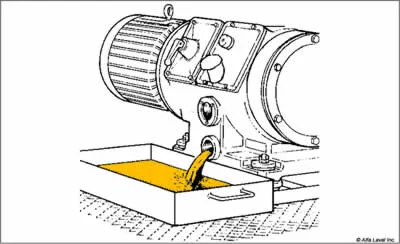
Follow the following steps to change the lubricating oil in a disc stack centrifuge:
- Shut off the centrifuge motor.
- Engage the manual brake.
- Let the centrifuge come to a complete stop.
- Lock out the power to the centrifuge motor.
- Wait for the lube oil to drain back into the oil sump (about 5 minutes).
- Place a collecting pan under the oil drain plug.
- Slowly remove the oil drain plug.
- Wait for all the used oil to drain from the centrifuge oil sump.
- Replace the drain plug gasket, if available.
- Reinstall and tighten the drain plug.
- Remove the oil fill plug (above the drain plug).
- Use a funnel to pour in the recommended amount of lubricating oil.
- Visually check the level of oil in the oil sight glass.
Quick Oil Check Tip
There are specific field lessons that can help the centrifuge operator monitor and maintain the oil in the centrifuge transmission. The following is a popular tip based on these lessons learned.
Oil Quality Check and Water Drain
Using this tip, the operator can quickly check the quality of the lubricating oil and drain any accumulated water simultaneously.
During the centrifuge shut-down period, slowly unscrew the oil drain plug. Do not remove the plug altogether. Unscrew the plug until a small amount of oil starts to drain out. Collect this oil in a small container.
If the drained oil sample shows lots of water and or metal particles, it is vital to change it. This method allows the operator to drain small amounts of water if necessary.
It is essential to replenish the removed oil with fresh oil to the original level in the oil sight glass.
For questions about oil specifications for a specific machine model, or to order replacement bearings, contact Dolphin Centrifuge at (248) 522-2573 or sales@dolphincentrifuge.com. Refer to our mechanical troubleshooting guide if you are experiencing bearing or gear issues. See also our centrifuge repair services for complete drive train rebuilds.
Running an older disc centrifuge with unknown oil status?
Dolphin Centrifuge offers complete drive train inspection and lubrication system service — including bearing replacement, gear inspection, and oil circuit flush — for all major disc centrifuge models.
Frequently Asked Questions
What type of oil is used in a disc stack centrifuge? +
How often should disc centrifuge oil be changed? +
What happens if a disc centrifuge is run without enough oil? +
Can I use synthetic oil in a disc stack centrifuge? +
How do I check oil quality in the field without a lab analysis? +
Related Articles
Comprehensive guide to disc centrifuge backpressure principles and adjustment.
Centrifuge RCF and RPMDifference between RCF and RPM in centrifuges with calculation methods.
Centrifuge Vibration Causes & Fixes10 causes of disc centrifuge vibration — including bearing wear from improper lubrication.
Mechanical Issues & FixesTop 10 mechanical problems on disc stack centrifuges with corrective actions.
Disadvantages of a Disc-Stack CentrifugeIllustrated guide to the limitations and disadvantages of disc stack centrifuges.
Decanter vs Disc Centrifuge ComparisonTechnical comparison between decanter and disc stack centrifuge types.
Keep Your Centrifuge Running Longer
Proper lubrication is the single most impactful maintenance practice for disc centrifuge longevity. Dolphin Centrifuge provides lubrication service kits, bearing replacements, and full gear drive rebuilds.