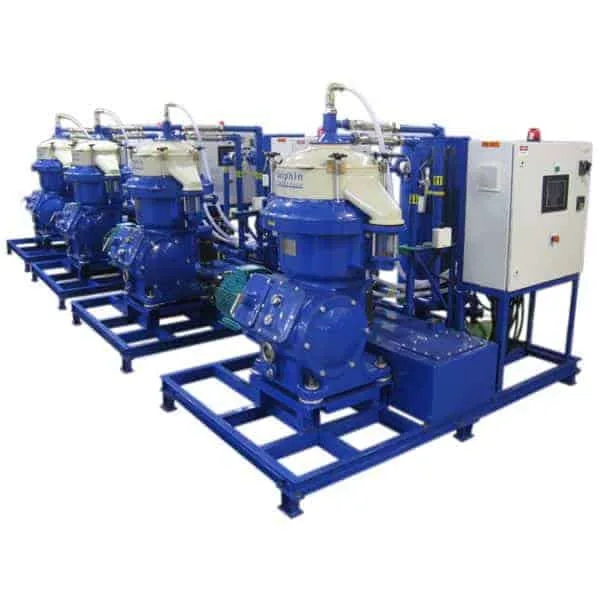
Dolphin Centrifuge disc stack centrifuge systems remove heavy metals, ash, and water from used engine oil at up to 6,800 G. Case study results show 97% ash reduction and 94% water removal at 10 GPM in a single pass.
Used Engine Oil — What is it? Where Does it Come From?
Used engine oil is a term used to describe used lubricating oil from Internal Combustion (IC) engines. Lubricating oil tends to lose its lubricating properties with use.
Hence, the oil is periodically replaced to prolong engine life and prevent breakdowns. The oil that is replaced is then referred to as used engine oil.
Automotive oil change shops to lubricating oil replacements in large marine engines are all sources of used engine oil.
Applications of Used Engine Oil
Used engine oil has several use cases in its afterlife, including serving as a fuel source or feedstock for producing fresh lubricating oil.
When used as fuel, used engine oil is burnt as heating oil in residential and commercial heating. It is a low-cost heating source, especially for producers of such oil.
Diesel fuel blended with used engine oil produces ‘black diesel’. Black diesel can often be used as fuel, even in engines that operate on straight diesel fuel. Engine manufacturers allow a certain percentage of blended fuel in their engines. This blended fuel does not affect the manufacturer’s warranty under certain conditions.
Furthermore, after being purified and distilled, used oil from engines can be used as feedstock for fresh lubricant manufacturing. See our waste oil centrifuge guide for more on downstream processing options.
Contaminants in Used Engine Oil
Contaminants in engine oil can take the form of either liquids or solids. The liquid contaminant could be water or glycol from the automotive engine coolant. Condensation in storage tanks can also introduce water (moisture) to the oil.
Solid contaminants are categorized as non-metallic or metallic. Non-metallic contaminants include sludge, dirt, carbon, ash, etc. Metallic particles include bearing and engine-wear metal particles. A disc stack centrifuge handles both categories simultaneously in a single pass.
What are the Sources of Heavy Metals and Ash in Used Engine Oil?
The most prominent example of a non-metallic engine oil contaminant is ash, a carbon-based particle generated as a by-product of combustion. Ash suspended in used engine oil causes the color of the oil to appear black.
Heavy metals present in fuel are major sources of metallic contaminants in engine oil. Heavy Fuel Oil (HFO) is the fuel of choice in large engines due to its low cost compared to diesel. HFO has high levels of heavy metals such as Chromium, Vanadium, Nickel, and Lead. These heavy metals can easily contaminate the engine lubricating oil.
The other source of heavy metals in engine oil is metal wear particles. As engine bearings and other parts wear due to friction, they release metal particles into the engine lube oil.
For example, the following table compares the metal content in virgin engine oil to used engine oil from marine engines.
| Sample Type | Lead (ppm) | Iron (ppm) | Nickel (ppm) | Copper (ppm) | Chromium (ppm) |
|---|---|---|---|---|---|
| Virgin Engine Oil | 5.5 | 55.0 | 2.0 | 3.25 | 2.0 |
| Used Engine Oil | 132.0 | 785.0 | 47.0 | 125.0 | 65.0 |
Why Remove Water, Heavy Metals, and Ash from Used Engine Oil?
Water removal is necessary for several reasons. Used oil with water reduces the sale value of used oil as fuel. The presence of water hampers the processing of used oil for lubricant feedstock. Used oil emulsion is caused by water and is not desirable for many reasons.
Removal of heavy metals and ash from used engine oil is essential for the following reasons.
When used engine oil is burnt as fuel, it releases heavy metals into the environment through combustion gases. This is a cause of environmental air pollution.
Air polluted with heavy metal compounds is detrimental to health. Polluted air introduces toxic metals into the oceans, which affect marine life. Soil and groundwater contamination is also a direct result of this pollution.
Ash in used engine oil causes processing challenges when converting used oil into lubricant feedstock. Ash residue causes distilling equipment to get gummed up with thick carbon sludge. This leads to frequent cleaning and low process efficiency.
Purifying Used Motor Oil Using a Disc Stack Centrifuge
Used Motor Oil Centrifuge
An industrial disc-stack centrifuge uses mechanical separation to remove heavy metal and ash particles from used motor oil.
A disc-stack centrifuge exerts a centrifugal force of up to 10,000 g on the process fluid. In the case of used motor oil, this force is sufficient to extract fine metal and carbon particles from the oil.
Under this force, the heavier metal particles get pushed outward toward the centrifuge bowl wall. The ash particles flocculate to form bigger solids that separate under the high g-force.
Oil centrifuges are also uniquely equipped to handle three-phase separation. The centrifuge can separate the water phase from the used oil while simultaneously removing any solid contaminants. The separated water discharges through a discrete heavy phase outlet on the centrifuge. Learn more on our disc stack centrifuge applications page.
Operating Parameters Affecting Separation Efficiency
Temperature
Oil temperature is inversely proportional to the viscosity of the oil. Thus, the hotter the oil, the lower the viscosity. Low-viscosity oil offers less resistance to the ash and metal particles from moving out of the oil. Oil temperature can be raised by adding an inline heater to the centrifuge system, in addition to the customer’s heated tanks.
Centrifugal Force (G-Force)
Centrifugal force is directly proportional to the separation efficiency of a centrifuge. A disc-stack centrifuge produces the highest level of centrifugal force among industrial centrifuges. See disc stack centrifuge performance data for detailed G-force comparisons.
Flow Rate
Flow rate of the used oil through a centrifuge is inversely proportional to retention time. Retention time is the duration each particle of used oil is exposed to the high centrifugal force. Thus, the lower the flow rate, the higher the retention time, which leads to better separation efficiency.
Specific Gravity Differential
A disc stack centrifuge magnifies the difference in specific gravity between phases. This magnification causes accelerated separation of the phases. So, the heavy metal particles separate from the oil more quickly than the lighter ash particles.
Case Study — Large Scale Removal of Heavy Metals and Ash from Used Engine Oil
Customer Background
A used oil collection and processing company based on the East coast collected used engine oil. Their collection came from cruise ships, naval vessels, and inland oil change shops.
They processed the used oil using filters and heating it to boil off the water. They then vacuum-distilled the cleaned oil to produce lube oil feedstock. The company faced many challenges while using this process.
Used Engine Oil Processing Challenges
- High cost of fine filtration media
- Labor costs associated with manual filtration
- Energy cost of water evaporation through boiling
- Inability to remove heavy metal particles and ash in the pre-distillation stage — this caused frequent cleaning and wear of expensive distillation equipment
- Environmental compliance costs related to the emission of metal-contaminated gases from the distillation
Industrial Centrifuge Testing and Selection Process
The company contacted Dolphin Centrifuge to conduct a pilot-scale test on their used engine oil. We processed a small (<1 gallon) sample through our pilot-scale disc centrifuge.
The customer then analyzed the clean oil sample from our test. There was a significant reduction in the used engine oil’s heavy metal and ash contamination.
Dolphin Centrifuge recommended an oversized centrifuge based on the flow-rate reduction required for ash removal. The following table summarizes the technical specifications of the centrifuge supplied by Dolphin. See our waste oil recovery case study for a related large-scale deployment.
| Type of Centrifuge | Self-Cleaning, Disc Centrifuge |
| RCF (Relative Centrifugal Force) | ~6,800 G |
| Rated Separation Efficiency | <1 µ Metal Particles |
| Rated Flow Rate | 28 GPM on Diesel Fuel |
| Flow on Used Engine Oil | 10 GPM @ 180 F |
| Drive Motor | 7.5 HP |
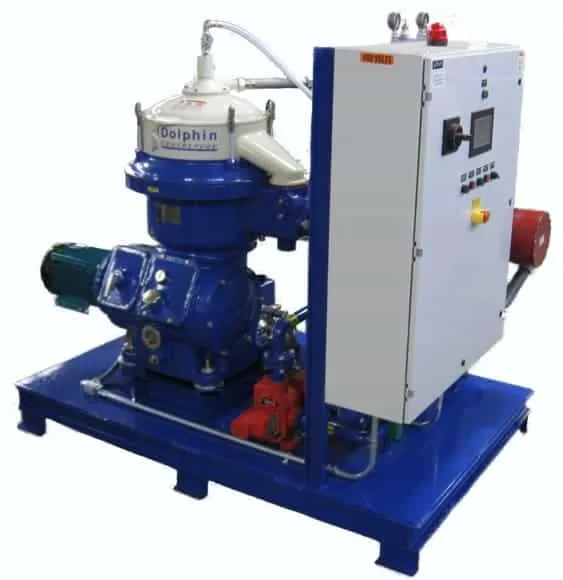
Disc Stack Centrifuge Skid for Used Oil Purification
Disc Centrifuge Performance Data on Used Engine Oil
The centrifuge system supplied by Dolphin Centrifuge produced the following results on used engine oil purification at the customer site.
| Test Parameter | Units | Before Centrifuge | After Centrifuge |
|---|---|---|---|
| Water | wt % | 12.65 | 0.80 |
| Sediment | wt % | 2.42 | 0.06 |
| Ash Content | wt % | 1.17 | 0.09 |
| Metals | |||
| Aluminum | ppm | 495 | 12 |
| Chromium | ppm | 522 | 31 |
| Silicon | ppm | 386 | 85 |
| Vanadium | ppm | 128 | 31 |
Summary
Using a disc stack centrifuge to remove heavy metal and ash particles from used engine oil is efficient and cost-effective. This method is especially suitable for the large-scale processing of used engine oil. Contact Dolphin Centrifuge to discuss centrifuge options for your used oil application, or review our used oil centrifuge page for system sizing guidance.
Want to see what a disc centrifuge can do with your used engine oil?
Send us a quart-size sample and we'll process it on our pilot centrifuge at 180°F, then provide a lab analysis showing before and after metal and ash reduction data — at no charge.
Frequently Asked Questions
Can a disc stack centrifuge remove metals from used engine oil? ⌄
Yes. Disc stack centrifuges effectively remove iron, copper, aluminum, lead, and chromium wear metal particles from used engine oil by exploiting the density difference between metal particles (7–11 g/cm³) and oil (0.87 g/cm³). Operating at 6,000–10,000 Gs, the centrifuge separates particles as small as 1 micron. Case studies show 90–97% reduction in metal content after a single pass at 180°F.
What is ash in used engine oil and how does a centrifuge remove it? ⌄
Ash in used engine oil is the residue from combustion — including burned additive packages (calcium, magnesium, zinc compounds), carbon soot, and combustion byproducts. These denser particles range from 0.5 to 50 microns. A disc centrifuge at 7,000+ Gs removes the inorganic ash fraction, reducing ash content to below 0.1% by weight and dramatically extending oil life for re-use or re-refining.
What centrifuge model is recommended for used oil metal and ash removal? ⌄
Dolphin Centrifuge recommends the DMPX-028 (45 GPM) or DMPX-042 (68 GPM) self-cleaning disc stack centrifuge modules for used engine oil processing. Systems include electric pre-heaters (180°F target), a sludge tank for metal/ash collection, and PLC controls for automated ejection cycle management. For smaller volumes (under 15 GPM), the DMPX-014 is suitable.
Does heating used oil improve centrifuge metal removal efficiency? ⌄
Yes. Heating used engine oil to 160–200°F dramatically improves metal and ash removal efficiency by reducing oil viscosity from 100–500 cSt (cold) to 15–30 cSt (hot). At lower viscosity, centrifugal force moves metal particles and ash to the bowl wall much more rapidly, allowing higher throughput or finer particle removal at the same flow rate. Heating also reduces water content through partial flash evaporation.
How does a disc centrifuge compare to filtration for used oil metal removal? ⌄
A disc stack centrifuge outperforms conventional filtration for used oil metal removal: centrifuges remove particles below 1 micron (filters stop at 5–10 microns), operate continuously with no media replacement or disposal costs, and simultaneously remove water and solids in one pass. Filtration requires separate stages for water removal and cannot handle sub-micron particles. For high-volume used oil processing, centrifuge total cost of ownership is significantly lower than filtration.
Ready to reduce metals and ash in your used engine oil?
Dolphin Centrifuge supplies complete used oil purification systems including centrifuge, heater, sludge tank, and PLC controls. Get a quote or send us a sample for pilot testing.
(248) 522-2573 • sales@dolphincentrifuge.com • Warren, MI 48089