Dolphin Centrifuge supplies decanter and disc stack centrifuge systems for ethanol extraction — separating hemp biomass from ethanol miscella at up to 3,100 Gs and 600 lbs/hour. Our explosion-proof, 316L stainless steel systems replace slow filter presses with continuous, fully sealed extraction for CBD and botanical producers. Based in Warren, Michigan, Dolphin Centrifuge brings over 40 years of centrifugal separation expertise to every application.
Ethanol Extraction Process
The use of solvents to extract CBD Oil and THC compounds from dry plant biomass is known as the ethanol extraction process. Depending on the type of compound desired, the process may vary, but alcohol in the form of ethanol is key to the extraction of cannabinoids.
An essential step in this process is separating the spent biomass from ethanol that has adsorbed the precious cannabinoids. The efficiency of this separation is critical to the efficiency of the extraction process.
Methods of Biomass and Ethanol Separation
There are several ways to separate the plant biomass from ethanol, starting with gravity separation, which is not feasible due to the time required for settling under gravity.
Another method uses filters, specifically filter presses to separate the biomass from the ethanol. Even though filter presses are in use by some CBD or THC producers, it is not an efficient method due to the labor involved in servicing the presses. Also, exposure to ethanol during the cleaning process is not conducive to the operator's safety.
Industrial centrifuges are the most popular ethanol extractors due to their sealed designs and high separation efficiency. This article delves into the different types of ethanol extraction centrifuges and the pros and cons of each centrifuge type.
Types of Extraction Centrifuges
A centrifugal extractor is an industrial centrifuge that uses the centrifugal force generated by the biomass and ethanol mix rotation to affect the separation of the two phases. There are two types of industrial centrifuges, i.e., sedimentation and filtration type.
The CBD & THC producers use both these types of centrifuges in basket and decanter centrifuges, as described below.
Basket Centrifuge (Washing Machine)
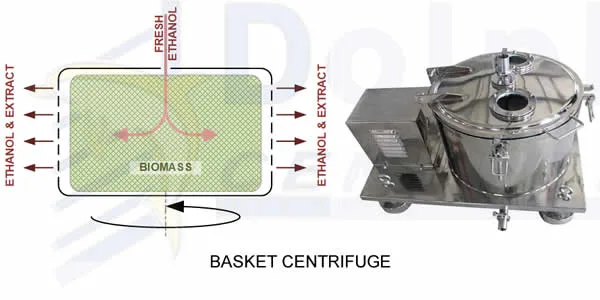
Basket Centrifuge for Ethanol Extraction
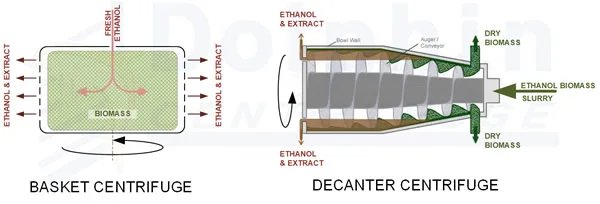
The image above shows the cross-section (left) and generic image (right) of a typical basket centrifuge, also known as a washing machine centrifuge.
As evident from the image, this is a filtration-type industrial centrifuge which means it uses centrifugal force to push the liquid out of the basket mesh (perforations) to separate the ethanol from the biomass.
Decanter Centrifuge
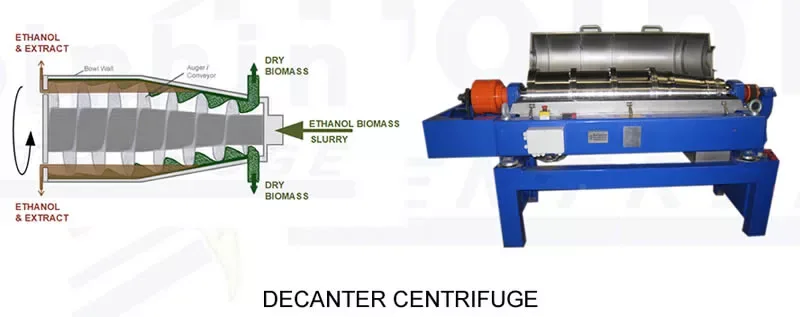
Decanter Centrifuge for Ethanol Extraction
The cross-section (left) and a decanter centrifuge (right) illustrate the construction and operation of a decanter centrifuge.
A decanter centrifuge is a solid-bowl centrifuge that falls in the sedimentation-type industrial centrifuge category. This type of centrifuge uses a much higher centrifugal force to affect the separation of heavier biomass particles from the lighter ethanol.
For more details, please read our article differentiating the filtration type and sedimentation type centrifuges.
Comparison of Specifications
Basket and decanter centrifuges differ in a variety of ways. In this section, we compare the typical specifications of these centrifuges.
The following table compares the essential characteristics that affect centrifugal performance.
| Characteristic / Specification | Basket Centrifuge (Washing Machine) | Decanter Centrifuge Ethanol Extraction | Comment |
|---|---|---|---|
| Axis of Rotation | Vertical | Horizontal | |
| Rotating Speed | 1,000 RPM | 4,000 RPM | |
| G-Force | ~700 Gs | 3,100 Gs | |
| Size (Typical) | 65″ L × 32″ W × 49″ H | 80″ L × 30″ W × 40″ H | |
| Weight (Typical) | 1,450 lbs | 2,500 lbs | |
| Basket / Bowl Size | 30″ Radius × 15″ (H) | 14″ Radius × 60″ (L) | |
| Basket / Bowl Construction | Perforated Sheet Metal | Solid, Thick Wall | |
| Material of Construction | Different Grades of Stainless Steel | 316L Duplex Stainless Steel* | *Wetted Parts |
| Power | 230 V; 3-Phase | 230 / 460 V; 3-Phase | |
| Drive Power | 7 HP | 15 HP | |
| Processing Capacity | ~140 lbs / Hour | ~600 lbs / Hour | |
| Operating Temperature | −40 F to 85 F | 32 F* to 85 F | *Process fluid cannot be below 32 F |
| Ethanol Recovery / Biomass Dryness | ~70%* | ~95%* (Adjustable) | *Based on field process data |
Operation
This section describes the operation of basket centrifuges and decanter centrifuges in ethanol extraction of CBD and THC cannabinoid production.
Basket Centrifuge (Washing Machine)
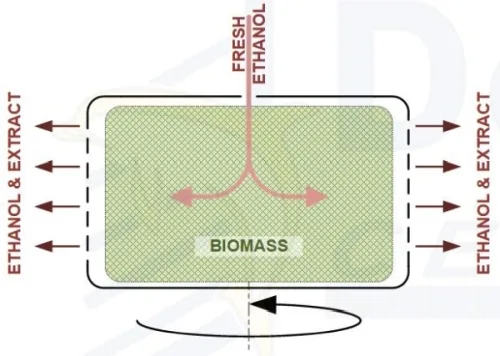
Ethanol Extraction Basket Centrifuge Cross Section
The operation of separating the hemp or cannabis biomass from ethanol using a basket centrifuge is as follows.
An operator stuffs a nylon bag with chopped, dry hemp or cannabis plant matter is placed in the centrifuge basket. The operator then closes the centrifuge and effectively seals the vessel from the atmosphere.
The operator then introduces clean ethanol to the enclosed basket chamber within the centrifuge vessel. The rotation of the loaded basket follows the ethanol addition. This rotation serves to circulate and agitate the ethanol within the hemp or cannabis plant matter.
The ethanol adsorbs the precious cannabinoids from the plant matter. After a predetermined period, an automatic valve allows the ethanol carrying the cannabinoids to exit the centrifuge. The constant rotation of the centrifuge causes a centrifugal force that spins out the ethanol from the plant matter, helping recover the maximum amount of ethanol.
The operator then opens the vessel to remove the spent biomass bag and replaces it with a bag containing fresh biomass. This cycle is repeated until the entire batch of biomass is processed.
This cannabinoid-loaded ethanol is filtered, winterized, and distilled to recover the cannabinoid concentrate.
Decanter Centrifuge
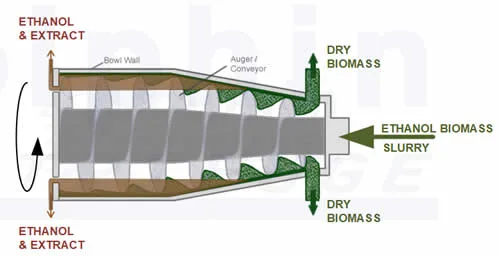
Ethanol Extraction Decanter Centrifuge Cross Section
A decanter centrifuge has a solid wall bowl that rotates around a horizontal axis. An independently rotating scroll within the bowl is concentric to the decanter bowl. The scroll connects to the bowl through a gearbox. This gearbox enables the scroll to rotate at a different speed than the bowl.
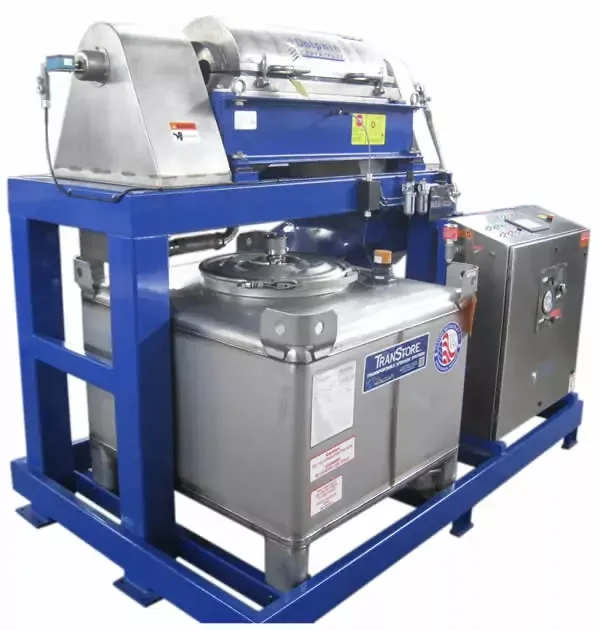
Stainless Steel (Food Grade) Decanter Centrifuge for Hazardous Areas Class 1 Div 2 for Alcohol Slurry Processing
The chopped or pulverized, dry hemp or cannabis biomass is mixed with a predetermined volume of ethanol to form a slurry in a reactor vessel. An agitator mixes this slurry with the ethanol, which lets the ethanol adsorb the cannabinoids from the plant biomass.
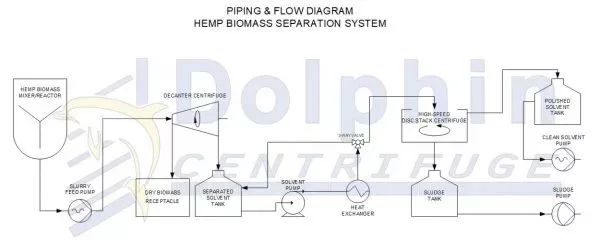
Hemp Process Flow Diagram
A pump feeds this slurry to the rotating decanter through an inlet pipe. This pipe is stationary and is located at the center of the rotating bowl, delivering the ethanol biomass slurry.
The centrifugal force created by the rotation of the bowl pushes the heavier biomass particles toward the outer bowl wall, where they accumulate.
The rotating scroll pushes the separated biomass particles towards and ejected through the solid discharge ports located at one end of the bowl.
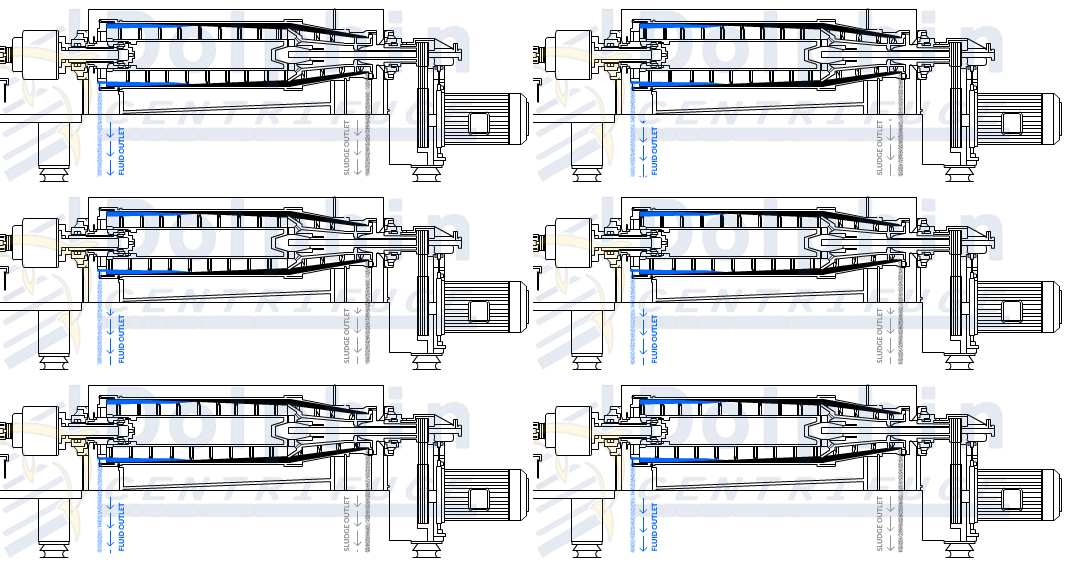
Decanter Centrifuge Animation
The relatively lighter ethanol floats above the solids and exits the bowl through the liquid exit ports located at the other end of the rotating bowl.
This separation is a continuous operation without stoppage. Thus, the decanter centrifuge can process the entire batch irrespective of the batch size or volume.
A decanter centrifuge has some unique mechanical adjustments that allow the operator to control the dryness of the biomass and the separated ethanol clarity. For full specifications and available models, see our decanter centrifuge applications page.
Biomass Dryness Versus Residence Time
The biomass dryness is directly proportional to the centrifugal force and residence time in the centrifuge for the biomass & ethanol slurry.
In the washing machine type, open-top; low-RPM, low G-force (< 1000 Gs) centrifuge, the residence time is adjustable and is typically in the range of 15 to 60 minutes.
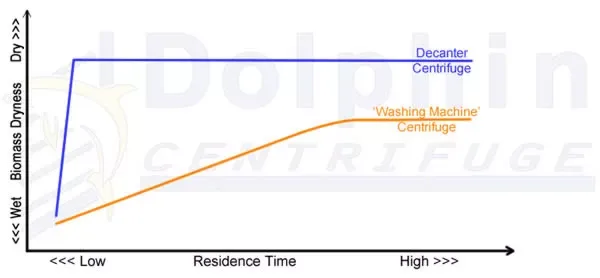
Biomass Dryness vs Ethanol Residence Time
A decanter centrifuge is a pass-through type centrifuge with a much higher centrifugal force (3,000+ Gs). The residence time in a decanter centrifuge is inversely proportional to the flow rate. In other words, a high flow rate causes reduced residence time and, therefore, can be adjusted to a smaller degree by varying the flow rate.
The typical residence time in a decanter centrifuge ranges from 10 to 30 seconds. The graph above shows the relationship between residence time and biomass dryness for these ethanol extraction centrifuges.
Operation Comparison Table
| Characteristic | Basket Centrifuge | Decanter Centrifuge | Comment |
|---|---|---|---|
| Process Mode | Batch | Continuous* | *Flowthrough Design |
| Labor Required? | Yes* | No | *Operator needed to replace biomass bags |
| Premix Required? | No | Yes* | *Biomass ethanol premixed slurry |
| Operator Exposure to Ethanol | Yes | No* | *Fully sealed design w/ continuous flow |
| Spent Biomass Recovery | Manual Extraction | Continuous Discharge | |
| Adjustable Residence Time? | Yes | Yes* | *Limited adjustment |
| Adjustable Ethanol Recovery? | Yes* | Yes | *Processing capacity tradeoff |
| Adjustable Ethanol Clarity? | No* | Yes | *Dependent on bag mesh size |
| Consumable Items | Yes* | None | *Mesh bags |
| Durability | Limited* | High | *Frequent Stop/Open/Close/Start cycles |
| Duty Cycle | Batch | Continuous | |
| Service Life | 5~10 Years* | 30+ Years | *Mechanical durability, field data |
Separating Efficiency
The separation efficiency is the smallest fluid or solid particle size effectively separated by the centrifuge. Stoke's law (shown below) defines the velocity of a solid particle as it travels through a fluid medium.
V = gRp²(ρp – ρ) / 4.5μ
Where: V = Terminal Velocity of Particle, Rp = Radius of Particle, g = Gravitation or G-Force, ρp = Density of Particle, ρ = Density of Fluid, μ = Viscosity of Fluid
It is evident from the formula above that the separation efficiency (escape velocity) of a centrifuge is directly proportional to the centrifugal force (g) exerted by the centrifuge. In other words, the higher the centrifugal force, the smaller the particle size of separation.
The ability of a centrifuge to separate the fluid from the solid particles is a function of the centrifugal force and residence time.
A centrifuge with a higher centrifugal force extracts more fluid from the solids than a centrifuge with a lower centrifugal force. Therefore, a higher g-force centrifuge is better for liquid extraction from biomass than a lower g-force centrifuge.
The lower g-force centrifuge can remove the same amount of liquid but with a longer residence time. A longer residence time means a longer spin cycle in the basket centrifuge, which leads to lower production.
The percentage of ethanol recovered quoted for basket centrifuges is likely at an extended spin cycle time, adversely affecting the batch cycle time. To learn more about how G-force affects performance, see our overview of industrial centrifuge types.
Summary of Pros and Cons
| Criteria | Basket Centrifuge | Decanter Centrifuge |
|---|---|---|
| Separation Efficiency | ~80% | ~95% |
| Processing Mode | Batch | Continuous |
| Processing Temperature | −40 F to 85 F | 32 F to 85 F |
| Processing Capacity | ~2.5 GPM | ~20 GPM |
| Labor | Required | Not Required |
| Operator Exposure to Solvent | Yes | No |
| Pre-Mixing Required | No | Yes |
| Small Scale Processing | Suitable | Not Suitable |
| Large Scale Processing | Not Suitable | Suitable |
| Downstream Filtration Load | Medium | Low |
| Capital Investment | Marginally Lower | Marginally Higher |
| Operating Cost (Labor & Material) | High | Low |
This article is based on our considerable experience with centrifuges, especially as they apply to the ethanol extraction process. For hazardous-area installations, see our guide on explosion-proof centrifuges. Contact Dolphin Centrifuge to discuss the right system for your extraction line.
by Sanjay Prabhu MSME, Engineering Manager, Dolphin Centrifuge
Frequently Asked Questions
What type of centrifuge is best for ethanol extraction?
Decanter centrifuges are preferred for continuous ethanol extraction operations due to their high throughput and fully automated operation. Basket centrifuges are used for smaller batch processes where maximum biomass dryness is critical. Decanters produce higher volumes of recovered ethanol per hour, while baskets achieve slightly drier cake for low-throughput applications.
What G-force is used for ethanol extraction centrifuges?
Decanter centrifuges for ethanol extraction typically operate at 1,500–3,000 × g. This G-force range is sufficient to sediment plant biomass (hemp, botanical) against the bowl wall while the clarified ethanol solvent exits as centrate. Higher G-force improves cake dryness and ethanol recovery from biomass.
Do ethanol extraction centrifuges need explosion-proof motors?
Yes. Ethanol is a Class I, Division 1 flammable solvent. All centrifuges processing ethanol must be rated for Class I Div 1 (or ATEX Zone 1 for international installations). Non-explosion-proof equipment in ethanol processing areas creates a serious fire and explosion hazard.
How much ethanol can a decanter centrifuge recover from biomass?
A decanter centrifuge recovers approximately 95% of the ethanol from biomass in a single pass (versus approximately 70% for basket centrifuges). The actual recovery rate depends on the biomass-to-ethanol ratio, feed temperature, G-force applied, and residence time in the decanter. Field data from extraction operations shows consistent recovery in the 92–97% range at standard operating conditions.
What is the processing capacity difference between basket and decanter centrifuges?
Basket centrifuges are batch-process machines typically processing 140 lbs of biomass per hour at approximately 700 Gs. Decanter centrifuges are continuous-flow machines processing 600 lbs per hour at 3,100 Gs. For large-scale extraction operations processing hundreds of pounds of biomass per shift, a decanter is the only practical option — basket centrifuges are limited to smaller boutique operations.
Ready to Upgrade Your Extraction Process?
Contact Dolphin Centrifuge to discuss Class 1 Div 1/2 decanter centrifuge systems for continuous ethanol extraction.