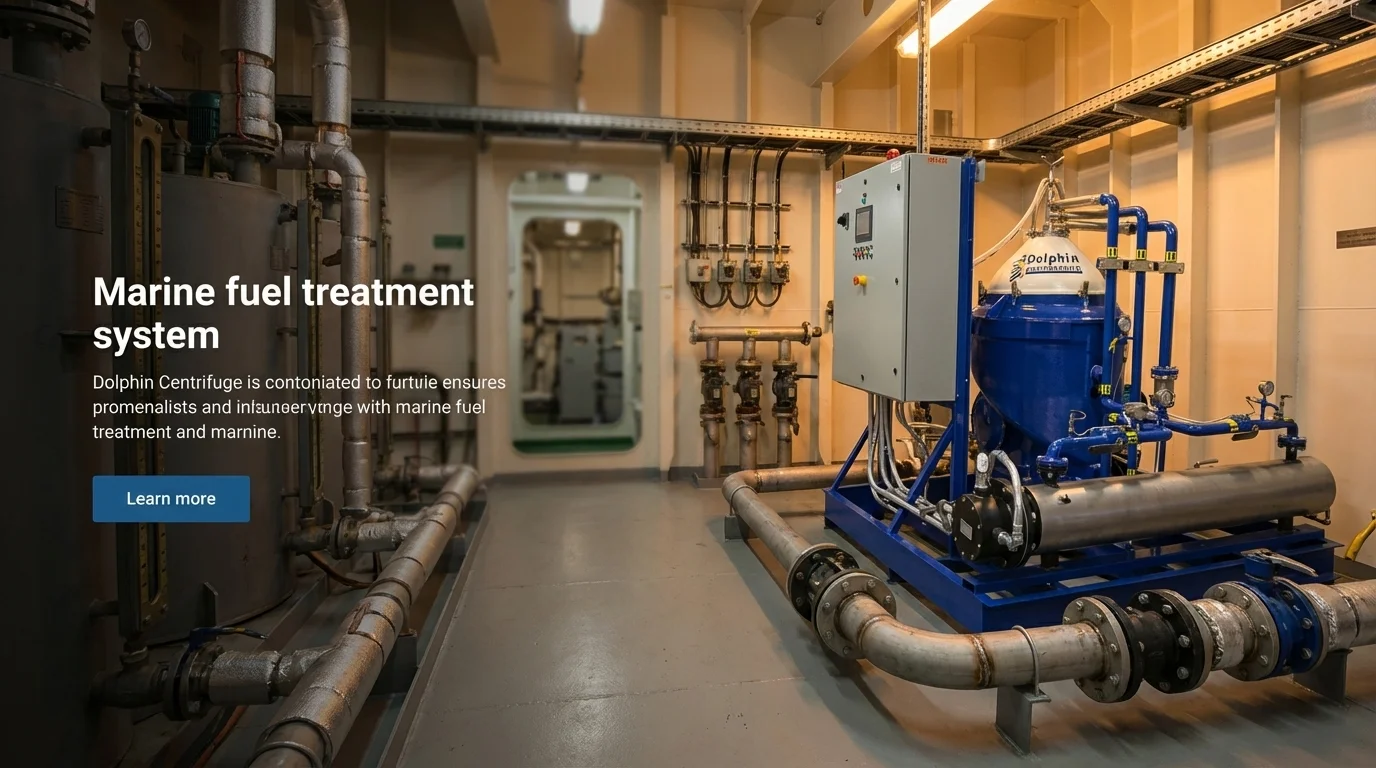
Dolphin Centrifuge supplies self-cleaning disc stack centrifuge systems for heavy fuel oil (HFO) purification. Operating at 6,000+ Gs, these 3-phase separators remove sludge, water, and solids from HFO at 12 to 65 GPM. Based in Warren, Michigan with over 40 years of centrifuge experience.
What is Fuel Oil (HFO)?
Fuel oil — also called heavy fuel oil (HFO), bunker fuel, or residual fuel — is a dense, viscous petroleum product used in large-scale combustion applications. It is the heaviest fraction remaining after crude oil refining, with a specific gravity greater than 0.90 and viscosities commonly exceeding 180 cSt at 50°C.
Marine engines and oil-fired captive power plants use HFO as fuel. The comparatively low cost of heavy fuel oil makes it fuel for commercial power generation and propulsion.
Heavy fuel oil is the leftover remains of crude oil after distilling all the lighter and more valuable fuels (diesel, gasoline, naphtha, kerosene, and distillate).
Because of its high viscosity and density, fuel oil requires heating before it can be pumped or burned. It also carries a heavier contaminant load than lighter fuels such as diesel, making centrifugal purification essential before combustion.
Why Purify Fuel Oil?
Heavy fuel oil contains two principal categories of contaminants:
- Sludge and Solids: Asphaltenes, catalyst fines, rust, and sediment from refining and storage. These abrasive particles damage fuel injectors, turbine blades, and combustion chambers.
- Water: Condensation during storage and transport introduces free water, which causes corrosion, flame instability, and microbial growth in fuel tanks.
Without purification, these contaminants cause accelerated engine wear, increased maintenance costs, and unplanned shutdowns. Turbine and engine manufacturers specify maximum permissible levels for solids, water, and vanadium — fuel oil centrifuges ensure these specifications are consistently met.
A centrifugal fuel oil separator is the most reliable and proven method to purify fuel oil as a pre-treatment method.
How Does a Fuel Oil Centrifuge Work?
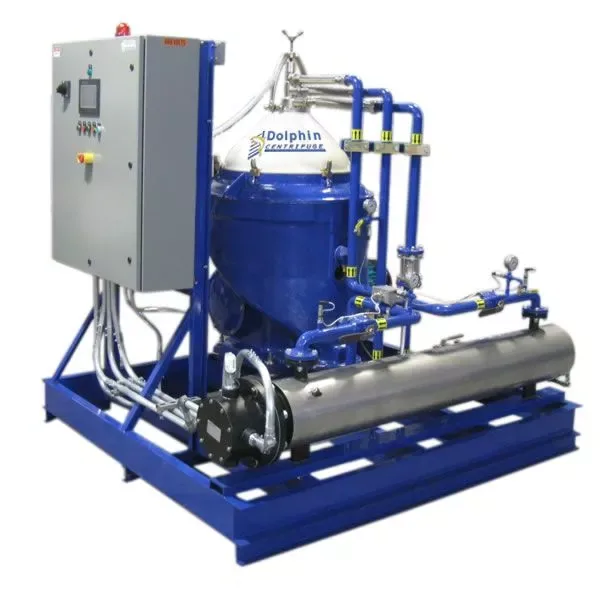
A fuel oil centrifuge is a disc-stack centrifuge configured to separate fuel from water and sludge. Raw fuel oil contains water and sludge and cannot be used directly in engines. A fuel oil separator centrifuge uses centrifugal force to remove the sediment and free water from the fuel.
Fuel oil centrifuges are 3-phase, self-cleaning disc-stack separators. Pre-heated fuel oil enters the spinning bowl through a central inlet. Inside the bowl, a stack of closely spaced conical discs multiplies the settling area, dramatically accelerating separation.
Under centrifugal forces exceeding 6,000 Gs, the three phases separate by density:
- Heavy phase (water): Spun outward to the bowl periphery and continuously discharged through the water outlet
- Sludge and solids: Collected at the bowl wall and periodically ejected by the automatic self-cleaning mechanism
- Clean fuel oil (light phase): Moves inward through the disc stack and exits through the clean-oil outlet
The self-cleaning cycle is triggered automatically by the PLC control system, eliminating the need for manual intervention during operation.
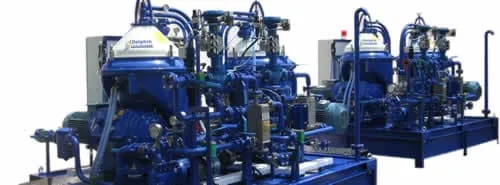
Dolphin Centrifuge's fuel oil centrifuges are fully automatic systems for the purification of light & heavy fuel oils. They feature Alfa Laval self-cleaning disc stack centrifugal separators.
The separation process is essential to remove contaminants such as heavy metals (vanadium, sodium, potassium, etc.) and water and fuel sludge before using the fuel.
If you have simple, routine questions: We have condensed our 40+ years of disc-stack centrifuge experience into 101 Frequently Asked Questions about Disc Stack Centrifuges!
Fuel Oil Centrifuge Applications
Fuel oil centrifuges are essential wherever HFO is stored or burned:
- Cogeneration & Power Plants: Gas turbines and reciprocating engines running on HFO require centrifuge-grade fuel to meet OEM cleanliness specs and avoid turbine blade erosion.
- Marine Vessels: Ships burning bunker fuel use onboard centrifuges to purify fuel between the settling tank and the day tank — a regulatory requirement for most engine classes.
- Fuel Storage Terminals: Bulk fuel depots install centrifuges to recondition aged or contaminated fuel before resale or distribution.
- Backup & Emergency Generators: Facilities with large standby generators on HFO use centrifuges to keep stored fuel in ready-to-burn condition, preventing startup failures.
Need Help With Your Fuel Oil Purification System?
Our engineers will evaluate your fuel oil application and recommend the optimal centrifuge system.
Benefits of Centrifuge Fuel Oil Purification
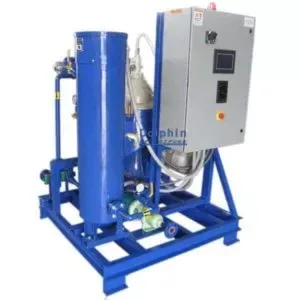
- Meets Turbine Fuel Quality Requirements: Ensures fuel meets ISO 8217 and OEM specifications for solids, water, and ash content
- Consistent Fuel Quality: Unlike filters that degrade as pores clog, centrifuge separation performance remains constant throughout operation
- No Pre-Filtration Required: Disc-stack centrifuges handle the high contaminant loads in HFO without the need for upstream strainers or coalescing filters
- Reduced Sludge Disposal: Concentrated sludge ejections minimize waste volume compared to filter-based systems
- Fully Automatic Operation: PLC-controlled sludge ejection, feed regulation, and fault monitoring — no manual labor required
- No Filter Replacement Costs: Centrifuges eliminate the ongoing expense of consumable filter elements, which clog rapidly with heavy fuel oils
- Extended Equipment Life: Clean fuel reduces injector wear, turbine blade erosion, and combustion chamber deposits — lowering long-term maintenance costs
Dolphin Fuel Oil System Features
Every Dolphin Centrifuge fuel oil module is a complete, skid-mounted system that includes:
- Pre-Filtration: Duplex basket strainers protect the centrifuge from large debris (rope fibers, gasket material) that can damage the bowl
- Pre-Heating: Electric or steam heaters reduce fuel viscosity to the optimal range for centrifugal separation (typically 190–200°F)
- PLC Control Panel: Fully automated start/stop sequences, sludge ejection timing, temperature regulation, and fault diagnostics with remote monitoring capability
Fuel Oil Centrifuge Specifications
| Specification | DMPX-014 | DMPX-042 | DMPX-070 |
|---|---|---|---|
| Type | Self-Cleaning Disc Stack | Self-Cleaning Disc Stack | Self-Cleaning Disc Stack |
| Centrifuge Efficiency | Solid Particles > 1 µ ; Free Water > 2 µ | ||
| Bowl Speed | 7,600 RPM | 5,180 RPM | 4,140 RPM |
| Rated Capacity | 21 GPM | 68 GPM | 105 GPM |
| Fuel Oil 30 cSt | 12 GPM @190°F | 42 GPM @190°F | 65 GPM @190°F |
| Fuel Oil 100 cSt | 10 GPM @190°F | 32 GPM @190°F | 47 GPM @190°F |
| Fuel Oil 700 cSt | 3 GPM @200°F | 14 GPM @200°F | 20 GPM @200°F |
| Sludge Space | 0.36 gal | 1.6 gal | 3.8 gal |
| Drive Motor | 5 HP | 15 HP | 20 HP |
| Skid Dimensions | 4' x 4' | 4' x 5' | 5' x 6' |
| Skid Weight | 1,700 lbs | 3,500 lbs | 4,200 lbs |
Actual throughput depends on fuel oil viscosity, specific gravity, temperature, and contaminant load. Higher viscosity fuels require lower flow rates and higher pre-heat temperatures for effective separation.
Dolphin Fuel Oil Treatment Systems for Sale
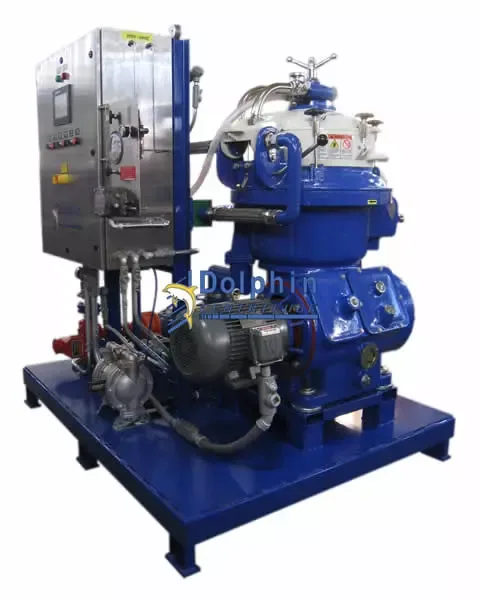
Dolphin-designed and manufactured fuel oil systems process untreated fuel oil through a pre-filtration and pre-heating system to the Alfa Laval, three-phase, disc-stack centrifuge.
The heated oil has a much lower viscosity conducive to easier centrifuge separation. The extremely high centrifugal force within the separator bowl slings out the water and sludge from the oil.
The centrifugal purifier internally pumps the separated clean fuel oil to a local storage tank, which feeds the turbine or engine.
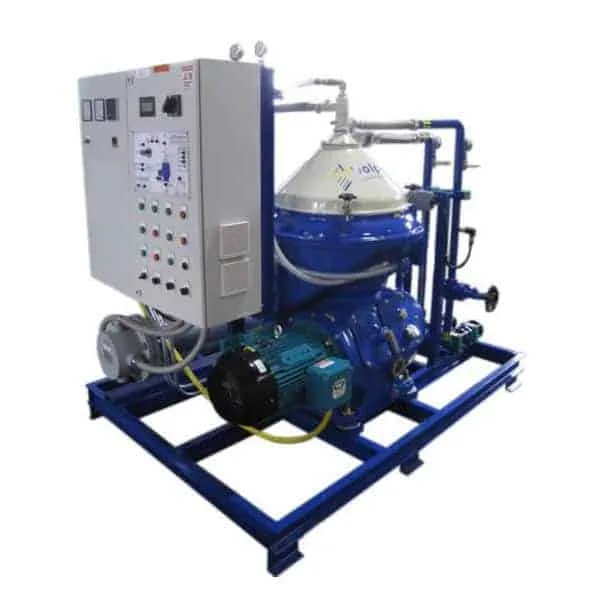
Fuel Oil Module with Remanufactured Alfa Laval MOPX 210 Centrifuge
| Capacity | 30 GPM on ISO 180 |
| Motor | 10 HP |
| Voltages | 230 / 460 V 3-Ph |
| Size | 5' x 5' |
| Weight | 2,800 Lbs |
| Bowl RPM | 5,150 |
HFO Module with Remanufactured Alfa Laval FOPX 613 HFO Centrifuge
| Capacity | 40 GPM on 380 cSt HFO |
| Motor | 15 HP |
| Voltages | 230 / 460 V 3-Ph |
| Size | 5' 6' x 8' (H) |
| Weight | 4,500 Lbs |
| Bowl RPM | 4,140 |
Available Fuel Oil Centrifuge Systems
| System | Type | HFO Capacity (30 cSt) | Best For |
|---|---|---|---|
| DMPX-014 | Self-Cleaning | 12 GPM | Small cogen / marine auxiliary |
| DMPX-042 | Self-Cleaning | 42 GPM | Medium power plant / vessel main engine |
| DMPX-070 | Self-Cleaning | 65 GPM | Large power plant / fuel terminal |
All fuel oil systems include pre-heating, pre-filtration, and PLC controls as standard. Contact us for sizing assistance based on your fuel type, flow requirements, and installation constraints.
Related resources: Centrifuge Selection Guide | Diesel Fuel Centrifuges | Centrifuge Controls & Automation | Centrifuge Rental Program | Picking the Right Industrial Centrifuge