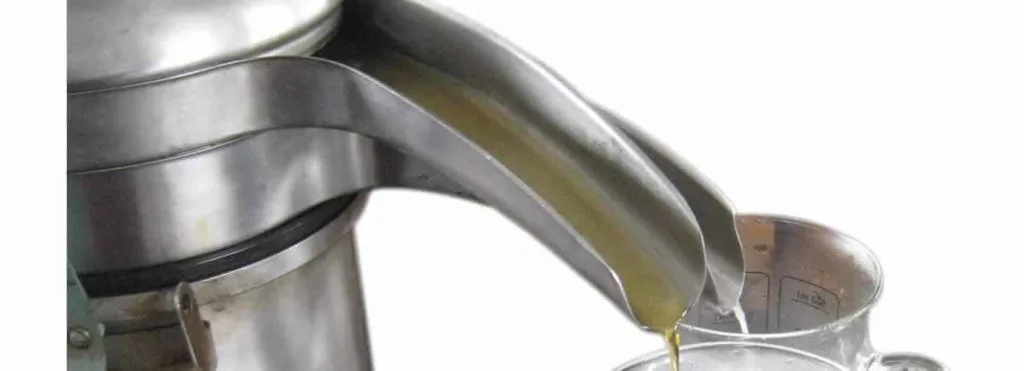
Dolphin Centrifuge provides industrial centrifuge sample testing at our Warren, Michigan facility. Customer fluid samples are processed through a lab-scale disc centrifuge operating at 10,000 Gs to evaluate separation feasibility, quantify solids and water removal, and recommend the right centrifuge model before full-scale commitment.
Centrifuge Sample Testing
We process customer samples through our Alfa Laval Lab Scale Disc Centrifuge (manual clean type) to determine the applicability of centrifugation as a possible separation method. Lab-scale centrifuge sample testing lets Dolphin Centrifuge get a thorough understanding of your separation application and limitations if any.
The test results allow us to recommend the right industrial centrifuge which will work for your process. Our explosion-proof, lab-scale disc centrifuge performs 3-phase separation and 2-phase clarification.
Based on this testing, Dolphin Centrifuge can make an informed recommendation as to: (a) Applicability & limitations (if any) of an industrial centrifuge. (b) Type and centrifuge model best suited for customer's needs.
The customer benefits by being able to evaluate centrifuge performance on their product. The customer may also run further laboratory analysis on the returned samples to verify separation efficiency.
What is a Lab Scale Disc Centrifuge?
A small industrial centrifuge is known as a lab-scale disc centrifuge. This centrifuge is designed to exert the same gravitational force as the larger (production) scale centrifuges but can process a small sample (approximately 1 Gallon) for evaluation purposes. Lab-scale centrifuges have the same characteristics as the production models, such as continuous flow, disc-stack, 2-phase, or 3-phase separation.
We can process larger samples based on customer requests. Contact us for details.
Small Batch Customer Sample Testing
Dolphin Centrifuge does have the in-house capability to batch process a sample (up to 10 Gallons) through a small industrial-scale disc-stack centrifuge. Please call one of our centrifuge experts for details on this batch testing service.
Lab Centrifuge Specifications
| Spec | Value |
|---|---|
| Centrifuge Type | Alfa Laval Disc Stack Centrifuge (Flow Through) |
| Bowl Speed | 12,000 RPM |
| Bowl Type | 3-Phase Separation (Liquid / Liquid / Solids) |
| Max. Centrifugal Force | 10,000 Gs |
| Max. Flow-Rate | 0.1 GPM |
| Max. Solids Concentration | ~ 8% (v/v) |
| Bowl Clean Type | Solid Bowl; Manual Clean |
| Bowl Material Of Construction | 316L Duplex Stainless Steel |
| Feed Pressure | Gravity Feed |
| Discharge Pressure | Light & Heavy Phase - Gravity Discharge |
| Max. Fluid Temperature | 210 F or 98 C |
Testing Process
- Phase analysis of incoming customer samples to understand the ratio of different phases.
- Thoroughly agitate and heat (if needed) the measured portion of the customer sample.
- Process the sample through the lab centrifuge and collect separated phases.
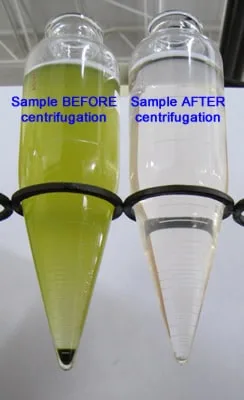
- Evaluate separation efficiency by spinning the separated liquid phase in a tube centrifuge.
- Create a test report for each customer sample.
- Upload a sample testing video for customer visuals.
- Ship separated sample phases back to the customer for review and analysis.
A testing charge depends on the type and volume of fluid to be tested.
Contact Dolphin Centrifuge for more information on our lab-scale testing service.
Why Test Before You Buy?
Every fluid is different. Viscosity, temperature, particle size distribution, emulsion stability, and chemical composition all affect how well a centrifuge will separate your material. Lab-scale testing on an actual centrifuge eliminates the guesswork and gives you hard data before you invest in a full-scale system.
Our sample testing program helps you find the right separation solution with real data. We test hundreds of samples per year across industries including oil purification, wastewater treatment, food processing, chemical manufacturing, and more.
What the Test Report Includes
Our test reports are thorough and designed to give you the confidence to make an informed purchasing decision:
- Before & After Photos: Visual comparison of your sample before and after centrifuge processing
- Separation Data: Measured water content, solids content, particle size removal, and clarity readings
- Optimal Parameters: Recommended bowl speed, flow rate, temperature, and discharge frequency
- Centrifuge Type Recommendation: Whether your application requires a disc stack separator, decanter, or both
- Model & System Recommendation: Specific Dolphin centrifuge model, system configuration, and capacity
- ROI Considerations: Estimated operating costs, consumable savings vs. filters, and payback timeline
Sample Requirements
To get the most useful results from testing, please follow these guidelines when shipping your sample:
- Volume: 1–5 gallons is ideal. We can work with as little as 1 quart for initial screening
- Container: Use a sealed, leak-proof container. Plastic jugs or pails work well
- Labeling: Include your company name, contact information, and material description
- Temperature: Ship at ambient temperature. Note if the material needs to be heated for processing
- Safety Data: Include an SDS (Safety Data Sheet) if the material is hazardous
- Shipping: Standard ground shipping is fine. We can provide a UPS or FedEx label if needed
Common Materials We Test
We have tested thousands of different fluids and slurries over 40+ years. Common materials include:
- Waste oil and used oil
- Diesel fuel and biodiesel
- Hydraulic and lube oils
- Crude oil and tank bottoms
- Cutting fluids and coolants
- Wastewater and process water
- Food-grade oils and fats
- Chemical process liquids
- Sludge and slurries for dewatering
- Any fluid requiring clarification
What Happens After Testing?
Once you have your test results, you can use the data to:
- Purchase a system: We provide a complete quotation for the recommended centrifuge and turnkey system from our design and engineering team
- Rent first: Start with a centrifuge rental to validate performance at full scale in your facility
- Keep the data: The test report is yours. Use it for internal justification, budgeting, or comparison