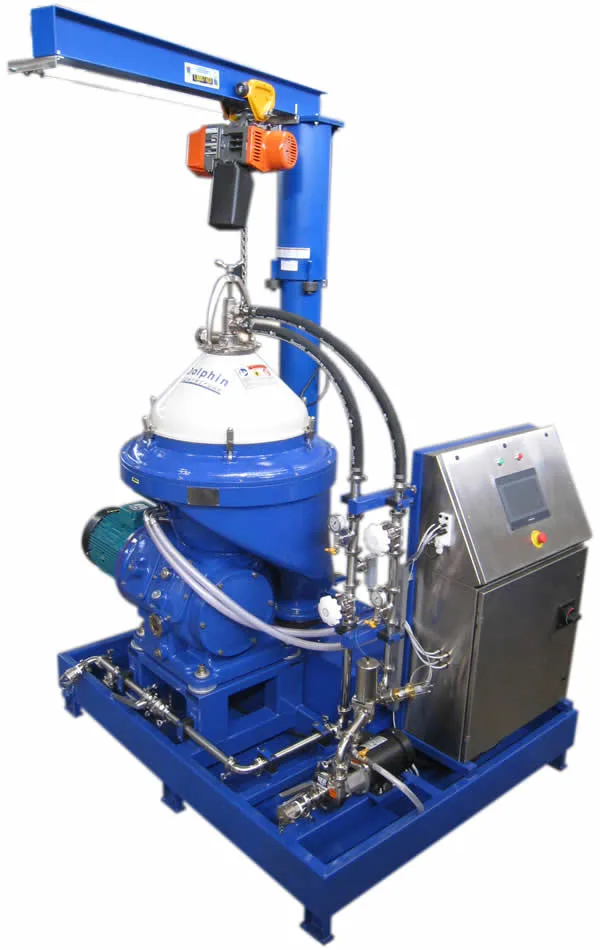
Dolphin Centrifuge DMPX-070 self-cleaning disc stack centrifuge processes 50,000 GPD of silica-laden grinding wastewater at 8,000+ Gs, delivering $1.28M annual savings versus membrane filtration at a silicon wafer facility. Warren, Michigan.
Summary: A semiconductor facility generating 50,000+ gallons of silica-contaminated wastewater daily replaced its ultra-filtration membrane system with a self-cleaning disc stack centrifuge. The result: annual savings of $1,279,000, near-zero consumable costs, and water clean enough to recycle back into the grinding process.
The Challenge
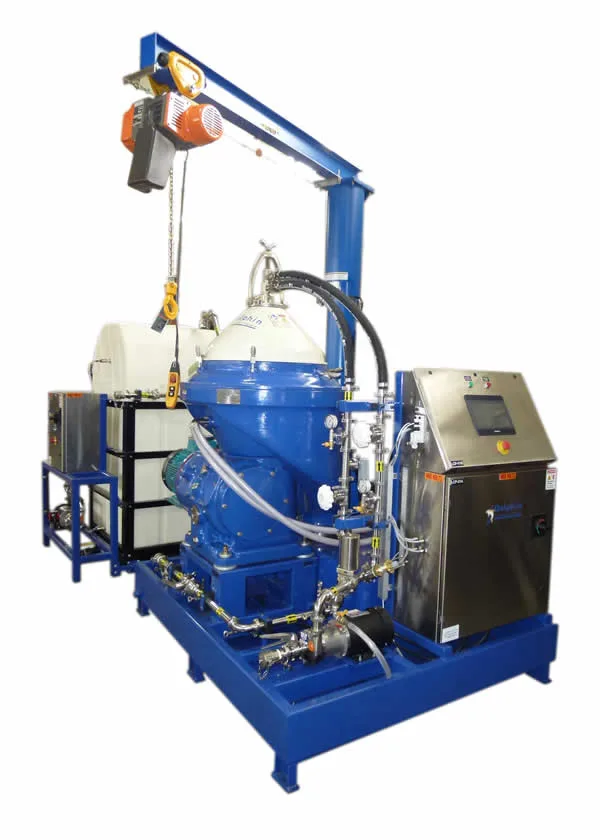
In semiconductor manufacturing, cutting and grinding silicon wafers with diamond blades generates large volumes of contaminated water containing fine silica and diamond particles. These particles are extremely small, often sub-micron in size, making them difficult to remove with conventional methods.
This facility was processing over 50,000 gallons of grinding wastewater every day. Their existing ultra-filtration system used membrane cartridges that cost $350 each and required replacement every 3 to 6 hours due to rapid clogging from the fine abrasive particles. With four membranes per cycle, the annual membrane cost alone reached approximately $1,400,000. Additional labor costs of $33,000 per year were incurred from the constant membrane swaps, and the frequent downtime disrupted production schedules.
The Centrifuge Solution
Dolphin Centrifuge recommended a DMPX-070 self-cleaning disc stack centrifuge rated at 50 gallons per minute for this application. Unlike membrane filters that physically trap particles and clog, the centrifuge uses centrifugal force exceeding 8,000 Gs to drive fine silica and diamond particles to the bowl wall, where they accumulate and are automatically ejected during periodic self-cleaning discharges.
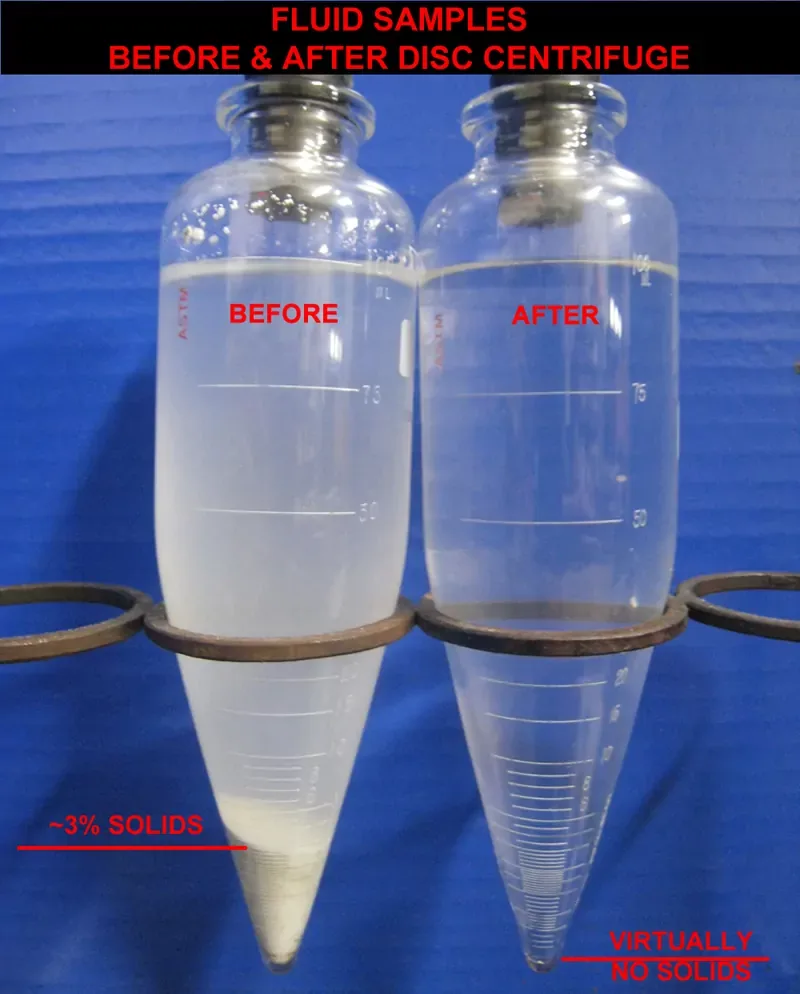
Before committing to a full-scale installation, Dolphin Centrifuge conducted pilot-scale testing using a 1-gallon sample of the facility's grinding wastewater. The test demonstrated complete removal of particle contamination, producing clear, reusable water suitable for recycling back into the grinding operation. Learn more about our industrial centrifuge sample testing process.
How the Disc Stack Centrifuge Works
The wastewater centrifuge operates continuously using the following separation principle:
- Feed inlet: Contaminated wastewater enters through a central feed tube into the spinning bowl
- Centrifugal separation: The bowl spins at high speed generating forces up to 10,000 Gs, driving dense silica and diamond particles outward to the bowl wall
- Disc stack: Conical discs stacked inside the bowl increase the effective settling area, enabling separation of particles down to a fraction of a micron
- Clean water discharge: Clarified water flows toward the center of the bowl and exits through an outlet, ready for reuse
- Automatic sludge ejection: Accumulated particles are periodically discharged from the bowl automatically, with no manual intervention required
Cost Comparison
| Cost Category | Ultra-Filtration | Centrifuge System |
|---|---|---|
| Consumables / Electricity | $1,400,000 | $125,000 |
| Labor / Maintenance | $33,000 | $4,000 |
| Depreciation | — | $25,000 |
| Total Annual Cost | $1,433,000 | $154,000 |
The centrifuge system delivered annual savings of approximately $1,279,000 compared to the ultra-filtration approach — an 89% reduction in operating cost.
Advantages Over Ultra-Filtration
- No consumable media: The centrifuge has no membranes or filter cartridges to replace, eliminating the $1.4M annual consumable cost
- Continuous operation: The self-cleaning mechanism runs without interruption, unlike membranes that require constant swaps every few hours
- Sub-micron separation: Disc stack centrifuges separate particles down to a fraction of a micron, matching or exceeding membrane performance
- Minimal labor: Automated sludge discharge reduces operator intervention to routine monitoring
- Water recycling: The clean centrate is suitable for reuse in the grinding process, reducing fresh water consumption
Environmental Benefits
By enabling on-site water recycling, the centrifuge system significantly reduced the facility's fresh water demand and the volume of contaminated wastewater requiring external disposal. The elimination of disposable membrane cartridges also removed a substantial solid waste stream. Lower overall energy consumption compared to continuous membrane pumping further reduced the facility's environmental footprint.
For semiconductor, glass, and other precision-grinding operations facing similar wastewater challenges, a disc stack centrifuge offers a proven, cost-effective alternative to membrane filtration. Contact Dolphin Centrifuge for sample testing with your grinding wastewater.
Send Us Your Grinding Wastewater Sample
Our engineers will test your actual wastewater and provide a separation report at no charge. Confirm centrifuge performance before any commitment.
Frequently Asked Questions
Can a disc stack centrifuge treat silicon wafer grinding wastewater?
Yes. Disc stack centrifuges effectively separate silica particles (silicon grinding swarf) from wastewater to produce clarified effluent. The centrifuge replaces ultra-filtration membranes that clog rapidly with fine abrasive silica particles. The case study on this page documents $1.28M in annual savings over the membrane filtration system.
Why do centrifuges outperform membrane filters for abrasive particle separation?
Centrifuges separate by density difference and have no membranes to clog — they continue running without fouling even with abrasive fine silica. Ultra-filtration membranes clog rapidly with fine abrasive particles, requiring frequent and costly replacement. Centrifuges have lower operating costs, higher continuous throughput, and no consumable filter media.
What industries besides semiconductor manufacturing benefit from centrifuge wastewater treatment?
Industries with similar fine abrasive particle wastewater challenges include glass grinding and polishing, ceramic manufacturing, precision optical lens production, sapphire wafer processing, and solar panel substrate manufacturing. All benefit from disc stack centrifuge separation as an alternative to membrane filtration.
How much wastewater can a DMPX-070 disc stack centrifuge process?
The DMPX-070 disc stack centrifuge processes up to 50 gallons per minute (72,000 GPD) at 5% solids content. At the silicon wafer facility in this case study, one unit handled 50,000 gallons per day of silica grinding wastewater continuously with a self-cleaning ejection cycle requiring no manual intervention.
Can the water recovered from grinding wastewater be reused in the process?
Yes. The centrifuge produces clarified water with particle counts reduced to near zero — suitable for direct recycling back into the silicon wafer grinding process. This eliminates fresh water procurement costs and reduces the volume of contaminated wastewater requiring external disposal, supporting sustainable semiconductor manufacturing.
Need a Wastewater Centrifuge Solution?
Contact Dolphin Centrifuge for a no-cost consultation and sample testing for your wastewater application.