Dolphin Centrifuge supplies industrial centrifuge systems for liquid humus fertilizer production — decanter centrifuges for bulk solids removal and disc stack polishers clarifying humic acid extracts down to 1 micron. Warren, Michigan. 40+ years experience.
How Liquid Humus Is Made
Dolphin Centrifuge, based in Warren, Michigan, supplies decanter and disc stack centrifuge systems for liquid humus fertilizer production. Liquid humus fertilizer is produced by extracting humic and fulvic acids from organic humus material. The process is straightforward: raw humus (composted organic matter, leonardite, or peat) is mixed with water and an alkaline agent, then allowed to steep for a controlled residence time. During this period, humic substances dissolve into the water phase.
After extraction, the challenge becomes separation. The slurry contains undissolved organic solids, fine sediment, and colloidal particles that must be removed to produce a clean, stable liquid fertilizer. This is where centrifugal separation becomes essential.
A two-stage centrifuge process delivers the best results:
- Primary separation (decanter): Removes bulk solids and coarse organic matter from the extract
- Polishing (disc stack): Clarifies the liquid to remove fine particles down to 1 micron, producing a shelf-stable product
Large-Scale Production with Decanter Centrifuge
For bulk humus extraction, a decanter centrifuge provides the primary separation step. The horizontal scroll decanter handles the high solids load of raw humus slurry — typically 10–30% solids — and produces a clarified liquid extract with minimal residual solids.
NX-314 Stainless Steel Decanter
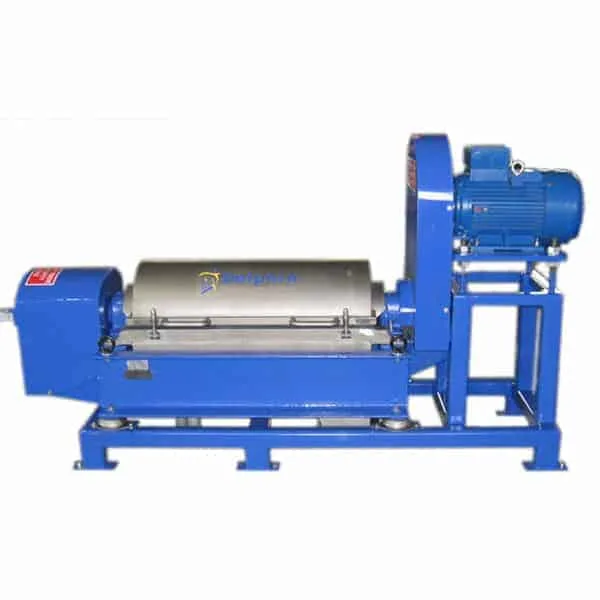
The NX-314 decanter is the recommended primary separator for liquid humus production. Constructed entirely in 316L stainless steel, it resists the corrosive alkaline environment of humus extraction and meets food-grade contact requirements for agricultural fertilizer products.
Key advantages for humus production:
- Continuous operation: No batch cycling — feed raw slurry and collect clarified extract without interruption
- Adjustable scroll differential: Fine-tune solids dryness and liquid clarity by varying the speed difference between bowl and scroll
- High solids handling: Processes slurries with up to 30% solids content without clogging
- 316L stainless steel: Full corrosion resistance for alkaline humus extraction chemistry
- Low moisture solids discharge: Produces dewatered solids at less than 5% moisture for disposal or re-extraction
Lab Testing of Humic Acid Samples
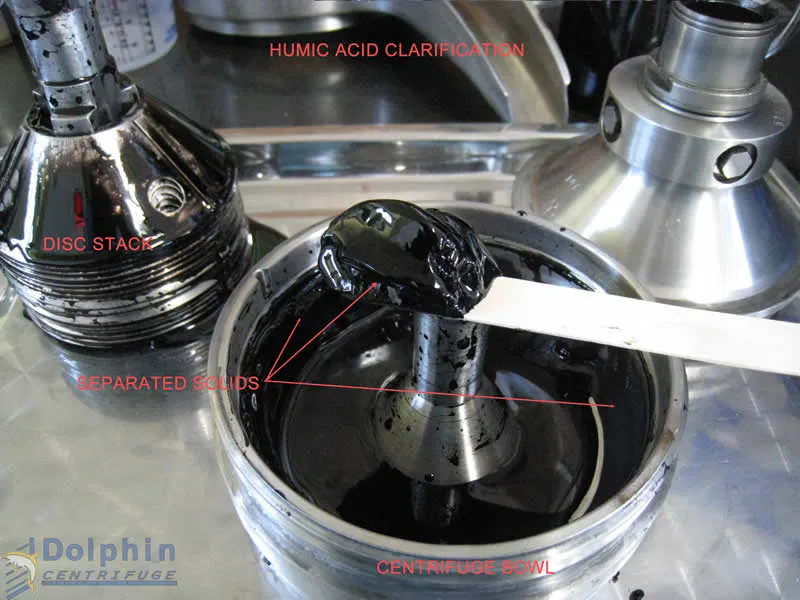
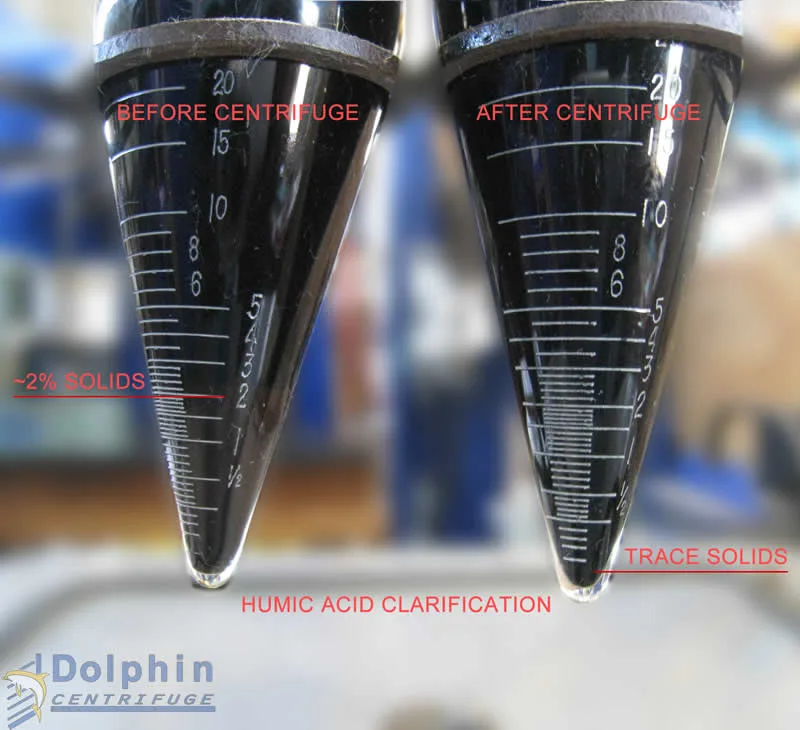
We offer sample testing to evaluate your specific humus material before committing to a production system. Our lab-scale disc stack centrifuge processes small batches of humic acid extract to determine:
- Optimal G-force and flow rate for your extract characteristics
- Expected clarity and color of the finished product
- Recommended discharge interval and solids handling
- Whether single-stage or two-stage separation is required
Send 5–10 gallons of representative humus extract to our Warren, Michigan facility. We provide a detailed test report with centrifuge recommendations and process parameters.
Test Your Humus Extract Before You Invest
Send us a sample of your liquid humus and we will process it through our pilot-scale centrifuge — confirming separation efficiency and recommending the right production system.
Request Sample Testing →Humus Clarifier — Disc Stack Polisher
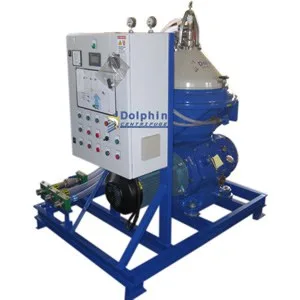
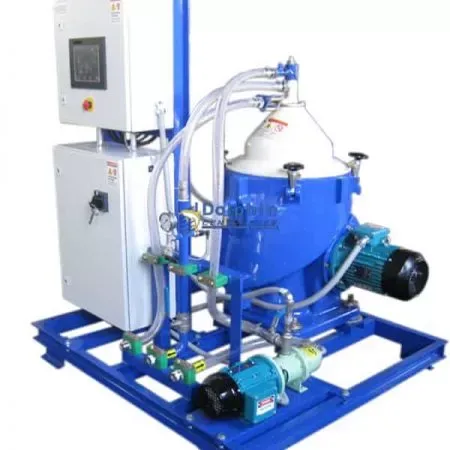
After the decanter removes bulk solids, a self-cleaning disc stack centrifuge polishes the liquid extract to production-grade clarity. Operating at up to 12,000 Gs, the disc stack captures particles down to 1 micron — including colloidal organic matter and fine sediment that would cause settling or cloudiness in the finished product.
The polishing step is critical for premium liquid humus products destined for:
- Foliar spray applications: Requires particle-free liquid to prevent nozzle clogging in spray equipment
- Drip irrigation (fertigation): Fine particles clog emitters and drip lines; polished extract flows cleanly
- Retail bottled products: Consumer-grade humic acid must be clear and free of visible sediment for shelf appeal
The self-cleaning disc stack ejects accumulated solids automatically at timed intervals. No manual cleaning, no batch processing, no downtime. This production step is similar to the clarification approach used for algae harvesting.
Specifications
Decanter Centrifuge — Primary Separator
| Parameter | Specification |
|---|---|
| Capacity | 30 GPM (nominal) |
| Centrifuge Type | Horizontal Scroll Decanter |
| Construction | 316L Stainless Steel |
| Dimensions (L × W × H) | 8′ × 4′ × 4′ |
| Weight | 2,500 lbs |
| G-Force | 3,150 Gs |
| Bowl Speed | 4,000 RPM |
| Drive Motor | 15 HP |
| Solids Moisture | < 5% |
| Power | 460V – 3 Phase |
Disc Stack Polisher — Clarification Stage
| Parameter | 15 GPM System | 25 GPM System | 40 GPM System |
|---|---|---|---|
| Centrifuge Type | Self-Cleaning Disc Stack | Self-Cleaning Disc Stack | Self-Cleaning Disc Stack |
| G-Force | 7,000–12,000 Gs | 7,000–12,000 Gs | 7,000–12,000 Gs |
| Separation | Down to 1 μm | Down to 1 μm | Down to 1 μm |
| Operation | Continuous; self-cleaning | Continuous; self-cleaning | Continuous; self-cleaning |
| Construction | Stainless Steel | Stainless Steel | Stainless Steel |
Contact us for detailed specifications and sizing assistance based on your production volume and humus material characteristics. Higher-capacity decanters are also available.
Related resources: Decanter Centrifuge Guide | Disc Stack Centrifuge Guide | Sample Testing Program | Decanter Applications | Algae Harvesting Centrifuge
Frequently Asked Questions
Why is centrifugal separation important for liquid humus production?
Can I test my humus material before purchasing a centrifuge system?
What equipment is needed for a complete liquid humus production line?
Why is a disc stack polishing step needed after the decanter?
What flow rates are available for liquid humus centrifuge systems?
Ready to Scale Your Liquid Humus Production?
Send a sample or request a quote. Our engineers will size the right decanter and disc stack system for your production volume.