Dolphin Centrifuge stocks the smallest available industrial disc stack centrifuge — the DMB-004 (built on the MAB 103 platform) at 4 GPM rated capacity, 8,600 RPM, and 1 HP. For decanters, the smallest practical unit is the Sharples P-660 at 3,050 Gs. Based in Warren, Michigan, Dolphin Centrifuge has over 40 years of experience matching compact centrifuge solutions to space-constrained applications.
Smallest Decanter Centrifuge
The smallest decanter centrifuge is the Sharples P-660, which has a bowl diameter of approximately 6" and a bowl RPM of 6,000. The operating g-force is 3,070 Gs at full speed. The P-660 has a cyclo gearbox and uses a 7.5 HP motor.
The Sharples P-660 decanter is an ideal lab-scale centrifuge to test the application of larger decanters on a smaller scale. The Sharples company originally manufactured this decanter, which Alfa Laval later took over.
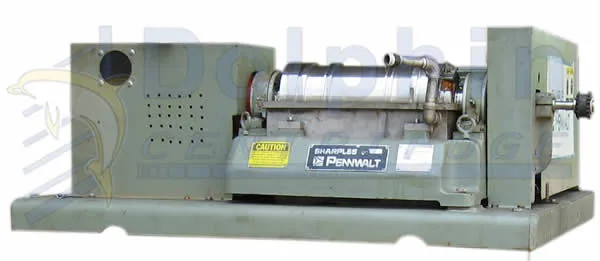
Sharples P-660 Decanter Centrifuge
Specifications
| Parameter | Sharples P-660 |
|---|---|
| Motor Power | 5–10 HP |
| Weight | 450 Lbs |
| Bowl Speed | 6,000 RPM |
| G-Force | 3,050 Gs |
| Dimensions | 15" H × 40" L × 30" D |
| Manufacturer | Sharples (Alfa Laval) |
Applications
The small decanter is applicable for low flow rates in the one to 5 GPM range with minimal solids load. Some of the typical applications are listed below.
Lab-Scale Process Evaluation
These decanters facilitate the evaluation of sludge dewatering and other liquid de-sludging applications on a smaller scale before the procurement of production-scale centrifuges. Separation efficiency and sludge dryness levels are consistent between small and large-scale decanters.
Small Batch Grease Trap Waste
For small volume grease recovery companies, the desludging of grease trap waste is a common application for these small-scale decanters. Grease trap waste with low sludge levels is easily separated from the sludge for downstream oil and water separation with small decanter centrifuges. Learn more about grease trap waste centrifuge systems offered by Dolphin Centrifuge.
Fruit Juice Pulp Separation
The separation of pulp for small volume production of exotic fruit is another application for which these decanters are well suited. The low volumes related to such juice production require small capacity decanters. The Sharples P-660 is well suited for such applications.
Cannabis Biomass Separation
Small-scale cannabis (THC) producers need to separate the biomass from the ethanol solvent. A small decanter efficiently separates the biomass from the ethanol with dry biomass output. The ethanol clarity is also controllable by adjusting the decanter settings.
Advantages
The small decanter offers the following advantages over larger-scale decanters.
Lower Cost
Decanters, in general, are cost-intensive centrifuges. The Sharples P-660 decanter offers the lowest-cost option for an industrial decanter centrifuge.
Small Footprint
The overall dimensions of the smallest decanter are small enough to allow its installation in space-constrained locations. Therefore, this decanter fits in laboratory settings for testing or pilot-scale evaluation purposes.
Mobility
These small sizes and weight decanters mean the user can modularize on portable mobile skids. This mobility allows the decanter for various applications in different locations.
Operable on Lower Voltage
The Sharples P-660 decanter uses a 5-HP motor that is available for operating on 110-volt single-phase power and 460-volt three-phase power. This versatility makes these decanters suitable for a wider variety of applications.
Ease of Service
Being small in size, the components of this decanter are easy to handle by a single technician without the need for lifting assistance, which makes the servicing of these decanters easier than bigger decanter centrifuges. For ongoing maintenance support, see Dolphin Centrifuge's centrifuge repair and service options.
Disadvantages
The small decanter centrifuge has one specific disadvantage, which is as follows.
Low Solids Handling Capacity
The smallest decanter has a lower torque gearbox for conveyor transmission. This lower torque limits the decanter to low solids applications that will not over-torque the gearbox.
Smallest Disc Stack Centrifuge
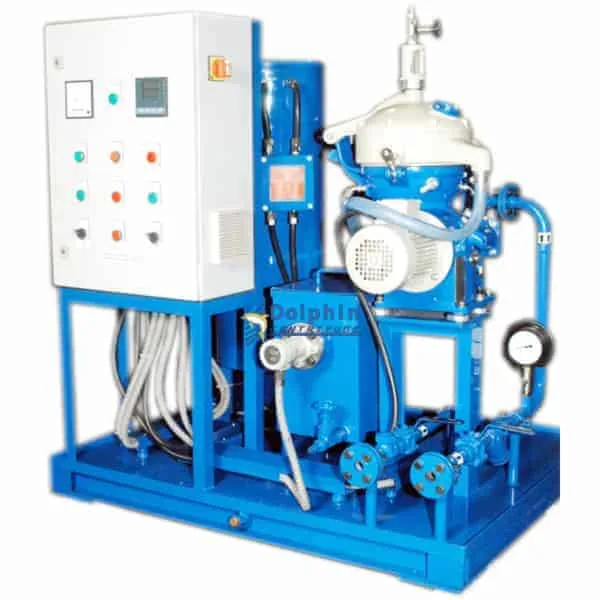
Small Capacity Compressor Oil Centrifuge
The Alfa Laval MAB-102 is the smallest disc-stack centrifuge. This centrifuge has a bowl speed of 9,300 RPM that exerts a g-force of over 8,000 Gs. It is a three-phase, manual clean type centrifuge that can separate oil, water, and small amounts of solid sludge.
This centrifuge is perfect for small boats and generators to polish the diesel fuel to ensure reliable engine operation.
Alfa Laval AB (Sweden) is the manufacturer of the MAB-102 disc stack centrifuge. Dolphin Centrifuge's equivalent model for this platform is the DMPX-005, available through our sales and quoting team.
Specifications
| Parameter | Alfa Laval MAB-102 |
|---|---|
| Motor Power | 0.5 HP |
| Weight | 100 Lbs |
| Bowl Speed | 9,375 RPM |
| G-Force | 8,500 Gs |
| Dimensions | 18" × 25" × 12" |
| Capacity | 2 GPM on Diesel Fuel |
Applications
The following are a few applications for which these small disc stack centrifuges are suitable.
Lab-Scale Process Evaluation
The small disc centrifuge is the primary method to determine the feasibility of a production-scale centrifuge for large-scale fluid processing. The Alfa Laval MAB-102 can demonstrate the separability and efficiency of disc stack centrifuges before acquiring the production equipment. Visit our sample testing page to learn how Dolphin Centrifuge helps customers validate separation before committing to capital equipment.
Small Marine Vessels
Small marine vessels use diesel fuel from storage tanks to power engines. Fuel contamination is common in storage tanks. The Alfa Laval MAB-102 centrifuge can separate diesel fuel from water and solid contaminants, and the clean fuel ensures the reliability of engines.
Catalyst Separation From Small-Batch Chemicals
Chemical industries process catalysts and other ingredients in relatively small batches. A small disc stack centrifuge is ideal for recovering these trace chemicals in small batch volumes.
Advantages
A small-scale disc centrifuge offers a few advantages over conventional filtration and larger centrifuges.
High Centrifugal Force
The smallest disc stack centrifuge (MAB-102) generates over 9,000 Gs of centrifugal force. This gravitational force is high enough to separate particles as small as 1 micron.
No Filter Media
There is no filter or other replaceable media in disc stack centrifugal separators. This is a considerable advantage since it eliminates the recurring cost of replaceable media and associated labor costs.
Three Phase Separation
The design of conventional disc stack centrifuges allows them to separate three phases — it can separate two immiscible liquids and any solids simultaneously. This ability of liquid-liquid separation is unique and offers significant advantages over other separation technologies. See the full range of disc stack centrifuge applications that benefit from this capability.
Disadvantages
Despite all the advantages listed above, the smallest disc stack centrifuge has the following disadvantages.
Cost to Capacity Ratio
Though the smallest disc centrifuge has high efficiency, the processing capacity of the centrifuge is relatively small, while the initial cost is not in proportion to the capacity reduction compared to the larger centrifuges.
Maintenance
These small centrifuges are mechanical devices that require maintenance like all machines. The need for a trained operator and spare parts is sometimes considered a disadvantage.
Capital Equipment Cost
The initial capital expenditure on a small disc stack separator is higher than on filters or coalescers. Though the savings on filter-related expenses quickly pay back the initial investment, the original cost prevents the easy acquisition of these centrifuges.
Utilities Required
The centrifuge operates on electric power and may need additional utilities such as water, compressed air, etc. This requirement is a disadvantage compared to conventional filters that do not need these additional utilities.
Need a small centrifuge for pilot testing or low-volume production?
Dolphin Centrifuge stocks the DMB-004 (smallest disc stack) and can source the Sharples P-660 decanter. Send us a sample and we'll validate your separation on a pilot unit before you buy anything.
Frequently Asked Questions
What is the smallest industrial disc stack centrifuge available? ⌄
The Alfa Laval MAB-102 (and its equivalent Dolphin DMPX-005) is among the smallest self-cleaning disc stack centrifuges, with a bowl diameter of approximately 100mm and a throughput of 50–150 liters per hour. These are used for pilot-scale testing, small batch pharmaceutical processing, and laboratory separation work.
What is the smallest industrial decanter centrifuge? ⌄
The Sharples P-660 is historically one of the smallest industrial decanter centrifuges, with a 6-inch bowl diameter. It handles low-volume continuous sludge dewatering and pilot testing applications. Modern small decanters typically handle 0.5–2 GPM feed rates.
When should I choose a small centrifuge over a full-size unit? ⌄
Small centrifuges are appropriate for pilot testing to validate separation before scaling up, low-volume production (under 200 L/hr), portable systems requiring compact footprint, and laboratory or R&D applications. For production-scale processing above 500 L/hr, full-size disc stack or decanter centrifuges are more economical.
Can a small disc stack centrifuge handle three-phase separation? ⌄
Yes. Even the smallest disc stack centrifuges (such as the MAB-102 / Dolphin DMPX-005) are capable of three-phase separation — simultaneously separating two immiscible liquids (e.g., oil and water) while removing solid sludge. The purifier configuration uses a gravity disc to maintain the liquid-liquid interface. This three-phase capability at a 2 GPM scale is a significant advantage over small filters or coalescers, which handle only one separation task at a time.
What are the limitations of small centrifuges compared to production-scale units? ⌄
Small centrifuges have limited throughput (2–5 GPM for disc stack, 1–2 GPM for decanter), lower solids holding capacity requiring more frequent cleaning or ejection, and a higher cost-to-capacity ratio compared to larger units. They are not suitable for continuous high-volume production but excel at pilot testing, where their separation performance accurately predicts results at production scale.
Ready to test your process on a small centrifuge?
Dolphin Centrifuge's pilot testing program validates your separation on a small disc stack or decanter unit — with full before-and-after lab analysis at no charge. Results scale reliably to production equipment.
(248) 522-2573 • sales@dolphincentrifuge.com • Warren, MI 48089