Dolphin Centrifuge supplies three-phase decanter centrifuges — UVNX-314 and UVNX-418 models at 3,150 Gs and up to 4,000 RPM — for simultaneous separation of solids and two immiscible liquid phases in olive oil, fish meal, slop oil, and produced water applications.
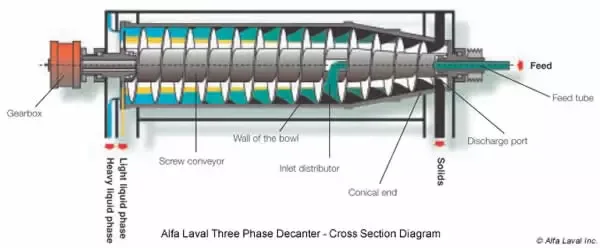
Summary: Three-phase decanter centrifuges are the standard separation technology for olive oil extraction, fish oil processing, slop oil recovery, and produced water treatment — anywhere the feed contains both a solids phase and two immiscible liquid phases that must all be separated simultaneously. Understanding how the three-phase design differs from a conventional two-phase decanter is essential for correct selection and operation.
What a Three-Phase Decanter Does
A standard (two-phase) decanter centrifuge separates one liquid and one solid — for example, dewatering sewage sludge to produce clarified water and a dense solid cake. The operating principle is straightforward: centrifugal force throws the denser solids outward to the bowl wall, where the screw conveyor continuously conveys them to the solids discharge end, while the clarified liquid overflows at the liquid end.
A three-phase decanter performs a more complex separation simultaneously:
- Heavy liquid phase (typically water, specific gravity ~1.0): Exits at the liquid end through a dedicated heavy phase overflow weir at the outer radius.
- Light liquid phase (typically oil, specific gravity ~0.85–0.93): Also exits at the liquid end but through a separate overflow weir or paring tube at a smaller radius, exploiting the density stratification inside the bowl.
- Solids phase (dense insoluble material): Conveyed by the screw to the solids discharge at the opposite end.
All three separations occur simultaneously in a single rotating bowl with a single feed inlet — a compact integration that replaces a more complex multi-stage system.
Types
Three-phase decanters are available in 2 design variants. The difference is in the discharge of the separated liquid phases.
In the standard configuration, the heavy and light liquid phases exit the bowl under gravity. In other words, the liquid phases fall into the casing.
A second variation of the decanter has paring disc pump(s) on the separated liquid phases. These centripetal pumps discharge the separated liquid under pressure. As an added benefit, applying back pressure on the liquid phases helps centrifuge efficiency.
Read more about regular or standard 2-phase decanter centrifuges here.
Process Optimization
The three-phase decanter centrifuge can adapt to specific process requirements by:
- Changing the bowl rotational speed to exert the best G-force for separation.
- Adjusting the scroll differential rotation to balance liquid clarity and sludge handling capacity.
- Calibrating the pond depth to adjust liquid clarity versus solid dryness.
- Interphase adjustment between the heavy and light liquid phases.
- Changing the feed flow rate. These 3-phase decanters can handle a wide range of feed rates.
Three-Phase Decanter Applications
The food and other process industries use the 3-phase decanter extensively. The primary application is to separate a feed slurry of two immiscible liquids and a solid phase. A typical example would be separating an oil phase from the water and solids phase. Specific examples include crude oil separation from water and sludge, fish oil separation from stickwater and fish meal, and industrial wastewater from oil and sludge.
Olive Oil Extraction
The most widespread three-phase decanter application worldwide. Crushed olive paste contains oil, vegetation water, and olive solids (pomace) — all three requiring separation. The three-phase decanter processes the malaxed olive paste continuously, producing separated olive oil, aqueous vegetation water, and pomace solids in a single pass. Virtually all modern commercial olive oil mills use three-phase decanter technology.
Fish Oil and Fish Meal Processing
Fish processing generates a mixture of oil, press water (stickwater), and fish solids. The three-phase decanter separates these streams for independent downstream processing: the oil phase goes to fish oil production; the press water to evaporation and protein recovery; the solids to fish meal drying. Three-phase decanters handle the high solids loads in fish processing better than disc centrifuges in the primary separation stage.
Slop Oil Recovery
Refinery and tank farm slop oil — accumulated from tank cleaning, spills, and process upsets — is a mixture of crude oil, water, and sediment solids. Three-phase decanters recover the oil value from slop streams that would otherwise require disposal. The separated oil returns to the refinery process; the water is treated; the solids are disposed of. This application has one of the shortest payback periods of any three-phase decanter installation.
Produced Water Treatment with Solids
Oil field produced water frequently contains entrained crude oil and formation solids. Three-phase decanters process the produced water stream to recover oil, clarify the water for reinjection or disposal, and discharge the solids separately. This is particularly valuable in facilities where the produced water contains enough oil to justify recovery as a secondary revenue stream.
Biodiesel Glycerin Separation
The transesterification reaction producing biodiesel generates a mixture of biodiesel (methyl ester), glycerin, and catalyst solids or soap. Three-phase decanter technology cleanly separates these streams, with glycerin as the heavy phase, biodiesel as the light phase, and solids continuously conveyed out.
Rendering
Animal rendering produces a hot mixture of fat, water (tank liquor), and greaves (protein solids). Three-phase decanters process the cooked material directly, separating tallow or lard, tank liquor for further processing, and greaves for animal feed or meal production.
Three-Phase Decanter Specifications
| Parameter | Alfa Laval UVNX-314 | Alfa Laval UVNX-418 |
|---|---|---|
| Bowl Diameter | 353 mm | 353 mm |
| Max. G-Force | 3,150 Gs | 3,150 Gs |
| Light Phase Discharge | Gravity | Gravity |
| Heavy Phase Discharge | Gravity | Gravity |
| Max. Bowl Speed | 4,000 RPM | 4,000 RPM |
| Bowl Length | 860 mm | 1,460 mm |
| Net Weight | 4,200 Lbs | 5,500 Lbs |
| Drive Motor | 15 HP | 25 HP |
| Noise Level | ~ 80 dB(A) | ~ 82 dB(A) |
You may also consider renting a decanter centrifuge from Dolphin Centrifuge. Call (248) 522-2573 to check for availability.
How the Three-Phase Design Differs from a Two-Phase Decanter
Dual Liquid Discharge at the Liquid End
The most visible design difference is at the liquid end of the bowl. A two-phase decanter has a single liquid overflow at one adjustable weir radius. A three-phase decanter has two separate overflow points: the heavy phase weir at a larger radius and the light phase weir at a smaller radius. The gap between these radii defines the annular space where the two liquid phases stratify — the fundamental separation zone for liquid-liquid separation within the decanter geometry.
Pond Depth Optimization
In a two-phase decanter, pond depth (the liquid depth inside the bowl) is set to maximize solids dryness — typically by raising the liquid level as low as possible. In a three-phase decanter, pond depth must be set to balance three competing requirements: adequate liquid residence time for oil-water stratification, sufficient solids conveying, and correct weir overflow ratios for both liquid phases. This makes three-phase pond depth adjustment more nuanced than in two-phase operation.
Beach Angle Considerations
The conical beach angle (the angle at the solids discharge end) influences both liquid-solid separation and the time available for liquid-liquid stratification as the solids are conveyed up the beach toward discharge. Three-phase decanters often use a shallower beach angle than equivalent two-phase models to maximize the liquid zone length and improve oil-water separation.
Water Addition (Three-Phase Olive Oil)
In some three-phase applications — particularly olive oil — dilution water is added to the feed before the decanter to reduce feed viscosity and improve oil-water separation efficiency. This is a deliberate design feature, not a limitation; the added water is separated and discharged through the heavy phase outlet. The quantity of dilution water added is an operating parameter that affects both oil quality and water volume.
Advantages vs. Running Two Separate Centrifuges
An alternative approach to the same separation — a two-phase decanter for solids removal followed by a disc centrifuge for liquid-liquid separation — is used in some applications. The three-phase decanter approach offers several advantages:
- Lower capital cost: One machine versus two machines. The three-phase decanter is more expensive than a simple two-phase model, but less than the combined cost of a two-phase decanter plus a disc centrifuge.
- Reduced footprint: Critical in retrofit installations and mobile processing units where space is at a premium.
- Simpler operation: One startup sequence, one shutdown procedure, one maintenance program.
- Handles high-solids feeds directly: In applications like olive oil or fish processing where the feed solids content is 15–40%, a disc centrifuge cannot be used as the primary separator — the solids load would fill the bowl sludge space immediately. The three-phase decanter's screw conveyor handles these high-solids feeds continuously.
- Reduced operator exposure: The sealed design minimizes operator contact with process fluids.
- Long service life: No replaceable filter media — only mechanical wear parts require periodic maintenance.
The two-machine approach (decanter + disc centrifuge) offers better liquid-liquid separation quality in the final polishing stage and is preferred in applications where product purity is paramount and solids content is lower. The three-phase decanter is preferred where feed solids are high and the combined capital and operating cost savings outweigh the marginal separation quality advantage of the two-machine approach.
When to Choose a Three-Phase Decanter
A three-phase decanter is the right choice when all of the following conditions apply:
- The feed contains solids plus two distinct immiscible liquid phases that all need separate processing.
- Feed solids content is too high for a disc centrifuge to handle as the primary separator (>3% by volume).
- Continuous operation is required — the process cannot tolerate batch separation cycles.
- A combined capital and footprint advantage over a two-machine approach is valuable.
If your feed has very low solids content and the primary challenge is liquid-liquid separation quality (for example, polishing a clarified oil to remove residual water and fine solids), a standard decanter followed by a disc centrifuge may achieve better final product quality than a three-phase decanter alone.
Dolphin Centrifuge can evaluate your specific application and recommend the optimal configuration. Contact us with your feed composition, flow rate, and separation targets.
To discuss three-phase decanter specifications for your application, call Dolphin Centrifuge at (248) 522-2573 or email sales@dolphincentrifuge.com.
Test Your Feed on a Three-Phase Decanter
Ship us a sample of your slurry or oily water stream. Our engineers will evaluate it and recommend the right three-phase separation configuration — at no charge to you.
Frequently Asked Questions
What does a three-phase decanter centrifuge separate?
When should I use a three-phase decanter instead of a two-phase decanter plus a disc centrifuge?
How is pond depth adjusted on a three-phase decanter?
What G-force does a three-phase decanter generate?
What capacity does a three-phase decanter centrifuge handle?
Related Articles
How standard two-phase decanter centrifuges work and their applications.
Decanter Pond DepthHow pond depth affects liquid clarity and solids dryness in decanter centrifuges.
Differential Speed ExplainedThe role of differential speed between bowl and conveyor in decanter performance.
Centrifuge FAQ (101 Questions)Frequently asked questions about industrial centrifuge selection and operation.
Industrial Centrifuge OverviewTypes, applications, cost, and benefits of industrial centrifuge systems.
Disc Stack Centrifuge GuideHigh-speed disc stack separators — operation, specs, sizing, and bowl types.
Sample TestingTest your feed material at Dolphin Centrifuge's Warren, MI facility at no charge.
Get a QuoteContact Dolphin Centrifuge for three-phase decanter pricing and availability.