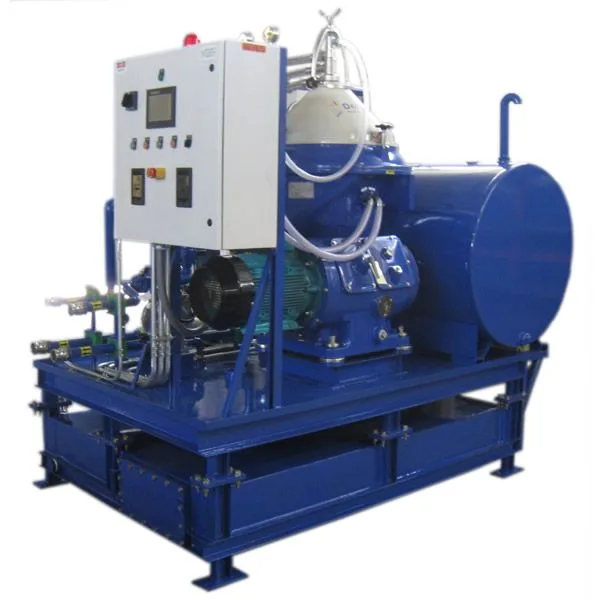
Dolphin Centrifuge supplies industrial used oil centrifuge systems that separate sediment, water, and ash at 7,000+ Gs. Separation efficiency of 0.5 microns for metal particles and 2 microns for non-metal particles. Processing 25–40+ GPM continuously from Warren, Michigan.
What is Used Oil?
Used oil is defined as any oil originating in crude oil or petroleum with physical or chemical impurities as contaminants from its use. Dolphin Centrifuge, based in Warren, Michigan, supplies purpose-built disc stack centrifuge systems for this application at 7,000+ Gs with separation down to 0.5 microns.
The United States produces over 2 billion gallons of used oil annually. This oil has considerable value as a heating fuel and for reblending into lube oil after recycling. Centrifugal separation is the most efficient industrial method for reclaiming used oil into a valuable commodity.
Used Oil vs. Waste Oil
Although the terms are sometimes used interchangeably, used oil and waste oil have distinct definitions that affect handling, regulation, and end-use options.
- Used Oil: Used oil has mineral-based origins, as in crude oil or synthetic oil. Used engine oil, transformer oil, turbine lube oil, etc., are examples of used oil.
- Waste Oil: Waste oil is an oil with organic origin such as WVO (Waste Vegetable Oil), Used Cooking Oil, yellow grease, etc. See our waste oil centrifuge page for more on those applications.
The distinction is important because used oil is a far better candidate for reclamation via centrifugation. Its mineral or synthetic base remains stable, and contaminants can be mechanically separated without altering the base stock.
Reclaiming Used Oil
Used oil reclamation is a thriving industry that collects and purifies used oil in large quantities. These industries use different types of separation techniques that are listed below in the methods section.
Benefits of Used Oil Reclamation
The commercial reclamation of used oil has multiple benefits from a commercial and environmental perspective. Some of these benefits are listed below.
- Reduce Environmental Pollution: Used oil discarded in landfills is a significant source of environmental pollution. It contaminates groundwater and soil. Recovery of used oil prevents this pollution.
- Feed Stock for Fresh Lube Oil: Refined used oil is a feedstock for the production of virgin lubricating oil. This process allows for the reuse of used oil as a low-cost and environmentally friendly alternative.
- Heating Fuel: A considerable amount of used oil finds use in heating industrial buildings. Though contaminated, used oil has a high calorific value and is ideal for heating fuel.
- Black Diesel: Purified used oil is also known as black diesel. This name comes from the use of this oil as fuel for diesel engines. The blend of diesel and used oil is allowable by the manufacturers of large diesel engines.
Methods of Used Oil Recovery
Heating, Settling, and Filtration
A used oil filtration system includes tanks, heaters, multi-bank filters, pumps, etc. The typical process involves the following steps.
- Pre-straining the incoming oil: The freshly collected used oil passes through a coarse strainer (½") to remove large debris such as rocks, twigs, nuts, bolts, etc.
- Heating and settling: An air diaphragm or similar pump transfers the used oil to a storage tank with heating coils or a circulation heater. The increase in oil temperature causes the water and sludge to drop out.
- Draining water: The operator then drains the water out of the settling tank from a drain port above the sludge level.
- Clean oil recovery: The remaining oil layer is siphoned from the top and is the clean oil from this system.
- Filtering & Distilling: The 'clean oil' recovered from the siphoning carries entrained water and fine sludge particles from the used oil. This oil is passed through a bank of filters of progressively finer mesh size to remove the small particles. Vacuum distillation removes the entrained water.
Centrifugation
An industrial oil centrifuge combines most of the recovery steps mentioned above into one device that uses highly amplified centrifugal force to separate the oil from water and sediment. These centrifuges are continuous processing devices that offer high separation efficiency with a small footprint. By generating centrifugal forces of 7,000 Gs or higher, the centrifuge compresses hours of gravity settling into seconds of continuous processing.
Test Your Used Oil Before You Commit
Dolphin Centrifuge offers pilot-scale sample testing for used oil at our Warren, Michigan facility. We evaluate water content, solids loading, and emulsion type to size the right system for your operation.
Request Sample Testing →Used Oil Centrifuge Operation
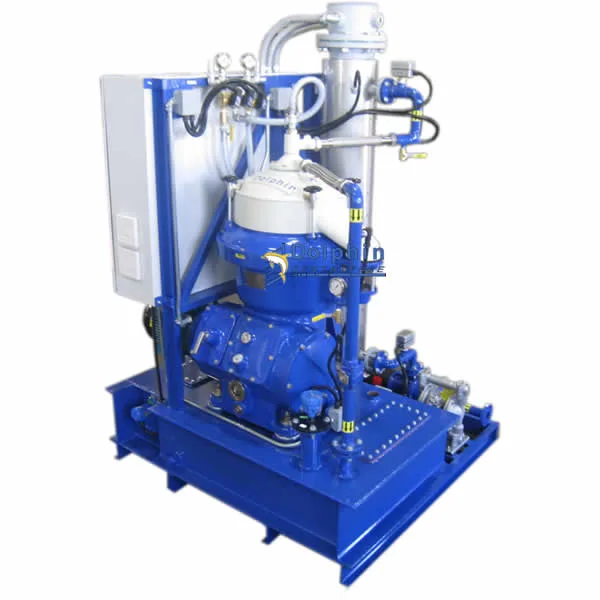
A used oil centrifuge is an industrial disc-stack centrifuge that exerts over 7,000 Gs of centrifugal force on the oil. This force is sufficient to separate all free water and sediment as small as 0.5 microns. The self-cleaning feature of the centrifuge allows it to eject the separated solids intermittently while the separated water exits the centrifuge continuously.
A used oil centrifuge works on the principle of differential settling of the different phases in used oil based on their respective specific gravity. The contaminated oil enters the rotating centrifuge bowl through an inlet pipe and passes through the rotating stack of discs within the bowl. The rotating discs impart the rotational velocity to the oil and its contaminants.
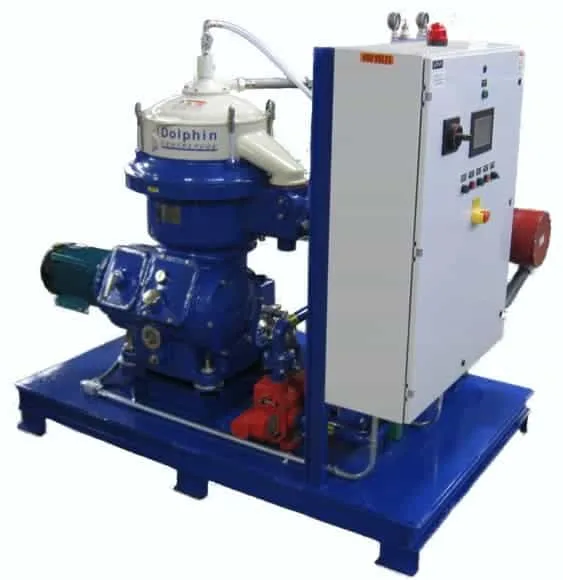
The heavier sludge moves towards the bowl wall due to the high centrifugal force. This sludge displaces the lighter oil towards the center from where the separated oil enters an exit chamber before discharge from the bowl.
The sludge and water (if any) accumulate at the bowl wall, and the centrifuge automatically ejects the sludge periodically. The centrifuge bowl has a passage for the separated water, which allows the water to discharge through.
Separation Efficiency
One of the advantages of using an industrial centrifuge for used oil separation is the separation efficiency of these centrifugal separators.
- Particle Separation: A disc-stack centrifuge has a separation efficiency of 0.5 microns for metal particles and 2 microns for non-metal particles. Metal fines, carbon particles, and dirt are continuously removed.
- Water Removal: In addition to particle removal, a used oil centrifuge also simultaneously separates all free water from the oil. This centrifuge can also break oil-water emulsions and recover more oil under certain conditions as an added benefit.
- Ash: Ash particles impart a black color to used oil. Though these particles are sub-micron level in size and light, the high centrifugal force in a disc-stack centrifuge can separate a considerable amount of ash from used oil. Flocculants enhance this ash separation ability further as they solidify some finer ash particles into larger particles that the centrifuge can separate.
- Emulsion Breaking: Used oil often carries an emulsion phase that is difficult to separate by gravity settling without chemicals. Disc stack centrifuges can break oil emulsion to a certain extent based on the emulsion type. Chemically bonded emulsions need acid treatment or demulsifiers to separate the oil from the water.
Benefits
There are several benefits to using centrifuges for used oil purification compared to gravity settling and filtration. The following is a list of the advantages.
- Three Phase Separation: Disc stack centrifuges separate water and sludge simultaneously from used oil. This ability is referred to as three-phase separation and is unique to disc-stack centrifugal separation. Filters and gravity separation are only helpful for separating sludge from used oil but not water.
- Small Footprint: Disc stack centrifuges have a relatively smaller footprint than conventional devices for used oil purification. A used oil centrifuge has a fraction of the size of filters and settling tanks for similar capacity.
- Operating Cost: Used oil centrifuges use gravitational force to affect oil-water separation. These centrifuges do not use media for separation, thus eliminating the media and related labor costs. Therefore, industrial centrifuges have very low operating costs as compared to filters and tanks.
- Separation Efficiency: Oil centrifuges separate a range of particle sizes that would otherwise require multiple filters of different sizes. The smallest particle size rating for a centrifuge is 0.5 microns.
- Emulsion Separation: In addition to microscopic particle size separation, disc stack centrifuges can often break oil-water emulsions by extracting the tiny particles that bind mechanical emulsions. The emulsion-breaking ability depends on the emulsions and may require chemical demulsifiers to assist in the separation.
- Equipment Durability & Longevity: Industrial centrifuges incorporate heavy-duty construction that allows these centrifuges to last for decades of operation. With periodic maintenance, these centrifuges operate continuously over extended periods. It is not uncommon for industrial centrifuges to operate for months without the need for shutdown or operator involvement.
- Automatic Operation: PLC-controlled self-cleaning cycles enable unattended operation at high throughput.
Disadvantages
The following list of the most prominent disadvantages of used oil centrifuges.
- Capital Cost: The initial capital expenditure for centrifuges is relatively higher than for filters and tanks. However, the lower operating costs and labor cost savings quickly recover the additional expense.
- Utilities Required: Used oil centrifuges are mechanically driven and therefore require utilities such as electricity and water for operation. Filters are primarily non-moving media that do not require utilities for operation.
- Noise: The rotating components in a used oil centrifuge create noise from the gears and drive motors as well as the air movement within the centrifuge. Filters, on the other hand, are relatively quiet during operation.
- Maintenance: All mechanical devices that operate at high rotational speeds require periodic maintenance. This upkeep ensures reliable operation of the equipment as well as equipment longevity. Filters only need to be replaced with new media on an ongoing basis with little maintenance.
Design Considerations for Used Oil Centrifuges
Specific design considerations apply to used oil centrifuges. Some of the important considerations are as follows.
Acidic Material
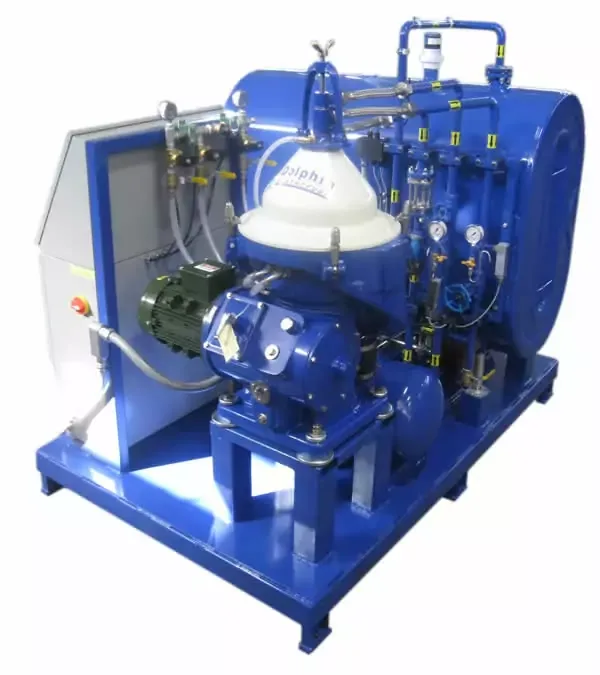
Used oil processors use acids to dissolve and remove metals and break emulsions. The low pH value of the oil necessitates the use of corrosion-resistant material in the centrifuges and related piping. Centrifuges with all stainless steel wetted parts are available for such applications.
Chemical Injection
The provision of chemical injection ports upstream of the centrifuge allows adding chemicals such as demulsifiers or flocculants. Metering chemical pumps as an option are well suited for these applications.
Water Phase Proportion
The standard disc stack centrifuges design uses large volumes of oil with a small proportion of water. However, the water proportion can be relatively high in the case of used oil. Some internal centrifuge modifications allow for the discharge of this larger volume of water to allow the centrifuge to process maximum volumes.
Special Elastomers
Adding chemicals or inherent used oil properties may not be compatible with ordinary elastomers. In such cases, the centrifuges have special elastomers with specific compatibility for the process fluid.
Used Oil Centrifuge Specifications
The following specifications apply to our two most popular self-cleaning disc stack centrifuge systems for used oil processing:
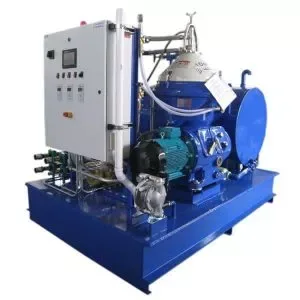
| Specification | DMPX-042 System | DMPX-070 System |
|---|---|---|
| Rated Capacity | 40 GPM | 68 GPM |
| Heavy Used Oil @ 180°F | 25 GPM | 40 GPM |
| Drive Motor | 10 HP | 15 HP |
| Bowl Speed | 5,200 RPM | 4,200 RPM |
| Weight | 3,200 lbs | 5,100 lbs |
| Dimensions | 4' × 5' × 7' (H) | 5' × 6' × 8' (H) |
| Sludge Discharge | Self Ejection (Automatic) | Self-Ejection (Automatic) |
| Liquid Phase Discharge | Light & Heavy Phase – Pressurized | |
| Bowl Wetted Parts | 316 Stainless Steel / Marine Grade Bronze (Nickel Plated) | |
| Operating Voltage | 230 or 460 VAC – 3-Phase – 60 Hz (50 Hz Available) | |
For smaller volumes, the DMPX-028 system offers rated capacity of approximately 20 GPM on used oil at 180°F. Contact us for sizing assistance based on your specific oil type and throughput requirements.
Used Oil Centrifuge Plant Layout
The following diagram shows a large-scale used-oil centrifuge processing plant layout using our three-phase centrifuges. This layout includes a decanter centrifuge that is a preprocessor to remove bulk sludge from the used oil if needed.
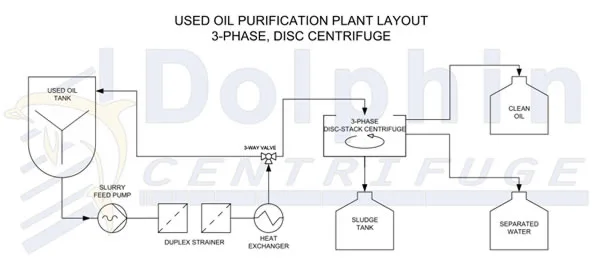
Two-Stage Process Flow
- Stage 1 — Decanter Pre-Processing: A decanter centrifuge receives crude used oil and removes bulk solids from ½" down to approximately 50 microns. The decanter handles high sludge loads (up to 40% solids) that would overwhelm a disc stack centrifuge.
- Stage 2 — Heating: The de-sludged oil passes through an inline electric heater to reach the target processing temperature of 180–200°F, reducing viscosity for optimal disc stack performance.
- Stage 3 — Disc Stack Polishing: A self-cleaning disc stack centrifuge (DMPX-042 or DMPX-070) performs three-phase separation at 7,000+ Gs, removing particles down to 0.5 microns and all remaining free water.
- Stage 4 — Controls: A PLC-based control panel manages both centrifuges, heaters, pumps, and sludge ejection cycles for fully automated operation.
This two-stage layout is the standard configuration for commercial used oil processors handling 1 million gallons per year or more. It maximizes equipment life by protecting the high-speed disc stack centrifuge from abrasive bulk solids.
Related resources: Waste Oil Centrifuge | Black Diesel Centrifuge | Disc Stack Centrifuge | Sample Testing Program | Decanter Centrifuge | Disc Stack Applications
Frequently Asked Questions
What is the difference between used oil and waste oil?
How clean can a centrifuge make used oil?
Why use a two-stage centrifuge system for used oil?
How many gallons of used oil can a centrifuge process per day?
Can I test my used oil before purchasing a centrifuge system?
Ready to Reclaim Your Used Oil?
Call our engineers or send a sample for testing. We will size the right centrifuge system for your used oil volume and feedstock.