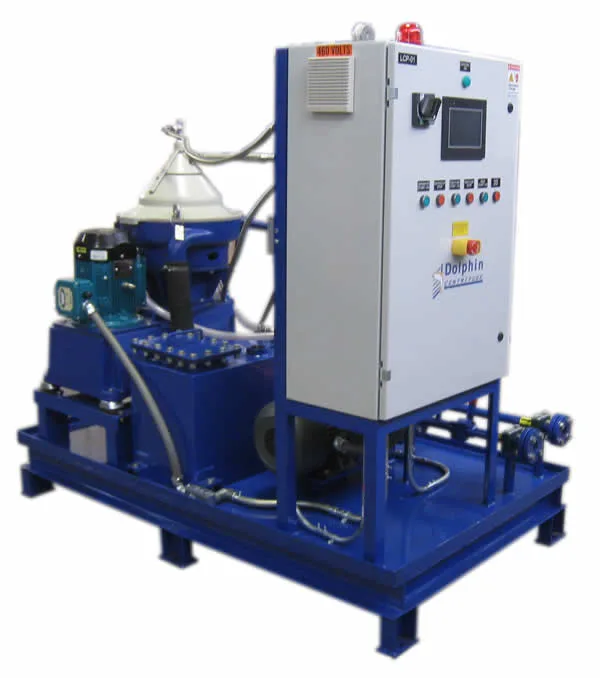
Dolphin Centrifuge supplies disc stack centrifuge systems generating up to 8,000 Gs for breaking waste oil emulsions mechanically — recovering up to 98.7% clean oil at 200 degrees F without chemical demulsifiers. Case study: $650,000 additional annual revenue from a Guam facility.
What Is an Emulsion?
An emulsion is a mixture of two immiscible liquids where one liquid is dispersed as microscopic droplets within the other. In the context of waste oil, emulsions form when water becomes finely dispersed throughout the oil — or vice versa — creating a stable mixture that resists natural separation by gravity.
Emulsified water in waste oil presents a major challenge for oil recyclers. Unlike free water, which settles to the bottom of a tank over time, emulsified water remains suspended within the oil indefinitely. This dramatically reduces the quality and value of recovered oil.
Types of Emulsions
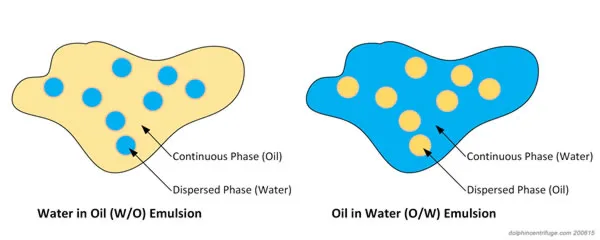
Oil-in-water vs water-in-oil emulsion types
Waste oil emulsions fall into two categories based on which liquid forms the continuous phase:
- Oil-in-Water (O/W): Oil droplets are dispersed within a continuous water phase. This type is commonly found in metalworking fluid waste, wash water, and bilge water. The mixture appears cloudy or milky.
- Water-in-Oil (W/O): Water droplets are dispersed within a continuous oil phase. This is the more common emulsion type in waste oil collection. The mixture appears dark and has a higher viscosity than clean oil.
The type of emulsion determines the optimal separation approach. Water-in-oil emulsions are particularly challenging because the water droplets are shielded by the surrounding oil, making them resistant to coalescence without mechanical force or heat.
What Causes Emulsion in Waste Oil
Emulsions in waste oil are caused by a combination of mechanical and chemical factors during the oil's service life and collection process:
- Mechanical Agitation: Pumping, mixing, and turbulent flow during oil collection and transfer break water into fine droplets within the oil, creating stable emulsions.
- Detergents and Soaps: Engine oils contain detergent and dispersant additives that act as surfactants — chemicals that stabilize emulsions by reducing the surface tension between oil and water.
- Fine Particulates: Microscopic solid particles (carbon, metal fines, dirt) accumulate at the oil-water interface and physically stabilize emulsion droplets, preventing them from coalescing.
- Temperature Cycling: Repeated heating and cooling of oil during engine operation promotes water absorption and emulsion formation.
In many waste oil operations, emulsified oil accounts for 15–25% of the total collected volume — representing significant lost revenue if not recovered.
Methods of Splitting Emulsions
There are two fundamental approaches to breaking waste oil emulsions: chemical treatment and mechanical separation.
Chemical Methods
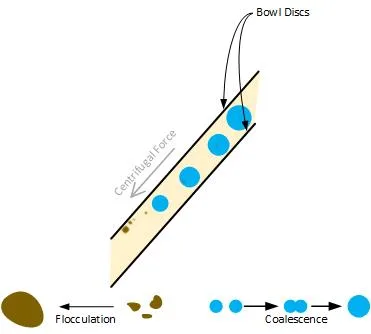
Flocculation and coalescence in waste oil emulsions
Chemical demulsifiers work by disrupting the surfactant film that stabilizes emulsion droplets. Coalescence occurs when the demulsifier weakens the interfacial film, allowing small water droplets to merge into larger ones that can settle by gravity. Flocculation uses polymers to aggregate dispersed droplets into larger clusters that separate more easily.
While chemical treatment can be effective, it has significant drawbacks: ongoing chemical costs, inconsistent results across varying oil compositions, and the need for precise dosing. Overdosing can actually stabilize the emulsion further.
Mechanical Methods
Mechanical emulsion breaking uses physical force — primarily centrifugal force — to overcome the interfacial tension holding emulsified droplets in suspension. A high-speed disc stack centrifuge generates forces up to 8,000 Gs, which is sufficient to break most waste oil emulsions without chemical additives.
The key advantage of mechanical separation is consistency. Unlike chemical methods that require adjustment for each batch of oil, centrifugal separation works predictably regardless of the oil's additive package or contamination profile.
Struggling With Emulsified Waste Oil?
Send us a sample for pilot testing — our engineers will evaluate your emulsified waste oil and recommend the optimal centrifuge for maximum oil recovery.
How a Disc Stack Centrifuge Separates Emulsified Water
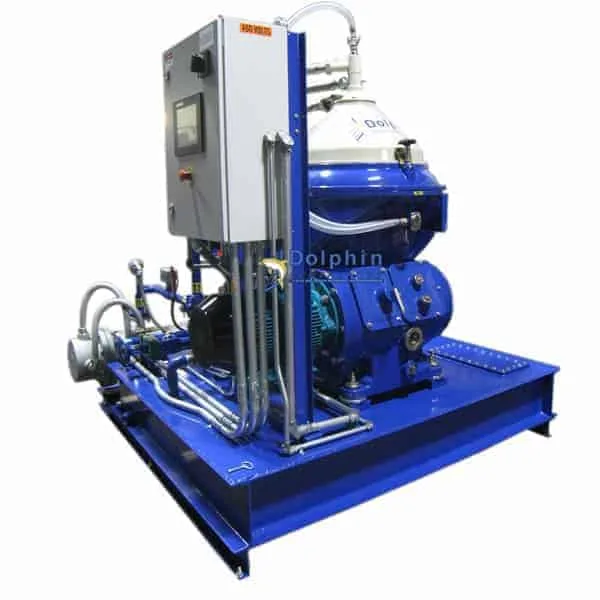
Alfa Laval MOPX-209 disc stack centrifuge for waste oil emulsion breaking
A self-cleaning disc stack centrifuge separates emulsified water from waste oil through intense centrifugal force applied across a thin-film flow path. The process works as follows:
- Waste oil is pre-heated to reduce viscosity and weaken the emulsion's interfacial film (typically 180–200°F)
- The heated oil enters the centrifuge bowl, which spins at high speed, generating thousands of Gs of centrifugal force
- Inside the bowl, a disc stack (a series of conical discs) creates thin-film channels that dramatically shorten the settling distance for water droplets
- The intense G-force overcomes the interfacial tension holding water droplets in suspension, forcing them to coalesce and migrate toward the bowl periphery
- Separated water (heavy phase) discharges through a dedicated outlet, while clean oil (light phase) exits through a separate outlet
- Accumulated solids are automatically ejected through the self-cleaning mechanism at timed intervals
The combination of high temperature and high centrifugal force is the key to effective emulsion breaking. Temperature weakens the emulsion, while centrifugal force provides the mechanical energy to complete the separation.
Case Study: Guam Waste Oil Recovery
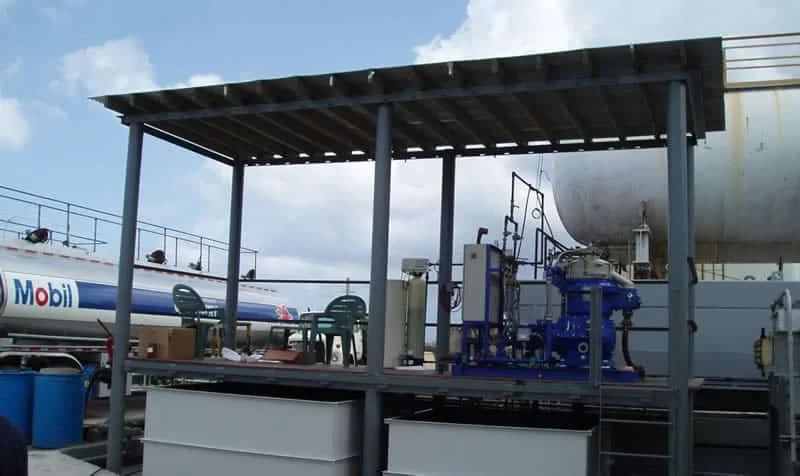
Waste oil centrifuge installation in Guam
A waste oil recycler based in Guam collects fuel oil and waste oil from naval vessels and cruise ships calling at the island's port. The collected oil contains a high proportion of emulsified water due to the mechanical agitation during ship-to-shore transfer and the detergent additives present in marine engine oils.
Prior to centrifuge processing, the customer relied on chemical demulsifiers combined with gravity settling. This approach recovered approximately 78% of the collected oil as sellable product. The remaining 22% — mostly emulsified oil — was either disposed of at a cost or left in settling tanks indefinitely.
The customer evaluated a self-cleaning disc stack centrifuge system to determine if mechanical separation could improve recovery rates and reduce dependence on chemical treatment.
Experiment Results
Four test iterations were conducted, varying process temperature and flow rate through the centrifuge. The objective was to determine the optimal operating parameters for maximum oil recovery from the emulsified waste oil.
| Test | Temperature | Flow Rate | Oil Recovery | Emulsion | Water |
|---|---|---|---|---|---|
| 1 | 140°F | 12 GPM | 89.2% | 7.4% | 3.4% |
| 2 | 140°F | 6 GPM | 93.5% | 4.1% | 2.4% |
| 3 | 200°F | 12 GPM | 95.8% | 2.7% | 1.5% |
| 4 | 200°F | 6 GPM | 98.7% | 0.9% | 0.35% |
Key Findings
- Temperature is the dominant factor. Raising process temperature from 140°F to 200°F improved oil recovery by 5–6 percentage points at both flow rates.
- Lower flow rate improves separation. Reducing flow from 12 GPM to 6 GPM provides longer retention time in the centrifuge bowl, yielding better emulsion breaking.
- Optimal parameters: 200°F at 6 GPM achieved 98.7% oil recovery with only 0.9% residual emulsion and 0.35% water in the clean oil.
Revenue Impact
The financial impact of centrifuge-based emulsion breaking was substantial. By increasing oil recovery from 78% (gravity settling) to 92% (centrifuge processing), the customer recovered an additional 14% of previously lost oil.
| Metric | Gravity Settling | Centrifuge Processing |
|---|---|---|
| Oil Recovery Rate | 78% | 92% |
| Additional Gallons Recovered/Year | — | 450,000 gallons |
| Additional Annual Revenue | — | $650,000 |
| Chemical Demulsifier Costs | Ongoing | Eliminated |
The 450,000 additional gallons per year of recovered oil — previously lost to emulsion — generated approximately $650,000 in additional annual revenue. This is in addition to the savings from eliminating chemical demulsifier purchases.
The centrifuge system paid for itself within the first year of operation through increased oil recovery alone.
Frequently Asked Questions
Can a centrifuge break waste oil emulsions without chemicals? ▼
Yes. A disc stack centrifuge generating up to 8,000 Gs of centrifugal force can mechanically break most waste oil emulsions without chemical additives. The intense force overcomes the interfacial tension holding emulsified water droplets in suspension. Pre-heating to 180-200 degrees F further weakens the emulsion for optimal separation.
What is a rag layer in waste oil processing? ▼
The rag layer is a stable emulsion zone that forms between the oil and water phases during gravity settling. It consists of finely dispersed water droplets suspended in oil, stabilized by surfactants, free fatty acids, and fine particulates. A centrifuge is the most effective way to break the rag layer and recover the trapped oil.
How much additional oil can a centrifuge recover from emulsified waste oil? ▼
In a documented case study, a waste oil recycler increased oil recovery from 78% (gravity settling) to 92% (centrifuge processing), recovering an additional 450,000 gallons per year worth approximately $650,000 in additional annual revenue. Results vary depending on feedstock composition and emulsion severity.
What temperature is needed for emulsion breaking with a centrifuge? ▼
Processing temperature of 180-200 degrees F provides optimal results. Higher temperature reduces oil viscosity and weakens the emulsion interfacial film, allowing the centrifuge to separate the phases more effectively. At 200 degrees F and 6 GPM, test results showed 98.7% oil recovery with only 0.35% residual water.
Which Dolphin Centrifuge model is best for emulsified waste oil? ▼
The DMPX-042 self-cleaning disc stack centrifuge is the most popular model for emulsified waste oil processing, handling 25–32 GPM on heated waste oil at 180°F. For smaller volumes, the DMPX-028 handles 15–20 GPM. Both models feature automatic sludge ejection for continuous unattended operation and are configured with appropriate gravity discs for water-in-oil emulsion separation.
Related resources: Waste Oil Centrifuge Systems | Used Oil Centrifuge | Cutting Oil Centrifuge | Disc Stack Centrifuge | Sample Testing Program | Decanter vs Disc Centrifuge | Centrifuge FAQ (101 Questions)
Ready to Recover More Oil from Your Waste Stream?
Contact Dolphin Centrifuge for a consultation or send us a waste oil sample. Based in Warren, Michigan — serving the USA for 40+ years.