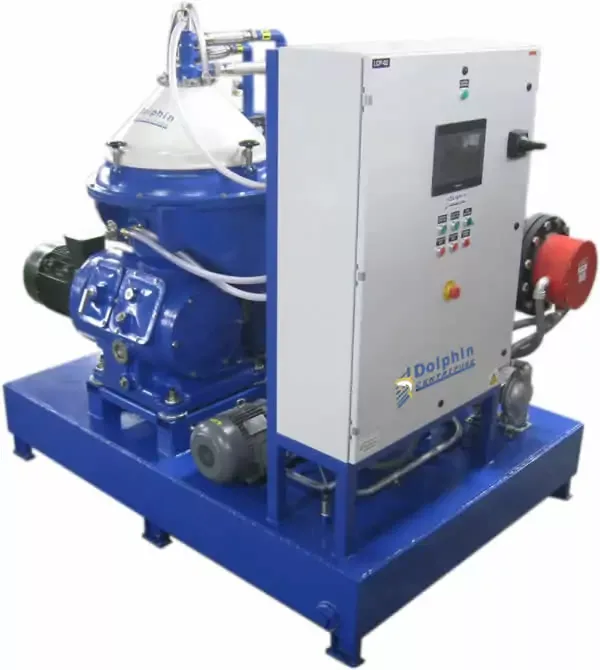
Dolphin Centrifuge supplies disc stack centrifuge systems for waste vegetable oil (WVO), used cooking oil (UCO), yellow grease, and biodiesel purification. Operating at up to 8,000 G with three-phase separation, these systems process 15–40 GPM continuously — removing water, food particles, and sediment to produce biodiesel-grade feedstock. Based in Warren, Michigan, with 40+ years of vegetable oil and biofuel separation experience.
Turn waste cooking oil and yellow grease into clean, profitable feedstock. Our disc stack centrifuges process WVO continuously — removing water, food particles, and free fatty acids to meet biodiesel or resale specifications.
WVO Centrifuge Applications
Dolphin Centrifuge provides purpose-built centrifuge systems for every stage of waste vegetable oil processing. Whether you are a WVO collector preparing feedstock for resale or a biodiesel producer polishing fuel to ASTM D6751, we have proven solutions.
WVO / Used Cooking Oil
Biodiesel Feedstock Preparation
Purify waste vegetable oil, yellow grease, and restaurant fryer oil for biodiesel feedstock or direct sale. Remove free fatty acids, water, and food particles.
Biodiesel Centrifuge
ASTM D6751 Compliance
Wash and polish biodiesel to ASTM D6751 specifications. Remove glycerin, soap, water, and catalyst residue continuously.
Yellow Grease Processing
Grease-to-Feedstock Conversion
Process collected yellow grease into sale-quality feedstock. Centrifugal separation removes moisture, solids, and impurities efficiently.
How Centrifugal WVO Purification Works
A disc stack centrifuge generates up to 8,000 G-force, separating water, solids, and free fatty acids from waste vegetable oil in a single continuous pass. Unlike bag filters or settling tanks, centrifugal separation handles high-solids feedstock without clogging and requires minimal operator intervention.
The self-cleaning bowl automatically ejects accumulated solids at timed intervals, allowing uninterrupted processing at flow rates from 10 to 40 GPM. This makes centrifuges ideal for high-volume WVO operations where downtime costs money.
Ready to Upgrade Your WVO Processing?
Send us a sample of your waste vegetable oil — we'll test it and confirm separation performance before you commit to a system. Sample testing from our Warren, MI facility.
Why Dolphin Centrifuge for WVO
- 40+ years of centrifuge expertise — deep application knowledge in oil-water-solids separation
- 150+ centrifuges in stock — fast delivery on reconditioned systems
- Sample testing — send us your oil and we'll prove separation results before you buy (request sample testing)
- Complete turnkey systems — centrifuge, heater, pumps, controls, and skid-mounted packaging
- Nationwide support — field service and parts for every system we sell
Frequently Asked Questions
What does a WVO centrifuge remove from waste vegetable oil?
A disc stack centrifuge removes water, food particles, sediment, free fatty acids (partially), and other impurities from waste vegetable oil and used cooking oil (UCO). The three-phase design separates oil, water, and solids simultaneously at 8,000 G-force — producing clean feedstock suitable for biodiesel production or direct sale to rendering operations.
What is the difference between WVO, UCO, and yellow grease?
WVO (Waste Vegetable Oil) and UCO (Used Cooking Oil) are interchangeable terms for oil recovered from restaurant fryers. Yellow grease is the commodity-grade term for collected WVO/UCO that meets moisture and FFA specifications for trading. Brown grease (trap grease) has higher contamination and is more challenging to process. All three can be purified using disc stack centrifuges.
Can a centrifuge polish biodiesel to ASTM D6751 specifications?
Yes. Disc stack centrifuges are widely used for water-washing and polishing biodiesel to ASTM D6751 compliance. The centrifuge removes glycerin, soap, residual catalyst, and water from the transesterification product — continuously, without the settling time required by gravity separation. Capacities of 10–40 GPM are common in biodiesel production.
What temperature is needed to process waste vegetable oil through a centrifuge?
WVO and UCO should typically be processed at 140–160°F (60–71°C) for effective centrifugal separation. At this temperature, the oil viscosity drops sufficiently for the centrifuge to separate water and fine particles efficiently. Dolphin Centrifuge systems include integrated electric heaters to bring the oil to operating temperature before it enters the centrifuge.
How much WVO can a Dolphin Centrifuge system process per day?
Dolphin Centrifuge WVO systems typically process 15–40 GPM (900–2,400 gallons per hour), depending on the centrifuge model selected. A DMPX-028 system running 8 hours per day can process 7,000–10,000 gallons. A DMPX-042 system at full rate processes 12,000–15,000 gallons per day. Contact us for sizing based on your collection volume.
Turn Waste Cooking Oil Into Biodiesel-Grade Feedstock
Disc stack centrifuge systems for WVO, UCO, yellow grease, and biodiesel polishing. 15–40 GPM. Turnkey skids from Warren, MI.