
30 Second Summary Takeaway
A biodiesel centrifuge is an industrial disc-stack centrifuge used in biodiesel production to separate biodiesel from glycerin, remove wash water, purify WVO feedstock, polish finished biodiesel, and clarify glycerin. In the biodiesel separation step, the centrifuge uses about 8,000 Gs and a rotating bowl to push denser glycerin out through the heavy-phase outlet while lighter biodiesel exits through the biodiesel chamber outlet. Because biodiesel plants often use methanol, biodiesel centrifuge systems may require hazardous-area electrical design, VITON seals, special plating, Teflon-covered collecting covers, and a biodiesel kit.
Dolphin Centrifuge is the independent specialist in Alfa Laval centrifuges: remanufactured machines, turnkey systems, parts, and service, built on 40+ years of Alfa Laval experience. Every biodiesel system we ship is built around a remanufactured Alfa Laval separator, an MAB 104, MAB 205, MAB 206, MAB 207, or MAB 209 for manual-clean duty and the self-cleaning MOPX 207 for continuous solids handling, and is engineered by Sanjay Prabhu, M.S.M.E. Dolphin is an independent remanufacturer and is not affiliated with Alfa Laval.
If your biodiesel operation is still low-volume, start with our paid sample-testing service for separation proof and the feasibility matrix to check whether volume and recovered product value justify equipment yet; if not, keep using simpler methods and reach out when you scale - we'll be here.
What is Biodiesel?
Biodiesel is an organic, renewable alternative to conventional diesel fuel. It is environmentally friendly due to lower emissions and is usable in current engines designed to operate on diesel fuel.
Biodiesel is not to be confused with black diesel, which is also an alternative fuel but is made from used oils.
How is Biodiesel Produced?
The transesterification process converts organic fats and oils into biodiesel. In other words, transesterification is the process of converting fats into biodiesel and glycerin. Methanol and lye are the catalysts in the process. The lipids are animal fat or used vegetable oil.
Large-scale biodiesel production utilizes Alfa Laval biodiesel centrifuges for high volume, continuous processing of feedstock, and separation of biodiesel from glycerin.
Also, read our Alfa Laval Centrifuge Selection Guide.
Biodiesel Centrifuge
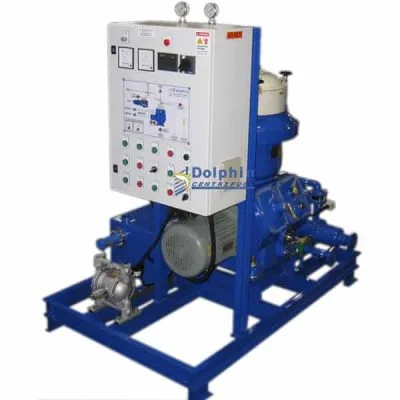
A biodiesel centrifuge uses a high g-force of 8,000 Gs to separate biodiesel from glycerin. The centrifuge bowl rotates at 7,000 RPM. The centrifugal force spins out the denser glycerin to discharge out the heavy-phase outlet. The lighter biodiesel discharges through the biodiesel chamber outlet.
A small 'self-cleaning' centrifuge can separate 10 GPM of biodiesel and 5 GPM of hot WVO.
Advantages
The following are key advantages of centrifuges in biodiesel production.
- A continuous process with the least operating costs.
- Mechanical separation extracts the most amount of biodiesel.
- Simultaneous separation of fine sediment.
- Fast separation under the high centrifugal force.
- The automatic process saves labor costs.
- Removal of small particles without filters (filters tend to plug up).
- Wash water removal to produce 100% clear biodiesel.
- Breaking emulsions (if any).
If you have simple, routine questions: We have condensed our 40+ years of disc-stack centrifuge experience into 101 Frequently Asked Questions about Disc Stack Centrifuges!
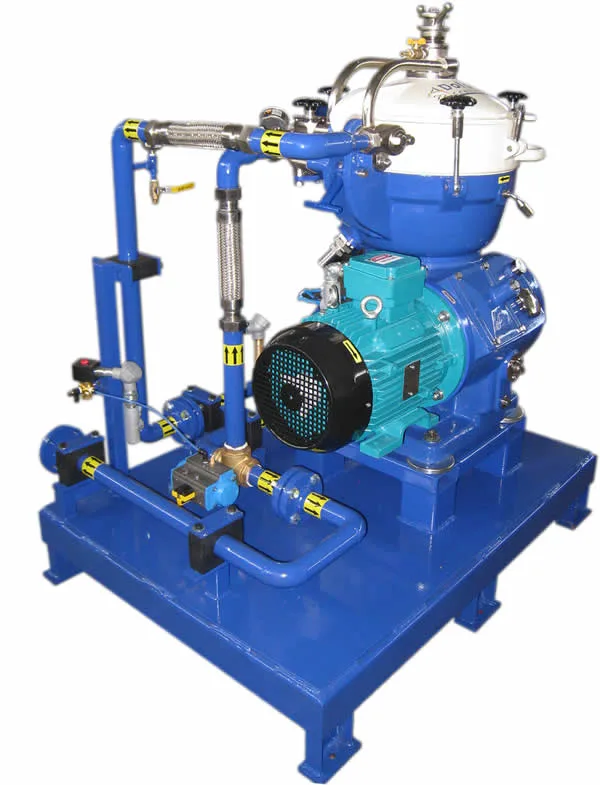
Specifications
| Centrifuge Type | Alfa Laval Disc Stack Centrifuge with Biodiesel Kit | ||
|---|---|---|---|
| Model | BDB-104Alfa Laval MAB 104 | BDPX-207Alfa Laval MOPX 207 | BDB-209Alfa Laval MAB 209 |
| Sludge Handling | Manual Clean | Self-Cleaning | Manual Clean |
| Biodiesel Kit Features | VITON Seals in Wetted Parts; Special Metal Plating of Non-Stainless Parts; Friction Clutch Replacement; Explosion Proof or HazLoc Motor & Control System | ||
| Capacity | |||
| Titrated WVO Stock | 3 GPM | 10 GPM | 35 GPM |
| Glycerin Separation | 6 GPM | 18 GPM | 60 GPM |
| Wash-Water | 3 GPM | 10 GPM | 35 GPM |
| Glycerin Clarification | 5 GPM | N/A | 40 GPM |
| Motor | 2 HP | 10 HP | 15 HP |
| Bowl Speed | 7,500 RPM | 6,400 RPM | 6,700 RPM |
| Sludge Space | 0.325 Gal | 1.3 Gal | 2.0 Gal |
BDB and BDPX are Dolphin's designations for an Alfa Laval separator fitted with the Biodiesel Kit. The centrifuge inside is a remanufactured Alfa Laval machine; the kit, skid, controls, and piping are Dolphin engineering.
Biodiesel Centrifuge Design
Biodiesel production requires the use of methanol. This requirement, in turn, needs unique manufacturing specifications. Biodiesel centrifuge systems built by Dolphin Centrifuge around remanufactured Alfa Laval separators have the following features. We refer to these features as the `Biodiesel Kit.'
- VITON seals in all fluid contact areas.
- Direct-drive (frictionless) design for hazardous area installation.
- Teflon-covered collecting covers.
- Electrical design for hazardous areas. (Class I Div 2 or Div 1)
Centrifuge Applications in Biodiesel Processing
The commercial biodiesel production process uses industrial centrifuges in most of the production steps. The list below explains each step with the corresponding centrifuge application.
WVO Purification
The WVO (Waste Vegetable Oil) feedstock contains water and food particles that need separation before the biodiesel conversion process. The three-phase disc stack centrifuge separates all free water and sediment down to the 0.5-micron level from WVO. This separation is a continuous (flow-through) process.
See our case study on using Alfa Laval centrifugal separators for large-scale WVO purification.
See the real numbers from a 6-million-gallon/year yellow grease installation ->
Biodiesel Glycerol Separation
Post reaction is essential to separate the two immiscible liquid phases (biodiesel and glycerol) to get pure biodiesel. Removing all traces of glycerol and any sediment is critical to reducing the load on the next process step.
Industrial centrifuges are a proven way to separate the two liquids at this stage. Alfa Laval industrial centrifuges (disc-stack type) generate a high centrifugal force on the fluid. This force separates the glycerol from the biodiesel to produce ASTM-grade biodiesel. Especially in cases where virgin vegetable oils are the feedstock.
Biodiesel Wash Water Separation
Biodiesel produced using WVO or animal fat needs a further step to remove any remaining impurities. A simple water wash polishes the biodiesel to the ASTM purity level.
An industrial centrifuge is the best fit for separating wash water from biodiesel. High centrifugal force in the disc stack centrifuge separates the water from biodiesel. This separation is, again, a continuous, efficient process.
Biodiesel Final Polishing
Polishing the biodiesel removes tiny particulate matter from the finished biodiesel. In the case of water wash, trace amounts of water may still be present in biodiesel. The Alfa Laval centrifuge removes the water from the biodiesel at this polishing stage.
Glycerin Clarification
Distilling separated glycerol recovers the methanol and produces glycerin. Pure glycerin has good resale value and is in demand in the food and cosmetics industries.
Clarification of glycerin to remove small impurities makes it usable. A disc stack centrifuge requires g-force to remove the finest trace particles from glycerin.
The advantages of using industrial centrifuges (listed above) are also applicable for glycerin purification.
Frequently Asked Questions
Does a biodiesel centrifuge need to be rated for hazardous areas? Why?
What is the smallest biodiesel centrifuge?
Do biodiesel centrifuges need special modifications?
Why do I need a centrifuge when biodiesel easily separates from glycerin?
What is the largest biodiesel centrifuge?
Does a biodiesel centrifuge have other applications in biodiesel production?
Can a biodiesel centrifuge produce ASTM grade biodiesel?
Is a biodiesel centrifuge expensive to operate?
Biodiesel Centrifuge Photo-Gallery
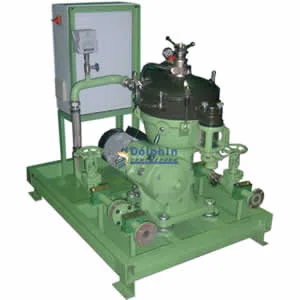
Alfa Laval MAB-205
| Capacity | 15 GPM on Biodiesel Glycerin |
| Motor Power | 5 HP |
| Voltages | 230 / 460 3-Phase |
| Size | 4' x 5' |
| Weight | 2,000 Lbs |
| Options | Teflon Coated Covers |
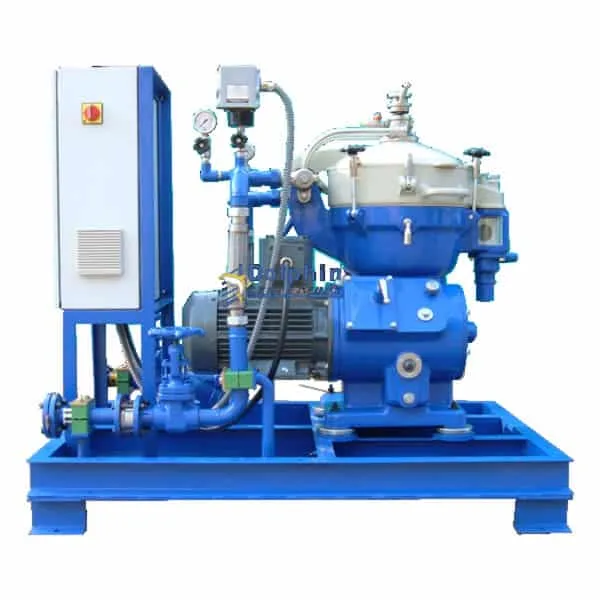
Alfa Laval MAB-206
| Capacity | 25 GPM on Biodiesel Glycerin |
| Motor Power | 7.5 HP |
| Voltages | 230 / 460 3-Phase |
| Size | 4' x 6' |
| Weight | 2,500 Lbs |
| Options | Teflon Coated Covers |
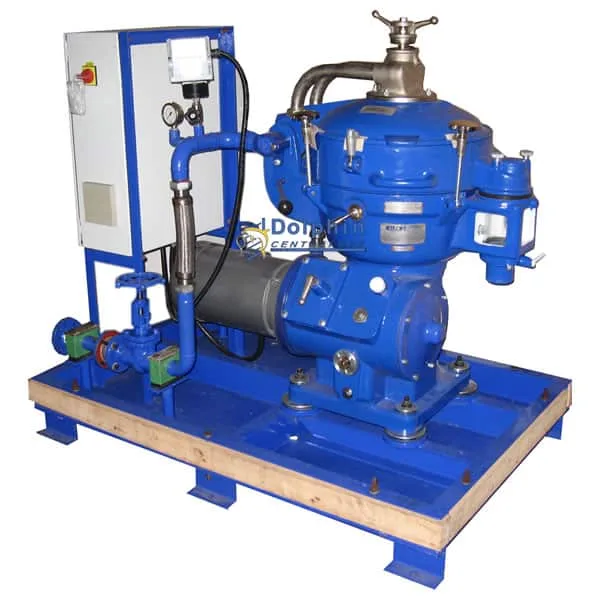
Alfa Laval MAB-207
| Capacity | 50 GPM on Biodiesel Wash Water |
| Motor Power | 15 HP |
| Voltages | 230 / 460 3-Phase |
| Size | 5' x 5' |
| Weight | 2,800 Lbs |
| Options | VITON O-Rings |
Get to know Dolphin Centrifuge through our about us page. See what our customers have to say about us.