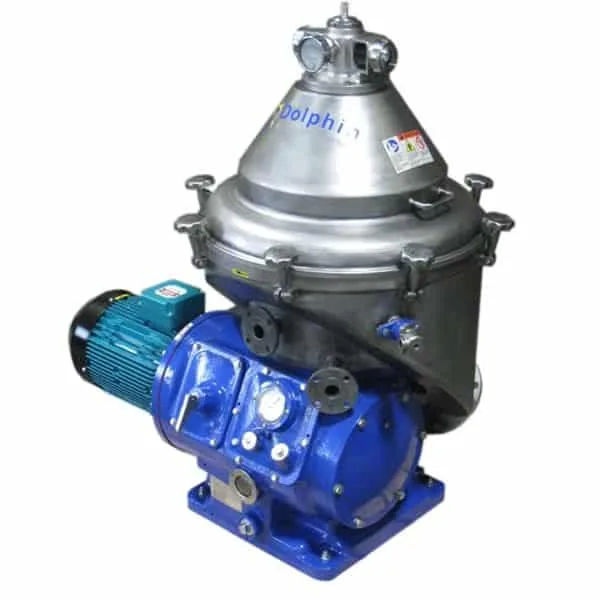
Dolphin Centrifuge supplies 316 stainless steel disc stack centrifuge systems for beer, wine, cider, and fruit juice clarification at capacities from 26 to 52 GPM. Operating at 7,000+ Gs with separation down to 0.5 microns, these self-cleaning centrifuges recover 5–10% more product from fermentation tank bottoms. Based in Warren, Michigan with over 40 years of beverage centrifuge experience.
Disc Centrifuges for Beverage Clarification
Dolphin Centrifuge, based in Warren, Michigan, supplies purpose-built disc stack centrifuge systems for this application at 7000 Gs with separation down to 0.5 microns. Disc stack centrifuges are the industry standard for clarifying beer, wine, cider, and fruit juice. These food-grade stainless steel systems generate thousands of Gs of centrifugal force to separate yeast, sediment, pulp, and other suspended solids from the finished beverage — continuously, without filter media or consumables.
Unlike plate-and-frame filters or diatomaceous earth (DE) systems, a centrifuge operates as a purely mechanical separator. There are no filter sheets to replace, no DE to purchase and dispose of, and no risk of taste or aroma stripping from excessive filtration. The centrifuge simply spins the beverage at high speed, forcing heavier particles outward while clean product exits through the center.
All Dolphin beverage centrifuges are constructed with 316 stainless steel product-contact surfaces and food-grade seals, meeting the hygiene requirements of brewing, winemaking, and juice processing facilities. See our food grade centrifuge page for full materials of construction details.
Beer Centrifuge
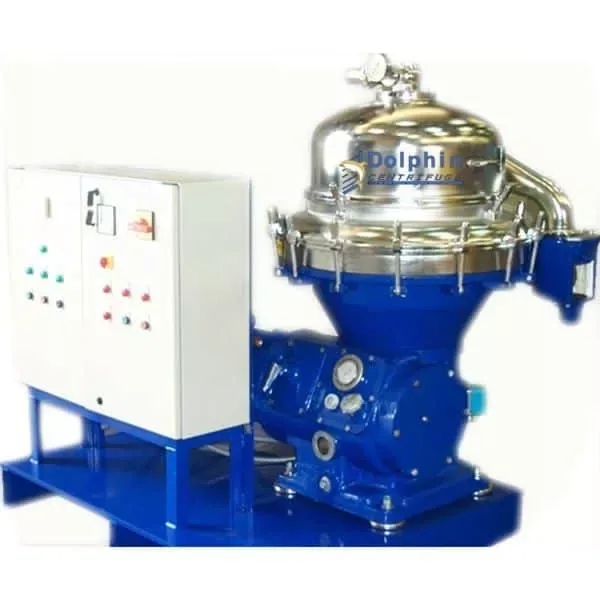
A beer centrifuge generates over 7,000 Gs of centrifugal force to separate yeast, haze-forming proteins, and hop residue from beer. The disc stack design creates thin fluid layers between each disc, enabling separation of particles down to 0.5 microns — well below the threshold for bright beer.
One of the most valuable applications is recovering beer from fermentation tank bottoms. When a fermenter is drained, the yeast and trub slurry at the bottom typically contains 80% or more recoverable beer. Without a centrifuge, this product is lost to the drain or sold as animal feed. A centrifuge processes this slurry and recovers 5–10% more beer per batch, returning bright, sellable product to the process.
Beer Clarification Process
The centrifuge is typically installed between the fermenter and the bright beer tank. Beer flows through the centrifuge at rated capacity, and the separated yeast and sediment collect at the bowl periphery. Self-cleaning models automatically eject the accumulated solids at timed intervals, allowing continuous operation without manual intervention.
The centrifuge can also be used for pre-filtration ahead of a membrane or sheet filter to extend filter life dramatically, or as the sole clarification step for craft breweries that prefer a less polished, naturally hazy product with reduced solids.
Benefits of a Beer Centrifuge
- Recover 5–10% more beer: Extract sellable beer from fermentation tank bottoms that would otherwise be discarded. At 80% beer content in typical tank bottoms, this represents significant revenue recovery
- Eliminate filter media costs: No DE powder, no filter sheets, no cartridges. The centrifuge is a purely mechanical process with no consumables
- Reduce labor and downtime: No filter setup, no media changes, no filter press cleaning. A centrifuge runs continuously with minimal operator attention
- Multi-purpose operation: The same centrifuge handles bright beer clarification, tank bottom recovery, yeast harvesting, and pre-filtration — switching between tasks with a simple valve change
- Consistent product quality: Centrifugal separation delivers repeatable results regardless of solids loading, unlike filters that degrade as they load
- No oxygen pickup: Sealed, pressurized flow path minimizes dissolved oxygen exposure, preserving beer freshness and shelf life
Need a Beverage Centrifuge System?
Our engineers will evaluate your brewery or winery production volume and recommend the optimal centrifuge system. Sample testing available.
Wine Centrifuge
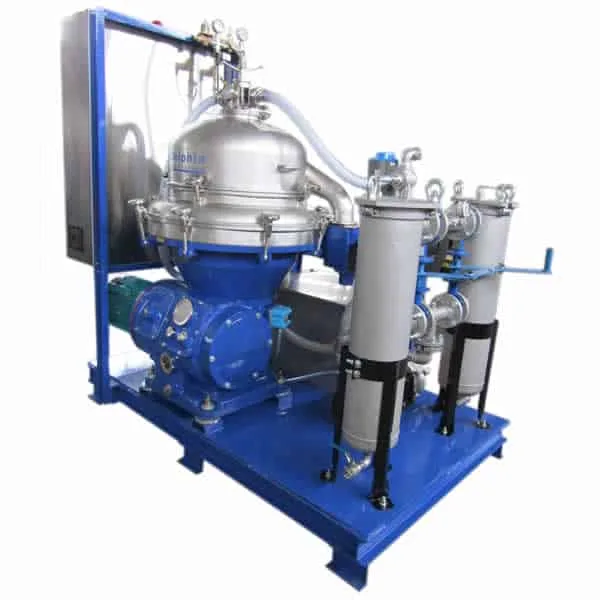
Wine clarification presents unique challenges compared to beer processing. Wines contain a wide range of suspended solids — from coarse grape solids and yeast lees to fine colloidal particles that affect clarity and stability. A disc stack centrifuge handles all of these in a single pass.
Must Clarification
Freshly pressed grape must (juice) contains grape skin fragments, pulp, seeds, and pectins that must be removed before fermentation. Centrifugal clarification produces clean must in minutes rather than the 12–24 hours required for cold settling. This speed is critical during crush season when tank space is at a premium.
Lees Clarification
After fermentation, wine is racked off its lees (dead yeast sediment). The lees slurry typically contains 60–75% recoverable wine. A centrifuge processes this slurry and returns clear wine to the process, recovering product that would otherwise be lost. This is analogous to beer tank bottom recovery and delivers similar economic benefits.
Finished Wine Polishing
Before bottling, wine requires final polishing to remove residual haze-forming particles. The centrifuge delivers brilliant clarity without the risk of stripping flavor or aroma compounds, which can occur with excessive pad filtration. Many premium wineries use centrifugal clarification as their primary or sole clarification method.
Fermentation Control for Dessert Wines
For sweet wines and dessert wines, fermentation must be stopped at a precise residual sugar level. A centrifuge rapidly removes active yeast from the wine, halting fermentation without the use of sulfur dioxide or other chemical additives. This produces a cleaner, more naturally sweet wine.
Cider & Juice Clarification
Hard cider and fruit juice production benefit from the same centrifugal clarification principles used in beer and wine processing. Freshly pressed apple, pear, or citrus juice contains pulp, pectins, and yeast that must be removed for a clear, shelf-stable product.
A disc stack centrifuge provides high-efficiency clarification with several advantages over traditional juice processing methods:
- No manual filter changes: Unlike plate-and-frame filters that require frequent sheet replacement during heavy pulp loads, the centrifuge ejects solids automatically and runs continuously
- Handles variable solids loading: Fruit juice solids content varies widely by variety, season, and pressing method. A centrifuge adapts to these variations without performance degradation
- Preserves fresh flavor: Mechanical separation avoids the flavor-stripping effects of tight filtration or fining agents
- Cost savings: Eliminates ongoing filter media purchases and reduces labor for filter maintenance. For high-volume operations, the centrifuge pays for itself through media cost savings alone
- Rapid processing: During harvest season, the ability to process juice immediately — rather than waiting for settling — frees tank space and prevents spoilage
Cider producers also use the centrifuge for yeast removal at the end of fermentation, providing the same fermentation-control benefits described for dessert wines.
Available Systems — Specifications
Dolphin offers a range of beverage centrifuge systems sized for craft producers through mid-scale commercial operations. All systems feature 316 stainless steel product-contact surfaces and food-grade seals.
| System | Capacity | Motor | Bowl Speed | G-Force | Size (L×W×H) | Weight |
|---|---|---|---|---|---|---|
| Beer Clarifier – 40 GPM | 40 GPM | 20 HP | 4,150 RPM | 6,500 Gs | 4' × 5' × 6' | 3,500 lbs |
| Beer Clarifier – 30 GPM | 30 GPM | 10 HP | 5,200 RPM | 6,700 Gs | 4' × 5' × 6' | 3,000 lbs |
| Wine Clarifier – 26 GPM | 26 GPM (white) / 30 GPM (red) | 10 HP | 6,400 RPM | 7,200 Gs | 5' × 5' × 6' | 3,000 lbs |
| Wine Clarifier – 44 GPM | 44 GPM (white) / 52 GPM (red) | 15 HP | 5,500 RPM | 7,100 Gs | 5' × 6' × 6' | 4,200 lbs |
Note: Wine flow rates differ between white and red wines due to viscosity and solids loading differences. Red wines with higher solids content process at higher volumetric rates because the centrifuge ejects sludge more frequently, maintaining bowl capacity. All systems are available with PLC automation for unattended operation.
These centrifuge systems are also suitable for hard cider, mead, kombucha, and other fermented beverages. Contact our engineers for application-specific flow rate recommendations.
Related resources: Food-Grade Centrifuge Applications | Centrifuge FAQ (101 Questions) | Sample Testing Program | Disc Stack Centrifuge Overview | How to Pick the Right Centrifuge | Disc Stack Centrifuge Efficiency
Frequently Asked Questions
How much beer can a centrifuge recover from fermentation tank bottoms?
Can a centrifuge replace diatomaceous earth (DE) filtration?
What capacity beer and wine centrifuges are available?
Can a beverage centrifuge process cider and fruit juice?
How does a wine centrifuge handle must clarification?
Ready to Clarify More Beer or Wine?
Dolphin Centrifuge supplies food-grade beverage centrifuge systems sized for your production volume. Contact us for pricing or arrange a sample test at our Warren, MI facility.