Dolphin Centrifuge supplies decanter centrifuges with adjustable differential speed from 1–40 RPM, operating at 2,000–4,000 G-force. Differential speed optimization controls cake dryness, solids throughput, and scroll torque protection across industrial dewatering applications.
30-Second Summary Takeaway
In this article, you will learn about the following aspects of differential speed in a decanter centrifuge:
- The two rotating speeds of a decanter centrifuge
- What differential speed is and how it is created
- The differential speed formula and a live calculator
- How varying differential speed affects cake dryness and solids output
- Benefits of speed variation and automatic scroll control
What Are the Different Speeds of a Decanter Centrifuge?

In technical terms, speed refers to the rotational speed or RPM (Rotations Per Minute) of the decanter's two main rotating components — the outer bowl and the internal scroll conveyor.
Bowl Speed
The outer bowl rotates continuously, driven by the main motor through pulleys and belts. This rotation creates centrifugal force that sediments solids along the bowl wall. Bowl speed is fixed during operation — typically 2,000–4,000 RPM.
Scroll Speed
The internal scroll (auger) rotates inside the bowl at a slightly different speed, conveying accumulated solids toward the discharge ports. The scroll speed is always slightly less than the bowl speed — this difference is the differential speed.
Decanter Differential Speed
The differential speed of a decanter centrifuge is the difference between the bowl's rotational speed and the scroll's rotational speed. It directly determines how long solids remain inside the bowl before being discharged — the residence time.
Longer residence time allows more compression under centrifugal force, producing drier solids cake. Shorter residence time increases solids throughput but yields wetter cake.
The Mechanism to Create Differential Speed
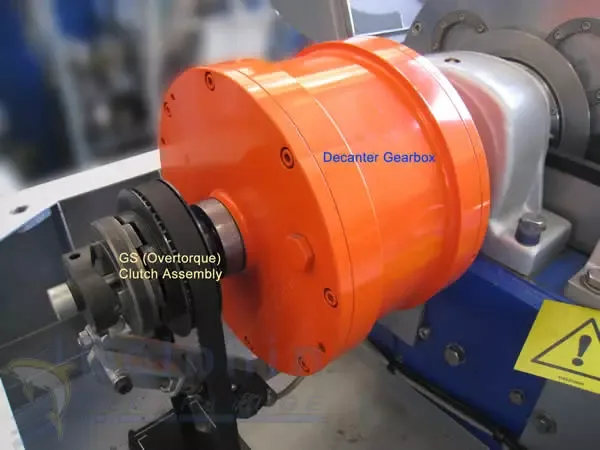
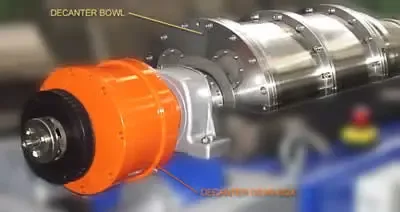
The decanter bowl connects to the scroll through a planetary gearbox assembly. The gear ratio within the gearbox determines the base differential speed. A separate back-drive motor controls the sun wheel shaft — varying its speed adjusts the differential in real time.
Adjustment or Variation
Differential speed is changed by controlling the rotation speed of the sun wheel shaft extension of the gearbox. The direction and speed of sun wheel rotation directly determines the actual differential speed of the decanter at any point in time.
Differential Speed Calculation
Three parameters determine differential speed: Bowl Speed, Sun-Wheel Shaft Speed, and the Gearbox Ratio.
Formula
Differential Speed = (Bowl Speed − Sun Wheel Shaft Speed) ÷ Gearbox Ratio
For example, with a Bowl Speed of 3,500 RPM, a Gearbox Ratio of 200:1, and a Sun Wheel Shaft Speed of 1,500 RPM:
(3,500 − 1,500) ÷ 200 = 10 RPM
Differential Speed Result
Live Differential Speed Calculator
Enter your decanter parameters below to instantly calculate differential speed. Adjust the sun wheel shaft speed (via back-drive VFD frequency) to see how differential RPM changes.
Decanter Differential Speed Calculator
dolphincentrifuge.comTypical range: 2,000 – 4,500 RPM
Typical range: 80 – 200:1
Controlled by back-drive VFD
Calculated Differential Speed
(4,000 − 2,460) ÷ 159
10
RPM
Typical operating range: 1–30 RPM
© Dolphin Centrifuge — for reference only. Contact our engineers to verify settings for your specific machine.
Differential Speed Reference Table
The table below shows how adjusting the back-drive motor frequency (VFD Hz) changes the differential RPM for a decanter with a 159:1 gearbox ratio at 4,000 RPM bowl speed. As back-drive frequency increases, sun wheel speed increases and differential speed decreases — producing drier cake.
| Gearbox Ratio: 159:1 | Bowl Speed: 4,000 RPM | Sun-Wheel Shaft Speed: Varying (back-drive VFD) | ||||
|---|---|---|---|---|
| BD Freq (Hz) | BD Motor Speed (RPM) | Scroll Speed (RPM) | Bowl Speed (RPM) | Differential RPM ↓ |
| 0 Hz | 0 | 3,975 | 4,000 | 25 RPM |
| 15 Hz | 615 | 3,979 | 4,000 | 21 RPM |
| 45 Hz | 1,845 | 3,986 | 4,000 | 13 RPM |
| 60 Hz | 2,460 | 3,990 | 4,000 | 10 RPM |
| Higher BD frequency → higher sun wheel speed → lower differential RPM → drier cake, lower throughput | ||||
Effects of Higher Differential Speed
Higher differential speed reduces solids residence time inside the bowl. This creates a direct trade-off between cake dryness and solids throughput capacity:
- Higher Solids Output Capacity — faster scroll conveyance evacuates solids more quickly
- Lower Torque Load on Scroll — solids don't accumulate as heavily before discharge
- Wetter Solids Cake — shorter residence time means less compression and less dewatering
Scroll conveying speed should never exceed what is required for satisfactory separation — over-speeding wastes energy and produces wet, high-cost-to-dispose cake.
Scroll Speed vs. Decanter Performance
dolphincentrifuge.comAs differential speed increases (scroll turns faster), cake gets wetter but solids output capacity rises. The crossover zone is the optimal operating range for your application.
Learn more about other types of industrial centrifuges.
Benefits of Differential Speed Variation
The ability to vary scroll speed in real time provides three critical operational advantages:
Quick Feed Adjustment
Solids concentration in feed slurry is rarely constant. When solids load increases, increasing differential speed moves separated solids out faster — preventing bowl overload.
Cake Dryness Control
Fine-tune solids moisture content by adjusting scroll speed under varying sludge load conditions. Lower differential = longer residence = drier cake and lower disposal costs.
Scroll Overload Protection
Sudden surges in solids load can overload the scroll. Automatic differential speed increase pushes solids out faster, shedding torque load before an over-torque shutdown occurs.
Automatic Control of Scroll Speed
A back-drive motor driven by an inverter or Variable Frequency Drive (VFD) automatically controls the decanter differential speed. An electronic controller monitors the current drawn by the back-drive motor — a direct indicator of scroll torque.
Automatic Control Logic
Normal operation: Back-drive runs at a set frequency. Differential speed remains constant.
Rising torque: Controller detects increased motor current → proportionally increases back-drive speed → scroll evacuates solids faster.
Over-torque alarm: If torque exceeds the limit, feed is temporarily shut off. Continued overload triggers automatic shutdown with an over-torque alarm.
Dolphin Centrifuge decanter control systems feature these advanced functions for automatic scroll speed adjustment during the process.
Summary
The differential speed between the decanter bowl and scroll is the key operating parameter of a decanter centrifuge. It directly controls how dry the separated solids are, how much solids the machine can process, and how protected the scroll is from overload. In advanced decanter control, differential speed variation is the primary tool for fine-tuning performance and protecting the machine.
by Sanjay Prabhu MSME, Engineering Manager, Dolphin Centrifuge
Need Decanter Controls or Service?
Our engineers design and build advanced decanter control systems with automatic differential speed adjustment and torque-based overload protection. Contact us to discuss your application.
Frequently Asked Questions
What is differential speed in a decanter centrifuge?
Differential speed is the rotational speed difference between the outer bowl and the internal scroll conveyor. The scroll must rotate slightly slower than the bowl to continuously push accumulated solids toward the discharge end. Typical differential speeds range from 1–30 RPM depending on application and solids characteristics.
How does differential speed affect solids dryness?
Lower differential speed allows solids longer residence time on the beach, improving cake dryness. However, if differential speed is too low for the sludge solids load, the scroll becomes overloaded and torque alarms activate. Optimum differential speed balances cake dryness against scroll torque within safe operating limits.
What causes high scroll torque in a decanter centrifuge?
High scroll torque is typically caused by excessive feed solids rate overloading the conveyor, too-low differential speed, very dense or compressible solids that resist conveying, or scroll wear that reduces conveying efficiency. Corrective actions include increasing differential speed, reducing feed rate, or inspecting scroll wear tiles.