Dolphin Centrifuge optimizes decanter centrifuge performance — including Alfa Laval NX-314, NX-418, and G2-40 models — by tuning five key parameters: pond depth, bowl speed, differential scroll speed, auger pitch, and feed temperature. Operating at the correct bowl RPM and weir plate radius reduces solids-in-centrate below 500 ppm. Based in Warren, Michigan with 40+ years of decanter expertise.
30 Second Summary Takeaway
Decanter centrifuge performance optimization involves tuning or adjusting specific operating parameters to improve the separation efficiency of the decanter.
In this article, we discuss the 5 most effective and straightforward ways to achieve optimal decanter operation. We address the following typical questions:
- What is decanter optimization?
- What parameters affect optimization?
- How does pond-depth help optimize decanter performance?
- How does bowl speed affect performance?
- Isn't high speed always good for separation? Not Necessarily!
- How does conveyor speed affect performance?
1. Pond Depth
The pond depth is the radial distance between the internal bowl wall and the inner surface of the concentric liquid layer. The high centrifugal force causes the liquid to form a concentric layer within the bowl.

Adjusting Pond Depth
It is easy to adjust the pond depth by changing the weir plates with different radii to the decanter bowl axis of rotation. The following is an image of a decanter weir plate.
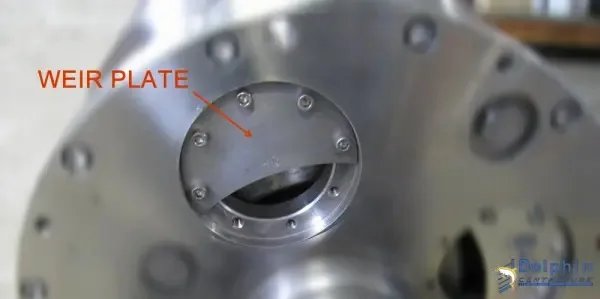
Decanter Weir Plate
The adjustment of the pond depth has the maximum effect on decanter centrifuge performance. In this section, we discuss these effects.
Deep Pond

Deep Pond Depth — Decanter Centrifuge
Weir plates with shorter radii allow a deeper pond formation within the decanter bowl. This shorter radius increases the settling space available for the sedimentation of sludge particles. Therefore, a deeper pond facilitates better sedimentation and sludge separation. Removal of more solids means clearer liquid.
However, the deeper pond depth also implies more liquid will cover the taper section (beach) of the bowl leading to reduced beach length. The reduced beach length impedes the liquid removal from the sludge as it travels up the beach toward the solids' outlet ports. Therefore, a deeper pond causes wetter solids.
The decanter auger pushes the sedimented solids towards the solid ejection ports along the tapered section of the bowl (beach). A deeper pond exposes a shorter section of the beach and reduces the torque required to push the solids out.
In summary, a deeper pond leads to:
- Removal of more solids from the liquid
- Sludge with more liquid or wetter solids
- Reduced torque on the solids auger
Shallow Pond

Shallow Pond Depth — Decanter Centrifuge
In contrast to a deeper pond, in this section, we discuss the effects of a shallow pond on decanter centrifuge performance.
Weir plates with longer radii cause the depth of the liquid layer to decrease, leading to a shallow pond depth. A liquid layer with reduced depth reduces the space available for solid settling, leading to reduced solids removal. Therefore, a shallower pond depth causes more solids in the liquid, leading to a murkier liquid.
As shown in the diagram above, a shallow pond exposes more of the taper section of the decanter bowl, i.e., increased beach length. The more extended beach enhances the separation of solids from the liquid as the auger pushes the sludge up the beach under the high centrifugal force. Therefore, a shallower pond causes drier solids. For a detailed treatment, see our guide on decanter centrifuge pond depth.
A more extended beach also implies that the auger has to push the sludge over a longer distance, thereby increasing the torque on the auger.
In summary, a shallow pond leads to:
- Removal of lesser solids from the liquid
- Sludge with less liquid or drier solids
- Increased torque on the solids auger
2. Bowl Rotation or Bowl Speed
Energy, Noise & Wear vs Bowl Speed
dolphincentrifuge.comAs bowl speed increases, all four operating cost and wear factors rise — energy consumption rises most steeply. Operating above the manufacturer's recommended RPM accelerates wear without proportional separation gains.
The rotational velocity of the bowl is known as the bowl speed or bowl RPM. This speed is directly proportional to the centrifugal force generated by the bowl. Therefore, a higher bowl speed indicates greater centrifugal force.
Adjusting Decanter Bowl Speed
The decanter bowl is directly connected to the drive motor. A slower motor speed reduces the bowl speed, and conversely, a higher motor speed leads to higher bowl RPM.
Higher Bowl Speed
Solids Recovery vs Bowl Speed
dolphincentrifuge.comBoth high and low solids feeds show increasing solids recovery with bowl speed, but performance plateaus at high speeds. High solids feed reaches peak recovery faster due to greater centrifugal sedimentation mass.
An increase in the bowl speed implies a higher g-force acting on the solids in the fluid. An increase in sedimentation is a direct consequence of higher centrifugal force. More sedimentation causes more solids to be separated from the liquid and pushed by the conveyor (auger), leading to higher torque on the auger.
Also, increased sedimentation means lesser solids in the exiting fluid leading to clearer liquid and more solids removal.
A higher bowl RPM generates a higher centrifugal force acting on the solids being pushed up the tapered beach section of the bowl, which squeezes out more liquid from the solids causing drier solids.
As explained above, a higher bowl speed requires the decanter motor to operate at a higher RPM leading to more energy consumption.
In summary, a higher bowl speed leads to:
- Higher torque on the solids auger
- Removal of more solids from the liquid & clearer liquid
- Sludge with lesser liquid or drier solids
- More power consumption
Lower Bowl Speed
Reduced bowl speed has the opposite effect on the decanter centrifuge performance due to increased bowl speed, as explained above.
A reduction in bowl speed leads to a reduction in the decanter bowl's centrifugal force, leading to decreased sedimentation and, consequently, reduced solids removal.
The reduction in solids removal means lesser solids that need to be pushed out, leading to reduced load and torque on the conveyor.
Following the above, a lower bowl speed causes reduced solids removal and more solids in the separated liquid, leading to a murkier liquid.
Lower bowl RPM implies the motor is turning at a lower speed leading to reduced energy consumption.
In summary, lower decanter bowl speed leads to:
- Lower torque on the solids auger
- Removal of lesser solids from the liquid & murkier liquid
- Sludge with more liquid or wetter solids
- Reduced power consumption
Need Help Optimizing Your Decanter Centrifuge?
Dolphin Centrifuge engineers can evaluate your process and recommend optimal settings for your specific application.
3. Auger (Scroll) Speed

Decanter Bowl Auger Differential Speed
The auger speed refers to the differential speed between the decanter bowl and the auger. This speed indicates how quickly or slowly the auger rotates inside the bowl. See our dedicated page on decanter differential speed for a deeper technical treatment.
Adjusting Auger Speed
The decanter bowl connects to the auger through the gearbox. The auger speed changes with the gearbox sun-wheel shaft speed. In other words, the user can adjust the auger speed by changing the sun-wheel shaft rotation speed.
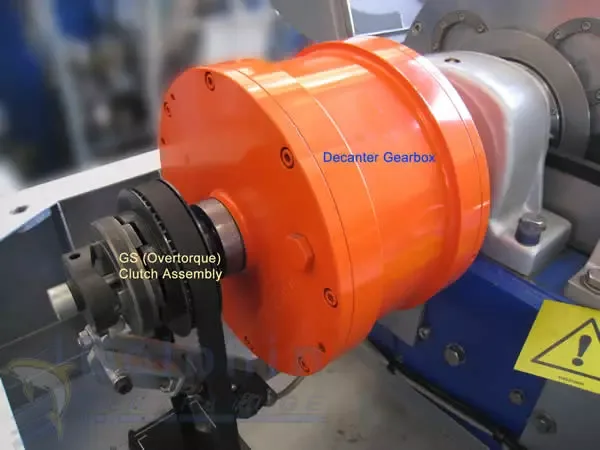
Decanter Centrifuge Gearbox and Torque Clutch Assembly
Higher Auger Speed
If the auger is rotating faster, it can move more solids to the solids discharge ports per rotation, allowing the decanter higher solids handling capability. Therefore, it is desirable to have a higher auger speed for high solid applications.
A higher rotational speed of the auger also implies the solids are pushed out quickly before they accumulate and cause more resistance to the auger, thereby reducing the torque required.
Following the above considerations, a higher speed of the auger causes the solids not to have enough settling time and therefore retain more liquid. This quicker discharge leads to wetter solids.
Summarizing the effects of higher auger speed:
- Higher solids handling capacity
- Reduced torque on the auger (conveyor)
- Wetter solids discharge
Lower Auger Speed
A slower auger RPM causes lesser solids movement reducing the solids handling capacity of the decanter. This reduced capacity means that a slower auger speed is better suited for low-solid applications.
Also, a lower auger speed means the solids are pushed out slower, giving more time for the solids to settle and accumulate. Higher solids accumulation leads to higher torque on the conveyor.
Similarly, a lower auger speed allows more time for the solids to settle out, thereby removing more water from the solids and ejecting drier solids.
Summarizing the effects of lower auger speed:
- Lesser solids handling capacity
- Increased torque on the auger (conveyor)
- Drier solids discharge
4. Auger Pitch
The auger pitch is the distance between the flights on the decanter auger. An auger with flights closer to each other is known as a fine-pitch auger. On the other hand, if the flights are farther from each other, it is known as a coarse pitch auger.
Adjusting the Auger Pitch
The pitch of the auger is a preset mechanical feature of the decanter. The user has the option to order the decanter with different auger pitches. However, once the decanter is manufactured, the only way to change the pitch is to replace the auger with a different pitch.
Fine Pitch Auger
A fine pitch of flights on the auger has similar performance effects as increasing the auger speed. So, a fine pitch leads to lower solid moving capacity.
The quick movement of solids also leads to higher auger torque.
Coarse Pitch Auger
As explained above, a coarse pitch auger has similar effects on the decanter performance as a slow auger speed. Therefore, a coarse flight pitch moves more solids per rotation which exerts lesser torque on the auger and gearbox.
Effects of Auger Pitch on decanter performance are as follows:
| Parameter | Coarse Pitch | Fine Pitch |
|---|---|---|
| Solids Handling Capacity | High | Low |
| Torque On Auger | Low | High |
5. Process Fluid Temperature
The fluid process temperature is significant when processing viscous fluid through a decanter centrifuge. Higher viscosity fluids such as crude oil resist the separation of solids. As the temperature of the fluid increases, the viscosity reduces, leading to better separation.
The fluid temperature does not affect the decanter performance in cases of low viscosity fluids such as water. For oil-water-solids separation, see our overview of decanter centrifuge applications.
Summary
The 5 adjustments mentioned above help optimize decanter centrifuge performance. Needless to say, each application has a different set of parameters. However, following the guidelines above, the user can optimize the decanter centrifuge under set operating conditions.
For a side-by-side comparison of decanter and disc stack centrifuge technology, see our article on the difference between decanter and disc centrifuges. If vibration is a concern during operation, refer to our decanter centrifuge vibration guide.
Frequently Asked Questions
What are the main ways to improve decanter centrifuge separation performance?
The five primary optimization parameters are: pond depth (weir plate position), bowl speed (G-force), differential speed (scroll vs. bowl), scroll pitch angle, and process fluid temperature. Adjusting these in sequence allows operators to tune the machine for both cake dryness and centrate clarity without hardware changes.
What happens if bowl speed is set too high on a decanter centrifuge?
Excessively high bowl speed increases G-force but also increases bearing wear and mechanical stress. Higher speed can also create finer particle fragmentation that may resist sedimentation. For most applications, operating at the manufacturer's recommended bowl speed is optimal — over-speeding rarely improves performance and accelerates wear.
How does process fluid temperature affect decanter centrifuge performance?
Higher process temperature reduces fluid viscosity, allowing finer solids to sediment faster under centrifugal force. Heating feed to 60–80°C for oil-water systems can significantly improve separation quality without changing any mechanical settings. Dolphin Centrifuge supplies fluid heating systems for viscous oil processing applications.
How do I know which optimization parameter to adjust first on a decanter centrifuge?
Start with pond depth (weir plate adjustment) — it has the largest impact and requires no tools beyond a wrench. If centrate clarity is the goal, deepen the pond. If cake dryness is the goal, shallow the pond. Once pond depth is optimized, adjust bowl speed to fine-tune G-force. Only adjust auger differential speed and temperature if pond depth and bowl speed adjustments alone are insufficient.
What is the difference between auger pitch and auger differential speed?
Auger differential speed is the rotational speed difference between the scroll (auger) and the bowl — it is adjustable in real time via the gearbox sun-wheel control. Auger pitch is a fixed mechanical dimension — the axial distance between scroll flights — that can only be changed by physically replacing the auger. Fine-pitch augurs move solids similarly to a fast auger speed; coarse-pitch behaves like a slow auger speed.
Need Expert Decanter Optimization?
Dolphin Centrifuge engineers can audit your decanter settings and recommend parameter changes to improve cake dryness, centrate clarity, and machine longevity.