Dolphin Centrifuge diagnoses and repairs decanter centrifuge vibration across all six root causes — from gradual bearing wear that pushes levels above the 10 mm/s action threshold to sudden part breakage requiring emergency shutdown. Based in Warren, Michigan, with over 40 years of centrifuge service experience.
Summary: A decanter centrifuge, like any rotating equipment, vibrates during operation. Some vibration during startup and coast-down is normal as the bowl passes through its resonance frequency. However, vibration beyond set limits signals a problem that must be investigated immediately. This article categorizes decanter vibration into two groups — gradually increasing and suddenly occurring — and details six specific causes with their fixes. For context on overall machine performance, see decanter centrifuge optimization.
Gradually increasing vibration
- Bowl or scroll imbalance due to wear
- Bearing wear
- Improper assembly of components or auxiliary accessories
Suddenly occurring vibration
- Imbalance due to parts breakage or chipping
- Separated sludge fall-over during shutdown
- Bearing failure
Vibration Reference Levels
New OEM
2–4 mm/s
Used — Good Condition
Up to 8 mm/s
Action Required
Above 10 mm/s
If a decanter centrifuge's vibration level exceeds 10 mm/s, it is time for a thorough inspection and likely bearing replacement.
Gradually Increasing Vibration
During regular operation, a decanter centrifuge's moving and consumable components are subject to wear and tear. Over time, this wear causes the vibration level to increase. Monitoring vibration levels is essential for tracking gradual increases that indicate wear on specific components.
Imbalance Due to Wear
The two main rotating parts of a decanter centrifuge are the bowl and the auger (conveyor). The auger pushes separated sludge along the bowl wall and up the conical beach section. This constant contact causes wear on the sludge-facing side and the top edge of the scroll flights.
A sludge layer known as the "cake wall" builds between the conveyor and the bowl wall. This cake wall is stationary relative to the bowl and acts as a protective barrier against internal bowl erosion. However, the auger flights themselves have no such protection and erode over time, especially when processing abrasive solids.
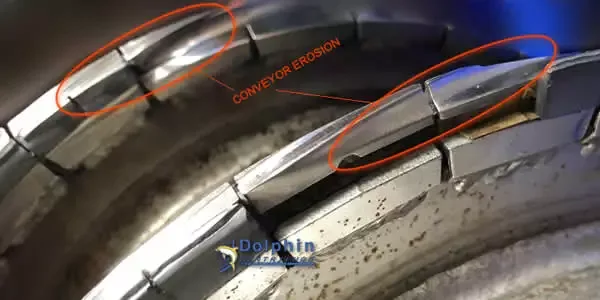
Fix: Inspect the auger flights for uneven wear during scheduled maintenance. If wear is significant, the conveyor must be rebalanced or replaced. Hard-surfacing (weld-on tiles or tungsten carbide overlay) on the flight edges extends service life in abrasive applications. Always re-balance the rotating assembly after any repair or resurfacing work.
Bearing Wear
The pillow-block main bearings support the entire decanter rotating assembly. These are heavy-duty bearings specifically designed for this application. Like all friction components, bearings have a finite lifespan and must be replaced at periodic intervals.
As bearings wear, they develop play beyond manufacturing tolerances. This play causes a gradual, measurable increase in decanter vibration. Periodic vibration checks — or continuous monitoring via the control system — is the most reliable way to track bearing condition.
Fix: Replace main bearings at recommended service intervals or when vibration data shows a consistent upward trend. Always replace bearings as a complete set. Use only bearings rated for the specific rotational speed and load. Flush and refill bearing housings with the correct lubricant grade after replacement.
Improper Assembly of Components
All rotating equipment has some inherent vibration. In decanters, vibration from the rotating assembly travels through the frame and all attached components. Incorrect assembly amplifies this vibration significantly.
Common assembly errors:
- Misalignment of pillow block bearings relative to the bowl's rotational axis, generating excessive torque on the drive motor
- Loose fasteners on belt guards, motor mount plates, motors, or collecting vessels
- Improperly tensioned drive belts causing resonance
Fix: Follow the OEM rotating assembly alignment procedure precisely. Check and tighten all fasteners on the decanter frame during scheduled maintenance or whenever excess vibration is detected. Verify drive belt tension and alignment. Ensure all auxiliary components are securely bolted to the frame.
Suddenly Occurring Vibration
Some vibrations occur without warning. They may strike while the decanter is running or appear at startup after a shutdown period. These causes require immediate investigation because they can escalate to equipment damage or safety hazards.
Imbalance Due to Part Breakage
The auger or conveyor is exposed to the most wear inside a decanter. Conveyors often have weld-on hard-surfacing or welded tiles for erosion protection of the flights. When these protective elements break or detach during operation, the resulting mass loss creates an immediate imbalance.
A loud noise typically accompanies this vibration, yet the cause is not visible through external inspection. The broken tile fragments are often carried away with the ejected sludge. Similarly, a missing chunk of weld-on hard-surfacing creates the same sudden imbalance effect.
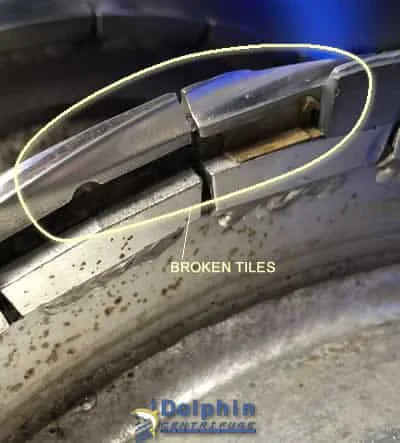
Fix: Stop the decanter immediately. Dismantle the bowl and extract the auger to inspect for missing or broken tiles and damaged hard-surfacing. Replace any missing protective elements and rebalance the conveyor before reassembly. Inspect remaining tiles for cracks that could lead to future breakage.
Separated Sludge Fall-Over During Shutdown
During normal operation, separated sludge collects on the decanter bowl wall, held in place by centrifugal force. When the decanter shuts down, this centrifugal force disappears. If the sludge is not sufficiently compacted, it dislodges from the upper side of the bowl wall and falls to the bottom under gravity.
This redistribution of sludge creates an imbalance in the bowl. Upon the next startup, the imbalance causes excessive vibration until the conveyor pushes out the displaced sludge and restores bowl balance.
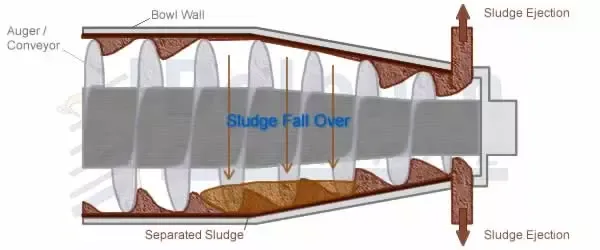
Fix: Start the conveyor rotation before the bowl during decanter startup. This pre-start sequence allows the conveyor to push out any fall-over sludge before the bowl begins to rotate, preventing the temporary imbalance. Adjust differential speed settings to ensure adequate sludge conveyance during the startup phase.
Bearing Failure During Operation
Safety Warning: A bearing failure during operation can cause catastrophic damage to the equipment and poses a risk of personal injury. Stop the decanter immediately if sudden, severe vibration accompanied by grinding noise is detected.
Although rare, a bearing can fail during decanter operation. The first indication is sudden, excessive vibration accompanied by a loud grinding noise. In practice, unanticipated bearing failure is uncommon because telltale signs — increasing vibration and higher motor current draw — typically appear as the bearing nears the end of its useful life.
Fix: Stop the decanter immediately upon detecting signs of bearing failure. Replace the failed bearing set and inspect the journal surfaces for scoring or heat damage. Before restarting, investigate and address the root cause (overloading, contaminated lubricant, or exceeded service interval). Install vibration and temperature monitoring via the control system to enable early detection and prevent future catastrophic failures.
Vibration Monitoring Best Practices
- Establish a baseline: Record vibration levels on a newly installed or freshly overhauled decanter. Use these values as the reference point for future comparisons.
- Log regularly: Maintain a vibration data log with readings taken at consistent intervals. This data reveals gradual trends that might otherwise go unnoticed.
- Use automated monitoring: Dolphin Centrifuge control systems offer optional vibration and temperature monitoring with data logging, providing continuous oversight without manual checks.
- Act on thresholds: When vibration exceeds 10 mm/s, schedule a thorough inspection. Do not wait for a catastrophic failure.
- Correlate with other data: Rising motor current draw alongside increasing vibration strongly indicates bearing wear. Review both parameters together for accurate diagnosis.
by Sanjay Prabhu MSME
Engineering Manager, Dolphin Centrifuge
Decanter Vibrating Beyond Safe Limits?
Dolphin Centrifuge provides expert decanter centrifuge inspection and repair services. Our engineers identify and resolve all vibration causes — bearing wear, scroll imbalance, and more.
Frequently Asked Questions
What causes vibration in a decanter centrifuge?
Decanter centrifuge vibration is caused by: bearing wear in the bowl or scroll shaft bearings, scroll wear causing imbalance, uneven material buildup on the bowl wall, incorrect differential speed causing scroll overload and torque spikes, feed inconsistency or air entrainment, or a broken/cracked component in the rotating assembly.
How do I monitor decanter centrifuge vibration?
Monitor vibration levels with a handheld vibration meter at the bearing housings during normal operation. Most decanter centrifuges should run below 4–6 mm/s RMS at steady state. An increasing trend over weeks indicates bearing wear or gradual imbalance. Sudden increases warrant immediate shutdown and inspection.
Can scroll wear cause decanter centrifuge vibration?
Yes. As the scroll flights wear unevenly — especially at the solids discharge end where abrasion is highest — the scroll assembly can become unbalanced. Worn scroll flights also allow solids to pack against the bowl wall rather than being conveyed out, further increasing imbalance and vibration.
What is the safe vibration level for a decanter centrifuge?
A new or freshly overhauled decanter typically runs at 2–4 mm/s RMS. Used machines in good condition may run up to 8 mm/s. When vibration exceeds 10 mm/s, a thorough inspection and likely bearing replacement is required. These thresholds apply during steady-state operation — some vibration during startup and coast-down is normal as the bowl passes through resonance.
What causes sludge fall-over vibration at decanter startup?
During shutdown, centrifugal force disappears and loosely compacted sludge on the bowl wall falls to the bottom under gravity. This redistributed sludge creates a bowl imbalance at the next startup, causing vibration until the conveyor pushes the displaced solids out. Starting the conveyor before the bowl during startup prevents this temporary imbalance.