Dolphin Centrifuge supplies decanter-type dewatering centrifuges that separate water from sludge at 3,000+ Gs, processing particles from 0.5 inches to below 100 microns continuously. Based in Warren, Michigan with 40+ years of industrial dewatering experience.
A dewatering centrifuge is an industrial centrifuge specifically designed to dewater, i.e., separate water from sludge. Water separation from a slurry thickens the sludge and reduces the volume of wastewater for disposal. Therefore, this centrifuge is also known as a sludge-thickening centrifuge. The decanter centrifuge is the most widely used type, generating over 3,000 G to separate particles from 0.5 inches down to below 100 microns. These centrifuges operate continuously without shutdown for media replacement, and their robust construction delivers service lives exceeding 50 years.
Operation
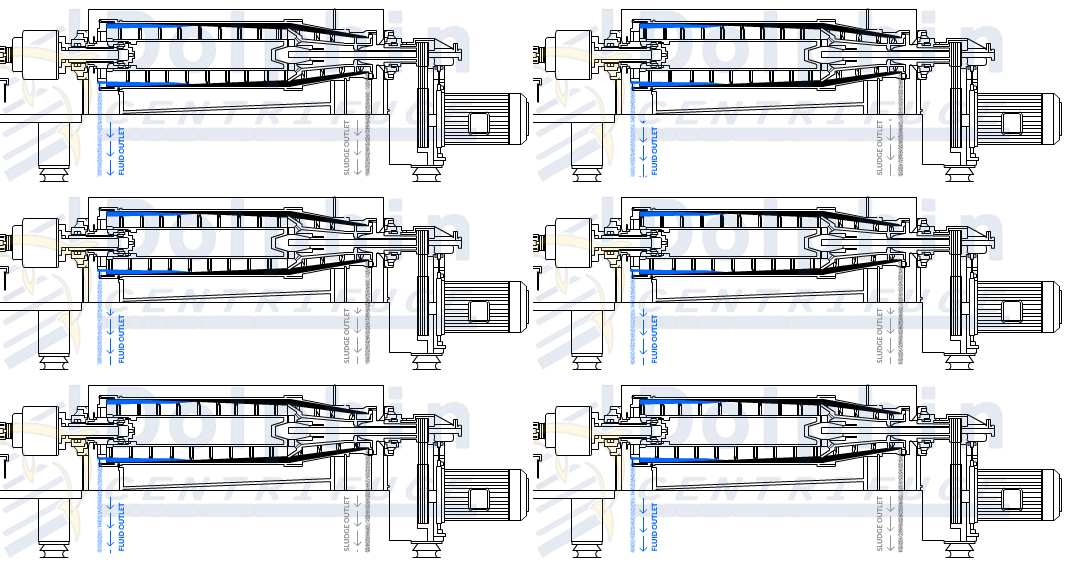
The operation of a dewatering centrifuge can be simply explained as follows. Under the high centrifugal force inside the rotating bowl, the sludge is spun out towards the periphery of the centrifuge bowl and pushed out by the auger through the solids' discharge ports. The centrifuge discharges the water through liquid ports on the fluid discharge end.
Animation
The animation below shows the operation of a dewatering centrifuge. One can see the auger pushing the dark sludge towards the solids' end (right side). The water flows towards the liquid discharge end (left side).
Main Components
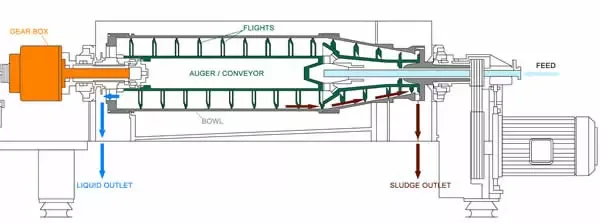
The main components of a dewatering (sludge-thickening) centrifuge are the bowl, scroll or auger or conveyor, and the gearbox.
Centrifuge Bowl
The centrifuge bowl is the outer cylindrical drum that rotates at a predetermined speed. This drum is the primary containment vessel for the feed slurry. The separation of the water from the sludge occurs within this bowl.
Auger (Scroll or Conveyor)
The auger is a screw-shaped conveyor that rotates within the bowl at a differential speed to the bowl body. The relative rotation of the auger pushes the separated thickened sludge towards the solids' end of the bowl. The solid ejection ports allow the separated sludge to exit the bowl into the sludge chute.
The separated water flows towards the liquid end and exits the bowl over the weir plates and into the water discharge chamber. The constant pushing of the separated sludge wears the flights of the auger. Therefore, the auger flights have a special erosion-resistant coating.
Gearbox
The planetary gearbox is a critical part of the dewatering centrifuge assembly. The gearbox facilitates the rotation of the auger at a differential speed to that of the bowl. It is easy to control the differential speed of the auger by changing the rotational speed of the sun wheel shaft of the gearbox.
A higher differential speed allows the centrifuge to push out larger volumes of sludge continuously. On the other hand, a lower auger speed allows the sludge to settle out better and therefore produces a clearer centrate.
Types
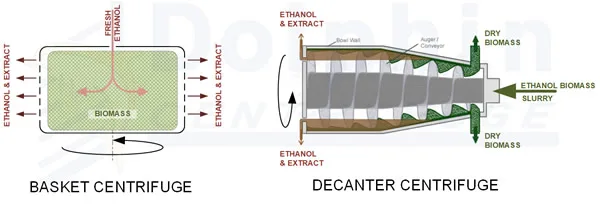
Different types of dewatering centrifuges are effective at different thickening types of slurries. But the most popular and commonly used dewatering centrifuge is the decanter type centrifuge.
Some basket-type or peeler-type centrifuges are also suitable for thickening slurries with high sludge content beyond the capacity of decanter centrifuges.
Dewatering centrifuge cross-section diagram
Basket vs. decanter centrifuge comparison
Need a Dewatering Centrifuge for Your Project?
Dolphin Centrifuge supplies reconditioned decanter centrifuges for purchase and rental — backed by 40+ years of industrial experience.
Benefits or Advantages
The benefits of dewatering centrifuges over other types of dewatering technologies are listed here. The other methods of sludge thickening are filter presses, screw presses, and just settling the sludge out of the water.
Compact Size
Compared to filter presses and screw presses, a dewatering centrifuge has a much smaller footprint than presses of similar processing capacity. Decanter centrifuges for sludge thickening are often less than half the size of comparable filter presses.
Efficiency
Dewatering centrifuges have a high separation efficiency when compared to other dewatering equipment. For example, a filter press has a rated sludge separation rate based on the particle size of the water slurry. Particles smaller than the filter pore pass through the filter press, leading to lower efficiency. A dewatering centrifuge separates mechanically, and therefore, it can separate a wide range of particles from 0.5" to less than 100 microns. The decanter centrifuge exerts over 3,000 Gs to separate the solids from water, and this centrifugal force is the reason for its high separation efficiency.
Continuous Processing
Unlike filter presses that are essentially operating in batch mode that require periodic manual cleaning, the dewatering centrifuges are flow-through type devices that operate continuously without any need for shut-downs related to cleanouts. The slurry passes through the decanter centrifuge, which dewaters the sludge to thicken it and concentrate the sludge.
Low Operating Cost
A dewatering centrifuge does not require filtration media that need a replacement that incurs labor and material costs. The centrifuge is a continuous process without manual intervention, and therefore, the operating costs for a dewatering centrifuge are considerably lesser than screw and filter presses.
Durability
Decanter centrifuges as dewatering centrifuges feature robust construction that gives these machines high durability. This durability is evident from the ability of these machines to operate continuously over long periods with the need for a stoppage. Filter and screw presses are not as durable as dewatering centrifuges due to their lightweight construction and the need for constant opening and closing to extract the sludge.
Equipment Longevity
Dewatering centrifuges manufactured by established brands have extremely heavy-duty construction, which leads to exceptionally high service life. It is not uncommon for Alfa Laval decanter centrifuges to have service lives of over 50 years. Comparatively, filter and screw presses have much higher failure rates and shorter service lives in the 10 to 15 years range.
Disadvantages
Like most industrial equipment, industrial centrifuges also have inherent disadvantages when compared to other dewatering technologies. The following are some of the disadvantages of dewatering centrifuges.
Capital Cost
Compared to presses (screw and filter), dewatering centrifuges initially cost more. However, the low operating costs and equipment longevity pay for the initial expense multiple times over the service life of the centrifuge. The cost difference between presses and decanter centrifuges for dewatering is not in multiples but fractionally more, which makes the dewatering centrifuge attractive as a long-term dewatering solution.
Vibration
Dewatering centrifuges are rotating equipment, and like all rotating equipment, these centrifuges generate vibrations. Decanter centrifuges must be isolated from the structural bases to prevent the vibrations from propagating to other structures. Spring and elastomer vibration isolators are standard parts of dewatering centrifuges and need to be maintained.
Noise
Unlike presses that do not emit any operating noise, dewatering centrifuges generate noise due to the rotating bearings and air currents within the centrifuge housing. Though the noise level is not excessive (~85 dB), it is still considered for dewatering centrifuge installations.
Maintenance
Like all mechanical rotating equipment, dewatering centrifuges also need periodic maintenance and repairs. Though these centrifuges have robust construction, the centrifuge may require the replacement of bearings once every few years.
Applications
As the name suggests, the primary purpose of dewatering centrifuges is to separate water from slurries to thicken the sludge. The following is a list of practical applications for these centrifuges.
Municipal Sewage Dewatering
Municipal sewage dewatering is the primary application of dewatering centrifuges. Alfa Laval decanter centrifuges are the most widely used centrifuges for this purpose. Large capacity dewatering centrifuges can process millions of gallons of wastewater per day to recover sewage water.
Industrial Sludge Thickening
Industrial wastewater pits accumulate sludge over time and need dewatering to reduce the sludge volume for disposal. Dewatering centrifuges can thicken the sludge from industrial wastewater pits and dry them enough to be sent to landfills. Thickened sludge leads to considerable cost savings in transportation and disposal.
Crude Oil Tank Bottom Sludge
Crude oil storage tanks accumulate sludge and water over time. It is crucial to clean these tanks to recover storage volume. A dewatering centrifuge separates the sludge from crude oil tank bottoms and allows cost-effective disposal of the thickened sludge. The separated water is pumped back into the ground.
Corn Mush Thickening
The commercial production of ethanol involves the corn mush extracting the sugars that are the source of ethanol as a fuel. A dewatering centrifuge separates the corn solids from the water efficiently. This centrifuge is, therefore, an integral part of ethanol production.
Specifications
The following table lists the specifications of commonly used dewatering centrifuges. For help picking the right industrial centrifuge for your application, contact our engineering team.
| Specification | Alfa Laval NX-314 | Alfa Laval NX-418 | Sharples P-3000 | Sharples P-3400 |
|---|---|---|---|---|
| Rated Capacity* | 60 GPM | 120 GPM | 55 GPM | 120 GPM |
| Bowl RPM | 3,250 | 4,000 | 4,000 | 4,000 |
| Bowl Diameter | 14" | 14" | 14" | 14" |
| Bowl Length | 34" | 58" | 30" | 50" |
| G-Force | 3,157 | 3,157 | 3,180 | 3,180 |
| Beach Angle | 8.5 Deg. | 8.5 Deg. | 10 Deg. | 10 Deg. |
| Motor Power | 15 kW | 20 kW | 15 kW | 20 kW |
| Gearbox | Planetary | Planetary | Planetary | Planetary |
| Dimensions | 28" × 72" × 48"(H) | 28" × 96" × 50"(H) | 28" × 70" × 46"(H) | 36" × 100" × 42"(H) |
| Weight | 2,000 Lbs | 3,600 Lbs | 2,400 Lbs | 4,100 Lbs |
* Rated capacity is under ideal fluid conditions. Actual processing capacity depends on fluid & sludge properties and volume.
Material of Construction (MOC)
The following is the typical material of construction for dewatering centrifuges manufactured by Alfa Laval.
| Component | Material of Construction |
|---|---|
| Bowl Body | 316 Duplex Stainless Steel (Some versions Carbon Steel) |
| End Caps (Hubs) | 316 Duplex Stainless Steel (Some versions Carbon Steel) |
| Vessel | 316 Duplex Stainless Steel |
| Auger (Conveyor) | 316 Duplex Stainless Steel (Some versions Carbon Steel) |
| Base Frame | Carbon Steel or Cast Steel |
| Gearbox | Carbon Steel (Planetary) |
Dolphin Centrifuge supplies reconditioned dewatering centrifuges with new controls, bearings, and wear components. Our systems are also available for rental for short-term or trial projects.
Call (248) 522-2573 or email sales@dolphincentrifuge.com to discuss your dewatering requirements.
By Sanjay Prabhu MSME, Engineering Manager, Dolphin Centrifuge
Frequently Asked Questions
What type of centrifuge is used for dewatering?
How does a dewatering centrifuge differ from a filter press?
What industries use dewatering centrifuges?
What is the minimum particle size a dewatering centrifuge can separate?
Can Dolphin Centrifuge supply dewatering centrifuges for rental?
Need a Dewatering Centrifuge?
Dolphin Centrifuge supplies reconditioned decanter centrifuges for purchase and rental. 40+ years of industrial dewatering expertise. Warren, Michigan.