AI Summary: Dolphin Centrifuge troubleshoots disc stack centrifuge bowl leaking caused by worn nylon seal rings, sliding piston lip damage, closing water faults, and paring disc blockage in self-cleaning centrifuges operating at 5,000–10,000 RPM. This guide covers causes, visual diagnosis, and repair procedures.
Disc stack centrifuge bowl leaking is a common occurrence. This troubleshooting article discusses the various reasons for the bowl leaking and how to fix it. This article refers to some disc-stack centrifuge bowl parts which are unique to these types of machines. The reader can see a brief explanation of each of these parts in our disc centrifuge terms glossary.
Disc Centrifuge Bowl Leaking Explained
A self-cleaning, disc-stack centrifuge has a split-bowl design. It means that the upper and lower parts of the bowl have a designed opening between them. The self-cleaning mechanism requires the two parts to separate, which allows the separated sludge to exit the bowl.
Under standard processing, the bowl needs to be closed to prevent the liquid from escaping the bowl through the sludge outlet. This requirement means that the two parts of the bowl need a tight seal when they are in a closed position.
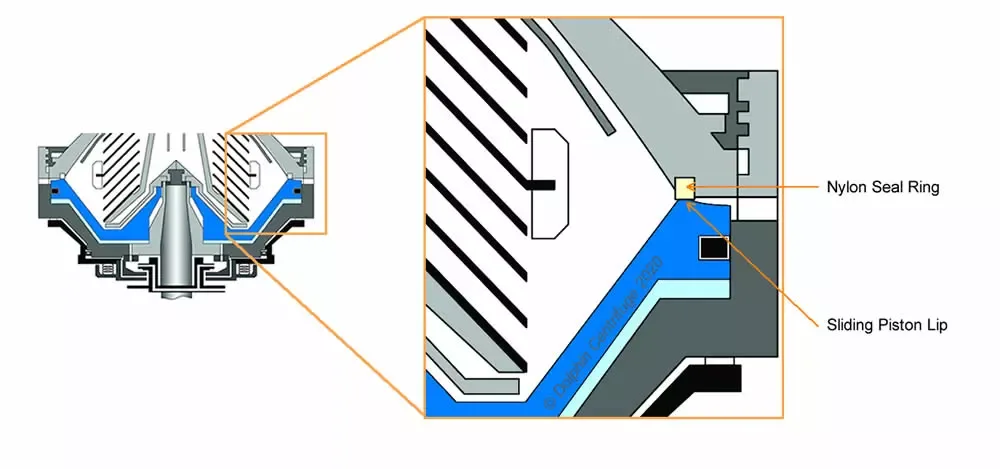
The upper part of the bowl, known as the bowl hood, has a circular seal embedded around its periphery. This seal ring is a sacrificial part known as the Nylon Seal Ring.
The lower part of this sealing mechanism is the Sliding Piston. This part is the only independently moving member inside the bowl cavity. The sliding piston has a protruding lip around its outer edge.
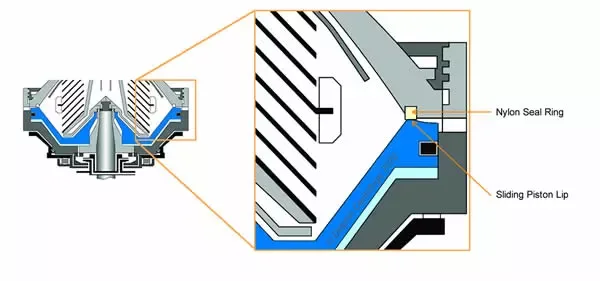
The Sliding Piston lip butts up against this Nylon Seal Ring to form the seal. See the image below showing the bowl cross-section of this seal.
A leaking bowl means that this seal is not functioning correctly. This malfunction allows the process liquid to escape through this seal.
Visual Clues to a Leaking Bowl
The main sign of a leaking bowl is a continuous discharge of process fluid during the fluid process cycle. The operator can see this discharge coming out through the sludge discharge chute.
This leak diverts some or all of the process fluid resulting in reduced or no flow through the clean oil path. Most centrifuge control systems monitor the pressure in this pipe, and flow loss will trigger the no-flow alarm.
The leaking process fluid will also cause resistance to the bowl rotation due to the air friction experienced by the escaping fluid at high velocity. This drag on the bowl causes the motor to draw a higher current, which is also detected by an advanced control system.
Read our 101 Frequently Asked Questions about Disc Stack Centrifuges.
Nylon Seal Ring Worn Out
The Nylon Seal Ring is a sacrificial part. During the sludge discharge cycle, the accumulated sludge exits the bowl at a high velocity past this seal ring. The sludge particles cause wear on the seal ring surface as they pass the seal ring. Over time this repeated process causes wear on the Nylon Seal Ring.
Inspecting and replacing the Nylon Seal Ring is the immediate fix for this problem. That is assuming a worn-out seal ring is the cause of the leak.
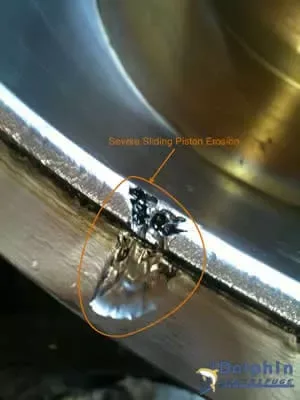
Another important consideration here is the periodic replacement of the Nylon Seal Ring. Consider the centrifuge operation with a worn-out seal ring, which is leaking the sludge-laden process fluid. The sludge particles will also cause wear on the sliding piston lip. The sliding piston is an expensive part to replace. Therefore, it is better to routinely replace the inexpensive Nylon Seal Ring to protect the sliding piston from wear.
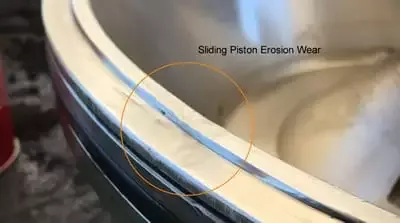
The photograph below shows an eroded sliding piston lip caused by a leaky bowl seal.
Bowl Not Fully Closed
It is possible that the sliding piston does not form the complete seal against the seal ring in some cases. The piston can cause this improper seal if the piston seal is not functioning as intended.
The operator should investigate this possible cause if the seal ring and the lip on the sliding piston appear to be in good condition.
Often a couple of inert sludge discharge cycles that the operator manually initiates can fix this problem. However, if this quick remedy does not fix the bowl leak, it must be thoroughly inspected for any impediment that may cause the piston to move within the bowl.
Closing Water Leaking
In older centrifuges, the bowl closing water may leak out from the bowl closing chamber due to worn valve plugs or a bad gasket or o-ring.
During the process, a slow leak of the bowl closing water can gradually reduce the upward force on the sliding piston causing it to slip down, resulting in the bowl leaking. See the operating water guide for detailed specifications on the closing water circuit.
One of the features of Dolphin Centrifuge automatic centrifuge control systems introduces fresh closing water into the bowl periodically. This feature can alleviate the cause of the bowl leak.
Sliding Piston Lip Wear
Damaged sliding piston lips are a common finding. Improper handling of the sliding piston during servicing can cause indentations on the sliding piston lip. These tiny gauges do not allow the seal ring to contact the entire sliding piston lip surface fully. The highly pressurized process fluid in the bowl escapes through the tiniest gaps in this seal, causing the bowl to leak.
The OEM recommends using a fine-grade abrasive tool to gently blend the indentation to the rest of the lip surface. This repair of the sliding piston lip often fixes the leak.
Sludge Particle Embedded in the Nylon Seal Ring
Partial discharge centrifuges can open and close the bowl in a very short time span. This quick opening allows this type of centrifuge to discharge some portion of the separated sludge. A standard design partial discharge centrifuge discharges approximately 70% of the sludge space in the bowl.
If the process fluid is not pre-strained and contains large solid particles, these particles can get caught between the nylon seal ring and the rising piston lip. The particles can get embedded in the nylon seal ring, which causes the seal to be uneven and incomplete. These embedded particles are another possible cause of a leaking bowl.
Replacement of the damaged seal ring is the proper fix for this cause of bowl leakage.
Small Lock Ring Not Fully Tightened
The small lock ring or paring chamber cover houses the paring disc pump in the upper part of the bowl hood. A loosely fitted small lock ring allows the process fluid to leak through it. The leaking process fluid then drains down the centrifuge frame's inner side and out the sludge drain.
This leak appears as soon as the bowl is full of fluid and continues throughout the process. The simple fix for this leak is to stop the centrifuge and fully tighten the small lock ring.
Plugging of the Paring Disc Impeller with Sludge
The upper paring disc pumps out the heavy phase from the disc centrifuge. Sludge buildup can cause this impeller to be blocked. The heavy phase fluid now overflows from the centrifuge bowl top and down the frame into the sludge outlet.
This fluid draining is again a constant flow and appears to be a leaky bowl. The operator needs to stop the centrifuge and clean the paring disc pump to fix this condition. For related troubleshooting, see our guides on bad separation causes and general bowl troubleshooting.
Need Help With a Leaking Bowl?
Our Warren, Michigan service team repairs and reconditions disc stack centrifuge bowls, including nylon seal ring and sliding piston replacement.
Dolphin Centrifuge customers can always call us to avail of our lifetime technical assistance. Contact us at (248) 522-2573 or email sales@dolphincentrifuge.com. We also offer sample testing services to evaluate separation performance after repair.
Frequently Asked Questions
What causes a disc stack centrifuge bowl to leak?
The most common causes are a worn nylon seal ring, sliding piston lip damage, a bowl that is not fully closed, closing water leaking from worn valve plugs, sludge particles embedded in the seal ring, a loose small lock ring on the paring chamber cover, or a plugged paring disc impeller. The leaking process fluid exits through the sludge discharge chute during the normal process cycle.
How can I tell if my centrifuge bowl is leaking?
The main sign is a continuous discharge of process fluid through the sludge discharge chute during the normal process cycle. This diverts fluid from the clean oil path, triggering a no-flow alarm on the centrifuge control system. The escaping fluid also creates air friction drag on the bowl, causing the motor to draw higher current.
Why is the nylon seal ring important in a disc centrifuge?
The nylon seal ring is a sacrificial part embedded in the bowl hood periphery. It seals against the sliding piston lip to prevent process fluid from escaping through the sludge outlet during normal operation. Routine replacement of the inexpensive nylon seal ring protects the much more expensive sliding piston from wear damage.
Can a plugged paring disc cause what looks like a bowl leak?
Yes. When sludge buildup blocks the upper paring disc impeller, the heavy phase fluid overflows from the centrifuge bowl top and drains down the frame into the sludge outlet. This constant flow appears identical to a leaking bowl. Stopping the centrifuge and cleaning the paring disc pump resolves the condition.
How often should I replace the nylon seal ring in my disc centrifuge?
The nylon seal ring should be inspected at every bowl opening and replaced at the first sign of wear, flat spots, or scoring. In high-solids applications, consider replacing it at every major service interval regardless of appearance. The seal ring is inexpensive — delaying replacement risks expensive sliding piston lip damage.