
Dolphin Centrifuge supplies disc stack centrifuge systems for hydraulic oil purification — removing water contamination, fine metal particles, and varnish-forming sludge from hydraulic fluid systems at 7,000+ Gs. These self-cleaning separators restore hydraulic oil clarity and extend fluid life continuously without filter media replacement, processing 7–38 GPM based on oil viscosity. Based in Warren, Michigan, Dolphin Centrifuge has over 40 years of experience in hydraulic fluid centrifugation.
Hydraulic Oil Centrifuge Overview
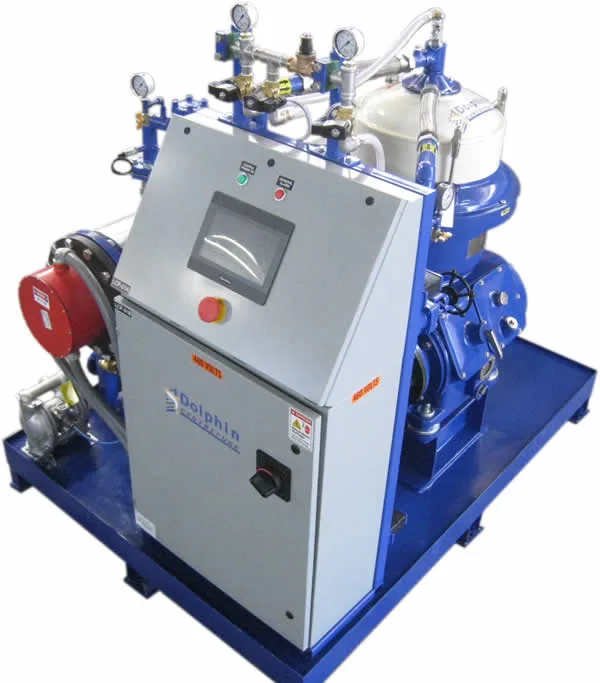
Disc Stack Centrifugal Separator for Hydraulic Oil
Dolphin Centrifuge, based in Warren, Michigan, supplies purpose-built disc stack centrifuge systems for this application at 8000 Gs. A hydraulic oil centrifuge is a disc stack centrifuge designed for continuous purification of hydraulic fluid used in extrusion presses, stamping presses, forging presses, injection molding machines, and heavy industrial hydraulic systems. These centrifuges remove water, metal fines, and sludge that degrade hydraulic oil performance and damage expensive components.
Hydraulic systems in manufacturing environments are particularly vulnerable to contamination. Metal particles from wear, water ingress from condensation, and sludge formation from thermal degradation all shorten oil life and cause valve, pump, and cylinder failures. A centrifuge provides continuous, automated purification without consumable filter media.
Dolphin Centrifuge supplies turnkey hydraulic oil purification systems for extrusion, stamping, forging, and molding operations — from 2 GPM manual-clean units to 10+ GPM self-cleaning systems.
How Does a Hydraulic Oil Centrifuge Work?
The centrifuge bowl spins at approximately 7,800 RPM, generating centrifugal forces up to 7,000 Gs. At this force level, contaminant particles as small as 0.5 microns are separated from the hydraulic oil. The disc stack inside the bowl creates thin oil layers between closely spaced conical discs, dramatically reducing the distance particles must travel to be captured.
Contaminated hydraulic oil enters the centrifuge through a central feed tube and is distributed between the disc stack. Under intense centrifugal force, heavier contaminants (metal fines, sludge, and water) move outward toward the bowl wall, while clean oil moves inward and exits through the light-phase outlet.
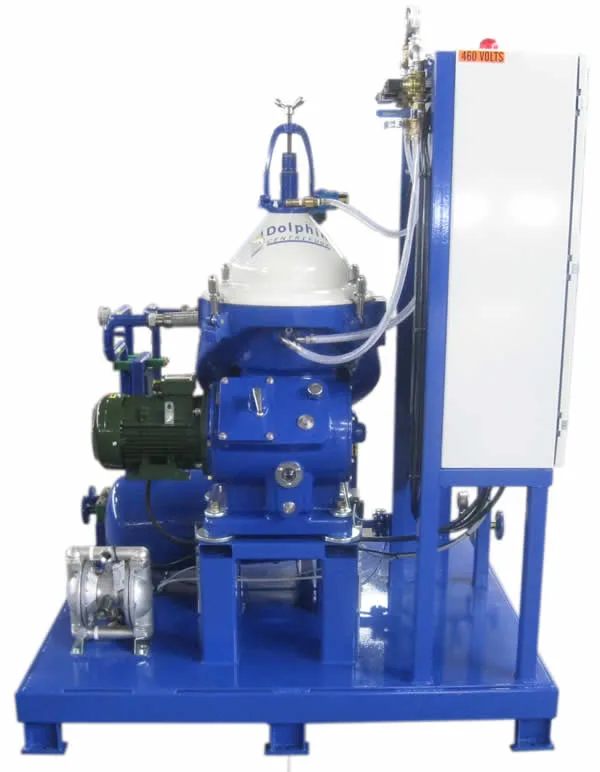
Self-Cleaning Disc Stack Centrifuge for Hydraulic Oil
The centrifuge operates in a kidney loop configuration, continuously drawing oil from the hydraulic reservoir, cleaning it, and returning purified oil. This arrangement maintains oil cleanliness without interrupting press or machine operation.
Unlike filters that lose efficiency as they load up with contaminants, centrifuge separation performance remains constant regardless of the sludge level in the bowl. The centrifuge maintains the same separation efficiency from the first gallon to the last.
Applications
Hydraulic oil centrifuges are used across a wide range of heavy manufacturing and industrial operations:
- Extrusion Industry: Aluminum and copper extrusion presses generate significant metal fines and operate at elevated temperatures, accelerating oil degradation. Centrifuges are essential for maintaining hydraulic oil quality in extrusion press applications.
- Stamping Presses: High-speed stamping operations introduce metal particles and die lubricant contamination into hydraulic fluid
- Forging Presses: Extreme pressures and temperatures in forging operations create severe hydraulic oil contamination
- Injection Molding: Hydraulic injection molding machines require clean oil to maintain precise pressure control and cycle consistency
- Cranes & Heavy Lift Equipment: Mobile and overhead cranes with large hydraulic reservoirs benefit from continuous oil purification
- Balers & Compactors: Recycling and waste processing equipment operates in dirty environments where hydraulic oil contamination is accelerated
Need Help With Your Hydraulic Oil System?
Our engineers will evaluate your hydraulic oil application and recommend the optimal centrifuge system.
Benefits of Centrifuge Hydraulic Oil Purification
- Simultaneous Water and Solids Removal: A centrifuge separates both water and solid contaminants in a single pass — filters can only address solids
- No Performance Degradation: Unlike filters that lose efficiency as they clog, centrifuge separation performance remains constant throughout the operating cycle
- Ultra-Fine Particle Removal: Removes contaminant particles across a wide range from 0.5μ to 250μ in a single pass
- Low Operating Cost: No consumable filter elements to purchase or dispose of — the centrifuge is a purely mechanical separator
- Extends Oil Life: Continuous purification dramatically extends hydraulic oil service life, reducing oil purchases and disposal costs
- Protects Components: Clean, water-free hydraulic fluid prevents valve spool sticking, pump wear, and cylinder scoring
- Reduces Downtime: Continuous operation eliminates the downtime associated with filter changes and hydraulic system failures
- Automatic Operation: PLC-controlled systems run unattended around the clock
Lab Scale Testing
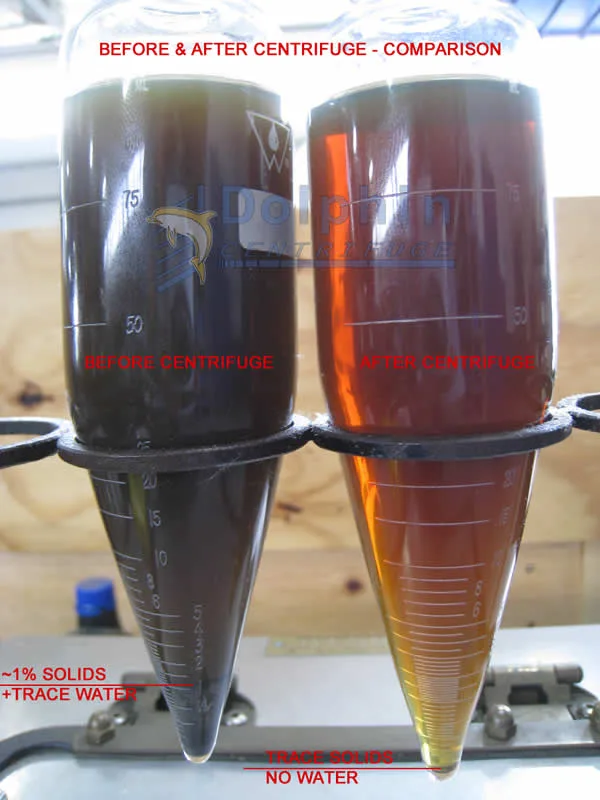
Hydraulic Oil Before and After Disc Stack Centrifuge
For new applications or unusual hydraulic fluids, we offer lab-scale centrifuge testing to determine the optimal centrifuge configuration before committing to a full-scale system. Testing provides quantifiable before-and-after results on your actual hydraulic oil.
The testing process is straightforward: send us a sample of your contaminated hydraulic oil. We process it through a lab-scale disc stack centrifuge under controlled conditions and provide a detailed report showing:
- Particle count and size distribution — before and after centrifuge processing
- Water content (ppm) — before and after
- Visual clarity comparison
- Recommended centrifuge model, flow rate, and system configuration
Lab testing removes all guesswork from system selection and gives you documented proof of centrifuge performance on your specific hydraulic oil before purchase. Contact us to arrange a lab test.
Materials of Construction
Hydraulic oil centrifuge components are manufactured from materials selected for durability, corrosion resistance, and long service life:
- Centrifuge Bowl: 316L Duplex stainless steel — provides superior corrosion resistance and mechanical strength at high rotational speeds
- Distributor: Marine bronze — wear-resistant material for the oil distribution element
- Bowl Covers: Silium (silicon-aluminum alloy) — lightweight, corrosion-resistant covers that reduce rotational inertia
- Frame & Base: Cast iron — heavy-duty construction for vibration dampening and stability
- Disc Stack: Stainless steel conical discs — precision-stamped for uniform spacing and maximum separation area
These materials ensure a service life of 30+ years with proper maintenance. All wetted parts are corrosion-resistant, suitable for processing hydraulic fluids with varying additive packages.
Specifications
The following table shows specifications for our most popular hydraulic oil centrifuge models. Manual-clean units are ideal for applications with low sludge volumes, while self-cleaning models are recommended for higher contamination levels.
| Specification | DMB-004 | DMB-007 | DMPX-014 |
|---|---|---|---|
| Type | Manual-Clean | Manual-Clean | Self-Cleaning |
| Hydraulic Oil Capacity | 2 GPM | 4 GPM | 10 GPM |
| Bowl Sludge Volume | 0.15 Gal | 0.38 Gal | 0.42 Gal |
| Bowl Speed | 8,600 RPM | 7,500 RPM | 7,600 RPM |
| Drive Motor | 1 HP | 2 HP | 4 HP |
| Separation Efficiency | 0.5μ particles; all free water | 0.5μ particles; all free water | 0.5μ particles; all free water |
| Footprint | 3' × 4' × 4' (H) | 3' × 4' × 4' (H) | 4' × 5' × 5' (H) |
| Weight | 500 lbs | 750 lbs | 1,500 lbs |
Note: Actual throughput depends on oil viscosity and process temperature. Higher temperatures reduce viscosity and enable higher flow rates through the centrifuge. Capacities shown are for hydraulic oil at typical operating temperature.
Available Hydraulic Oil Centrifuge Systems
Dolphin Centrifuge offers complete turnkey hydraulic oil purification systems. Each system includes the centrifuge, feed pump, controls, piping, and instrumentation — ready for installation into your hydraulic circuit.
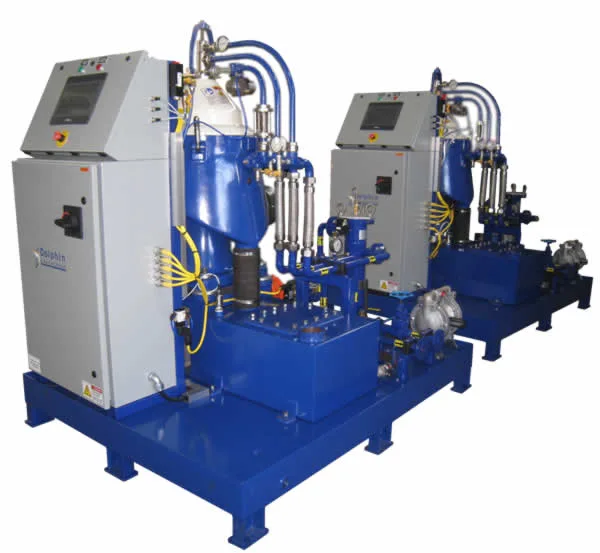
DMPX-014 Hydraulic Oil Centrifugal Filter Modules
| System | Type | Capacity | Best For |
|---|---|---|---|
| DMB-004 | Manual-Clean | 2 GPM | Small presses / low contamination |
| DMB-007 | Manual-Clean | 4 GPM | Medium presses / stamping |
| DMPX-014 | Self-Cleaning | 10 GPM | Extrusion presses / high sludge |
| DMPX-028 | Self-Cleaning | ~20 GPM | Large forging / high-volume systems |
Need help selecting the right system? Our engineers will recommend a centrifuge based on your reservoir size, contamination type, and throughput requirements. Contact us for a custom recommendation.
Related resources: Extrusion Industry Centrifuges | Lube Oil Centrifuges | Sample Testing Program | Centrifuge FAQ (101 Questions) | Decanter vs. Disc Centrifuge
Frequently Asked Questions
What contaminants does a hydraulic oil centrifuge remove?
How much longer will my hydraulic oil last with a centrifuge?
Can I test my hydraulic oil in your centrifuge before buying a system?
What industries use hydraulic oil centrifuges?
How is a hydraulic oil centrifuge installed in an existing hydraulic system?
Extend Your Hydraulic Oil Life — Get a Quote
Dolphin Centrifuge supplies turnkey hydraulic oil purification systems for extrusion, stamping, forging, and molding operations. Contact us to spec the right centrifuge for your reservoir size and contamination level.
Call us: (248) 522-2573 • sales@dolphincentrifuge.com