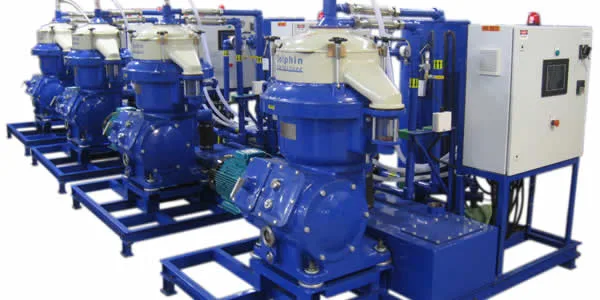
Dolphin Centrifuge answers frequently asked questions about industrial centrifuge types, applications, utilities, explosion proof requirements, pricing, warranties, lead-times, testing services, and after-sales support. Covers manual-clean, self-cleaning, and decanter centrifuges for liquid/liquid and liquid/liquid/solid separation. Based in Warren, Michigan, Dolphin Centrifuge has over 35 years of application engineering experience across fuel, oil recovery, wastewater, and chemical processing industries.
Whether you're evaluating your first industrial centrifuge purchase or comparing Dolphin Centrifuge to other suppliers, this FAQ covers the questions our engineers hear most often. Browse by topic below or use the table of contents to jump to a section.
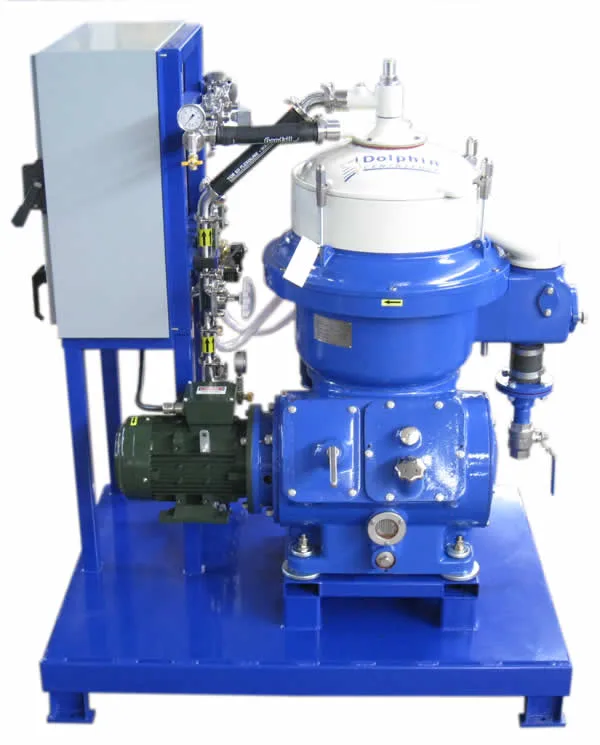
FAQ About Industrial Centrifuges
We have a batch of oil with diesel dissolved in it. Can your centrifuge separate the diesel from the oil?
Industrial Centrifuges work on the principle of different specific gravity separating into different phases under extremely high "g" force. If you have dissolved liquids there is effectively no difference in specific gravity for the centrifuge to separate. Therefore centrifuges of any type cannot separate dissolved liquids or solids dissolved in liquids (i.e. Salt / Water).
Visit our diesel centrifuge page to see examples of what diesel separation centrifuges can accomplish — removing free water and sediment from diesel fuel rather than separating dissolved components.
We have oil with 25% or more sludge — can your "self-cleaning" centrifuge separate the oil from the sludge?
"Self-Cleaning" centrifuges are capable of separating up to 5% sludge (by volume) due to the inherent design of these types of centrifuges.
For high sludge applications we recommend horizontal decanter type centrifuges which are capable of separating high sludge content fluids up to 30% or more in some cases.
| Centrifuge Type | Max Solids (vol %) | Best For |
|---|---|---|
| Manual Clean (Clarifier) | < 0.5% | Liquid/liquid, trace solids |
| Self-Cleaning (Purifier) | Up to 5% | Liquid/liquid/solid, moderate solids |
| Decanter | Up to 50%+ | High-solids slurries, sludge dewatering |
What are the typical applications of a "Manual Clean" centrifuge?
As the name implies, "Manual Clean" centrifuges are designed for liquid/liquid separation of 2 immiscible liquids with no solids or very low solids contamination (< 0.5% by volume). Typical applications include:
- Separation of water from diesel fuel
- Separation of water from turbine lube oil
- Biodiesel separation from glycerin
What are the typical applications of a "Self Cleaning" centrifuge?
"Self Cleaning" Centrifuges have more extensive uses. They are designed for liquid/liquid/solid separation. They can separate fluids with up to 5% (by volume) solids. Typical applications include:
- Separation of crude-oil from salt-water and sediment
- Fuel oil separation from water and sediment
- WVO (waste vegetable oil) separation from water and sediment
- Used motor oil separation from water and fine metal particles
What are the typical applications of a Decanter centrifuge?
Decanter centrifuges are widely used for applications with more than 5% solids (up to 50%) by volume. They are designed for both 2-phase and 3-phase separation. Typical applications include:
- Crude oil tank bottom sludge
- Industrial and municipal wastewater
- Hemp biomass separation
- Chemical sludge thickening
- Oilfield drilling mud separation
See our full range of decanter centrifuge options.
What utilities are required for industrial centrifuges? Do they consume a lot of power?
Most industrial centrifuges operate on 460 Volts AC power. Power requirements scale with capacity:
- Small centrifuges (1-2 GPM): 1 HP motor
- Large centrifuges (100+ GPM): 50 HP or larger motors
Self-cleaning centrifuges additionally need a clean, potable water supply for the sludge ejection mechanism (city water @ 50 psig is sufficient). Some systems with integral sludge tanks and sludge pumps require compressed air at 100 psig.
We need a centrifuge for biodiesel separation — does it need to be Explosion Proof?
Requirement of explosion proof components / systems are entirely defined by your local codes. Dolphin Centrifuge is unable to verify applicability of your local codes. The customer needs to contact the appropriate authorities to ascertain the requirement of such codes.
Dolphin Centrifuge has in-house capability to design and manufacture explosion proof centrifuge systems.
Not sure which centrifuge type fits your application?
Send us a sample and our engineers will test it on a pilot-scale disc stack centrifuge — at no charge.
FAQ About Dolphin Centrifuge
Who is Dolphin Centrifuge? How is Dolphin different from other suppliers?
Dolphin Centrifuge is a Michigan incorporated company specializing in industrial centrifuges for over 35 years. Industrial Centrifuges is ALL WE DO.
The main difference is that Dolphin is essentially an engineering company specializing in industrial centrifuges — NOT a used equipment dealer. Dolphin has an inventory of over 300 new, re-manufactured, and used centrifuges at our Warren, MI factory. Dolphin does not list equipment that it does not own.
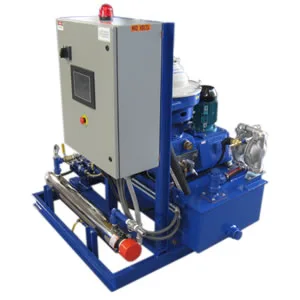
Can we see the centrifuge before we buy it?
Absolutely! All prospective customers are welcome to our Warren, MI factory to inspect our centrifuges. Customers are also invited to witness the testing of their centrifuge system at our facility prior to shipment.
Can we see the centrifuge in operation before we take delivery?
Yes. In fact, we recommend our customers visit our Warren, MI factory to see their centrifuges being tested. We also offer hands-on operational training at our factory at no charge to our customers.
Where is the Reconditioning, Fabrication & Manufacturing work done?
All Re-manufacturing, Fabrication, Assembly, Control System Assembly, Wiring & Testing are done at our Warren, MI factory — 24248 Gibson Dr, Warren MI 48089.
Do you provide on-site start-up and training? Is it included in the cost?
In addition to the no-charge training available at the Dolphin Centrifuge factory in Warren, MI, we provide on-site start-up and training at your facility. These services are typically not included in the cost of the base centrifuge system, however we can provide a comprehensive proposal to include start-up and training on request.
What about after-sales support? Is there a charge after a defined period?
Dolphin Centrifuge is known for its lifetime after-sales technical support which is included with all centrifuges supplied by us. We routinely get calls from customers who have been operating our centrifuges over many years.
How do we know a centrifuge will work for our process? Does Dolphin provide testing services?
We have supplied centrifuges for over 35 years, for practically all centrifuge applications. We can often tell you if a centrifuge will work based on our experience.
Dolphin Centrifuge offers a sample testing service. We process a small sample (1 gal) of your product through our pilot scale disc stack centrifuge to provide documented, real-world separation results.
What lead-times are expected for reconditioned centrifuge skids?
Typical lead-times for small centrifuges are in the 4-8 week range. Larger centrifuges can be anywhere from 12-20 weeks depending on the scope of supply and options selected.
How does pricing compare with new centrifuges from the OEM?
Generally you can expect our pricing for a reconditioned centrifuge system — with new skid, new pump, new controls, and all new accessories — to be about 50% of similar capacity new centrifuge systems.
Does Dolphin Centrifuge provide a warranty with reconditioned centrifuges?
Yes, all our reconditioned centrifuges come with a 6-month mechanical warranty with a written warranty statement provided with the formal proposal.
How do we know Dolphin Centrifuge won't disappear after they get our money?
Dolphin Centrifuge has been in the centrifuge business for over 35 years during which we have delivered hundreds of centrifuges throughout the world. Yes, we can provide references of customers who have been with us for years.
You are also welcome to visit our facility before you make your final purchase decision. We highly recommend it.
Related Resources
Disc Stack Centrifuge FAQ
Questions specific to disc stack / purifier centrifuges
Sample Testing Service
Test your fluid on our pilot centrifuge before you buy
Centrifuge Applications
Full library of industrial centrifuge applications
Explosion Proof Centrifuges
Hazardous area rated systems for flammable fluids
Still have questions? Contact a Dolphin Centrifuge engineer at (248) 522-2573 or email sales@dolphincentrifuge.com.