
Dolphin Centrifuge supplies disc stack centrifuge systems for lube oil purification — removing water, soot, oxidation products, and fine metal wear particles from industrial lubricating oils and gear oils at over 6,000 Gs. These separators remove solid particles greater than 1 micron and all free water without consumable media (in kidney-loop applications, separation down to 0.5 microns is achievable through multiple recirculation passes). Systems range from 3–45 GPM based on model and oil viscosity. Based in Warren, Michigan, Dolphin Centrifuge has over 40 years of experience in lube oil centrifugation.
These centrifuges are also known as Lube Oil Purifiers or Lube Oil Conditioning Modules.
What Is a Lube Oil Centrifuge?
A lube oil centrifuge is a disc stack centrifuge configured for continuous purification of lubricating oil used in steam turbines, gas turbines, large engines, and compressors. These systems remove water contamination from condensate leaks and fine metal particles from bearing wear. Dolphin Centrifuge, based in Warren, Michigan, supplies purpose-built disc stack centrifuge systems for this application, generating over 6,000 Gs of centrifugal force.
In power plants and industrial facilities, turbine lube oil reservoirs range from 1,500 to over 5,000 gallons. A centrifuge operates in a continuous kidney loop arrangement, constantly circulating and cleaning the oil to keep contamination levels near zero.
Dolphin Centrifuge supplies turnkey lube oil purification systems for steam turbines, gas turbines, and large industrial equipment — from 3 GPM to over 45 GPM capacity.
How Does a Lube Oil Centrifuge Work?
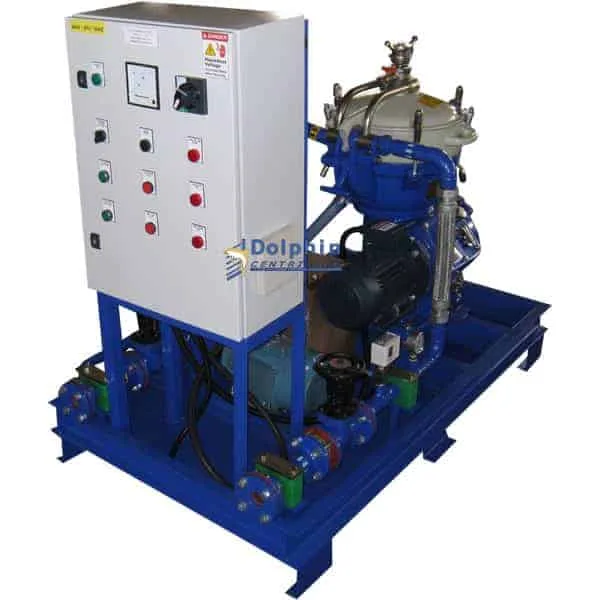
The centrifuge bowl spins at high speed, generating centrifugal forces over 6,000 Gs. Under this force, heavier components (water and metal particles) are pushed outward toward the bowl periphery, while lighter clean oil moves inward toward the center.
Clean oil exits through the light-phase outlet and returns to the reservoir. Separated water is continuously discharged through a dedicated heavy-phase outlet. Solid contaminants accumulate in the bowl and are either ejected automatically (self-cleaning models) or removed during scheduled manual cleaning.
For lube oil applications, the centrifuge provides three-phase separation — simultaneously removing both water and solids from the oil in a single pass. This is the key advantage over filters, which can only address solids.
Need Help With Your Lube Oil System?
Our engineers will evaluate your turbine or engine lube oil application and recommend the optimal centrifuge system.
Advantages of Centrifuge Lube Oil Purification
- Simultaneous Water and Solids Removal: Separates water, metal particles, and sludge in a single pass — filters can only remove solids
- Continuous Processing: Operates 24/7 in a kidney loop, keeping oil clean at all times
- Fine Particle Removal: Removes particles down to 1 micron and all free water
- No Consumable Media: Unlike filters, centrifuges don't use disposable elements — no ongoing filter costs
- Consistent Performance: Separation efficiency does not degrade over time as it does with filters that clog
- Extends Oil Life: Continuous purification allows turbine oil to remain in service far longer
- Protects Bearings: Clean, water-free oil prevents bearing corrosion and wear
- 30+ Year Service Life: Industrial disc stack centrifuges are built for decades of reliable operation
Limitations
- Higher Initial Cost: Centrifuge systems cost more upfront than filter assemblies, though they pay for themselves through eliminated filter purchases and reduced maintenance
- Skilled Maintenance: Periodic bowl cleaning and inspection require trained technicians (we offer centrifuge training for your team)
- Power Requirement: Centrifuges require dedicated electrical supply (1–15 HP depending on model)
- Operating Water: Self-cleaning models require a clean water supply for bowl ejection cycles
Specifications
Manual-Clean Systems (Recommended for Turbine Lube Oil)
Manual-clean centrifuges are the preferred choice for turbine lube oil because lube oil contamination is primarily water with minimal solids. The low sludge volume makes automatic ejection unnecessary, and manual-clean units offer excellent value.
| Specification | DMB-004 | DMB-007 | DMB-019 | DMB-028 |
|---|---|---|---|---|
| Type | 2-Phase; Manual-Clean | 2-Phase; Manual-Clean | 2-Phase; Manual-Clean | 2-Phase; Manual-Clean |
| Lube Oil (R&O) Capacity | 2 GPM | 4 GPM | 10 GPM | 15 GPM |
| Steam Turbine Oil Capacity | 4 GPM | 6 GPM | — | — |
| Separation Efficiency | 1μ particles; all free water | 1μ particles; all free water | 1μ particles; all free water | 1μ particles; all free water |
| Drive Motor | 1 HP | 1–2 HP | 5 HP | 7.5 HP |
| Bowl Speed | 8,600 RPM | 8,600 RPM | — | — |
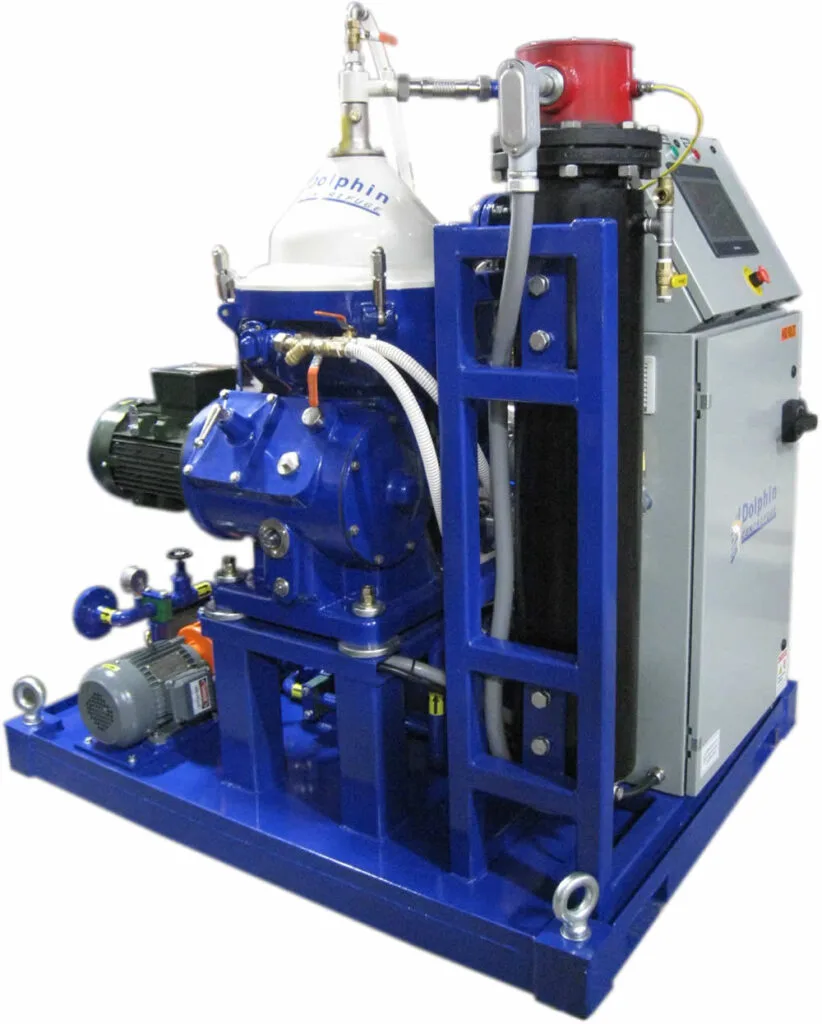
Self-Cleaning Systems (High-Volume or Higher Sludge Applications)
| Specification | DMPX-014 | DMPX-028 | DMPX-042 |
|---|---|---|---|
| Type | 3-Phase; Self-Cleaning | 3-Phase; Self-Cleaning | 3-Phase; Self-Cleaning |
| Lube Oil (R&O) Capacity | 7–8 GPM | 10–14 GPM | 15–24 GPM |
| Steam Turbine Oil Capacity | 14–16 GPM | 21–26 GPM | 34–46 GPM |
| Separation Efficiency | 1μ particles; all free water | 1μ particles; all free water | 1μ particles; all free water |
| Centrifugal Force | 8,000 Gs | 7,200 Gs | 6,800 Gs |
| Drive Motor | 4 HP | 7.5 HP | 15 HP |
| Power | 460V; 20A | 460V; 30A | 460V; 60A |
Legacy Alfa Laval Reference Specifications
The following legacy Alfa Laval models are the original OEM centrifuges on which Dolphin systems are based. These specifications are provided for reference.
| Specification | Alfa Laval MAB 103 | Alfa Laval MAB 205 | Alfa Laval MOPX 210 |
|---|---|---|---|
| Centrifuge Efficiency | Solid Particles > 1μ; Free Water > 2μ | ||
| Sludge Handling | Manual Clean | Manual Clean | Self-Ejecting / Auto Desludging |
| Bowl Speed | 8,600 RPM | 8,700 RPM | 5,180 RPM |
| Rated Capacity | 5 GPM | 28 GPM | 72 GPM |
| ISO 32 Lube Oil Capacity | 3 GPM | 18 GPM | 45 GPM |
| Sludge Space | 0.15 Gal | 0.54 Gal | 1.5 Gal |
| Motor Power | 1 HP | 5 HP | 15 HP |
| Module Dimensions* | 2' x 3' x 3' (H) | 3' x 4' x 4' (H) | 5' x 6' x 7' (H) |
| Module Weight* | 800 Lbs | 1,500 Lbs | 3,000 Lbs |
| Operating Voltage | 110V, 230/460V | 230/460V | 230/460V |
| Utilities Required** | Power, Water | Power, Water, Air | Power, Water, Air |
* Base module without options. ** Module with optional accessories.
System Setup: Kidney Loop Configuration
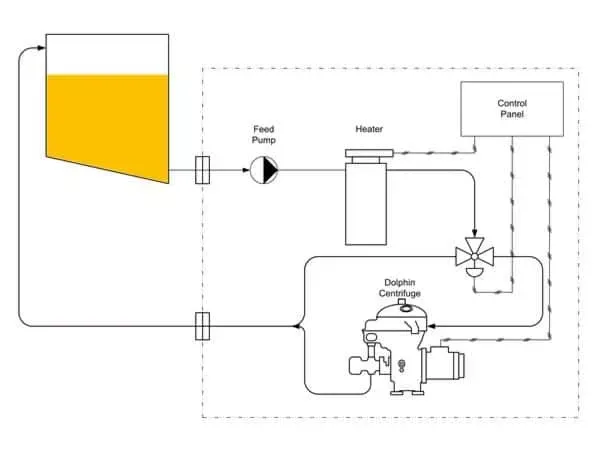
Lube oil centrifuges are installed in a kidney loop arrangement, continuously processing oil from the reservoir and returning clean oil. The typical setup includes:
- A feed pump draws oil from the bottom of the reservoir (where contaminants settle)
- The oil passes through an inline pre-heater to reduce viscosity and improve separation efficiency
- The heated oil enters the centrifuge, where water, particles, and sludge are separated
- Clean oil returns to the top of the reservoir
- Separated water drains to a collection point; sludge is ejected or removed during cleaning
This arrangement continuously polishes the oil without interrupting turbine or engine operation. The centrifuge processes the entire reservoir volume multiple times per day, maintaining ISO cleanliness targets.
Sizing by Reservoir Volume
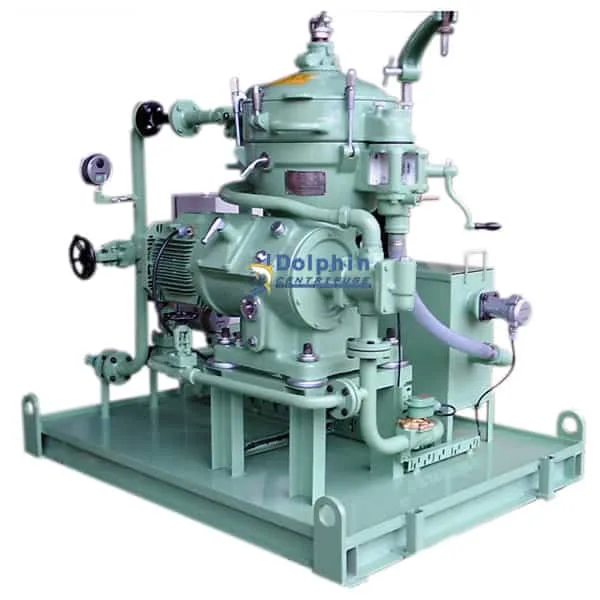
The correct centrifuge size depends on the lube oil reservoir volume and the type of equipment being protected. General guidelines:
| Reservoir Volume | Recommended System | Lube Oil Flow Rate |
|---|---|---|
| Up to 1,500 gallons | DMB-004 | 2 GPM |
| 1,500 – 2,000 gallons | DMB-007 | 4 GPM |
| 3,000 – 5,000 gallons | DMB-019 or DMB-028 | 10–15 GPM |
| 5,000+ gallons | DMPX-042 | 15–24 GPM |
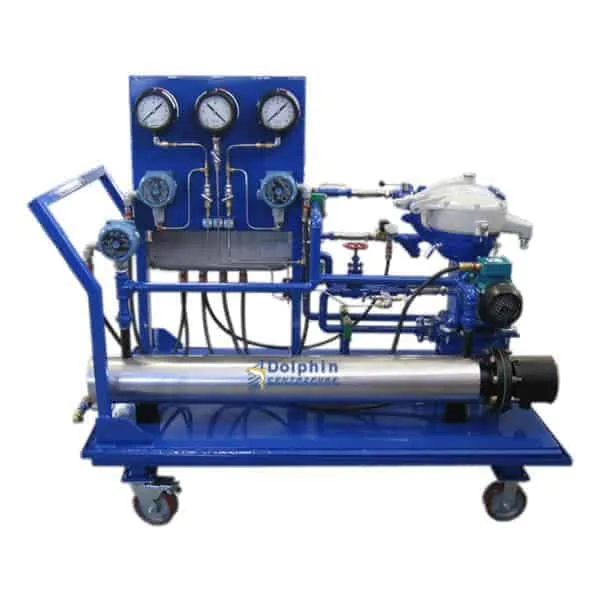
Note: Power plant lube oil applications normally do not require explosion-proof centrifuge systems. Lube oil flash points are well above ambient operating temperatures. For offshore platform installations, Class 1 Div 2 certified systems may be required.
Available Lube Oil Centrifuge Systems
| System | Type | Lube Oil Capacity | Best For |
|---|---|---|---|
| DMB-004 | Manual-Clean | 2 GPM | Small turbines / compressors |
| DMB-007 | Manual-Clean | 4 GPM | Medium turbines / engines |
| DMB-013 | Manual-Clean | 7 GPM | Larger turbines |
| DMB-019 | Manual-Clean | 10 GPM | Large turbines / multi-unit |
| DMB-028 | Manual-Clean | 15 GPM | High-volume industrial |
| DMPX-014 | Self-Cleaning | 7–8 GPM | Higher sludge / continuous |
| DMPX-028 | Self-Cleaning | 10–14 GPM | Large-scale / high sludge |
| DMPX-042 | Self-Cleaning | 15–24 GPM | 5,000+ gallon reservoirs |
All systems include the centrifuge, feed pump, controls, and piping — ready for installation. Pre-heaters are available as an option for all models. Contact us for a recommendation based on your reservoir size, oil type, and contamination levels.
Legacy Alfa Laval Models
Dolphin Centrifuge also services and supplies the following legacy Alfa Laval lube oil centrifuge models:
Alfa Laval MAB 205 Turbine Lube Oil Centrifuge
Manual-Clean · Hi-Speed · Disc Centrifuge
| MAB 205 Technical Specs | |
|---|---|
| Capacity | 15 GPM on Turbine Lube Oil |
| Motor HP | 5 HP |
| Voltages | 110V / 230V / 460V |
| Skid Dimensions | ~4' x 5' |
| Skid Weight | ~1,800 lbs |
Alfa Laval MAB 206 Lube Oil Centrifuge
Manual-Clean · Hi-Speed · Disc Centrifuge
| MAB 206 Technical Specs | |
|---|---|
| Capacity | 20 GPM on Lubricating Oil |
| Motor HP | 7.5 HP |
| Voltages | 230V / 460V |
| Skid Dimensions | 4' x 5' |
| Skid Weight | ~2,000 lbs |
Alfa Laval MAB 103 Lube Oil Centrifuge
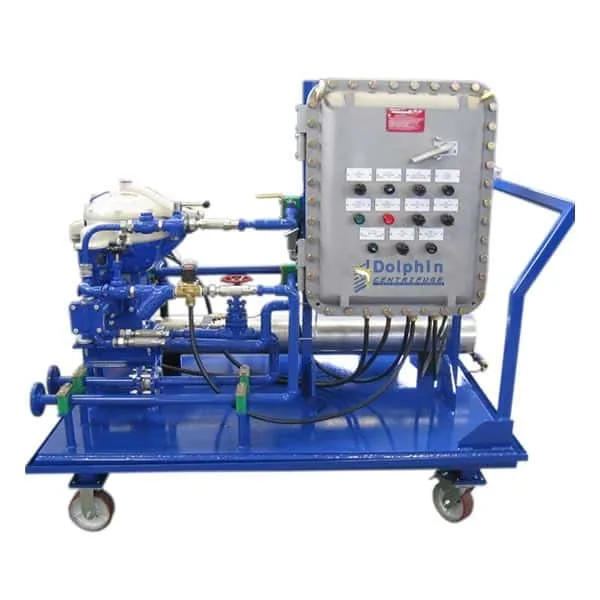
Manual-Clean · Hi-Speed · Disc Centrifuge
| MAB 103 Technical Specs | |
|---|---|
| Capacity | 3 GPM on Steam Turbine Lube Oil |
| Motor HP | 1 HP |
| Voltages | 230V / 460V |
| Skid Dimensions | 3' x 4' |
| Skid Weight | ~1,500 lbs |
Related resources: Centrifuge Selection Guide | Hydraulic Oil Centrifuges | Centrifuge Rental Program | Centrifuge FAQ (101 Questions) | Picking the Right Industrial Centrifuge