Dolphin Centrifuge supplies decanter centrifuge systems for livestock manure separation — dewatering slurry at 3,150 Gs into solids up to 50% dry and nutrient-rich liquid retaining 50% nitrogen. Continuous, automated operation for dairy, swine, and poultry facilities. Warren, Michigan.
Why Separate Manure?
Dolphin Centrifuge, based in Warren, Michigan, supplies decanter centrifuge systems for manure separation, operating at 3,150 Gs. Raw manure from dairy, swine, and poultry operations presents significant storage, transportation, and nutrient management challenges. Separating manure into solid and liquid fractions addresses all three:
- Dry solids have higher value: Separated solids can be composted for premium bedding, sold as organic fertilizer, or used as soil amendment — all commanding higher prices than raw slurry
- Transportation becomes practical: Dewatered solids weigh a fraction of raw manure, dramatically reducing hauling costs to off-site fields or compost facilities
- Phosphorus reduction: The majority of phosphorus binds to solid particles. Removing solids from the liquid fraction prevents over-application of phosphorus to fields, helping operations meet nutrient management plan requirements
Manure Separation Process
Not all separation methods deliver the same results. The three most common approaches differ significantly in efficiency, operating cost, and solids dryness:
Gravity Separation
Settling basins and weir boxes rely on gravity alone. While simple and inexpensive to build, they produce wet solids with high moisture content and cannot capture fine particles or colloidal phosphorus.
Screw Press / Filter Press
Mechanical presses squeeze liquid out of manure through screens or filter media. They require regular screen replacement, produce moderately dry solids, and struggle with fine particles that blind the filter media.
Decanter Centrifuge
A decanter centrifuge generates 3,000+ Gs of centrifugal force to separate manure continuously. No filter media, no screens, no batch cycling. The centrifuge produces the driest solids of any mechanical method while capturing fine particles that gravity and presses miss.
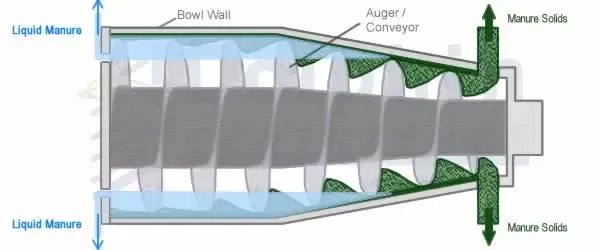
Cross-section of a manure decanter centrifuge
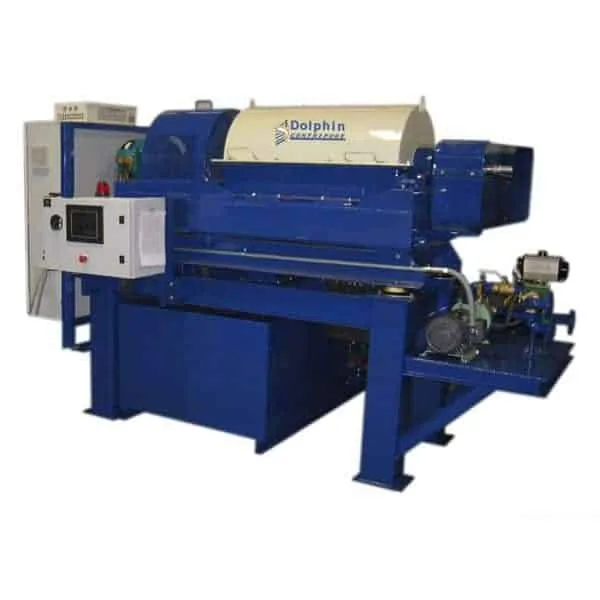
Sharples P3000 wastewater decanter centrifuge
Centrifuge Operation
The horizontal decanter centrifuge operates on a simple principle: manure slurry enters a spinning bowl rotating at high speed. Centrifugal force — over 3,000 Gs — drives solid particles to the bowl wall within seconds. An internal scroll (auger) rotating at a slightly different speed conveys the accumulated solids toward the discharge end.
The separation produces two distinct streams:
- Solids fraction: Dewatered cake discharged continuously from the conical end of the bowl. Phosphorus, which is bound to solid particles, concentrates in this fraction — removing it from the liquid stream
- Liquid fraction (centrate): Clarified liquid exits through adjustable weir plates at the opposite end. Approximately 50% of nitrogen remains dissolved in the liquid, making it a valuable fertigation resource
The entire process is continuous and automated. A PLC control panel manages feed rate, bowl speed, differential speed, and discharge torque without operator intervention.
Manure Decanter Specifications
| Parameter | Specification |
|---|---|
| Capacity | 25 GPM (nominal) |
| Centrifuge Type | Horizontal Scroll Decanter |
| Bowl Speed | 4,000 RPM |
| G-Force | 3,150 Gs |
| Scroll Differential | 6–50 RPM (adjustable) |
| Gearbox Torque | 2.5 kN·m planetary |
| Drive Motor | 15 HP |
| Dimensions (L × W × H) | 3′ × 8′ × 5′ |
| Weight | 2,500 lbs |
| Power | 460V – 3 Phase |
Need Help With Your Manure Separation System?
Our engineers will evaluate your livestock operation and recommend the optimal decanter centrifuge system for manure dewatering.
Benefits of Centrifugal Manure Separation
- Higher liquid value: Clarified centrate with balanced nitrogen content is ideal for fertigation, reducing commercial fertilizer purchases
- Reduced storage and transport costs: Dewatered solids occupy a fraction of the volume of raw slurry, cutting storage lagoon requirements and hauling trips
- Higher-value fertilizer product: Concentrated solids with high phosphorus content command premium pricing as organic compost or soil amendment
- Lagoon dredging savings: Continuous solids removal reduces sludge accumulation in storage lagoons, extending lagoon life and reducing or eliminating costly dredging operations
- Nutrient management compliance: Phosphorus removal from liquid fraction helps meet regulatory nutrient application limits
Advantages over Filter Press
While screw presses and belt presses are common in manure handling, a decanter centrifuge offers measurable advantages across every performance metric:
| Parameter | Filter / Screw Press | Decanter Centrifuge |
|---|---|---|
| Separation Efficiency | 100–200 μm particles | 25–50 μm particles |
| Solids Dryness | 25–35% | Up to 50% dry solids |
| Chemical Addition | Often required (polymer) | Reduced or eliminated |
| Labor Requirements | Screen changes, monitoring | Minimum — fully automated |
| Filter Media Costs | Ongoing screen/belt replacement | None — no media required |
| Fine Particle Capture | Poor — particles pass through | Excellent — captures colloidal solids |
| Phosphorus Removal | Limited | High — bound to captured fines |
Related resources: Decanter Centrifuge Guide | Dewatering Centrifuge | Industrial Centrifuge Guide | Sample Testing Program | Decanter vs. Disc Centrifuge
Frequently Asked Questions
How does a decanter centrifuge compare to a screw press for manure separation?
What capacity manure centrifuge systems are available?
Does a manure centrifuge remove phosphorus from the liquid fraction?
What are the end products from centrifugal manure separation?
Can a manure centrifuge handle swine, dairy, and poultry waste equally?
Ready to Upgrade Your Manure Handling?
Dolphin Centrifuge supplies reconditioned decanter centrifuge systems for livestock operations. Contact us for sizing and pricing based on your herd size and manure volume.