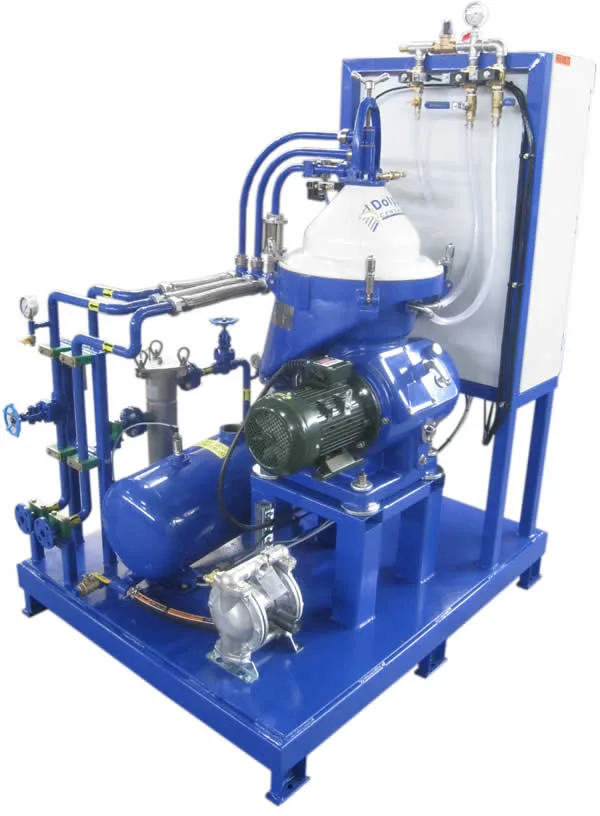
Dolphin Centrifuge supplies self-cleaning disc stack centrifuge systems for quench oil purification in heat treatment operations. These systems remove carbon, scale, and sludge down to 0.5 microns at 7,000+ Gs with automatic sludge discharge and no consumable filter media. Based in Warren, Michigan with 40+ years of centrifugal separation experience.
What Is a Quench Oil Centrifuge?
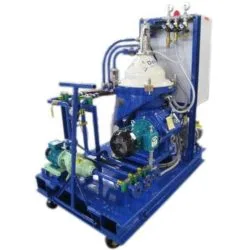
A quench oil centrifuge is an efficient way to filter out the sludge from quenching oil continuously. The centrifuge can remove contaminant particles down to 0.5 microns from the quenching oil by exerting over 7000 Gs. Its self-cleaning design makes the centrifuge fully automatic, requiring minimal labor compared to filtration.
Dolphin Centrifuge, based in Warren, Michigan, supplies purpose-built disc stack centrifuge systems for quench oil purification at 7,000+ Gs with separation down to 0.5 microns.
Dolphin Centrifuge supplies complete turnkey quench oil purification systems for heat treatment operations — from 12 GPM to 32+ GPM self-cleaning centrifuge systems.
The Function of Quench Oil or Heat-treatment Oil
Time-bound or quick cooling of metals changes the base metal's grain structure, enhancing its physical properties. This process of rapidly cooling metals is known as quenching.
The quenching process involves pre-heating the metal component to a high enough temperature to allow its recrystallization. The heated part is then immersed in a medium of choice based on the desired end properties.
The cooling medium is often a heat-treating oil, also known as quench oil. The use of this medium enhances the quenching process and protects the parts from oxidation.
Effects of Contamination
Quench oil accumulates the carbon, rust, and scales from the immersion of heated parts. Additionally, oxidation by-products also degrade the quench oil over time.
These contaminants reduce the oil's effectiveness, resulting in uneven heat treatment and quality issues.
This accumulated sludge also clogs up filtration systems and heat exchangers used to cool the quench oil.
If you have simple, routine questions: We have condensed our 40+ years of disc-stack centrifuge experience into 101 Frequently Asked Questions about Disc Stack Centrifuges!
Test Your Quench Oil — Sample Analysis
Ship us a sample of your quench oil and we'll demonstrate exactly how much sludge, carbon, and scale a centrifuge removes from your specific fluid.
Request Sample Testing →Need Help With Your Quench Oil System?
Our engineers will evaluate your quench oil application and recommend the optimal centrifuge system for your heat treatment operation.
Operation
A quench oil centrifuge from Dolphin Centrifuge is a disc-stack centrifuge. These centrifuges exert over 7,000 G-force on the process liquid. In the case of quench oil, this centrifugal force is sufficient to remove all the sludge particles from the oil.
Additionally, the centrifuge's automatic self-cleaning ability means that the centrifuge can work continuously and independently. This advantage eliminates any labor requirement that filtration requires.
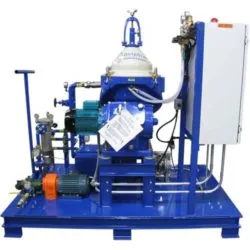
A system-integrated pump feeds the contaminated quench oil into the centrifuge bowl. Inside the centrifuge bowl, the quench oil experiences high centrifugal forces. This force pushes out the heavier sludge particles toward the bowl wall, where it accumulates.
The clarified quench oil is pushed towards the center of the bowl and out through the clean oil chamber at the bowl top. A centripetal impeller built into the bowl pumps out the clean oil back to the quenching oil reservoir.
Filters can only do so much to quench oil. If you use too fine a filter, the media cost and labor multiply due to the increased filter change frequency. If you use a coarse filter, the quench oil retains its contaminants.
Benefits
A quench oil centrifuge offers considerable benefits to the heat-treatment industry. Based on case studies conducted by Dolphin Centrifuge, the typical payback period of a centrifuge system is less than 3~6 months, considering the abovementioned costs. Additionally, improved product quality and equipment durability are collateral benefits.
Some of these benefits of centrifuging quench oil are listed below.
Features and Benefits:
- Eliminates or reduces filtration.
- Cost savings based on reduced quench oil replacement.
- Reduced used oil disposal costs.
- Better heat treatment of components with consistent grain structure.
- Labor saved on post-heat-treatment job cleaning and machining operations.
- The enhanced durability of pumps and other process components.
- Eliminate heat-exchanger clogging.
- Quench Oil tanks do not accumulate sludge, which requires cleaning.
Specifications
The following table compares the two most popular self-cleaning centrifuge models for quench oil purification. Model selection depends on quench tank volume, contamination rate, and required throughput.
| Specification | DMPX-014 | DMPX-042 |
|---|---|---|
| Capacity on Quench Oil | 12 GPM | 32 GPM |
| Bowl Speed | 7,600 RPM | 5,150 RPM |
| G-Force | 7,800 Gs | 7,500 Gs |
| Separation Efficiency | Particles > 0.5μ | Particles > 0.5μ |
| Drive Motor | 5 HP | 10 HP |
| Footprint | 4' × 5' × 5' (H) | 5' × 6' × 7' (H) |
| Weight | 1,500 lbs | 3,000 lbs |
| Electrical | 230/460V 3-Phase | 230/460V 3-Phase |
Note: Actual throughput depends on quench oil viscosity and operating temperature. Higher temperatures reduce viscosity and allow higher flow rates. Capacities shown are for typical quench oil at standard operating temperature.
Quench Oil Centrifuge Modules
Alfa Laval WHPX 405
Quench Oil Centrifuge Module
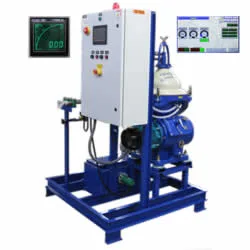
Alfa Laval Centrifuge for Quench Oil
Dolphin Centrifuge offers complete turnkey quench oil purification systems. Each system includes the centrifuge, feed pump, PLC controls, piping, and instrumentation — ready for connection to your quench tank.
| System | Type | Capacity | Best For |
|---|---|---|---|
| DMPX-014 | Self-Cleaning | 12 GPM | Small to medium quench tanks |
| DMPX-028 | Self-Cleaning | ~20 GPM | Medium to large quench operations |
| DMPX-042 | Self-Cleaning | 32 GPM | High-volume heat treatment lines |
Need help selecting the right system? Our engineers will recommend a centrifuge based on your quench tank volume, throughput, and contamination level. Contact us for a custom recommendation.
Related resources: Cutting Oil Centrifuges | Hydraulic Oil Centrifuges | Machine Coolant Centrifuge | Self-Cleaning Centrifuge | Disc Stack Centrifuge | Sample Testing Program | Picking the Right Centrifuge | Centrifuge FAQ (101 Questions)
Frequently Asked Questions
Why is quench oil cleanliness critical for heat treatment?
What is the ROI on a quench oil centrifuge?
How fine can a quench oil centrifuge separate particles?
How does a self-cleaning quench oil centrifuge work?
What quench oil centrifuge model does Dolphin Centrifuge recommend?
Ready to Purify Your Quench Oil Continuously?
Dolphin Centrifuge delivers turnkey quench oil purification systems with 40+ years of centrifugal separation expertise. Warren, MI.