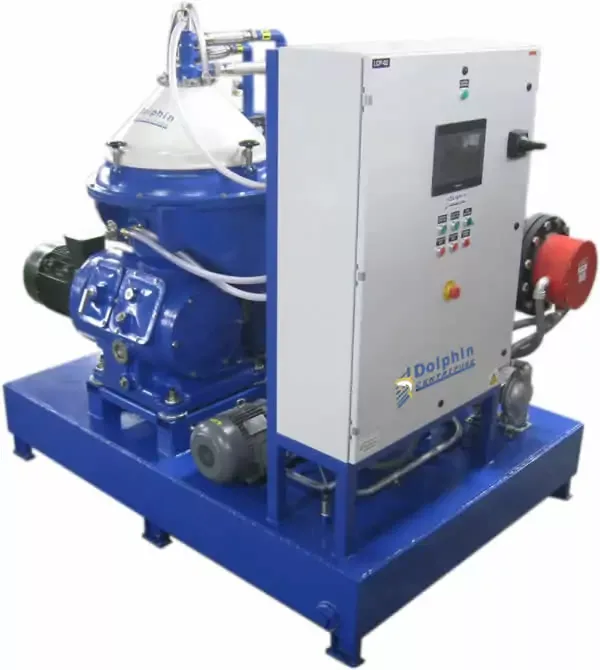
Dolphin Centrifuge supplies self-cleaning disc stack centrifuge systems for waste vegetable oil (WVO) purification at 8,000 Gs. These 3-phase separators remove water, solids, and emulsions from used cooking oil, processing 5–70+ GPM continuously for biodiesel feedstock and industrial reuse.
Synopsis
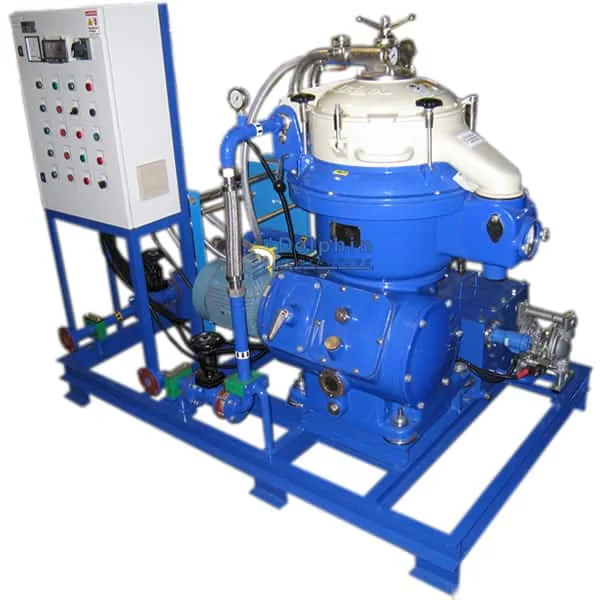
Dolphin Centrifuge, based in Warren, Michigan, supplies purpose-built disc stack centrifuge systems for this application at 8000 Gs with separation down to 0.5 microns. The food service industry generates millions of gallons of waste vegetable oil (WVO) every year. Restaurants, food processors, and industrial kitchens produce used cooking oil that must be collected, purified, and repurposed. Without proper processing, this oil cannot be used as feedstock for biodiesel, industrial lubricants, or other valuable secondary products.
Compared to commercial (open bowl) centrifuges, a disc-stack type industrial centrifuge generates a very high centrifugal force and has an effective settling area, which is thousands of times larger.
For large-scale processing of WVO, an industrial centrifuge is a robust and durable solution for used cooking oil recovery.
An industrial centrifuge is the most efficient method for purifying waste vegetable oil. Unlike gravity settling or filtration, a disc stack centrifuge performs continuous 3-phase separation — removing water, solid contaminants, and sludge simultaneously in a single pass. This makes centrifugal separation the preferred technology for WVO processors operating at commercial scale.
What is WVO
Waste Vegetable Oil (WVO) — also referred to as Used Cooking Oil (UCO) or yellow grease — is any vegetable-based oil that has been used for cooking or food processing and is no longer suitable for its original purpose. It is collected from commercial kitchens, restaurants, food manufacturing facilities, and institutional dining operations.
WVO is a broad category that encompasses multiple types of used fats and oils:
- Used cooking oil: Vegetable oils (soybean, canola, corn, sunflower, peanut) used for deep frying and pan cooking
- Fryer oil: Oil from commercial deep fryers, typically with higher contamination levels due to extended heat exposure
- Grease trap waste: Fats, oils, and grease (FOG) collected from kitchen grease traps, often heavily contaminated with water and food debris
- Animal fats: Tallow, lard, and poultry fat from meat processing operations
The quality and composition of WVO varies significantly depending on the source, cooking temperature, duration of use, and storage conditions. This variability makes centrifugal separation essential, as the process handles a wide range of contaminant types and concentrations without adjustment.
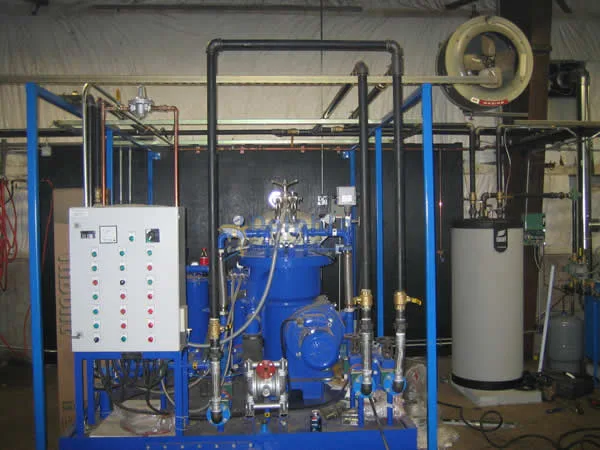
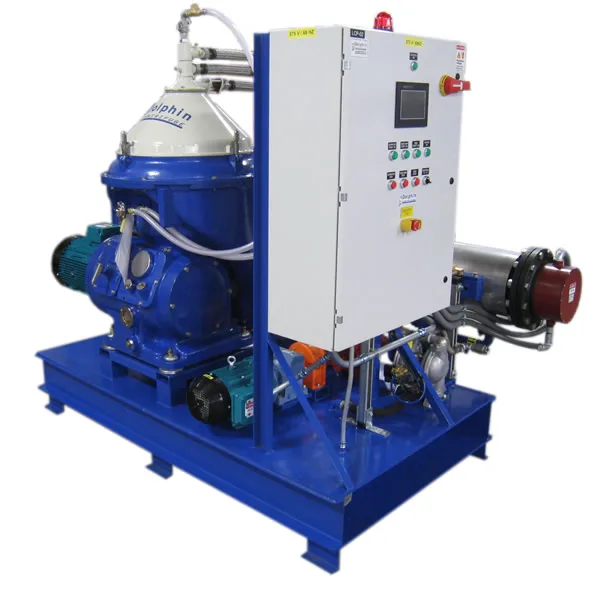
This WVO centrifuge package designed and manufactured by Dolphin Centrifuge is currently operational in the NE and has processed over 10 million gallons of WVO.
Typical Contaminants in WVO
Waste vegetable oil contains several categories of contaminants that must be removed before the oil can be repurposed. The type and concentration of contaminants determine the separation equipment required and the processing parameters.
Water
Free water is the most common contaminant in WVO. It enters through condensation during cooling, wash-down operations, and improper storage. Water content typically ranges from 2% to 15% by volume, but grease trap waste can contain up to 50% water. Free water separates easily in a centrifuge due to the large density difference from oil.
Soapy Wash Water
Kitchen cleaning operations introduce soapy water into the oil stream. Detergents and surfactants create partial emulsions that resist gravity separation. A centrifuge operating at high G-force breaks these loosely bound emulsions and removes the wash water effectively.
Emulsions & Rag Layer
The rag layer is a stable emulsion zone that forms between the oil and water phases during gravity settling. It consists of finely dispersed water droplets suspended in oil, stabilized by surfactants, free fatty acids, and fine particulates. The rag layer is the most challenging contaminant to remove and is the primary reason gravity settling alone is insufficient for WVO processing.
Sludge & Food Particles
Solid contaminants include food particles, breading, carbonized residue, and sediment. These range from visible debris to sub-micron particles that remain suspended indefinitely. A self-cleaning disc stack centrifuge ejects accumulated sludge automatically, enabling continuous unattended operation.
Uses of Purified WVO
Once properly cleaned and dewatered, waste vegetable oil becomes a valuable commodity with multiple end markets:
- Biodiesel feedstock: The largest market for purified WVO. Clean, dry oil is converted to biodiesel (FAME) through transesterification. Feedstock quality directly impacts biodiesel yield and production costs.
- Straight vegetable oil (SVO) diesel fuel: Some modified diesel engines can burn purified WVO directly as fuel without transesterification, though this requires thorough removal of water and solids.
- Industrial lubricant base stock: Purified vegetable oils serve as environmentally friendly alternatives to petroleum-based lubricants in certain applications.
- Heating fuel: Clean WVO can be burned in modified oil furnaces and boilers, providing a renewable alternative to petroleum heating oil.
- Soap and cosmetics manufacturing: High-quality purified WVO is used in soap production through saponification, as well as in cosmetic formulations.
- Animal feed ingredient: Purified yellow grease that meets quality specifications is used as a calorie-dense additive in animal feed formulations.
Test Your WVO Feedstock — Sample Testing
Not sure how much water or sludge your WVO contains? Send us a sample and Dolphin Centrifuge's engineers will run a pilot separation test, reporting actual purity levels achievable for your feedstock.
WVO Centrifuge Operation
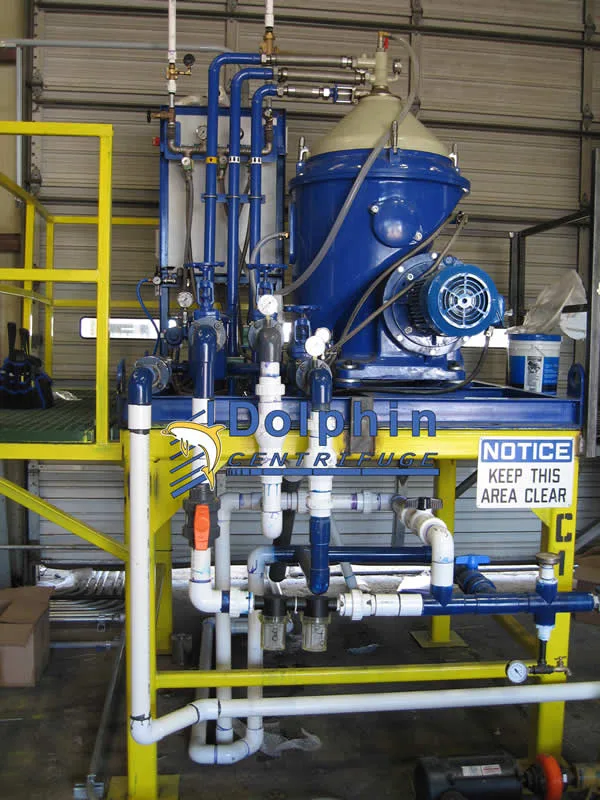
A WVO centrifuge operates as a 3-phase, self-cleaning disc stack separator. The centrifuge bowl spins at high speed, generating up to 8,000 Gs of centrifugal force. This extreme force separates the oil, water, and solids based on their density differences — a process that takes seconds rather than the hours required for gravity settling.
The three phases are separated simultaneously:
- Clean oil (light phase): Purified WVO migrates toward the center of the rotating bowl and exits through the light-phase outlet
- Water (heavy phase): Water and water-soluble contaminants are forced outward by centrifugal force and exit through the heavy-phase discharge
- Sludge (solids): Solid particles accumulate at the bowl periphery and are periodically ejected through hydraulically operated discharge ports
The self-cleaning mechanism is critical for WVO processing. The centrifuge bowl contains a sludge space at its periphery where solids accumulate during operation. At timed intervals, the bowl opens momentarily to eject the collected sludge, then closes and resumes separation — all without stopping the flow of oil. This enables continuous, unattended operation for extended production runs.
Separation efficiency reaches down to 1 micron for solids and 2 microns for water droplets, far surpassing what conventional filters or gravity settling can achieve. The disc stack inside the bowl creates hundreds of thin separation channels, dramatically increasing the effective settling area within a compact footprint.
WVO Centrifuge Specifications
The following table compares our two primary disc stack centrifuge models for WVO processing. Both are self-cleaning designs with automatic sludge ejection for continuous operation.
| Specification | DMPX-014 | DMPX-042 |
|---|---|---|
| Type | Self-Cleaning Disc Stack | Self-Cleaning Disc Stack |
| Separation Efficiency | Solids >1μ; Water >2μ | Solids >1μ; Water >2μ |
| Rated Capacity | 23 GPM | 69 GPM |
| WVO Capacity @ 180°F | 15 GPM | 45 GPM |
| Bowl Speed | 8,500 RPM | 5,180 RPM |
| Sludge Space | 0.36 gal | 1.55 gal |
| Drive Motor | 5 HP | 15 HP |
| Dimensions (L×W×H) | 4′ × 5′ × 6′ | 5′ × 6′ × 7′ |
| Weight | 1,500 lbs | 3,500 lbs |
| Power | 460V AC; 3-Phase | 460V AC; 3-Phase |
Note: WVO capacity is derated from rated capacity to account for the higher viscosity of vegetable oil at processing temperature (180°F). Actual throughput depends on the feedstock type, contaminant loading, and required outlet quality.
Emulsified WVO Separation
One of the most challenging aspects of WVO processing is the separation of emulsified oil-water mixtures. Emulsions form when water becomes finely dispersed in oil and stabilized by surfactants, free fatty acids, or fine particles. The resulting emulsion — often called the rag layer — resists gravity separation and can represent a significant portion of the total volume.
While a disc stack centrifuge operating at 8,000 Gs can break loosely bound emulsions mechanically, tightly bound emulsions may require chemical pretreatment:
- Acid treatment: Adding a small amount of acid (typically citric or phosphoric acid) neutralizes the surfactants that stabilize the emulsion, allowing the centrifuge to separate the phases
- Demulsifiers: Chemical demulsifying agents destabilize the emulsion interface, causing the dispersed water droplets to coalesce and separate under centrifugal force
The combination of chemical pretreatment and centrifugal separation effectively breaks the rag layer and recovers oil that would otherwise be lost. This is particularly important when processing grease trap waste or heavily contaminated fryer oil, where emulsion content can exceed 20% of the total volume.
How Well Does an Industrial Centrifuge Purify the WVO?
A disc-stack type industrial centrifuge can produce 99% or better clean oil from WVO. Processing temperature and centrifuge tuning are critical to high separation efficiency.
The separated water phase contains trace amounts of oil. Further tuning of the centrifuge can reduce this oil in water to a minimum level for water disposal.
WVO solids separated by an industrial centrifuge come out as thick sludge. It is pumpable sludge but not runny. Oil content in this sludge varies from 10% to 50%, depending on the centrifuge settings and processing temperature.
Disc Stack vs Open Bowl vs Filters
Several separation technologies are used for WVO processing. The following comparison highlights the key differences:
| Feature | Disc Stack Centrifuge | Open Bowl Centrifuge | Filtration |
|---|---|---|---|
| Centrifugal Force (Gs) | 8,000 ~ 10,000 | 500 ~ 1,500 | N/A |
| Construction | Industrial Grade | Commercial Grade | Industrial Grade |
| Bowl Material | 316L Stainless Steel | Aluminum or Carbon Steel | All Material (Housings) |
| Capacity (GPM) | 3 ~ 100+ | 0.1 ~ 7 | 1 ~ 500+ |
| Separation Efficiency | 0.5 Micron | 100 Micron | 0.1 Microns |
| Water Separation | Continuous (Any Proportion) | Not Capable | Not Capable |
| Sludge Removal | Automatic During Operation | Manual (Stop Centrifuge) | Manual |
| Operating Mode | Continuous | Batch | Batch |
| Equipment Cost | High | Low | Cheap |
| Labor Cost | None | Medium | Very High |
| Media Cost | None | None | Very High |
For commercial WVO processing, the self-cleaning disc stack centrifuge is the clear choice. It is the only technology that performs continuous 3-phase separation with automatic sludge ejection, eliminating the need for filter media and manual intervention.
WVO Processing Plant Setup
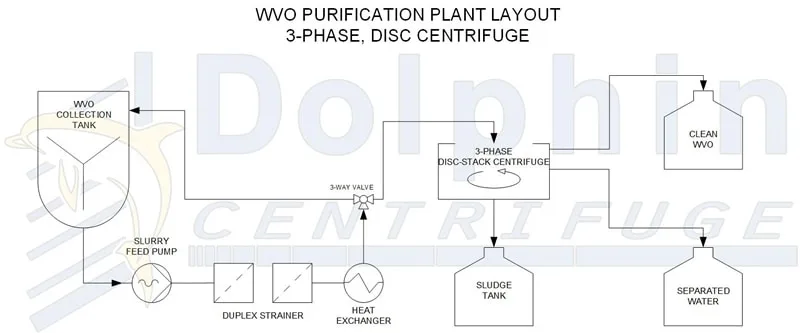
A complete WVO processing plant integrates multiple stages of treatment to handle the wide range of contaminant types and concentrations found in waste vegetable oil. The following describes a typical plant configuration. Also read about using a disc-stack centrifuge for yellow grease purification.
Collection & Pre-Treatment
- WVO Collection Tank (Agitated): The incoming collected WVO is dumped into the collection tank. This tank is typically agitated to keep the sludge from settling. It is advisable to keep this tank heated to reduce the thermal load on the system heater. Special consideration is given to the tank design to alleviate sludge-blocking issues.
- Slurry Feed Pump: The feed pump is a positive displacement pump with a high sludge handling capacity. It functions to transfer the raw WVO to the centrifuge or back to the tank in bypass mode. In this bypass mode, the pump also acts as an agitator to keep the tank from settling.
- Duplex Strainer: The duplex strainers protect the downstream centrifuge from damage from large solid contaminants such as rocks, debris, twigs, rags, bones, etc.
De-Sludging (Decanter Stage)
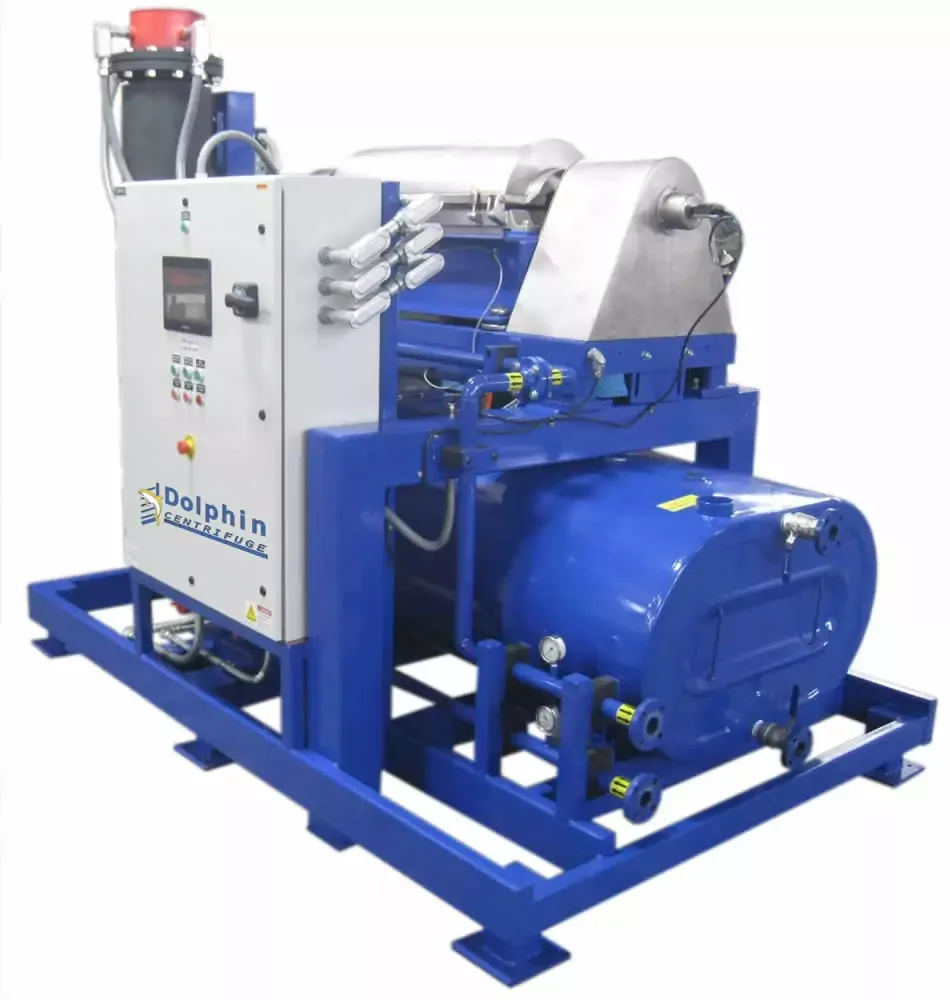
A decanter centrifuge is a continuous (flow-through) centrifuge that can de-sludge Grease Trap Waste (GTW) with up to 50% solids, and down to 1% solids. For WVO with high solids content, an NX-314 decanter centrifuge is used as a first-stage de-sludging unit. This centrifuge is ideal for large-scale processing of WVO and can process 25 GPM of GTW at around 150°F. The decanter removes heavy sludge and large solids that would otherwise overload the disc stack centrifuge sludge space.
Heating & Conditioning
- Heat exchanger: For maximum centrifuge separation efficiency, the WVO needs to be hot. The ideal processing temperature is around 180°F. An inline heater (or heat exchanger) is perfect because it only heats the oil in the process instead of heating the entire tank of 1000 gallons. Specially designed heaters provide gentle heating to avoid overheating and burning of the UCO.
- 3-Way Valve: This 3-way valve works as a diverter valve to recirculate the oil when the centrifuge is not ready for processing or cleaning mode. The PLC automatically operates it with many process parameters influencing this valve's operation and position.
Centrifugal Separation
- Disc stack centrifuge: The self-cleaning disc centrifuge performs the primary 3-phase separation, producing clean oil, separated water, and ejected sludge as distinct output streams.
Output Streams
- Clean oil tank: Most self-cleaning Alfa Laval centrifuges discharge the clean oil under pressure. Therefore there is adequate pressure to transfer the pure oil to a local clean oil tank.
- Separated water tank: The water separated by the centrifuge is also discharged under pressure by most disc centrifuges. Discharging the separated water into the local drain is often possible, but storing the separated water before discharge to verify oil levels is recommended.
- Sludge tank: The self-cleaning WVO centrifuge ejects the sludge through the bottom of the centrifuge frame. A sludge receptacle is placed under the centrifuge to collect the separated sludge. The system integrates this sludge tank into the centrifuge base skid as an option, allowing the centrifuge package to be mobile.
For high-volume operations processing grease trap waste, the combination of an NX-314 decanter for de-sludging and a DMPX-042 disc stack centrifuge for final purification provides the highest throughput and cleanest output quality.
Ancillary Equipment & Recommended Accessories
The ancillary equipment for maximum throughput from a WVO centrifuge includes:
- Operating Water Supply: Filtered, potable, soft water is essential for the trouble-free operation of the self-cleaning mechanism of the disc stack centrifuge. The supply pipe should provide a minimum flow rate and should be made of a non-corrosive material such as copper, PVC, or stainless steel.
- Hot Water Boiler: For optimum separation, operating water should be at a temperature close to that of the process fluid i.e., hot. A water heater is a good investment to ensure high separation efficiency.
- Local Clean Oil Receptacle: A local receptacle (tank) to collect the separated clean WVO prevents back pressure from being exerted on the centrifuge outlet from a long, elevated discharge pipe. Disc stack centrifuges work best with consistent back pressure.
- Elevated Platform with Service Deck: An elevated platform with an operator service deck has two functions. First, it allows for placing a sludge tank below the centrifuge to collect the separated sludge. Second, the deck allows easy and safe access for the operator for service and operational adjustments.
WVO centrifuge packages typically include sample ports, sight glasses, flow meters, flow sensors, temperature monitors, and other process-enhancing features.
Available WVO Centrifuge Systems
Dolphin Centrifuge offers complete, turnkey WVO processing systems at two production scales:
10 GPM WVO Processing System
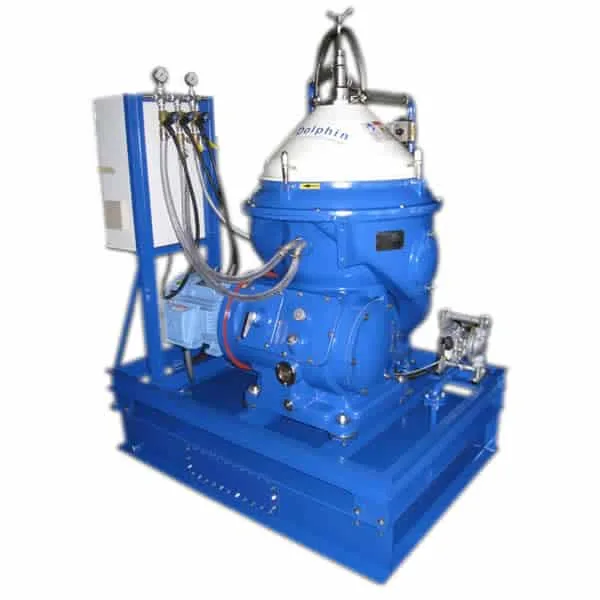
Built around the DMPX-014 self-cleaning disc stack centrifuge, this system is designed for small to mid-size WVO processors. The 10 GPM system handles up to 600 gallons per hour of waste vegetable oil and includes the feed pump, strainer, heat exchanger, centrifuge, and PLC control panel. Ideal for independent collectors, small rendering operations, and biodiesel feedstock processors.
25 GPM WVO Processing System
Built around the DMPX-042 self-cleaning disc stack centrifuge, the 25 GPM system is designed for high-volume WVO processing operations. This system handles up to 1,500 gallons per hour and is typically paired with an NX-314 decanter for pre-stage de-sludging. Suited for large rendering companies, regional WVO collectors, and industrial-scale biodiesel feedstock operations.
Both systems are available as skid-mounted, pre-piped packages for rapid installation. Contact our engineers for system sizing and pricing based on your specific WVO feedstock and throughput requirements.
Summary
Various ways and equipment are available to clean WVO to recover clean, saleable oil. If it is a small-scale operation (<100 Gallons/Day), a simple heat, settle, and filter process will work.
However, serious consideration must be given to a robust, durable, high-speed, high-G centrifuge for larger volumes. These centrifuges produce clean WVO continuously and separate the water at high throughput capacities.
Related resources: Biodiesel Centrifuge | Yellow Grease Purification | Centrifuge FAQ (101 Questions) | Sample Testing Program | Disc Stack Centrifuge | Self-Cleaning Centrifuge | Centrifuge Rental Program | Picking the Right Centrifuge | Centrifuge Selection Guide
Frequently Asked Questions
What is the best method for purifying waste vegetable oil commercially?
Can a centrifuge break WVO emulsions and rag layers?
What capacity WVO centrifuge systems are available?
What can purified WVO be used for?
What processing temperature is required for WVO centrifuge separation?
Ready to Purify Your WVO at Commercial Scale?
Dolphin Centrifuge supplies complete WVO centrifuge systems — from 10 GPM compact units to 45 GPM industrial-scale systems with decanter pre-stage. Based in Warren, Michigan.