Dolphin Centrifuge supplies self-cleaning disc stack centrifuge systems for yellow grease (used cooking oil) purification. Operating at 7,800 Gs with separation down to 0.5 microns, the DMPX-042 processes 30 GPM of UCO continuously — replacing slow settling tanks. Based in Warren, Michigan, with over 40 years of centrifuge expertise.
Synopsis
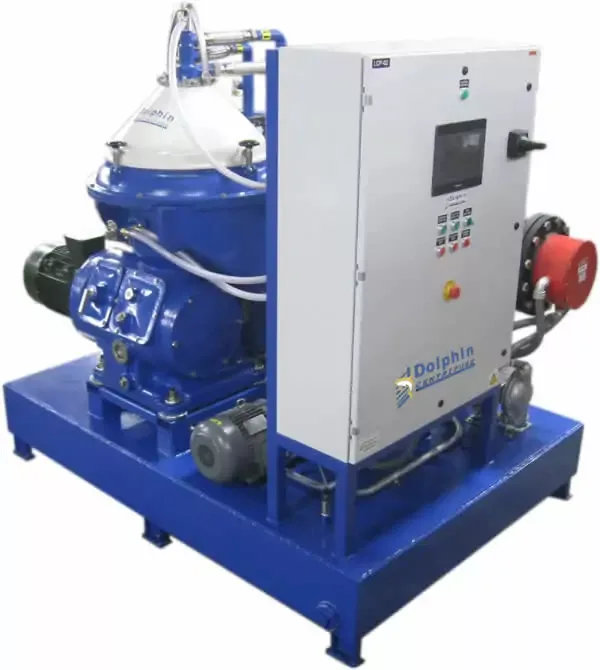
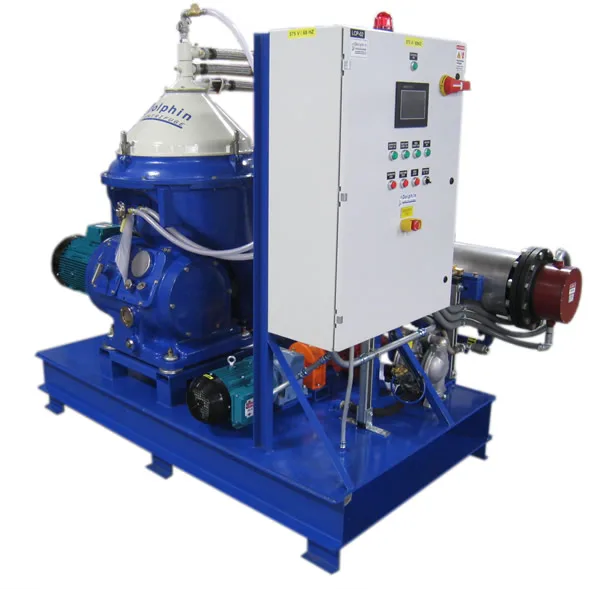
Dolphin Centrifuge designed and manufactured a complete yellow grease purification centrifuge system featuring a self-cleaning disc stack centrifuge. We supplied the system to a Used Cooking Oil (UCO) collection company. The following is a case study of this particular application of a yellow grease centrifuge for large-scale processing.
Yellow grease — also known as used cooking oil (UCO) — is one of the most widely collected and recycled fats in the United States. Rendering companies and UCO collectors process millions of gallons annually, supplying feedstock for biodiesel production, animal feed supplements, and oleochemical manufacturing. The quality of the finished product directly determines its market value, making efficient purification critical to profitability.
This case study documents how a large mid-west UCO collection company replaced its legacy heating-and-settling process with a DMPX-042 self-cleaning disc stack centrifuge from Dolphin Centrifuge. The results: a 30% increase in throughput, dramatically cleaner product, and full return on investment in less than six months.
Customer Background
A large-scale, mid-west waste oil collection company processed 6 million gallons per year. They collect waste oil consisting of grease trap waste, UCO, yellow grease, restaurant slop oil, fryer oil, and similar streams.
The company used the age-old heating method and settling to get good oil from their collected yellow grease. In this process, the processor heats the yellow grease and allows it to settle under gravity. They then decant the clean oil off the top, leaving the ‘rag layer’ (emulsion), water, and sludge in the tank.
Like most UCO collectors, the company’s revenue depends on the quality of its purified product. Buyers — primarily biodiesel producers and animal feed manufacturers — pay premium prices for yellow grease that meets strict specifications for moisture, impurities, and free fatty acid (FFA) content. Any water, sludge, or solid contaminants remaining in the finished product reduce its grade and market price.
Disadvantages of Heating & Settling
There are many challenges with the Heating & Settling method of purifying yellow grease. Some of these are listed below.
- Settling under gravity takes time — it is a slow process.
- Settling also requires storage volume — more investment in tanks.
- Heating large volumes of crude yellow grease is energy-intensive.
- Decanting clean oil leaves a lot of ‘good’ oil in the tank bottom.
- Cleaning tank bottoms are essential to reclaiming storage volume.
- Disposal costs are associated with a large volume of tank bottom waste.
The company recognized that gravity settling had reached its practical limit and began evaluating centrifugal separation as an alternative.
Centrifuge Selection & Validation Process
The yellow grease company contacted Dolphin Centrifuge in mid-2018. They wanted to investigate using an industrial centrifuge to improve their process efficiency.
The customer provided a detailed process flow diagram (PFD) to Dolphin Centrifuge. The PFD provided details on their existing facility, equipment, and process.
Customer Sample Testing
Dolphin Centrifuge has extensive experience with WVO processing. Based on our experience, we suggested lab-scale centrifuge testing of the customer’s WVO sample.
As part of this process, we run a small sample of the process fluid through our small-scale disc stack centrifuge. This is a 3-phase centrifuge that separates water, oil, and sludge.
If confirmed by pilot-scale testing, phase separation assures the customer of disc stack centrifuges’ applicability for their process.
Yellow Grease Sample Testing Results
The test results showed excellent separation at an optimum process temperature of 180°F. The test simulated a flow rate of about 40 GPM. This was the customer’s preferred throughput rate in production.
The customer compared the clean oil from the test centrifuge with their product. The disc-stack centrifuge produced a much better product. The centrifuged clean oil had no sludge and <0.05% water!
Based on the test results, Dolphin offered a detailed technical proposal for an oil centrifuge system. Dolphin also provided an improved PFD for the customer’s existing plant. The intent was to repurpose some of the existing pre-straining equipment.
The quality of the purified yellow grease and centrifuge-related cost savings convinced the customer to order the centrifuge system.
Test Results
The lab-scale centrifuge testing produced results that far exceeded the customer’s existing gravity-settled product quality:
| Parameter | Gravity Settling | DMPX-042 Centrifuge |
|---|---|---|
| Residual Water | 0.5–2.0% | <0.05% |
| Sludge in Product | Present (variable) | None detectable |
| Product Clarity | Hazy / variable | Clear, bright |
| Processing Time | Hours to days | Single-pass (continuous) |
| Oil Recovery from Sludge | Poor — oil trapped in tank bottoms | Excellent — minimal oil in centrifuge sludge |
The most significant improvement was the elimination of sludge in the finished product and the reduction of residual water to below 0.05%. This level of purity exceeded the requirements of the customer’s buyers, opening the door to premium pricing.
Ready to Upgrade Your Yellow Grease Processing?
Our engineers will evaluate your UCO feedstock and recommend the optimal centrifuge system for your operation.
DMPX-042 Specifications for Yellow Grease
The following table lists the specifications of the centrifuge supplied for yellow grease recovery. The DMPX-042 is a high-capacity, self-cleaning 3-phase disc stack centrifuge. These specifications apply to yellow grease processing at the recommended operating temperature of 180°F.
| Specification | DMPX-042 |
|---|---|
| Type | Self-Cleaning 3-Phase Disc Stack |
| Bowl Speed | 5,150 RPM |
| G-Force | 7,800 Gs |
| Solids Separation | >0.5 micron |
| Free Water Separation | >2 micron |
| Capacity (Yellow Grease @ 180°F) | 30 GPM |
| Drive Motor | 15 HP |
| Dimensions (L × W × H) | 5′ × 6′ × 7′ |
| Weight | 4,500 lbs |
Centrifuge Options
Listed below are the added options for this yellow grease separation system.
- WHPX 510 Self-Cleaning Disc Stack Centrifuge
- VFD Control PD Feed Pump
- Automatic PLC/Touch-Screen Control Panel
- Sludge Tank with Sludge Disposal System
Centrifuge Capabilities
The centrifuge can perform 3-phase separation of yellow grease to remove all free water and sediment down to 0.5μ. The system can process up to 30 GPM of yellow grease at 180°F to separate all free water and sludge.
Note: The 30 GPM capacity on yellow grease is derated from the machine’s rated water capacity to account for the higher viscosity of UCO at processing temperature. Actual throughput may vary depending on feedstock quality, contaminant loading, and target outlet specifications.
Installation, Startup, and Benefits
Dolphin Centrifuge designed and manufactured a complete, turn-key centrifuge system. It can process 30,000 gallons of yellow grease per day.
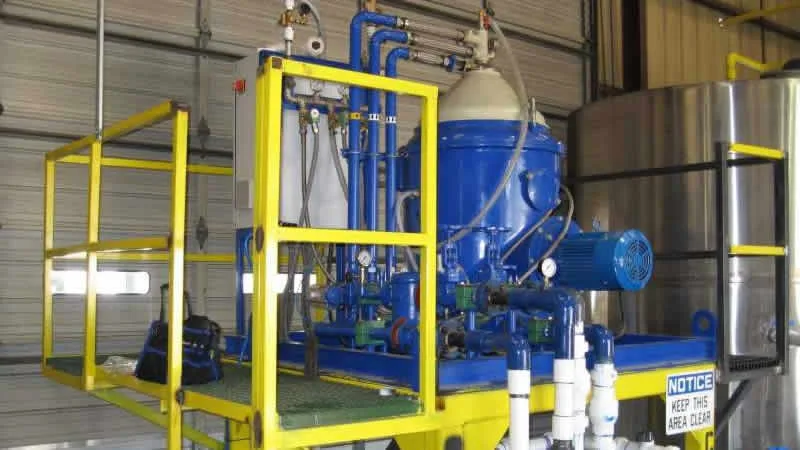
The customer installed the centrifuge system at their facility under our guidance. After installation, Dolphin engineers helped start the centrifuge system at the customer’s site.
Return on Investment
The customer soon realized labor (decanting, changing filters, etc.) and material cost savings (filter media). The customer could recoup the capital investment in less than six months of installation!
Throughput Increase
The ~30% increased throughput was an extra benefit. Their annual throughput was on track to reach 8 million gallons. This increase was achieved without adding floor space or labor, simply by replacing the slow batch-settling process with continuous centrifugal separation.
Settling Tanks Eliminated
The centrifuge also eliminated some of the settling tanks. This freed up valuable floor space, eliminated the energy costs of maintaining large volumes of heated oil, and removed the manual tank-cleaning labor that had been required on a regular basis.
Product Quality
The centrifuge-processed yellow grease consistently met or exceeded buyer specifications for moisture (<0.05% water), impurities, and clarity. The customer reported that the improved and consistent product quality strengthened relationships with their downstream buyers and reduced quality-related disputes.
Recommended Upgrade: Upstream Decanter
For UCO collection operations handling feedstock with high solids content — particularly grease trap waste or heavily contaminated fryer oil — Dolphin Centrifuge recommends adding an NX-314 decanter centrifuge upstream of the DMPX-042 disc stack.
The decanter serves as a first-stage de-sludging unit, removing heavy sludge, food debris, and coarse solids before the oil reaches the disc stack centrifuge. This two-stage configuration provides several benefits:
- Extended disc centrifuge run time: By removing the bulk of solids upstream, the DMPX-042’s sludge space fills more slowly, reducing the frequency of automatic sludge ejections and extending continuous operation between maintenance cycles
- Higher overall throughput: The disc stack centrifuge can operate at or near its rated capacity when it receives pre-cleaned feedstock from the decanter
- Better oil recovery: The decanter recovers oil from heavy sludge that would otherwise be lost, improving overall yield
- Ability to process lower-grade feedstock: The two-stage system can handle grease trap waste and other highly contaminated streams that would overwhelm a disc stack centrifuge operating alone
The Decanter Centrifuge will eliminate the need for pre-filtration or straining except for the removal of large debris such as rags, rocks, bones, etc. to prevent damage to the centrifuges.
A complete NX-314 Decanter module (shown below) includes a coarse pre-strainer basket which practically allows the decanter to accept yellow grease or UCO loads directly from the tanks (with agitation).
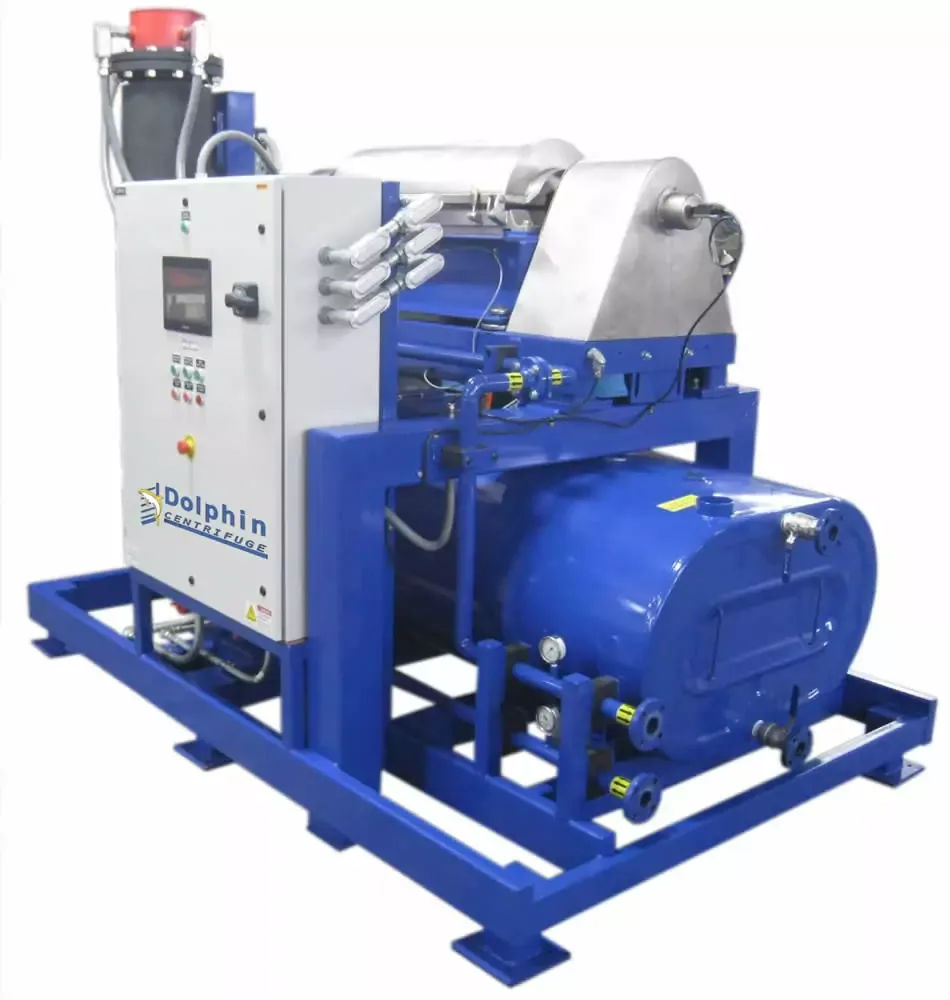
The combination of an NX-314 decanter for de-sludging and a DMPX-042 disc stack for final purification is our recommended configuration for large-scale yellow grease and UCO processing operations exceeding 5 million gallons per year.
Conclusion
In summary, an industrial centrifuge is an ideal solution for purifying yellow grease. As detailed above, it is cost-efficient for large-scale purification of yellow grease.
Contact Dolphin Centrifuge for more information or to discuss your particular application with our centrifuge experts!
Frequently Asked Questions
What is yellow grease and how is it processed?
What ROI can I expect from a yellow grease centrifuge?
How does a centrifuge compare to gravity settling for yellow grease?
Do I need a decanter centrifuge for yellow grease processing?
What temperature should yellow grease be processed at?
Ready to upgrade your yellow grease operation? Call (248) 522-2573 or email sales@dolphincentrifuge.com to discuss your feedstock, volume, and quality targets. We offer lab-scale sample testing to validate performance before you commit to a full-scale system.
Related resources: WVO Centrifuge Separator | Biodiesel Centrifuge | Food Grade Centrifuge | Disc Stack Centrifuge | Self-Cleaning Centrifuge | Sample Testing Program | Centrifuge Rental Program | Picking the Right Centrifuge | Centrifuge FAQ (101 Questions)