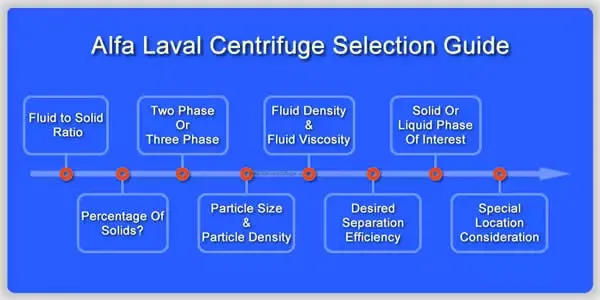
Dolphin Centrifuge provides this selection guide to help customers choose between decanter centrifuges (2,000–4,000 Gs) and disc stack centrifuges (7,000+ Gs) based on solids percentage, particle size, viscosity, and flow rate for their specific separation application.
Our centrifuge selection guide aims to help potential customers select the correct type of industrial centrifuge for their specific application. This article discusses the selection process that will help you identify whether a decanter centrifuge or disc-stack centrifuge is suitable for your solid, liquid separation.
Suitability
Industrial centrifuges are designed to separate fluids from solid and liquid contaminants. These centrifuges feature a flow-through design which means that the predominant phase in the process material should be fluid that can flow.
In other words, process material that is predominantly solid and cannot flow freely is unsuitable for these centrifuges. In addition, these separating devices can separate liquids from other immiscible liquids and solids.
Suitable Applications
Based on the above, applications such as separation of waste oil from water & sludge, diesel from water, wastewater from sludge, lube oil from moisture and metal particles, fish oil from stickwater, and fish meal, crude oil from salt-water and sand, etc. are applications that are well suited for industrial centrifuges.
Decanter and disc-stack centrifuges are suitable for many other similar liquid/solid and liquid/liquid/solid separation applications.
Not Suitable Applications
Decanter and disc stack centrifuges are limited to applications wherein the process material is fluid, i.e., pumpable and flowable. Therefore, applications with a large volume of solids relative to the liquid are unsuitable for these centrifuges. The separation of solvent from rags, extracting oil from used filters, etc., are unsuitable applications for these industrial centrifuges.
Selection Process
Typically, we follow the following selection process to narrow down the type and model of centrifuge that is best suited for the specific application.
With your assistance, we will try and understand the following parameters related to your process application.
Fluid Properties
The most crucial consideration in selecting the correct centrifuge is the properties of the process fluid. The following is a list of the essential parameters from a centrifuge perspective.
Percentage of Solids
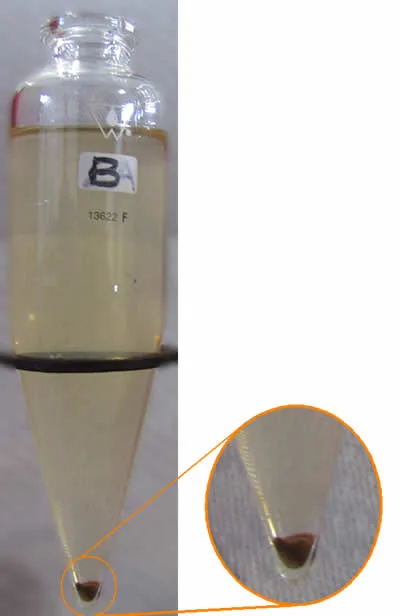
Centrifuge Graduated Tube Showing % of Solids
A vast majority of centrifuges eject the separated solids automatically. The proportion of solids in the process fluid is critical since it affects the solids discharge mechanism built into the centrifuge.
For example, process fluids such as wastewater with a high percentage of solids (sludge) require a continuous discharge of the separated solids. This specific requirement eliminates the disc-stack centrifuges that intermittently discharge solids. On the other hand, a decanter centrifuge can handle up to 50% solids by volume and is well suited for this application.
A disc-stack centrifuge limits the percentage of solids it can handle due to its periodic solids ejection cycle. The centrifuge discharge frequency exceeds the recommended range with a high percentage of solids, and the centrifuge loses process efficiency.
However, with its high centrifugal force and separation efficiency, a disc-stack centrifuge is a good choice for applications with a limited (< 8% or so) percentage of solids. The proportion of the two liquid phases (in case of liquid/liquid separation) does not significantly impact the performance of the disc-stack centrifuge.
Particle Size Distribution
Decanter and disc-stack centrifuges have a maximum particle size in the process fluid. These limits are based on the size of the sludge outlet ports in the case of a decanter centrifuge.
An NX series decanter, for example, has 40-millimeter sludge ports; therefore, allowable solids in a decanter centrifuge are limited to that size.
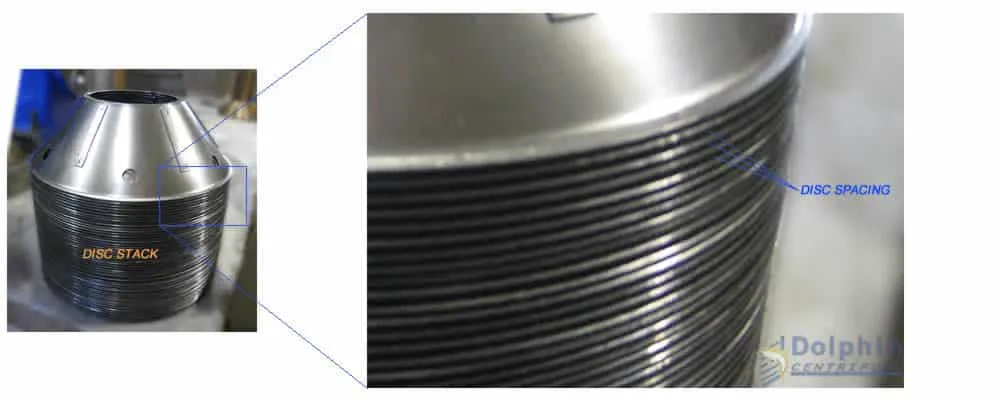
Disc Stack Centrifuge Disc Spacing
In a disc-stack centrifuge, the inter-disc spacing limits the particle size to allow the free flow of particles toward the bowl wall (as shown above). A typical disc-stack centrifuge has discs that are up to 2 millimeters apart. Therefore, a disc stack centrifuge cannot handle particles larger than the space between the discs in the stack.
Specific Gravity of Solids
The specific gravity of the solids in the process stream is also an important consideration. Heavier solids (with a relatively higher specific gravity than the liquid) are easier to separate than lighter solids.
Lighter solids with a specific gravity closer to the process liquid require a higher centrifugal force to separate the solids. In such cases, a disc-stack centrifuge with its higher centrifugal force is better suited for the application.
On the other hand, a decanter centrifuge has a lower centrifugal force; therefore, it is more suited for solids with higher specific gravity than the fluid.
Referring to the previous consideration regarding the percentage of solids, fluids with a high percentage of light solids (small specific gravity differential between solids and liquids) require a two-step process. In such cases, a decanter centrifuge separates a bulk of the larger solids (size), and a downstream disc-stack centrifuge uses its high centrifugal force to separate the remaining finer particles.
Number of Phases
Industrial centrifuges of the decanter and disc-stack type can separate liquids from other liquids and solids. However, the separation of liquid from liquids is trickier because it requires the adjustment of the centrifuge based on the specific gravity ratio of the liquids.
Also, the high centrifugal force in the disc-stack centrifuge offers an advantage in the liquid-liquid separation process.
Therefore, if the percentage of solids in process fluids with liquid-liquid-solids mix is manageable with a disc-stack centrifuge, then a three-phase disc stack centrifuge is ideal for the application.
However, if the percentage of solids is high, a decanter centrifuge acts as a de-sludger upfront, followed by a three-phase disc stack centrifuge to separate the two liquid phases.
Fluid Viscosity
The viscosity of the process fluid is the 'thickness' of the liquid in layman's terms. The fluid process viscosity is essential in determining the type of centrifuge.
Fluids with higher viscosity tend to be difficult to separate with centrifuges due to the resistance offered by the fluid to the movement of the solid particles during separation. A higher centrifugal force helps the separation of particles in viscous liquids.
A disc stack centrifuge has a higher centrifugal force, making separating solids in viscous liquids easier.
The user can reduce the viscosity of thicker fluids by increasing the temperature of the liquid to a certain extent. However, not all process fluids are suitable for heating.
Also, the user can overcome the adverse effects of higher viscosity by increasing the residence time of the process fluid inside the centrifuge. Reducing the process flow rate increases the residence time of the process fluid. Therefore, processing viscous liquids at a lower flow rate helps separation.
Using a higher capacity centrifuge allows the operator to reduce the flow rate and achieve higher residence time to separate viscous liquids for a given throughput requirement.
Process Volume
The amount of process fluid defines the size of the centrifuge once the type of centrifuge is narrowed down based on the previous considerations. Centrifuges are available in various sizes, and their ability to process fluid volume defines the size.
For example, disc-stack centrifuges are available that can process 2 GPM to over 300 GPM. Decanter centrifuges that process 10 GPM to over 1,000 GPM are available.
With a relatively lower G-force, decanter centrifuges have a more significant process capacity than disc-stack centrifuges. This large centrifuge capacity is partly because decanter centrifuges have a complete flow-through design to handle larger volumes.
Desired Separation Efficiency

Decanter and disc-stack centrifuges generate different centrifugal forces. A decanter centrifuge typically exerts G-forces in the range of 3,000 Gs. In comparison, a disc-stack centrifuge generates G-forces over 7,000 Gs.
The higher G-force allows the disc-stack centrifuge to separate smaller particles than a decanter centrifuge.
In other words, a decanter centrifuge's particle size separation efficiency is over 100 microns, and that of a disc stack centrifuge is as low as 1 micron.
If the users' goal is to remove minute particles (1–50 microns) from the fluid, then a disc stack is an ideal choice if the proportion of solids is within the range for disc stack centrifuges.
On the other hand, if the proportion of solids is high (over 10% v/v) and the solids are bigger, then a decanter centrifuge is a good choice for the application.
Lab Scale Testing
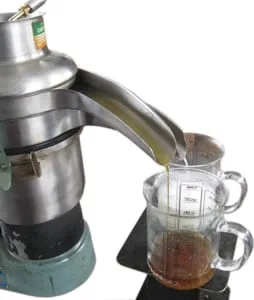
Lab Scale Industrial Centrifuge Lab
We have a lab-scale disc-stack and test tube centrifuge that exerts centrifugal force similar to production scale centrifuges. Lab-scale testing of process fluid samples allows the potential customer to evaluate the applicability and efficiency of disc stack and decanter centrifuges. The lab-scale centrifuge has two configurations, namely disc-stack bowl and test-tube attachment.
Disc Stack Bowl
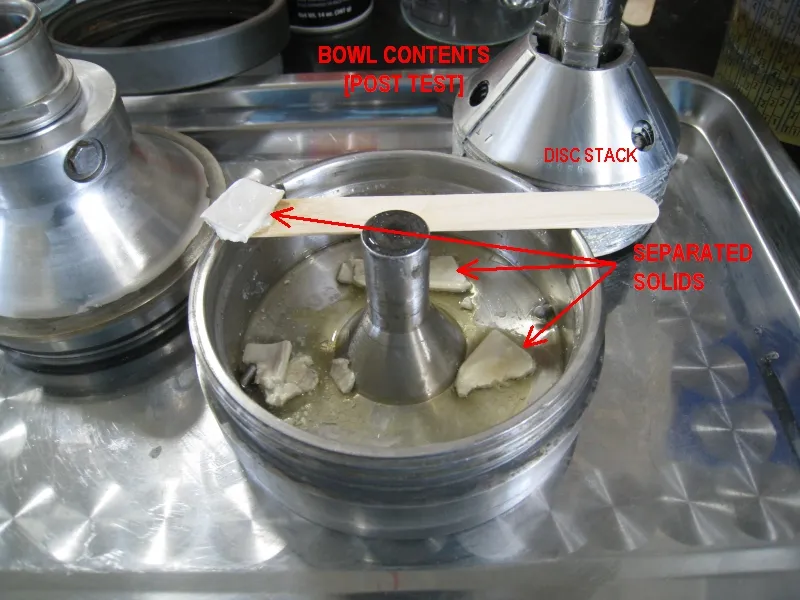
Lab Scale Disc Centrifuge Bowl
The processing of a small fluid sample (~1 Gallon) through this lab-scale disc stack centrifuge bowl demonstrates the ability of these centrifuge's applicability to specific fluid separation processes, including the separation of small particles and liquid-liquid separation.
In liquid-liquid separation, the two separated liquids and solids (if any) are available for the customer to review or analyze to further establish the disc-stack centrifuge efficacy.
Test Tube
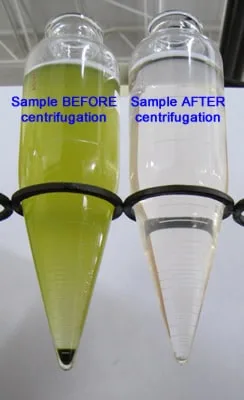
Industrial Centrifuge Pilot Testing Results
The test-tube method helps evaluate the applicability of decanter centrifuges by a quick spin test. This test is applicable for fluids with a high proportion of solids.
In this test, the decanter centrifuge is often suitable for the process if the solids settle out of the liquid within a predetermined time interval. If the solids are still suspended after the spin, the fluid may not be suitable for separation with a decanter centrifuge.
Special Considerations
Additional considerations may be applicable for specific uses that can affect the centrifuge selection process.
Explosion Proof or Hazardous Areas
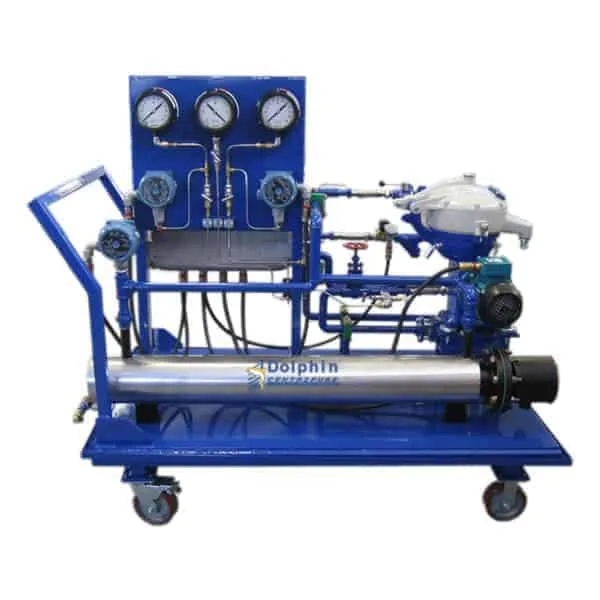
Explosion Proof Oil Centrifuge
The installation of centrifuges in the presence of flammable liquids, vapors, or dust requires the selection of a special centrifuge that is suitable for such environments. Special modifications of standard centrifuges can allow their application in such areas.
Read our article about the application and execution of explosion-proof centrifuges.
Accessories Selection
The selection of certain accessories can enable a decanter or disc-stack centrifuge for applications not directly applicable to the base centrifuges. Some of these enhancements and their related benefits are below.
Strainer
As discussed above, industrial centrifuges have inherent limitations on the maximum particle size and the percentage of solids. This limitation does not necessarily prevent using a specific centrifuge for an application.
Using strainers or filters can separate the large particles from the process fluid. This pre-grading may allow the use of a centrifuge which would otherwise not be applicable due to particle size limitations.
Filter banks can catch the larger particles in bulk, reducing the proportion of solids in given process fluid. A disc-stack centrifuge, for example, may be applied with the reduction of the solids load through pre-filtration.
Process Heater

Highly viscous fluids such as heavy crude oil, heavy fuel oil, and some gear oils are typically too thick for centrifuges. But with the use of a pre-heater, the increase in temperature reduces the oil's viscosity, making it suitable for processing with centrifugal separators.
Related Articles
- Difference Between Decanter & Disc Centrifuge | Technical Comparison
- Disc Stack Centrifuge Applications Overview
- Decanter Centrifuge Applications
- Industrial Centrifuge Sample Testing
- 9 Steps to Selecting & Buying the Right Industrial Centrifuge
Not Sure Which Centrifuge is Right for Your Application?
Dolphin Centrifuge engineers can review your application and recommend the correct centrifuge type and size — at no charge. Send us a sample for lab testing or call for a consultation.
Get Expert Help →Frequently Asked Questions
How do I choose between a disc stack and decanter centrifuge?
The primary decision factors are: (1) Solids content — disc stack centrifuges handle <2% solids; decanters handle up to 40%; (2) Particle size — disc stacks separate particles down to 0.5 microns; decanters handle >100 microns; (3) Separation type — disc stacks excel at liquid-liquid separation (oil/water); decanters excel at solid-liquid separation (sludge dewatering).
What information do I need to select the right centrifuge size?
To select the right centrifuge: (1) Required throughput in GPM; (2) Fluid type and viscosity at operating temperature; (3) Percent solids in the feed; (4) Solid particle size distribution; (5) Desired separation quality. Dolphin Centrifuge engineers can size the right unit based on these parameters — call (248) 522-2573.
Can centrifuge sample testing help select the right unit?
Yes. Dolphin Centrifuge offers sample testing — send a fluid sample to our Warren, MI facility and our engineers will test it on our centrifuge equipment to characterize separation performance, determine the right centrifuge type, and size the appropriate model. This removes guesswork from centrifuge selection.
What is the smallest disc stack centrifuge Dolphin Centrifuge supplies?
The smallest disc stack centrifuge system in Dolphin's lineup is the DMPX-010, rated at 7 GPM on diesel and 4 GPM on lube oil. For manual-clean disc centrifuges, the smallest is the DMB-004, rated at 4 GPM on diesel. Both are available as complete turnkey system modules.
What is the largest centrifuge Dolphin Centrifuge supplies?
For disc stack centrifuges, the largest standard system is the DMPX-070, rated at 59–72 GPM on diesel and 30–38 GPM on lube oil. For decanter centrifuges, the Alfa Laval NX-428 handles flow rates up to 80+ GPM. Multiple units can be installed in parallel for higher throughput requirements.
Ready to Select and Source Your Centrifuge?
Call Dolphin Centrifuge at (248) 522-2573 or submit a quote request online.