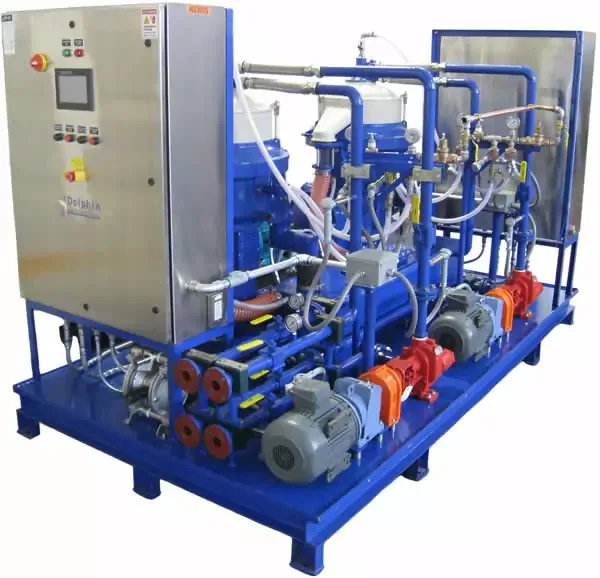
Dolphin Centrifuge supplies disc stack centrifuge systems for diesel polishing, heavy fuel oil (HFO) purification, and bunker fuel treatment. Operating at up to 8,000 G, these systems remove water, cat fines, asphaltenes, and particulates at 10–60 GPM. Based in Warren, Michigan, with 40+ years of fuel separation experience across power generation, marine, and fleet industries.
Why Centrifuge Fuel Purification
Fuel contamination is one of the leading causes of engine failure, injector wear, and unscheduled downtime in power generation, marine, and fleet operations. Water, particulates, cat fines, and asphaltenes degrade fuel quality and damage critical engine components. Disc stack centrifuge systems provide the most effective method of removing these contaminants, delivering fuel that meets or exceeds OEM cleanliness specifications.
Unlike conventional filters that clog and require frequent replacement, a centrifugal separation system continuously purifies fuel at high throughput rates — removing both free water and sub-micron solids that filters cannot capture.
Diesel Fuel Centrifuge
Diesel fuel centrifuge systems remove water, particulates, and asphaltenes from diesel fuel. These systems are essential for bulk storage facilities, fleet operations, and generator fuel systems where fuel sits in storage and degrades over time.
Dolphin Centrifuge offers diesel purification modules with capacities ranging from 10 to 40 GPM, built as turnkey skid-mounted systems ready for immediate deployment. Each system includes a self-cleaning disc stack centrifuge, feed pump, heater (when required), and PLC-based controls.
Fuel Oil / HFO Centrifuge
Heavy fuel oil (HFO), bunker fuel, and residual fuel oils require high-temperature centrifugal separation to remove cat fines, water, and sludge. Fuel oil centrifuge systems operate at elevated temperatures to reduce viscosity, enabling effective separation of contaminants that would otherwise cause catastrophic engine wear.
These systems handle capacities from 10 to 60 GPM and are widely used in power plants, marine vessels, and industrial boiler operations. Dolphin builds both simplex and duplex configurations for continuous, uninterrupted fuel treatment.
Contaminants Removed
- Free and emulsified water — protects injectors and prevents microbial growth
- Particulate matter — removes sub-micron solids that pass through conventional filters
- Cat fines (catalytic fines) — abrasive alumina and silica particles from refinery cracking processes
- Asphaltenes and sludge — heavy organic compounds that foul fuel systems
- Biological contaminants — bacteria and fungi that thrive in fuel-water interfaces
Dealing with Fuel Contamination or Engine Wear?
Send us a fuel sample — our engineers test your actual fuel and recommend the right centrifuge system. Simplex and duplex configurations available for diesel, HFO, and bunker fuel.
Choosing the Right System
Selecting the right fuel centrifuge depends on fuel type, throughput requirements, and contaminant profile. The DMPX-042 disc centrifuge is well suited for mid-range diesel and light fuel oil applications, while the DMPX-028 handles smaller volume requirements with the same separation efficiency.
Dolphin Centrifuge provides sample testing to evaluate your fuel and recommend the optimal centrifuge configuration. Our engineers size every system based on actual fuel analysis data, not guesswork.
Ready to discuss your fuel purification needs? Contact our engineering team for a consultation and quote.
Frequently Asked Questions
What contaminants does a fuel centrifuge remove?
A disc stack fuel centrifuge removes free and emulsified water, particulate matter, cat fines (catalytic fines — abrasive alumina and silica from refinery cracking), asphaltenes and sludge, and biological contaminants (bacteria and fungi). This protects injectors, reduces wear, and extends engine component life.
What is the difference between diesel polishing and fuel oil centrifugation?
Diesel polishing typically refers to processing stored diesel fuel to remove water and particulates that accumulate during storage. Fuel oil centrifugation (for HFO or bunker fuel) requires elevated temperatures to reduce viscosity for effective separation of cat fines and asphaltenes. Both processes use disc stack centrifuges, but HFO systems require larger, heated systems.
How much flow rate do I need for a generator fuel polishing system?
For generator fuel polishing, a common rule of thumb is to size the centrifuge to turn over the fuel tank volume every 24–48 hours. For a 10,000-gallon tank, a 7–15 GPM centrifuge provides adequate polishing. Dolphin Centrifuge engineers will size your system based on actual fuel volume and contamination level.
Can a centrifuge replace fuel filters entirely?
A centrifuge significantly extends filter life and often eliminates frequent filter changes, but most installations use a post-filter as a final polishing step to ensure absolute cleanliness. Centrifuges handle the bulk of contamination — removing 95%+ of water and solids — while post-filters provide the final quality guarantee.
Does Dolphin Centrifuge build duplex fuel purification systems?
Yes. Dolphin Centrifuge builds both simplex and duplex centrifuge systems for fuel purification. Duplex configurations use two centrifuges in parallel for 100% continuous operation — one unit processes fuel while the other is in standby or maintenance. This is essential for critical power generation or marine applications where fuel supply cannot be interrupted.
Protect Your Engines. Purify Your Fuel.
Dolphin Centrifuge fuel purification systems for diesel, HFO, and bunker fuel. Turnkey skids. Factory tested. Fast delivery from Warren, MI.