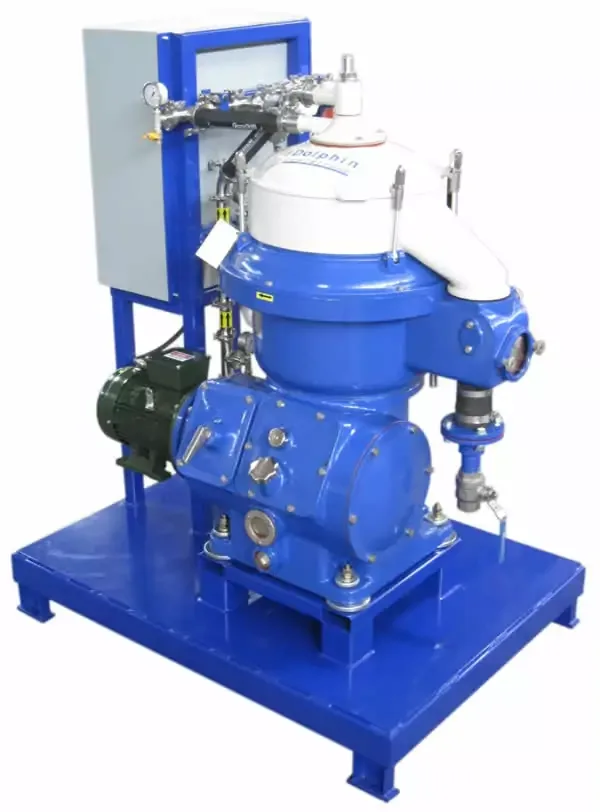
Dolphin Centrifuge supplies disc stack and decanter centrifuge systems for municipal and industrial wastewater treatment, algae harvesting, manure separation, and biodiesel processing. Systems process 20–100+ GPM continuously, separating suspended solids, oils, and sludge to meet discharge permit requirements. Based in Warren, Michigan, with 40+ years of wastewater and environmental separation experience.
Overview
From municipal sludge dewatering to algae harvesting and manure processing, our disc stack and decanter centrifuges deliver reliable solids–liquid separation for the toughest wastewater streams. Dolphin Centrifuge provides turnkey systems backed by 40+ years of field experience and over 150 centrifuges in stock.
Municipal & Industrial Wastewater
Our wastewater centrifuge systems handle municipal and industrial wastewater treatment at flow rates of 20–80 GPM. They remove suspended solids, oils, and sludge to help facilities meet discharge permit requirements. Both disc stack and decanter configurations are available depending on particle size and solids concentration.
Wastewater Centrifuge
Municipal & Industrial Treatment
Disc stack and decanter centrifuges for municipal and industrial wastewater treatment. Remove suspended solids, oils, and sludge to meet discharge permit requirements.
Algae Harvesting Centrifuge
Continuous Biomass Recovery
Harvest algae cells from water at industrial scale using self-cleaning disc stack centrifuges. Process continuously with automatic biomass ejection.
Manure Centrifuge Separator
Solids–Liquid Separation
Separate manure into dry solids and nutrient-rich liquid using decanter centrifuges. Reduce storage volumes and produce high-value fertilizer.
Liquid Humus Centrifuge
Commercial Humus Production
Produce liquid humus fertilizer at commercial scale. Decanter centrifuges separate humus biomass from nutrient-rich water.
Biodiesel Centrifuge
ASTM D6751 Compliance
Wash and polish biodiesel to ASTM D6751 specs. Remove glycerin, soap, water, and catalyst residue continuously.
Algae Harvesting
Algae harvesting centrifuges use self-cleaning disc stack technology to continuously separate algae cells from water at flow rates of 5–100+ GPM. Automatic biomass ejection keeps the process running without manual intervention, making these systems ideal for large-scale biofuel and nutraceutical operations.
Manure Separation
Manure centrifuge separators use decanter centrifuge technology to split manure into dry solids and nutrient-rich liquid. This reduces storage volumes, controls odor, and produces high-value fertilizer — a critical tool for modern dairy and livestock operations processing 25+ GPM.
Solving a Wastewater or Environmental Separation Challenge?
Our engineers can run sample tests on your specific waste stream and recommend the optimal disc stack or decanter centrifuge system. Testing available at our Warren, MI facility.
Liquid Humus Production
For commercial humus production, liquid humus centrifuges separate humus biomass from nutrient-rich water at 15–40 GPM. Decanter centrifuges provide the continuous throughput and consistent separation efficiency that commercial fertilizer producers require.
Biodiesel Processing
Biodiesel centrifuges wash and polish biodiesel to ASTM D6751 specifications, continuously removing glycerin, soap, water, and catalyst residue at 10–40 GPM. Disc stack centrifuges are the preferred technology for this application due to their ability to handle fine liquid–liquid separation.
Choosing the Right Centrifuge
The right centrifuge type depends on your wastewater characteristics — particle size, solids concentration, and required throughput. Disc stack centrifuges excel at fine-particle and liquid–liquid separation, while decanter centrifuges handle high-solids slurries and dewatering tasks. Our engineers can run sample tests on your specific waste stream to recommend the optimal system.
Frequently Asked Questions
What types of centrifuges are used for wastewater treatment?
Two main centrifuge types are used in wastewater treatment: disc stack centrifuges for fine-particle separation and liquid-liquid separation (removing oils and fine solids from water), and decanter centrifuges for high-solids sludge dewatering. Dolphin Centrifuge supplies both types, sized for municipal and industrial wastewater applications at 20–80+ GPM.
Can a centrifuge handle industrial wastewater with high oil content?
Yes. Three-phase disc stack centrifuges are highly effective for industrial wastewater streams containing both oil and suspended solids. The centrifuge simultaneously separates oil, water, and solids — recovering the oil phase for reuse or disposal while producing a clarified water effluent that meets discharge permit requirements.
What is the difference between disc stack and decanter centrifuges for wastewater?
Disc stack centrifuges excel at fine-particle separation and liquid-liquid separation (removing oil or fine solids from water). Decanter centrifuges are designed for high-solids slurries and dewatering — separating thick sludge into dry cake and liquid. For wastewater with fine suspended solids, a disc stack is preferred; for primary or secondary sludge dewatering, a decanter is more appropriate.
How does a centrifuge support algae harvesting operations?
Disc stack centrifuges concentrate algae cells from dilute growth media at flow rates of 5–100+ GPM. The self-cleaning bowl automatically ejects harvested algae biomass at timed intervals, allowing continuous operation. This avoids the slow settling times and large footprint of gravity separators — critical for commercial-scale biofuel and nutraceutical algae production.
Can a centrifuge help dairy operations meet manure management requirements?
Yes. Decanter centrifuges separate dairy manure into a dry solids fraction (for composting or bedding) and a nutrient-rich liquid fraction (for fertilizer or biogas). This reduces lagoon storage volume, controls odor, and can recover valuable nutrients. Dolphin Centrifuge supplies decanter systems sized for dairy and livestock operations at 25+ GPM.
Meet Your Discharge Permits. Maximize Recovery.
Disc stack and decanter centrifuge systems for municipal and industrial wastewater, algae, manure, and biodiesel. Turnkey systems from Warren, MI.