Dolphin Centrifuge supplies disc stack and decanter centrifugal filter systems that separate solids and water from process fluids without consumable filter media. Operating at 7,000+ Gs, these sedimentation-type centrifuges remove particles from 0.5 microns upward and process 13-47 GPM continuously.
What Is a Centrifugal Filter?
The process of using centrifugal force to separate solids from liquids is called centrifugal filtration. This method uses gravitational force instead of filter media to affect the separation.
A centrifugal filter separates a range of particles based on their density, whereas a conventional filter separates particles based on their size. This fundamental difference gives centrifugal filters several key operational advantages over media-based filtration.
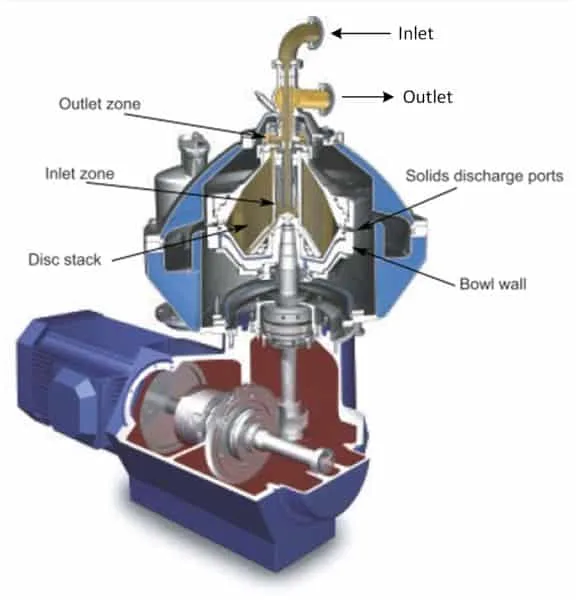
A centrifugal filter separates particles from liquids based on density rather than particle size — removing a wide range of particles (0.5 to 200+ microns) while simultaneously removing water from oil. The two main types are filtration (perforated basket) and sedimentation (disc stack and decanter).
Working Principle
A centrifugal filter works on the principle of differential settling of immiscible phases, i.e., solids and liquids settling at different rates based on their respective densities. The denser or heavier phase settles out quicker than the lighter phase under the high centrifugal force. Thus the two phases are separated or filtered.
A conventional filter separates particles based on size — anything smaller than the pore opening passes through. A centrifugal filter separates based on density — particles of all sizes separate based on how much heavier they are than the carrier fluid. This fundamental difference gives centrifugal filters several operational advantages.
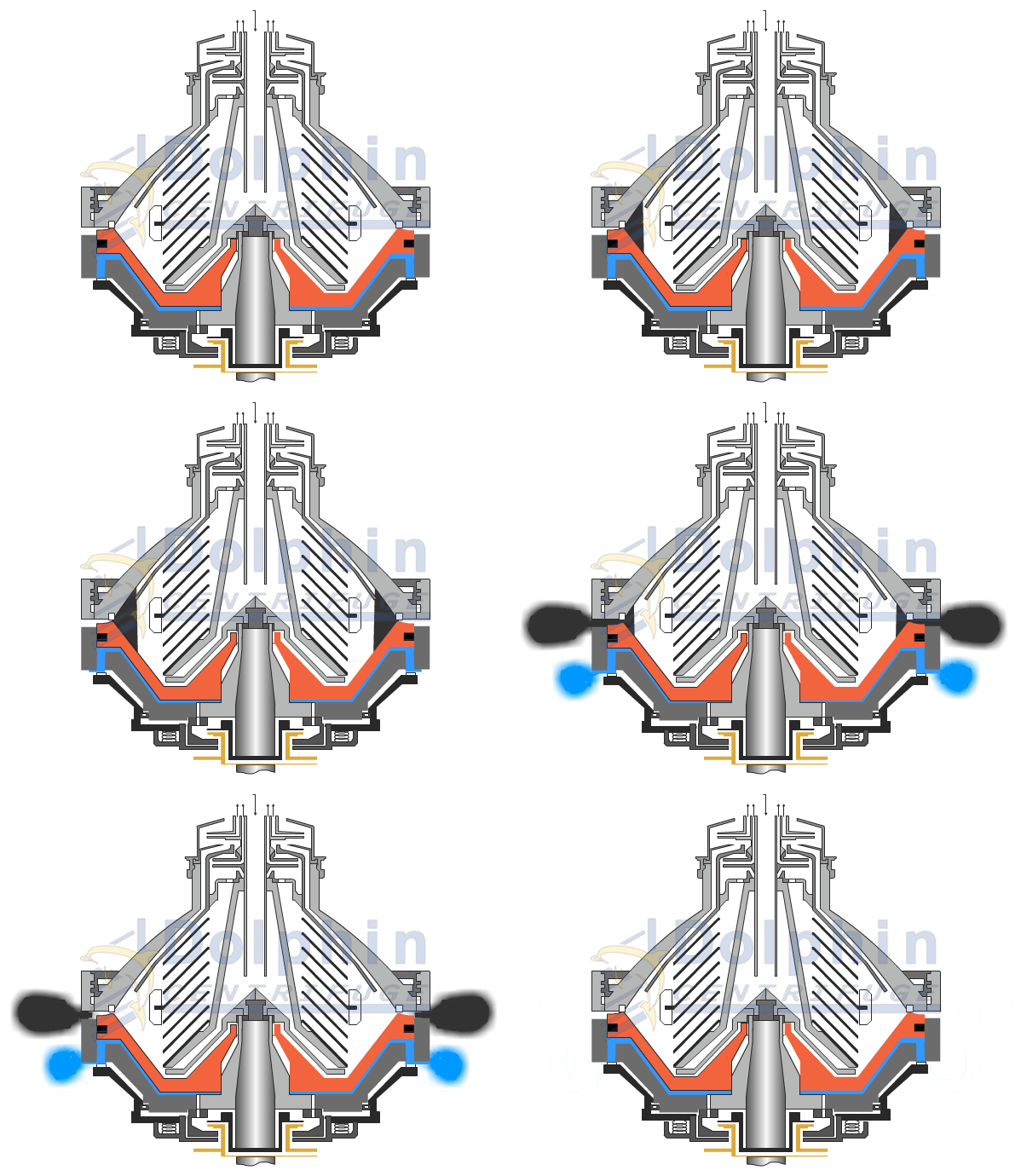
The rotating centrifuge bowl generates extremely high G-forces that push denser particles and water outward while clean liquid moves toward the center outlet. Self-cleaning disc stack centrifuges automatically eject accumulated solids at timed intervals, allowing continuous unattended operation.
Types of Centrifugal Filters
Unlike regular filters, centrifugal filters are available in two different types that are significantly different. These types both use centrifugal force but handle the separated solids differently.
Filtration Type (Basket)
The centrifugal filter filtration type uses the centrifugal force exerted by the centrifuge to push the fluid through a perforated screen or similar media. The fluid passes through the screen while the solids collect on the screen surface. A mechanical scraper extracts these separated solids from the screen surface.
The screen perforation size determines the separation grade of the conventional filter. The screen replacement with different size perforations allows the machine to handle fluids with different particle sizes. This type of centrifuge filter is essentially a batch-type process — once the filter screen saturates with separated solids, the centrifuge cannot be effectively used until the screen has been cleared.
Sedimentation Type (Disc Stack / Decanter)
A separation device that uses centrifugal force to cause separation is known as a sedimentation-type centrifugal filter. This type of separation uses differential settling of solids and liquids that are based on their densities.
The centrifugal force causes the heavier solids to collect on the rotating bowl wall while the lighter liquid flows away from the solids through a liquid outlet in the centrifuge bowl. Since this centrifugal filter separates and discharges solids and liquids continuously, it is considered a flow-through type separation.
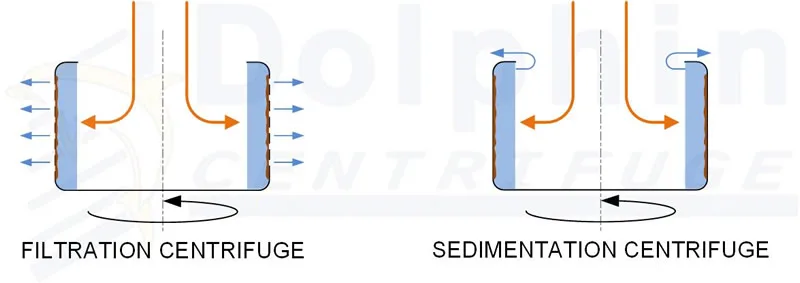
The diagram shows the structural difference between a filtration-type basket centrifuge and a sedimentation-type decanter centrifuge. Basket centrifuges use perforated screens while sedimentation types use differential settling under centrifugal force.
Media Filtration vs. Centrifugal Filtration
The primary difference between media filtration and centrifugal filtration is the working principle. Ordinary filters use media such as a filter bag or paper that prevents particles of a specific size from passing through. Particles smaller than the pore size and liquids pass through the filter media. This process separates the particles of a specific size (and larger) from the liquid.
Centrifugal filters use the principle of centrifugal force (RCF) to cause liquid and solid separation. The high centrifugal force pushes the heavy solid particles toward the centrifuge bowl wall while displacing the lighter liquid toward the center of the bowl. The separated liquid then exits the bowl through a central pathway. The automatic bowl ejects the separated solids intermittently.
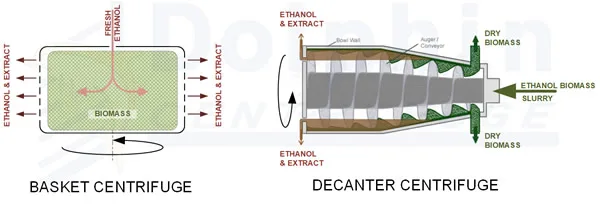
The comparison image illustrates the physical differences between a basket centrifuge (filtration type) and a decanter centrifuge (sedimentation type), highlighting their distinct separation mechanisms.
| Factor | Media Filter | Centrifugal Filter |
|---|---|---|
| Separation Basis | Particle size (pore rating) | Particle density (specific gravity) |
| Water Removal | No — water passes through with oil | Yes — simultaneous water and solids removal |
| Performance Over Time | Degrades as media clogs | Consistent — no media to clog |
| Operating Cost | Ongoing media + labor costs | Electricity only |
| Particle Range | Fixed by media pore size | 0.5 to 200+ microns (density dependent) |
| Separation Type | Absolute (rated particle size) | Mechanical (density dependent) |
| Capital Cost | Lower initial investment | Higher initial investment |
Advantages of Centrifugal Filters
Centrifugal filters have many advantages over standard media filters. The following are some of the main advantages.
Low Operating Cost
Unlike conventional filters, centrifugal filters separate the liquid from solids by using centrifugal force. Therefore, these filters do not need any filter media or labor to replace them, leading to considerable cost savings over the operational life of the filters.
Consistent Performance
The solid particles collecting on the surface of filter media block the passage of fluids over time. This accumulation of sediment reduces the flow passing through the filter. The separated particles collect in a separate sludge space in centrifugal filters without causing any impediment to the fluid flow. Based on the above, a centrifugal filter delivers consistent performance compared to a conventional filter, whose performance degrades as the filter media collects solids.
Water & Solids Removal
A centrifugal filter separates both water and solids from the oil by using the principle of differential settling. This water separation occurs concurrently with solids removal. Conventional filters only separate the solids but not the water that passes through the filter and the oil.
Wide Range of Particle Size Removal
The size of the pores of the filter media defines the smallest particles separated by a standard filter. That also means that all particles smaller than the filter media pore size pass through the filter and do not separate. A centrifugal filter separates all the particles from 0.5-micron size to over 200 microns, depending on the density of the particles.
Disadvantages of Centrifugal Filters
Like all industrial equipment, centrifugal filters have certain disadvantages, which are listed below.
Capital Investment
Centrifugal filters are industrial centrifuge machines that require capital investment. Therefore, there is a need for an initial investment. Conventional filters are relatively inexpensive and do not require an initial investment.
Maintenance
The only maintenance needed for conventional filters is the periodic replacement of the filter media. A centrifugal filter is a mechanical device that requires periodic maintenance as recommended by the manufacturer.
Skilled Operating Labor
The maintenance and day-to-day operation of a centrifugal filter needs a mechanically skilled technician. Though most centrifugal filters operate automatically, an operator is essential to oversee the operation. Filters do not need skilled operators to maintain or service them. The periodic replacement of filter media is a relatively uncomplicated process.
Utilities Required
Electric power, water, and compressed air are the typical utilities needed by a centrifugal filter. In comparison, a conventional filter does not require any of these utilities to function.
No Absolute Separation
Standard filters use filter media rated for a particular particle size defined by the size of the pores in the media. This means that no particles larger than the pore size will pass through the filter, ensuring absolute separation. Centrifugal filters are mechanical separation devices that use centrifugal force to affect the separation of particles. The actual separation depends on certain operating factors such as flow rate, fluid temperature, particle size, density, etc. Therefore, a centrifugal filter is not an absolute separation device, and particles can pass through the device.
Examples of Applications
There are several real-world examples of centrifugal filter usage where conventional filters are unusable due to their inherent limitations. The following are some examples of centrifugal filter applications in different industries.
Food & Beverage
Milk
The milk standardization process involves removing milk fat from the milk and controlling fat back into the milk. Centrifugal filters in disc-stack separators are the primary separators of fat from milk in the dairy industry.
Juice
Freshly crushed fruit such as oranges, apples, etc., carry fruit pulp along with the juice. A decanter or disc centrifugal filter is the preferred method of separating this pulp from the juice.
Flavor
Food flavoring is essentially the extract from food products for flavoring commercial baked or prepared foods. The primary method of food flavor extraction uses some solvent to absorb the flavor from the food ingredient. A centrifugal filter as a disc separator is ideal for separating this solvent from the food biomass.
Beer
The process of brewing beer involves the addition of hops to flavor the beer. Centrifugal disc type filters have the high centrifugal force to separate the tiny organic particles to produce clear beer.
Wine
Centrifugal filters of the disc stack type are the preferred choice for clarifying wine from grape residue. A self-cleaning type centrifugal filter produces clear wine continuously.
Pharmaceutical
Cell Culture
Centrifugal filters are the primary separators to remove cultivated cell cultures from the broth or culture media. These are disc-type centrifugal filters that have high separation efficiency.
Raw Ingredients
A wide variety of pharmaceutical ingredient production processes use centrifugal filters as the means of primary separation.
Oil and Gas
Crude Oil
The decanter and disc-type centrifugal separators are the primary means of separation in the oil and gas industry. These separation devices separate crude oil and water, sludge, and other contaminants from the oil.
Refinery Waste
The waste streams in the refinery are a significant environmental issue. Centrifugal filters allow for the efficient separation of waste and emulsified crude oil from water and therefore are the essential equipment for refinery waste recovery.
Produced Water
Produced water is water that is the primary source of contamination in crude oil production. Large volumes of produced water contain trace amounts of oil that the centrifugal filter separates.
Drilling Mud
The production of crude oil involves drilling oil wells using special abrasive fluids. These fluids are recycled using centrifugal filters in the form of decanter centrifuges.
Environmental
Waste Water
Municipal or industrial wastewater contains sludge, the removal of which is essential for the reuse of the water. Centrifugal filters perform this role as the primary separation mode for large quantities of wastewater.
Waste Oil
Waste oil or used oil is a commonly used term to describe oil that has been used and carries contaminants such as sludge and water. Clean waste oil has commercial value as heating fuel and as feedstock for biofuels. Centrifugal filters of the three-phase type (disc stack centrifuges) efficiently separate water and fine sediment from waste oil continuously to produce saleable oil.
Fuels
Diesel
Diesel fuel is the primary fuel for the transportation and power cogeneration industries. The contamination of stored diesel fuel is a common problem. A centrifugal separator separates the water and sludge in diesel storage tanks to keep the fuel clean for use in engines.
Fuel Oil
Fuel oil is a relatively cheaper energy source and is, therefore, widely used in the bulk transportation industry. Like any stored liquid fuel, water and sludge contaminate fuel oil making it unusable for engines. A centrifugal filter is the only durable and reliable device for continuous fuel oil separation onboard ships and power plants.
Aviation Fuel (Kerosene)
Another fuel that is prone to contamination is aviation fuel or kerosene. Once again, water and sediment are the critical contaminants in this fuel. The removal of these impurities through the use of centrifugal filters is a widely used practice.
Biofuels
Algae Harvesting
Algae is the new source of oil to produce biodiesel. Algae is also popular as a food supplement. In either case, the harvesting of algae cells is the first step in the process. With its high g-force, a centrifugal filter is the best method for continuously harvesting algae cells.
Biodiesel
The commercial production of biodiesel involves a chemical process using vegetable oil that splits the oil into biodiesel and glycerin. For smaller volumes, gravity separation works for biodiesel recovery. For commercial-scale biodiesel production, the centrifugal filter is highly effective in producing clean biodiesel that meets ASTM fuel specifications.
Ethanol
Corn-based ethanol is the mandated additive in gasoline to produce E-85 grade gasoline. The industrial production of ethanol from corn requires separating corn biomass from the ethanol using centrifugal filters such as decanter centrifuges.
For help determining whether centrifugal filtration is the right approach for your separation challenge, call (248) 522-2573 or email sales@dolphincentrifuge.com.
Related resources: Centrifuge Selection Guide | Disc Stack Centrifuge Overview | Decanter vs. Disc Stack | Sample Testing Program | Industrial Centrifuge
By Sanjay Prabhu MSME, Engineering Manager, Dolphin Centrifuge