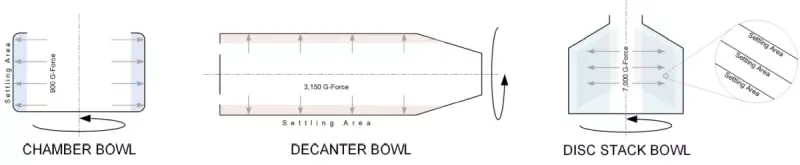
Dolphin Centrifuge publishes centrifuge comparison guides to help engineers select the right separation technology — covering disc stack vs. decanter, purifier vs. clarifier, self-cleaning vs. manual-clean, and centrifuge vs. alternative separation methods. Based in Warren, Michigan, with over 40 years of centrifuge application engineering experience.
Technical Comparisons & Explainers
Browse our library of 10 expert comparison articles covering the most common centrifuge selection questions. Whether you need to understand RCF vs RPM or choose between a dewatering centrifuge and a disc stack separator, these guides provide the technical clarity you need.
Decanter vs Disc Stack Centrifuge
A detailed comparison of the two main industrial centrifuge types — when to use a decanter vs a disc stack, and the key differences in design, performance, and applications.
Purifier vs Clarifier — What's the Difference?
The critical difference between purifier and clarifier disc centrifuges — two-phase vs three-phase separation, gravity disc selection, and application matching.
RCF vs RPM — Difference & Calculation
Understanding the difference between relative centrifugal force (RCF/G-force) and revolutions per minute (RPM), plus how to calculate and convert between them.
Centrifugal Filter Guide
How centrifugal filters work, types of filtration centrifuges, and how they compare to sedimenting centrifuges for different separation applications.
Dewatering Centrifuge Explained
How dewatering centrifuges work to remove water from sludge and slurries — types, operating principles, and application considerations.
Three Phase Decanter Centrifuge
How three-phase decanter centrifuges simultaneously separate two liquid phases and a solid phase — design, applications, and operating principles.
Smallest Industrial Centrifuges
A guide to the smallest industrial centrifuges available — compact disc stack and decanter models for pilot plants, labs, and low-volume applications.
Tramp Oil Centrifuge
How centrifuges remove tramp oil from machining coolants and wash water — comparison with skimmers, coalescers, and other removal methods.
Can a Centrifuge Separate Salt from Water?
Exploring whether centrifugal separation can remove dissolved salts from water — the physics behind it and what centrifuges can and cannot do.
Ethanol Extraction Centrifuges — Technical Comparison
Comparing centrifuge types for ethanol extraction applications — disc stack vs decanter vs basket centrifuge performance and suitability.
Not sure which centrifuge type fits your application?
Our engineers can evaluate your process fluid and recommend the right centrifuge technology — disc stack, decanter, or alternative. Sample testing available.
Explore Other Knowledge Categories
Continue learning with our other Knowledge Center categories covering troubleshooting, how-to guides, product information, and real-world case studies.
Frequently Asked Questions
+ What is the main difference between a disc stack centrifuge and a decanter centrifuge?
Disc stack centrifuges separate two liquids (or liquid plus fine solids) at high speed using a stack of conical discs. They are best for low-solids applications — oil/water separation, fuel purification, beer clarification. Decanter centrifuges use a scroll conveyor inside a rotating bowl to continuously discharge high-solids slurries. Choose decanters when solids content exceeds 5–10% by weight.
+ What is the difference between a purifier and a clarifier centrifuge?
A purifier separates two liquid phases (plus solids) — for example, oil from water. It uses a gravity disc to maintain the liquid/liquid interface inside the bowl. A clarifier removes only solids from a single liquid phase — no gravity disc is used, and the full bowl volume is dedicated to liquid clarification. The same centrifuge bowl can often be configured as either a purifier or a clarifier by changing the gravity disc.
+ What is the difference between RCF and RPM in centrifuge specifications?
RPM (revolutions per minute) is the rotational speed of the bowl. RCF (relative centrifugal force, also called G-force) is the actual separation force generated — calculated as RCF = 1.118 × r × (RPM/1000)², where r is the bowl radius in mm. Two centrifuges at the same RPM but different bowl sizes will have very different RCF values. RCF is the meaningful comparison for separation performance.
+ When should I use a three-phase decanter centrifuge instead of a two-phase unit?
Use a three-phase decanter when you need to simultaneously separate two liquid phases and a solid phase — for example, recovering oil and water from an oily sludge while also dewatering the solids. Two-phase decanters only separate one liquid from solids. Three-phase units are common in oily water treatment, rendering, and olive oil processing.
+ Can a centrifuge separate dissolved salts from water?
No. Centrifuges separate phases based on density difference. Dissolved salts are in true solution — they have no density difference relative to the surrounding water at the molecular level, so centrifugal force cannot separate them. Centrifuges can remove suspended particles and immiscible liquids, but dissolved materials require chemical precipitation or membrane filtration for removal.
Still unsure which centrifuge is right for you?
Send us your fluid sample and our engineers will run it through the appropriate centrifuge and provide documented separation results with equipment sizing recommendations.