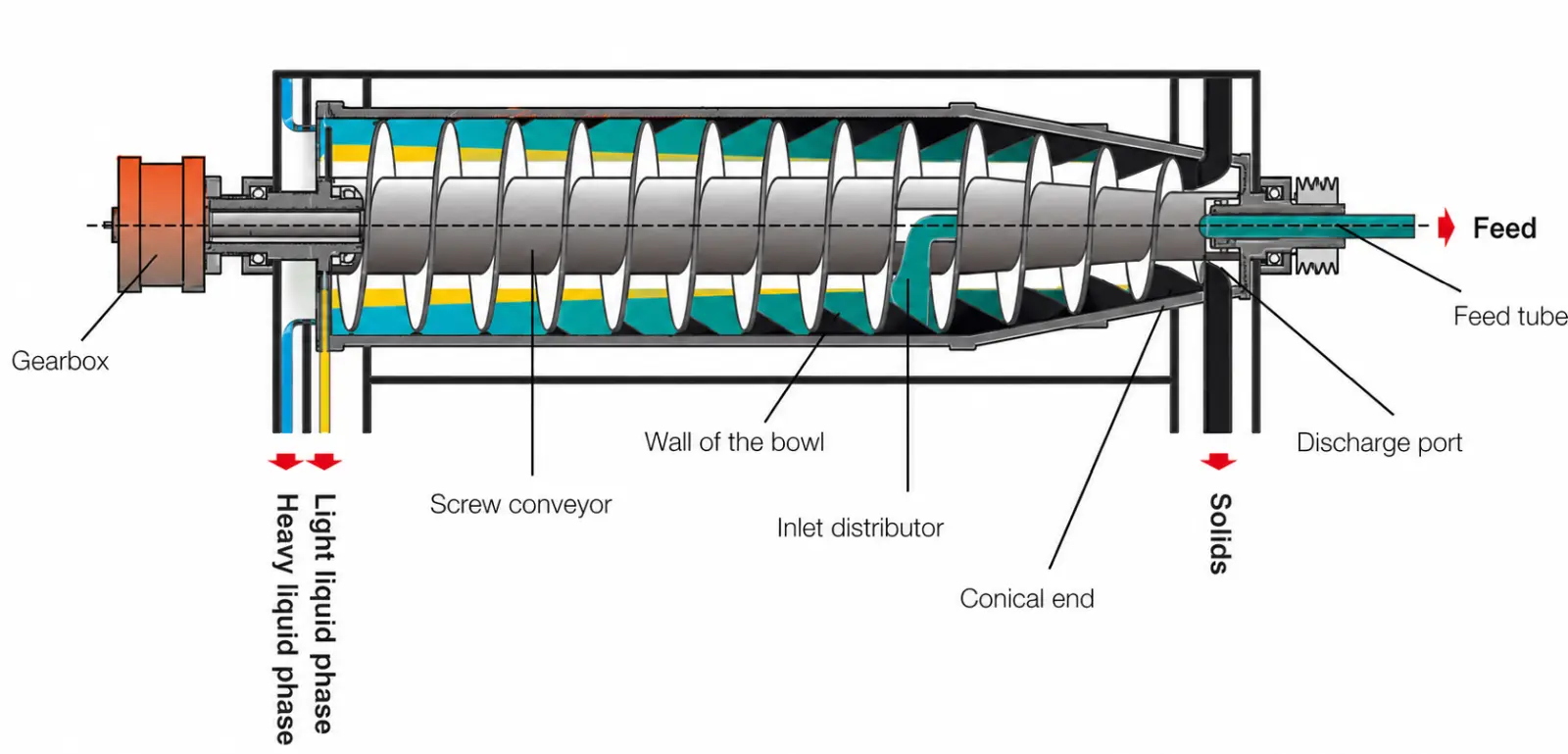
Cutaway diagram © Alfa Laval Inc
A three phase decanter, also called a tricanter, separates a heavy liquid, a light liquid, and solids in a single pass. Dolphin Centrifuge is the independent specialist in Alfa Laval centrifuges, with remanufactured machines, turnkey systems, parts, and service built on 40+ years of Alfa Laval experience and led by Sanjay Prabhu, M.S.M.E. The three phase decanters we supply are genuine Alfa Laval machines, principally the UVNX 314 and the larger UVNX 418, stripped, rebuilt, balanced, and tested in our Warren, Michigan shop. Dolphin is an independent remanufacturer and is not affiliated with Alfa Laval.
Working Principle
The 3-phase separation occurs in the horizontally rotating bowl of the decanter centrifuge. A fixed inlet tube feeds the slurry into the bowl, where the fluids are gently accelerated.
The high centrifugal force causes the heavier solids to accumulate on the bowl wall. The screw conveyor rotates within the bowl at a differential speed to the bowl. The relative rotation between the bowl and the screw pushes the solids to the bowl's conical section.
The centrifugal force drains the liquid from the solids as they move up the conical bowl wall. The conveyor pushes the dry solids through the sludge outlet ports. The ejected solids fall out of the casing vessel.
The entire cylindrical bowl section is the separation surface. The heavy and light liquid phases exit the bowl into individual chambers for each liquid phase in the decanter vessel.
Types
Three-phase decanters are available in 2 design variants. The difference is in the discharge of the separated liquid phases.
In the standard configuration, the heavy and light liquid phases exit the bowl under gravity. In other words, the liquid phases fall into the casing.
A second variation of the decanter has paring disc pump(s) on the separated liquid phases. These centripetal pumps discharge the separated liquid under pressure. As an added benefit, applying back pressure on the liquid phases helps centrifuge efficiency.
Read more about regular or standard 2-phase decanter centrifuges here.
Process Optimization
The three-phase decanter centrifuge can adapt to specific process requirements by:
- Changing the bowl rotational speed to exert the best G-force for separation.
- Adjust the scroll differential rotation to balance liquid clarity and sludge handling capacity.
- Calibrate the pond depth to adjust liquid clarity versus solid dryness.
- Interphase adjustment between the heavy and light liquid phases.
- Changing the feed flow rate. These 3-phase decanters can handle a wide range of feed rates.
Benefits
The benefits of three-phase decanters include:
- The simultaneous separation of two liquids and solids
- The ability to handle a wide range of solids concentrations
- The adjustment of the centrifuge during the process
- Low operating cost for high processing volume
- Compact size to process capacity ratio
- Reduced operator exposure to process fluids by sealed design
- Long service life due to absence of replaceable media
Specifications
| Three Phase Decanter Model -> | Alfa Laval UVNX-314 | Alfa Laval UVNX 418 |
|---|---|---|
| Bowl Diameter | 353 mm | 418 mm |
| Max. G-Force | 3,157 Gs | 3,740 Gs |
| Light Phase Liquid Discharge | Gravity | Gravity |
| Heavy Phase Liquid Discharge | Gravity | Gravity |
| Max. Bowl Speed | 4,000 RPM | 4,000 RPM |
| Bowl Length | 860 mm | 1,460 mm |
| Net Weight | 4,200 Lbs | 5,500 Lbs |
| Drive Motor | 10 HP | 20 HP |
| Noise Level | ~ 80 dB(A) | ~ 82 dB(A) |
Application
The food and other process industries use the 3-phase decanter extensively. The primary application is to separate a feed slurry of two immiscible liquids and a solid phase.
A typical example would be separating an oil phase from the water and solids phase.
Oilfield service is the clearest case. In a tank bottom recovery or refinery slop oil train, the three phase decanter is the front-end machine: it takes the raw emulsion and splits recovered sale oil, water, and sand in one pass, so the disc stack centrifuge downstream only has to polish clean oil. Dolphin supplies these as remanufactured Alfa Laval UVNX 314 and UVNX 418 decanters, skid-mounted or containerized for remote sites, with US engineering support and startup from Warren, Michigan.
Other specific examples include:
- Crude Oil Separation from Water and Sludge
- Fish Oil Separation from Stickwater and Fish Meal
- Industrial Waste Water from Oil and Sludge
- Beef Tallow from Water & Solids
You may consider Renting a Decanter centrifuge from Dolphin Centrifuge! Call (248) 522-2573 to check for availability.