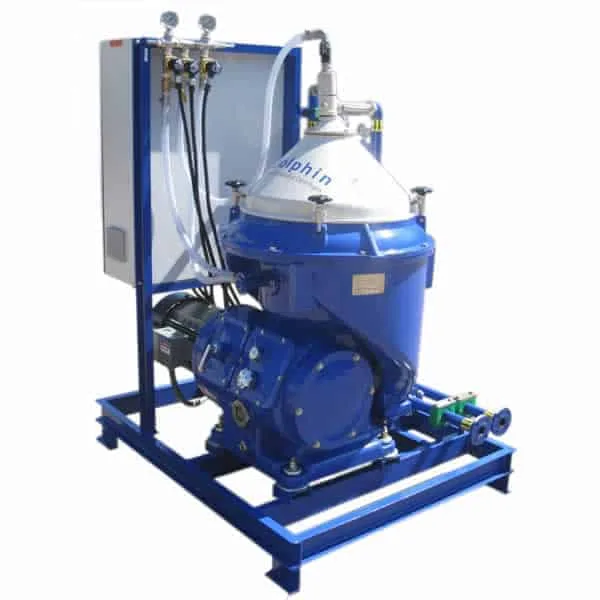
Dolphin Centrifuge supplies two-stage centrifuge systems for pyrolysis oil clarification — decanter for bulk char removal and disc stack at 8,000+ Gs polishing to 0.5 micron. Processes up to 30 GPM, producing sale-ready bio-oil with less than 0.1% sludge. Warren, Michigan.
Summary: Pyrolysis converts waste tires and plastics into valuable bio-oil, but removing residual char and metal particles from the crude oil presents a major filtration challenge. Industrial centrifuges — both decanters for coarse desludging and disc stack centrifuges for fine polishing — provide a continuous, filter-free solution that produces sale-ready bio-oil.
The Pyrolysis Process
Pyrolysis is a thermal decomposition process in which solid organic materials such as plastics, tires, and other petroleum-based waste are heated to high temperatures in the absence of oxygen. The process breaks down these materials into three byproducts: solid char (biochar), liquid bio-oil (pyrolysis oil), and gases.
Bio-oil is the primary product of commercial interest because its properties are similar to petroleum. Further refining of bio-oil yields fuels like diesel and fuel oil that can serve as direct replacements for conventional fossil fuels.
The Separation Challenge
Producing clean bio-oil at industrial scale presents specific separation challenges:
- Char residue: Fine carbon particles from the pyrolysis reaction remain suspended in the crude bio-oil and are difficult to remove by conventional filtration
- Sticky particles: The nature of pyrolysis char makes it adhere to filter media, causing rapid clogging and frequent filter replacement
- Metal contamination: Bio-oil from tire pyrolysis contains metal particles from the steel wire mesh embedded in tires, which can damage downstream processing equipment
- Continuous production: Large-scale pyrolysis operations require continuous separation, not batch processing, to maintain throughput
Two-Stage Centrifuge Solution
Industrial centrifuges address these challenges through a two-stage mechanical separation process that operates continuously without filter media:
Decanter Centrifuge — Coarse Desludging
A decanter centrifuge handles the first stage, removing bulk sludge including char and large metal particles from the crude pyrolysis oil. Decanters can handle particles up to 1/2" in size and feeds with up to 50% solids by volume.
- • Max solids: up to 50% (v/v)
- • Max particle size: 1/2"
- • Min particle separated: 50 µm
- • Capacity: 10 to 350+ GPM
- • Mode: Continuous
Disc Stack Centrifuge — Fine Polishing
A self-cleaning disc stack centrifuge performs the second stage, removing the remaining fine char and metal particles that the decanter cannot reach. The high centrifugal force (6,000 to 8,000+ Gs) separates particles down to 0.5 microns, producing sale-ready bio-oil.
- • Max solids: up to 5% (v/v)
- • Max particle size: 250 µm
- • Min particle separated: 0.5 µm
- • Capacity: 2 to 100+ GPM
- • Mode: Continuous, self-cleaning
Real-World Installation
Dolphin Centrifuge supplied a disc stack centrifuge system for a tire pyrolysis oil producer on the U.S. west coast. The customer supplied crude bio-oil from a post-straining tank. A heat exchanger reduced the oil temperature to the optimal processing range before entering the centrifuge.
The self-cleaning centrifuge separated all fine metal and char particles continuously, producing clear bio-oil ready for sale with less than 0.1% residual sludge.
| System Specification | Details |
|---|---|
| Centrifuge Type | Self-cleaning disc stack centrifuge |
| Separation | 3-phase: oil, water/sludge, fine sediment down to 0.5 µm |
| Capacity | Up to 30 GPM of pyrolysis oil at 200°F |
| Controls | Fully automatic PLC/touch-screen panel |
| Feed Pump | VFD-controlled positive displacement pump |
| Output Quality | Less than 0.1% residual sludge |
Why Centrifuges Over Filters
- No consumable media: Centrifuges separate mechanically using G-force, eliminating the cost of filter cartridges that clog rapidly with sticky char
- Continuous operation: Self-cleaning centrifuges run 24/7 with automatic sludge discharge, matching production line throughput
- Sub-micron separation: Disc stack centrifuges remove particles down to 0.5 microns, far exceeding the capability of most industrial filters for this application
- Metal particle removal: The high G-force effectively separates dense metal particles from tire wire mesh that would damage downstream equipment
Contact Dolphin Centrifuge at (248) 522-2573 or sales@dolphincentrifuge.com to discuss centrifuge solutions for your pyrolysis oil production. We offer sample testing for pyrolysis oil applications.
Test Your Pyrolysis Oil — Sample Testing
Not sure which centrifuge will work for your bio-oil? Send us a sample. Dolphin Centrifuge's lab team will run a pilot test and report exactly what separation efficiency your feedstock achieves before you invest.
Frequently Asked Questions
What centrifuge types are used in pyrolysis oil production?
Pyrolysis oil production typically uses a two-stage centrifuge process: a decanter centrifuge for primary separation of heavy char solids from crude pyrolysis oil, followed by a disc stack centrifuge for fine polishing to remove residual particles and metal contaminants. The decanter handles the high solids load; the disc centrifuge achieves final product clarity.
What particle sizes does a disc centrifuge remove from pyrolysis oil?
Industrial disc stack centrifuges operating at 6,000–12,000 × g can remove particles down to 0.5–2 microns from pyrolysis oil. This level of solids removal meets most pyrolysis bio-oil specifications for storage stability and combustion quality.
What temperature and viscosity requirements apply to pyrolysis oil centrifuge systems?
Pyrolysis oil is typically heated to 60–80°C before centrifuging to reduce viscosity and improve separation efficiency. Feed viscosity should ideally be below 20 cSt at processing temperature for effective disc centrifuge operation. Dolphin Centrifuge supplies integrated heating systems for pyrolysis oil centrifuge installations.
Can a centrifuge handle the char and metal particles in tire-derived pyrolysis oil?
Yes. Tire-derived pyrolysis oil contains steel wire particles from tire reinforcement mesh and sticky char residue that rapidly clogs conventional filters. A self-cleaning disc stack centrifuge removes metal particles at high G-force continuously, automatically ejecting accumulated sludge. The DMPX-014-BO is a purpose-built 2-phase clarifier variant optimized specifically for pyrolysis oil at up to 20 GPM.
What output quality does a pyrolysis oil centrifuge achieve?
A properly configured two-stage centrifuge system (decanter + disc stack) produces pyrolysis bio-oil with less than 0.1% residual sludge. This quality level is suitable for direct sale, further refining into diesel and fuel oil, or combustion in industrial burners. Send a sample to Dolphin Centrifuge for a pilot test to confirm results for your specific feedstock.
Ready to Purify Your Pyrolysis Oil?
Dolphin Centrifuge has supplied centrifuge systems for pyrolysis oil producers across the U.S. Call us or send a sample for a no-obligation evaluation.