
Dolphin Centrifuge supplies industrial decanter and disc-stack centrifuges for wastewater sludge dewatering, clarification, and oily water separation. Processing 3–170 GPM at up to 3,100 Gs with separation to 0.5 microns. Warren, Michigan — 40+ years of centrifugal separation experience.
Types of Wastewater
Wastewater is a generic term for water with solid or liquid contaminants. For example, municipal wastewater has organic sludge, and industrial wastewater carries industrial or inorganic sludge, etc.
Generation in large volumes is the other aspect of wastewater; therefore, the separation equipment must process large amounts of contaminated fluid.
Wastewater from the sources, as mentioned earlier, contains bulk sludge, which is easier to separate. On the other hand, wastewater from mines and oilfield drilling operations contains fine, suspended solids requiring smaller mesh filtration or higher g-force centrifuges.
We also have industrial effluent water, which contains oil in addition to the solids or sludge. This application may need two different centrifuges to separate the sludge and the oil from the de-sludged water.
Municipal Wastewater
Organic sludge from sewage treatment — high volume, moderate solids content. Requires sludge thickening or dewatering centrifuges for volume reduction.
Industrial Wastewater
Inorganic sludge from manufacturing, food processing, automotive wash water. Often contains heavier solids requiring robust decanter centrifuges.
Mining Effluent
Fine silt and clay particles requiring high g-force disc-stack centrifuges for effective clarification. Standard filtration cannot handle these micron-level particles.
Oilfield Wastewater
Drilling mud, produced water with fine suspended solids. High sludge content of up to 50% demands heavy-duty dewatering capacity.
Industrial Effluent (Oily)
Oil plus sludge combination requiring two-step centrifuge separation — a decanter for sludge removal followed by a three-phase disc-stack for oil separation.
Food Processing Wastewater
Organic sludge from bakeries, tortilla factories, onion processing, and other food manufacturing operations generating large daily wash-water volumes.
Wastewater Centrifuges — Types and Capacities (Full Article)
Separation Technologies for Wastewater
Filtration is not an option for this application, given the type and volume of wastewater that needs to be purified. Other separation technologies, such as belts and filter presses, have limited uses in wastewater separation duties. Again, these technologies have drawbacks, including labor and equipment reliability issues that limit their widespread use in wastewater treatment plants.
Mechanical separation using a wastewater centrifuge has many advantages for continuously processing large quantities of wastewater. As with all technologies, centrifuges also have some drawbacks highlighted below.
Centrifuge vs. Alternative Technologies
The table below compares wastewater centrifuges against belt presses, filter presses, and standard filtration equipment across key operational criteria. Centrifuges offer the only truly continuous, low-labor, zero-media-cost solution for high-volume wastewater treatment.
| Technology | Continuous? | Labor? | Media Cost? |
|---|---|---|---|
| Centrifuge | Yes | Minimal | None |
| Belt Press | Semi | High | Belt media |
| Filter Press | Batch | High | Filter media |
| Filtration | Limited | Moderate | Filter media |
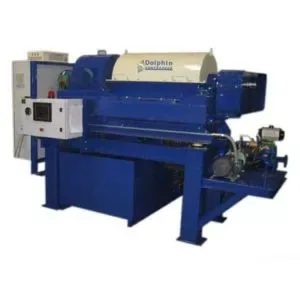
Sharples P3000 — 40 GPM — Wastewater Decanter
Ready to Test Your Wastewater?
Dolphin Centrifuge offers pilot testing — send us a sample and we will size and recommend the right centrifuge system for your application.
Wastewater Centrifuge Operation
A wastewater centrifuge is a separation machine that utilizes a centrifugal force of 3,100 Gs to separate the wastewater from sludge. The sludge accumulates on the bowl periphery, and the internal auger scrapes it towards the sludge discharge ports. The water flows out through the bowl's liquid outlet at the opposite end.
The centrifugal force generated inside the rotating bowl is thousands of times greater than gravity, which is what makes centrifuges so effective at separating fine particles that would take hours or days to settle naturally. This high g-force is particularly important for wastewater containing micron-level suspended solids from mining, drilling, or industrial operations.
How it works: Wastewater enters the rotating bowl. Centrifugal force separates heavy sludge to the bowl wall. The internal scroll auger continuously conveys sludge to the discharge end while clarified water exits from the opposite end — all in one continuous process. The entire separation cycle happens in seconds, allowing for continuous high-volume throughput without operator intervention.
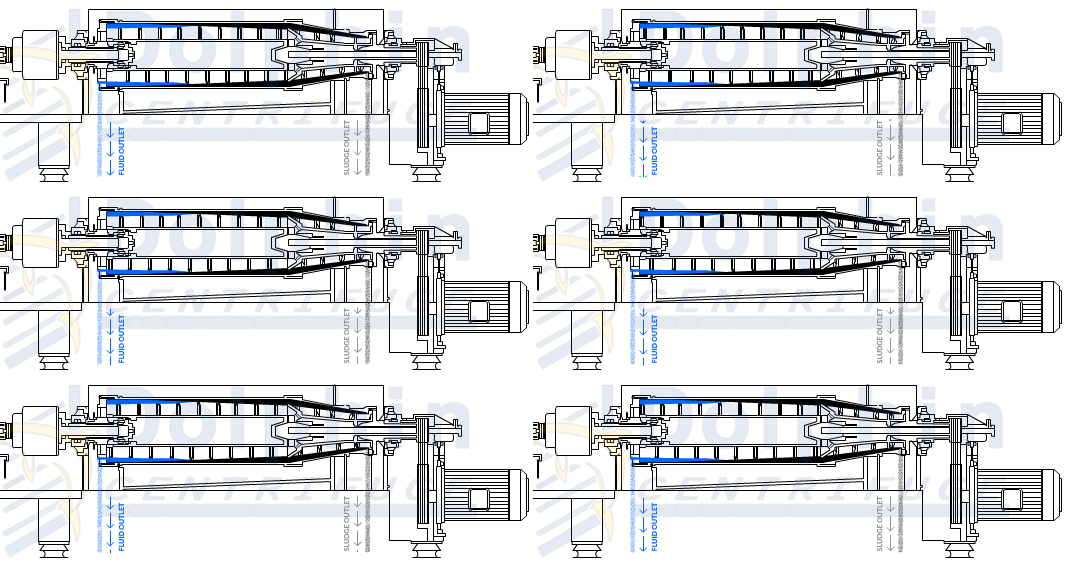
Dewatering Centrifuge Operation — Animation
Types of Wastewater Centrifuges
Three types of centrifuges apply to wastewater depending on the type and amount of sludge. The following section describes these broad categories. The selection of the appropriate centrifuge type depends on the wastewater source, contaminant characteristics, sludge volume percentage, and whether oil is present in the stream.
Sludge Thickening or Sludge Dewatering Centrifuge
A sludge dewatering or sludge thickening centrifuge is a decanter-type horizontal de-sludger that can remove water from slurries to thicken the sludge. In other words, a heavy-duty industrial centrifuge dewaters and concentrates (thickens) the sludge, also known as a sludge thickening machine. These machines are available in different sizes to continuously process large quantities of sludge-laden water.
Livestock farm manure, municipal sewage, car washes, and oilfield drilling mud produce wastewater with high sludge content of up to 50%. The primary objective of such applications is to reduce the sludge volume to minimize handling and disposal costs. The recovered water is often clean enough to be reused or discharged with minimal environmental impact.
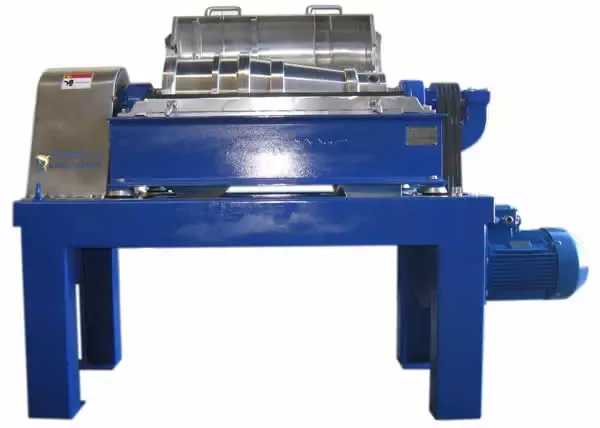
Alfa Laval NX-314 Decanter Centrifuge
Clarifying Centrifuge for Mining Effluent
A wastewater clarifier centrifuge is a disc-stack type, a high-speed, self-cleaning separator that produces very high centrifugal forces that can separate micron-level suspended particles. The particles are pushed toward the bowl wall and automatically purged during the cleaning cycle. The cleared centrate discharges the bowl continuously through a centrally located outlet port.
Wastewater from mining applications is one such example. This stream contains minute silt and clay particles that are difficult to separate with a wastewater decanter. A high-speed disc centrifuge has sufficient g-force to pull out these particles and clarify the water. The self-cleaning feature of the disc-stack centrifuge allows it to automatically eject accumulated solids at preset intervals, enabling truly continuous operation without manual intervention.
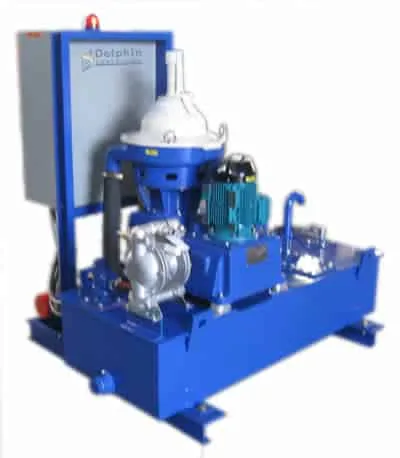
Alfa Laval WSPX-303 Wastewater Concentrator Centrifuge
Separator for Industrial Oily Wastewater
Industrial wastewater often carries oil in addition to sludge. This oily water is challenging because it cannot be disposed of in standard drains. A three-phase industrial centrifuge separates the oil from the water, making it disposable.
Industrial cleaning fluid containing shop-floor sludge and oil from the manufacturing run-off is ideal for separation with a liquid-liquid-solid separator. The three-phase centrifuge simultaneously separates the wastewater stream into three distinct outputs: clean water, recovered oil, and concentrated sludge. This three-way separation eliminates the need for multiple sequential treatment steps in many applications.
For higher volume or more complex oily wastewater streams, a two-step approach is often recommended: a decanter centrifuge first removes the bulk sludge, followed by a self-cleaning three-phase disc-stack centrifuge that polishes the water and separates the oil. This staged approach ensures maximum water quality and oil recovery.
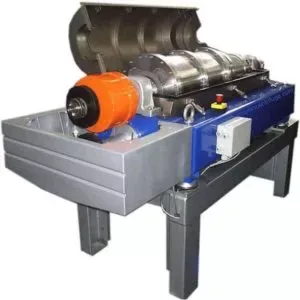
Alfa Laval Decanter — Onion Processing Wastewater
Benefits of Centrifuges for Wastewater
Centrifuges offer many benefits compared to other dewatering and separation technologies. A brief description of some of the advantages follows.
- Reduced sludge transportation and disposal costs (up to 50% savings)
- Decades of service life with stainless steel construction
- No filter media — eliminates media replacement labor and cost
- Fully automatic operation via PLC and touchscreen controls
- Compact footprint relative to processing capacity
- Continuous processing with no batch cycle downtime
Reduced Transportation and Disposal Expenses
Centrifuges produce dry sludge cake, significantly reducing transportation costs (up to 50%). Dry sludge also reduces disposal costs because the disposal volume is a fraction of the wet sludge. For operations generating thousands of gallons of wastewater daily, this cost reduction translates to substantial annual savings in waste hauling and landfill disposal fees.
Equipment Durability and Longevity
Industrial decanters are heavy-duty machines that have long service lives. Their material of construction (Stainless Steel) provides corrosion resistance in corrosive processing applications.
These centrifuges have superior erosion protection in critical areas for enhanced wear protection. It is not uncommon for these dewatering machines to operate for decades without needing replacement or even significant rebuilds. The use of tungsten carbide hard surfacing on the scroll auger and Stellite bushings on the sludge discharge ports ensures long-term resistance to abrasive wear from high-solids wastewater streams.
Low Operating Expense
Unlike belt and filter presses, centrifuges do not use filter media, significantly benefiting these machines' users. Also, this eliminates the labor cost related to media replacement.
The only operational expense associated with centrifuges is maintenance. The only parts that need occasional replacement are the bearings because a decanter has fewer moving parts than filter presses. This minimal maintenance requirement makes centrifuges one of the most cost-effective wastewater treatment solutions over the life of the equipment.
Minimized Operator Requirements
Most sludge-thickening and dewatering centrifuges are fully automatic. The control systems have built-in sensors with self-correcting features to allow operator-free processing.
Other methods mentioned above need manual service to replace media or perform other periodic functions. The fully automatic PLC and touchscreen control systems on modern wastewater centrifuges enable remote monitoring and hands-off operation, reducing staffing requirements at treatment facilities.
Compact Size for Processing Capacity
Centrifuges are compact when compared to other dewatering equipment. For equivalent capacity, a decanter footprint is often a fraction of other comparable machines. This small size makes them a viable option for wastewater de-sludging in confined areas in treatment plants.
The centrifuge equipment's compact size means that its location can be changed or moved to the worksite for ease of use and flexibility. A typical NX-314 decanter measures just 3 feet by 8 feet by 4 feet high while processing up to 80 GPM, making it suitable for installation in space-constrained facilities or temporary deployment on job sites.
Wastewater Centrifuge Specifications and Sizing
Centrifuge specifications and sizing depend highly on the manufacturer and the customer's capacity throughput requirements. Listed below are some specific technical details and sizes of the commonly used dewatering separators from Alfa Laval. Note that actual processing capacity varies based on the sludge concentration in the wastewater stream — higher sludge content reduces effective throughput.
Dewatering Centrifuge (Decanter Type)
| Specification | NX-418-B31-G | NX-314-B31-G |
|---|---|---|
| Manufacturer | Alfa Laval Decanter | |
| Rated Capacity | 170 GPM | 80 GPM |
| Capacity on Wastewater with 5% Sludge | 100 GPM | 40 GPM |
| Capacity on Wastewater with 10% Sludge | 60 GPM | 25 GPM |
| Motor Power | 20 ~ 25 HP | 10 ~ 15 HP |
| Weight | 4,000 Lbs | 2,500 Lbs |
| Size / Dimensions (L × W × H) | 3′ × 10′ × 4′ | 3′ × 8′ × 4′ |
| Material of Construction (MOC) | 316L Stainless Steel | |
| Wear Protection — Auger | Tungsten Carbide Hard Surfaced Auger | |
| Wear Protection — Sludge Ports | Stellite Bushings | |
| Wear Protection — Inlet Feed Zone | Hard Surface or Stellite Insert | |
Disc-Stack Centrifuge for Wastewater Clarification
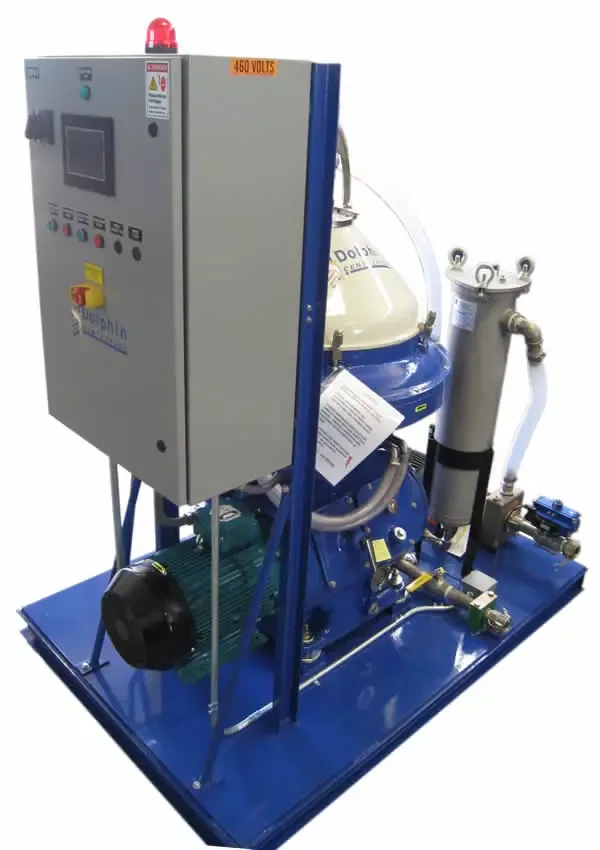
Alfa Laval WHPX-513 Centrifuge for Waste Water Clarification
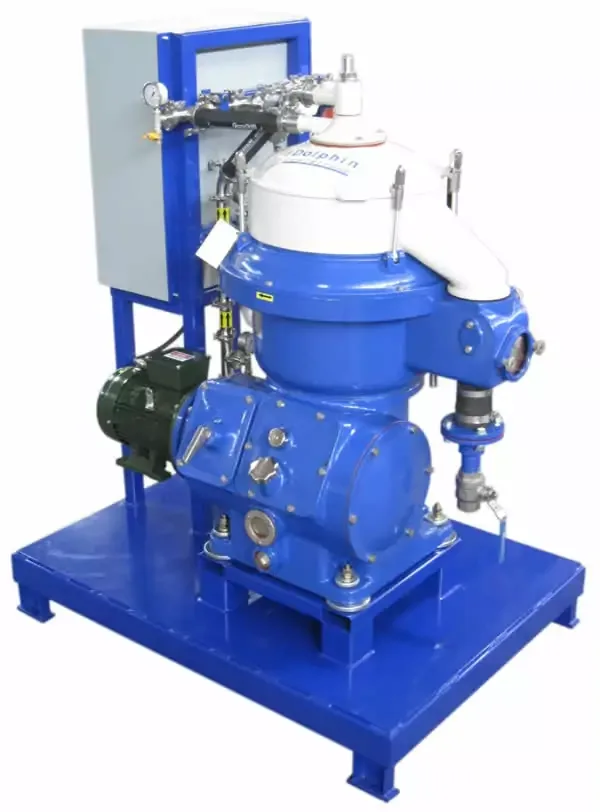
DMPX-028 Self-Cleaning Disc Stack Centrifuge for WasteWater
| Specification | WHPX-513 | DMPX-028 |
|---|---|---|
| Manufacturer | Alfa Laval Separator | |
| Type | Hi-Speed; Disc-Stack; Self-Cleaning | |
| Separation Efficiency | Solid particles down to 0.5 µ | |
| Rated Capacity | 100 GPM | 30 GPM |
| Capacity with 5% Sludge (Max.) | 80 GPM | 12 GPM |
| Motor Power | 15 HP | 10 HP |
| Skid Weight | 4,000 Lbs | 3,500 Lbs |
| Size / Dimensions (L × W × H) | 6′ × 7′ × 7′ | 4′ × 5′ × 6′ |
| Bowl Material of Construction (MOC) | 316L SS with some Red Metal parts | |
| Disc Stack Configurations | 2-Phase or 3-Phase | |
| Control System | Fully Automatic PLC & Touchscreen | |
Applications for Centrifuges in Sludge Thickening or Dewatering
Dolphin Centrifuge has supplied industrial decanters and disc-stack clarifiers for a wide range of wastewater applications. Some of these applications are listed below.
Bakery Bread Mold — Wash-Water
A bakery in Texas produced over 20,000 gallons of wash water from bread mold washing daily. The water was contaminated with flour, bread crust, and other organic residues. Dolphin Centrifuge pilot tested the water, recommended, and supplied an Alfa Laval NX-414 Decanter rated at 40 GPM on the water with light solids. The centrifuge effectively separated the organic contaminants, producing clean water suitable for discharge and reducing the bakery's waste disposal costs significantly.
University Composting Leachate
A university in California was having trouble handling abnormally high solids in the composting leachate. The leachate also carried a small amount of oil. Dolphin Centrifuge supplied a Sharples P-3000 Decanter accompanied by an Alfa Laval WHPX-510 (3-phase) oily water separator centrifuge. The two-step system first removed the bulk solids with the decanter, then the disc-stack separator polished the water and removed the oil contamination.
Tortilla Factory Wash-Water
Dolphin Centrifuge supplied an Alfa Laval NX-314B-31 Decanter to thicken the flour sludge in a tortilla factory wastewater stream. The compacted sludge reduced waste hauling and disposal costs by over 60%. Separated water was clean enough for sewer discharge. This is a common food-processing wastewater application where the organic sludge is concentrated and the water is clarified in a single continuous process.
Small Municipal Water Treatment Plant
A small municipality in the mid-west needed a sludge-thickener for their sewage treatment operation. Dolphin Centrifuge supplied an Alfa Laval NX-418B-31 Decanter centrifuge with a Chemical Dosing attachment. Municipal sewage dewatering is a common application, and the decanter works as expected to produce dry cake minimizing disposal costs. The chemical dosing system enhances flocculation of fine organic particles, improving the separation efficiency and producing drier sludge cake.
Large Onion Factory — Process Water
One of the largest onion producers in California was having issues with its organic sludge-carrying wastewater disposal. Dolphin Centrifuge supplied an Alfa Laval NX-416 2-Phase Decanter centrifuge to dewater the organic sludge from the wash water. The process throughput was approximately 40 GPM with a sludge load of about 20% by volume. The decanter effectively concentrated the organic waste while producing clarified water suitable for disposal or reuse in the processing facility.
Automotive Supplier — Industrial Wash-Water
A Detroit-based auto supplier generated over 10,000 gallons of wash water from floor and pit washing every week. The wash water carried oil in addition to the sludge. Dolphin Centrifuge supplied a 2-step water recovery system with an Alfa Laval NX-314 Decanter, followed by an Alfa Laval MOPX-207 'Self-Cleaning' 3-Phase Disc-Stack Centrifuge as a polisher to remove the oil. This two-stage centrifuge approach recovered clean water, separated the tramp oil for proper disposal, and concentrated the sludge for efficient waste handling.
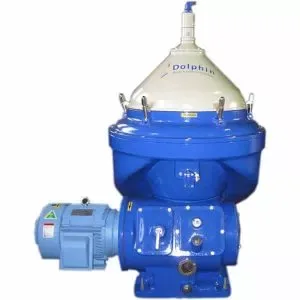
Disc Stack, Self-Cleaning Centrifuge for Wastewater Clarification at 80 GPM
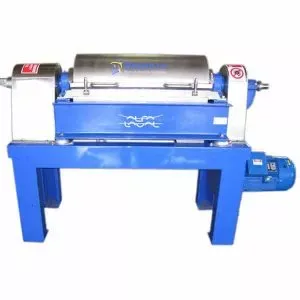
Sludge Thickener for Food Industry 40 GPM @ 15% Solids
Wastewater Centrifuge Models for Sale
Dolphin Centrifuge carries a range of Alfa Laval wastewater centrifuges in stock. The following are the various models available for the three types of wastewater centrifuges with additional options. All units are fully reconditioned, tested, and supplied with complete documentation and warranty coverage.
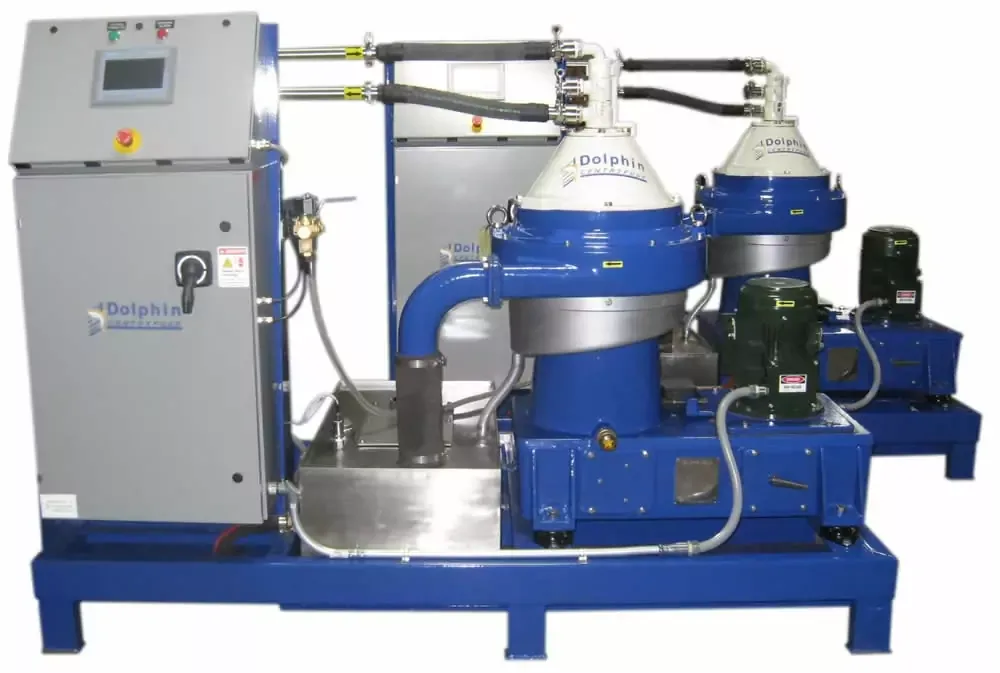
Alfa Laval WSPX-307 Waste-Water Centrifuge
Dewatering Decanter Centrifuges (High Sludge Content)
Decanter centrifuges are the workhorses of wastewater sludge dewatering. These horizontal scroll centrifuges are designed for continuous processing of high-solids wastewater streams and produce dry sludge cake while discharging clarified water.
| Model | Capacity | Options Available |
|---|---|---|
| Alfa Laval NX 418B-31G | 20 to 100 GPM | Feed Pump w/ VFD Control & Torque Lock; Fluid Tank w/ Level Sensor & Pump; Sludge Auger w/ Motor & Gear Reducer; Bearing Temp. Monitoring System; Automatic Back-Drive Control System |
| Alfa Laval NX 314 B-31G | 3 to 40 GPM | Feed Pump w/ VFD Control & Torque Lock; Fluid Tank w/ Level Sensor & Pump; Sludge Auger w/ Motor & Gear Reducer; Bearing Temp. Monitoring System; Automatic Back-Drive Control System |
| Sharples P 3400 | 20 to 100 GPM | Contact Dolphin Centrifuge for available options and configurations |
| Sharples P 3000 | 3 to 40 GPM | Contact Dolphin Centrifuge for available options and configurations |
Clarifier Disc Stack Centrifuge (Low Sludge Content) — Wastewater With Oil
Disc-stack centrifuges are ideal for wastewater with low sludge content and oil contamination. These high-speed, self-cleaning separators operate in 2-phase (solids-liquid) or 3-phase (solids-liquid-liquid) configurations to handle the most challenging oily wastewater streams.
| Model | Capacity | Options Available |
|---|---|---|
| Alfa Laval MOPX 213 3-Phase Centrifuge | Up to 80 GPM | Feed Pump w/ VFD Control; Sludge Tank w/ Sludge Pump; Clean Fluid Tank w/ Return Pump; Pre & Post Duplex Filters; Flow-Meter w/ Auto Pump Control |
| Alfa Laval WSPX 307 3-Phase Centrifuge | Up to 15 GPM | Feed Pump w/ VFD Control; Sludge Tank w/ Sludge Pump; Clean Fluid Tank w/ Return Pump; Pre & Post Duplex Filters; Flow-Meter w/ Auto Pump Control |
Related resources: Decanter Centrifuge Overview | Dewatering Centrifuge | Disc Stack Centrifuge Overview | Alfa Laval NX-418 Decanter | Wastewater Centrifuge Types & Photos | Centrifuge Sample Testing | Centrifuge Rental Program | Manure Centrifuge Separator | Decanter vs Disc Centrifuge | Industrial Centrifuge Controls
Ready to Get Started?
Dolphin Centrifuge supplies decanter and disc-stack centrifuge systems for wastewater sludge dewatering, clarification, and oily water separation. Contact us for sizing, pricing, and pilot testing.