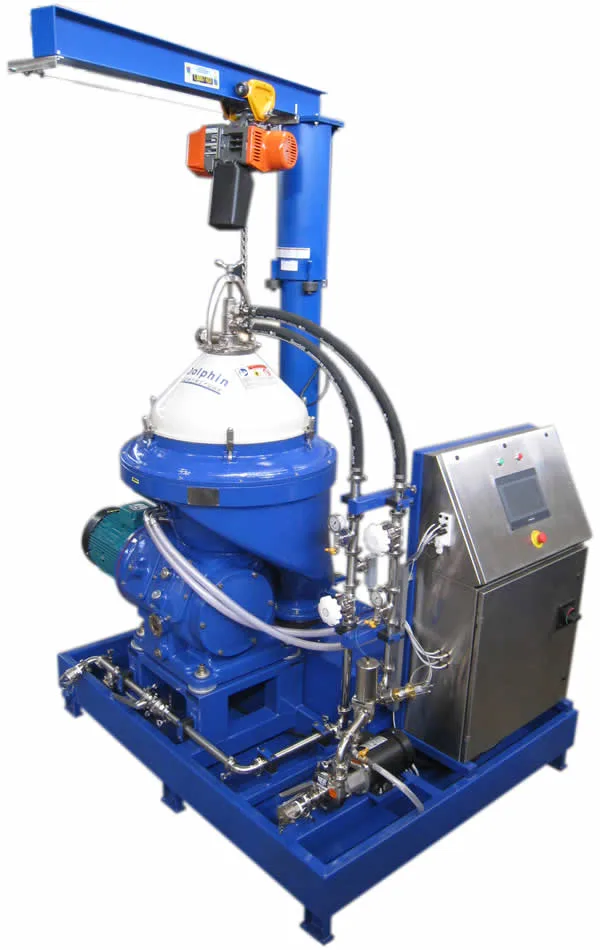
Dolphin Centrifuge supplies disc stack centrifuges (up to about 7,200 Gs depending on model, 0.5-micron separation) for wastewater under 10% solids and decanter centrifuges (up to 4,000 RPM) for high-sludge streams over 10% solids, serving semiconductor, food processing, battery manufacturing, and municipal applications. The machines shown here are remanufactured Alfa Laval centrifuges. Dolphin is the independent specialist in Alfa Laval disc stack and decanter centrifuges, with 40+ years of remanufacturing, turnkey systems, parts, and service behind every unit.
Dolphin is an independent remanufacturer and is not affiliated with Alfa Laval.
Overview
Industrial wastewater centrifuges fall into two broad categories based on the solids content of the waste stream. The correct choice depends on whether the wastewater has low sludge (under 10% solids) or high sludge (over 10% solids). Each type has distinct operating principles, G-force ranges, and ideal applications.
- Disc Stack Centrifuges - for wastewater with less than 10% solids. High-speed separators that remove particles down to 0.5 micron and separate oils. G-forces up to about 7,200 Gs depending on model.
- Decanter Centrifuges - for wastewater with greater than 10% solids. High-volume, continuous sludge dewatering machines that produce a dry cake and clarified effluent.
Disc Stack Centrifuges for Low-Sludge Wastewater
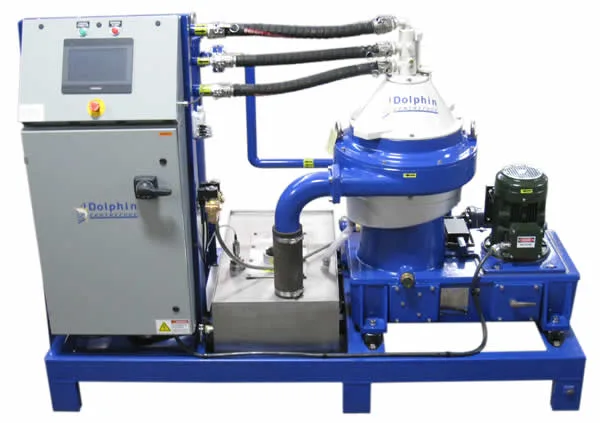
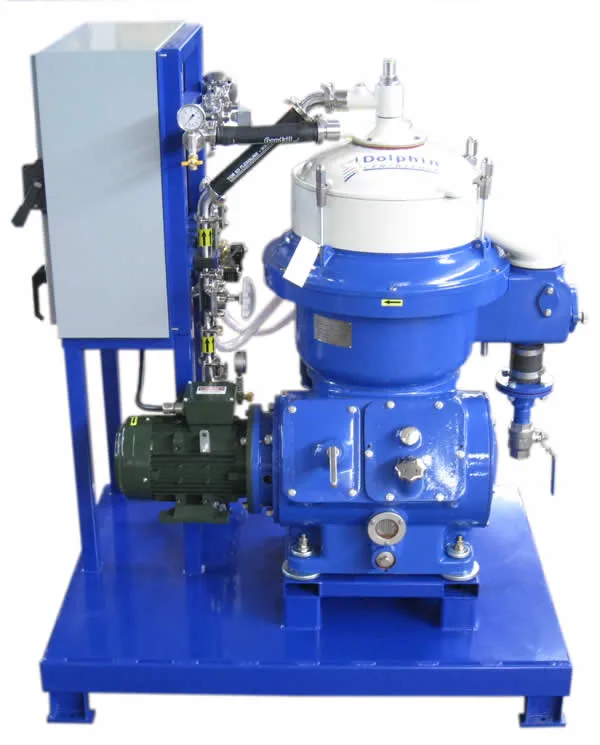
Disc stack centrifuges are the preferred technology when the wastewater contains less than approximately 10% solids by volume. These machines spin at extremely high speeds, generating centrifugal forces up to about 7,200 Gs depending on model. At these forces, particles as small as 0.5 micron are separated from the liquid phase, and any free oil is simultaneously removed via a separate discharge.
Self-cleaning disc stack models periodically eject accumulated sludge from the bowl automatically, allowing continuous, unattended operation. The following real-world examples illustrate how disc stack centrifuges handle different wastewater streams.
1. Silica Grinding Wastewater (Semiconductor Industry)
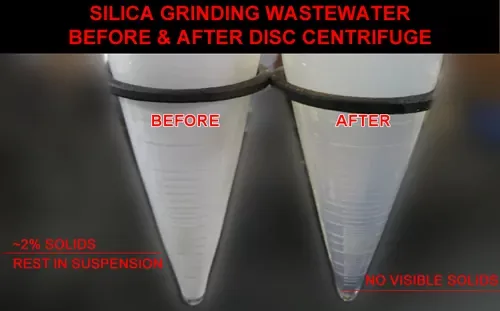
Silicon wafer manufacturing generates grinding slurry wastewater containing fine silica particles. A DMPX-070 disc stack centrifuge handles this application by clarifying the grinding water for reuse, dramatically reducing both water consumption and disposal costs. The DMPX-070 is Dolphin's turnkey module built on a remanufactured Alfa Laval WHPX 513 centrifuge (MOPX 213 equivalent), so the separation performance is Alfa Laval's and the skid, controls, and warranty are Dolphin's.
| Specification | DMPX-070 (Alfa Laval WHPX 513 / MOPX 213) |
|---|---|
| Motor Power | 25 HP |
| Capacity | 50 GPM @ 5% solids |
| Bowl Speed | 5,000 RPM |
| Wetted Material | 316L Stainless Steel |
| Dimensions (L × W × H) | 7′ × 6′ × 7′ |
2. Oily Wastewater (Food Processing)
Food processing plants produce oily wastewater that must be treated before discharge. A 28 GPM self-cleaning disc stack centrifuge in the Alfa Laval WSPX 307 class, remanufactured and packaged by Dolphin, simultaneously removes suspended solids and separates free oil from the water phase in a single pass. The three-phase separation eliminates the need for separate oil skimmers and settling tanks.
| Specification | Self-Cleaning Disc Stack (Alfa Laval WSPX 307 class) |
|---|---|
| Motor Power | 10 HP |
| Capacity | 20 GPM |
| Bowl Speed | 7,800 RPM |
| Wetted Material | 316L Stainless Steel |
| Dimensions (L × W × H) | 6′ × 4′ × 5′ |
3. Battery Manufacturing Wastewater
Battery manufacturing generates chemical-laden wastewater with fine metallic particles and dissolved contaminants. A DMPX-028 disc stack centrifuge, Dolphin's module built on a remanufactured Alfa Laval MOPX 207 centrifuge (WHPX 407 equivalent), provides the high G-force needed to separate these fine particles, producing clean water suitable for recycling back into the production process.
| Specification | DMPX-028 (Alfa Laval MOPX 207 / WHPX 407) |
|---|---|
| Motor Power | 10 HP |
| Capacity | 20 GPM @ 5% solids |
| Bowl Speed | 7,800 RPM |
| Wetted Material | 316L Stainless Steel |
| Dimensions (L × W × H) | 5′ × 5′ × 6′ |
Need Help Choosing the Right Wastewater Centrifuge?
Our engineers will evaluate your wastewater stream and recommend the right remanufactured Alfa Laval centrifuge type and configuration.
Decanter Centrifuges for High-Sludge Wastewater
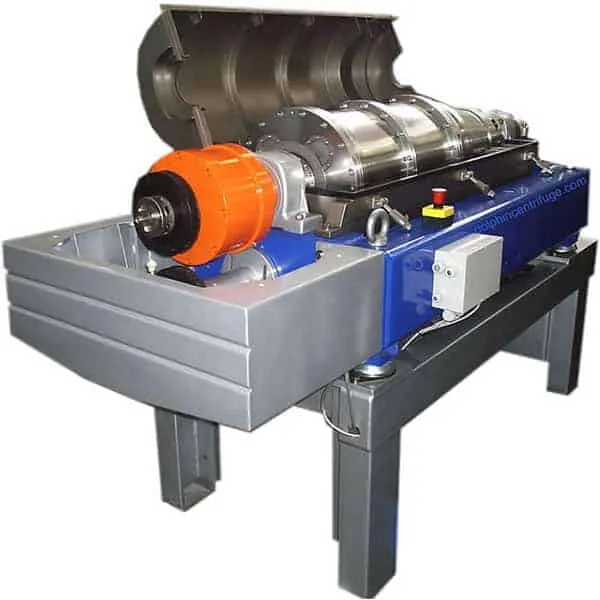
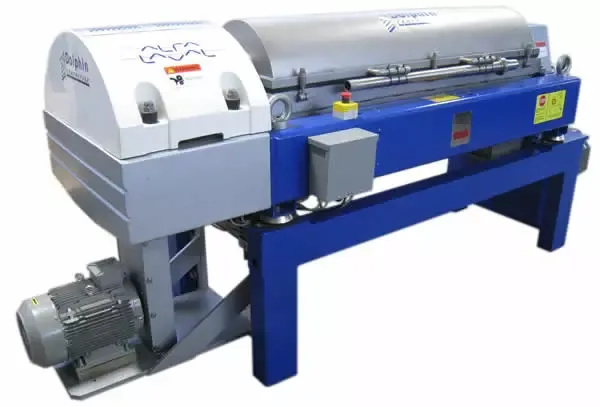
When wastewater contains more than 10% solids, a decanter centrifuge is the appropriate choice. Decanters are designed for high-volume, continuous processing of heavy sludge. An internal scroll conveyor transports the separated solids to the discharge end while clarified liquid overflows at the opposite end.
Decanters excel at municipal biosolids dewatering, mining tailings, food processing waste, and any application where the waste stream has a significant solids load. They produce a stackable cake that is far cheaper to haul and dispose of than liquid sludge.
Dolphin supplies these as remanufactured Alfa Laval decanters, most often the Alfa Laval NX-314 and Alfa Laval NX-418, rebuilt, test run, and warrantied in our Warren, Michigan shop.
Available Alfa Laval Decanter Models
| Specification | Alfa Laval NX-314 | Alfa Laval NX-418 | Sharples P-3000 |
|---|---|---|---|
| Motor Power | 10 HP | 20 HP | 20 HP |
| Capacity | 25 GPM on hemp ethanol slurry | 80 GPM @ 15% solids | 40 GPM @ 15% solids |
| Bowl Speed | 4,000 RPM | 4,000 RPM | 3,250 RPM |
| Scroll Torque | 2.5 kNM | 2.5 kNM | 2.5 kNM |
| Dimensions (L × W × H) | 7′ × 3′ × 5′ | 10′ × 4′ × 5′ | 8′ × 6′ × 6′ |
Choosing the Right Wastewater Centrifuge
The single most important factor is solids concentration. Wastewater with low solids content (under 10%) and fine particles benefits from the extreme G-forces of a disc stack centrifuge. Wastewater with heavy sludge loads (over 10%) requires the high-throughput solids handling of a decanter.
If the waste stream contains both oil and solids, a three-phase disc stack centrifuge can separate oil, water, and solids simultaneously. For extremely heavy sludge combined with an oily water phase, a two-stage approach, decanter followed by disc stack polishing, delivers the best results.
Contact us at (248) 522-2573 or sales@dolphincentrifuge.com with your wastewater analysis and flow rates for a no-cost equipment recommendation.
Frequently Asked Questions
What types of wastewater centrifuges are available? ▼
Two main types of industrial centrifuges handle wastewater: disc stack centrifuges for wastewater with less than 10% solids (generating up to about 7,200 Gs depending on model for sub-micron particle removal), and decanter centrifuges for wastewater with more than 10% solids (producing dry sludge cake with continuous scroll discharge).
When should I use a disc stack centrifuge for wastewater? ▼
Use a disc stack centrifuge when your wastewater contains less than 10% solids by volume and requires fine particle removal down to 0.5 micron. Disc stack centrifuges are ideal for semiconductor wastewater, oily wastewater requiring oil-water-solids separation, and battery manufacturing wastewater with fine metallic particles. Dolphin supplies these as remanufactured Alfa Laval disc stack centrifuges, typically the WSPX, MOPX, and WHPX series, packaged as Dolphin DMPX modules.
When should I use a decanter centrifuge for wastewater? ▼
Use a decanter centrifuge when your wastewater contains more than 10% solids and you need high-volume continuous sludge dewatering. Decanters excel at municipal biosolids, mining tailings, food processing waste, and any application producing a stackable dry cake for cheaper hauling and disposal. Dolphin supplies remanufactured Alfa Laval NX decanters, such as the NX-314 and NX-418, for these duties.
Can a centrifuge separate oil from wastewater? ▼
Yes. A three-phase disc stack centrifuge simultaneously separates oil, water, and solids from oily wastewater in a single pass. For extremely heavy sludge combined with an oily water phase, a two-stage approach using a decanter followed by disc stack polishing delivers the best results.
Can I test my wastewater before purchasing a centrifuge system? ▼
Yes. Dolphin Centrifuge offers a pilot sample testing program. Send us a sample of your wastewater and we will process it through our in-house lab centrifuge, delivering a full separation report including particle removal rates, recommended model, and estimated throughput. Testing eliminates uncertainty before capital commitment.
Related resources: Wastewater Centrifuge Overview | Silica Wastewater Case Study | Dewatering Centrifuge Guide | Manure Centrifuge Separator | Industrial Washer Fluid Centrifuge | Decanter Centrifuge | Disc Stack Centrifuge | Sample Testing Program | Decanter vs Disc Centrifuge | Centrifuge FAQ (101 Questions)