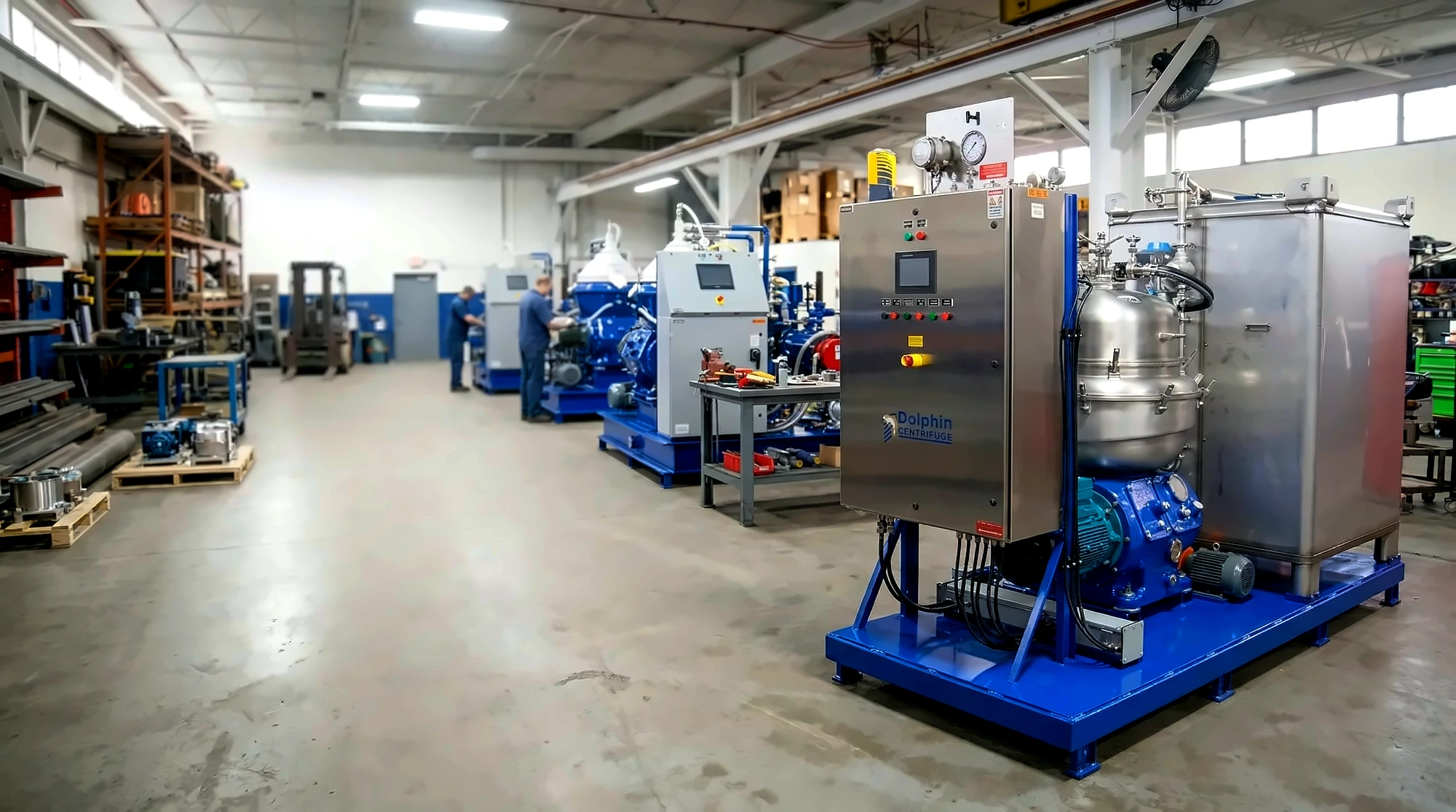
Dolphin Centrifuge supplies industrial disc stack and decanter centrifuge systems for liquid-solid and liquid-liquid separation at 3,000 to 12,000 Gs. Processing 1 to 300+ GPM across oil, wastewater, food, and chemical industries without filter media. Warren, Michigan — over 40 years of experience.
What is an Industrial Centrifuge?
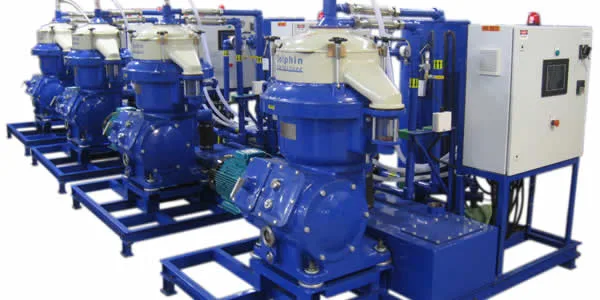
Industrial Centrifuge Systems for Waste Oil
An industrial centrifuge is a separation machine that uses centrifugal force to separate solids from liquids. A centrifuge exerts a centrifugal force that is thousands of times that of gravity.
This force causes the immediate separation of solids from liquids. And, in the case of immiscible liquids with different densities, it separates the fluids as well.
You can think of an industrial centrifuge as a scaled-up version of a lab centrifuge (test tube) except at a much bigger scale with a flow-through design.
That means the separated solids and liquid(s) continuously exit the centrifuge.
Types of Industrial Centrifuges
Industrial centrifuges fall into two main categories: Filtration type and Sedimentation type.
Filtration Type
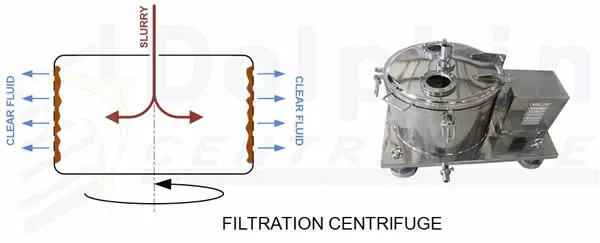
A perforated media allows the fluid to exit the 'screen' bowl in a filtration centrifuge while retaining the solids. The separated liquid collects in the bowl casing and drains out.
A relatively lower rotational speed (lower centrifugal force) is adequate for filtration centrifuges.
They are suitable for separating large amounts of coarse solids from a liquid. An example would be separating crystallized sugar from syrup or a chemical precipitate from the supernatant.
There are various mechanisms to collect the separated solids. A description of some of these methods is in the following section.
There are a variety of filtration centrifuges.
A peeler centrifuge has cloth media, which the user 'peels' away with the solids. A basket centrifuge has a perforated 'basket' that retains the separated solids.
Pusher centrifuges have slotted bowls with an articulated pusher arm to 'push' the accumulated solids. A wire mesh 'screen' holds the solids in screening centrifuges.
Sedimentation or Solid Bowl

Decanter Centrifuge Cross Section Diagram
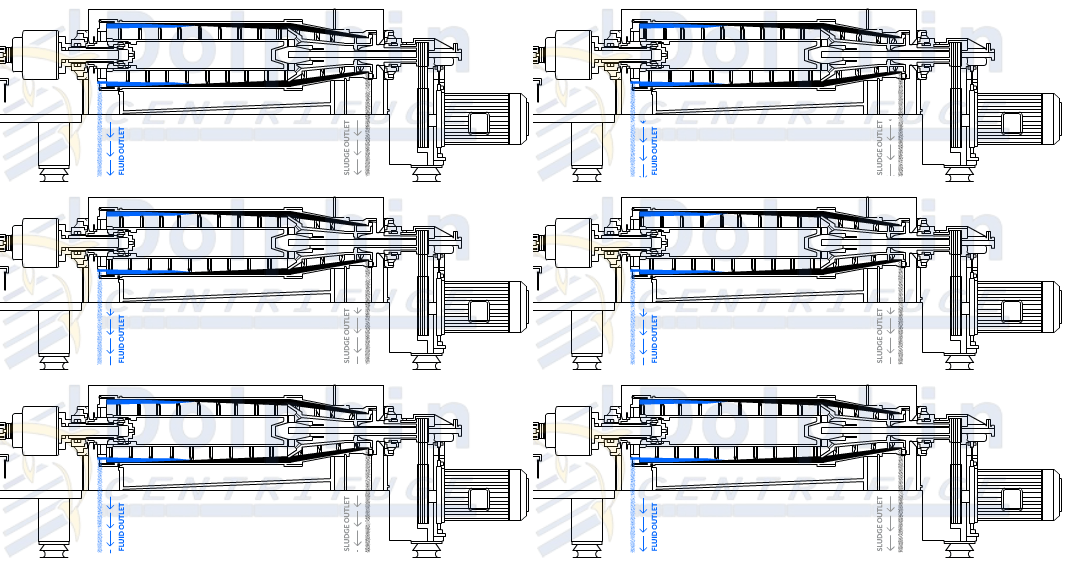
Dewatering Centrifuge Animation
A sedimentation centrifuge does not use a flow-through or perforated screen or media. This centrifuge uses a solid bowl, which is also known as a 'solid bowl centrifuge.'
The centrifugal force causes the denser solids to collect along the bowl wall. The lighter liquid thus separates from the solids. A liquid pathway allows the separated fluid to exit the bowl.
This 'solid bowl' feature adds an extra benefit to these sedimentation centrifuges.
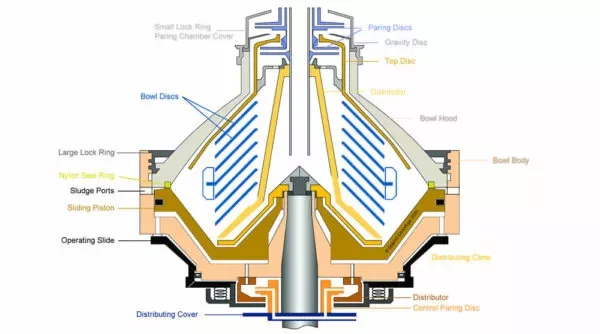
Disc Centrifuge Cross Section Diagram
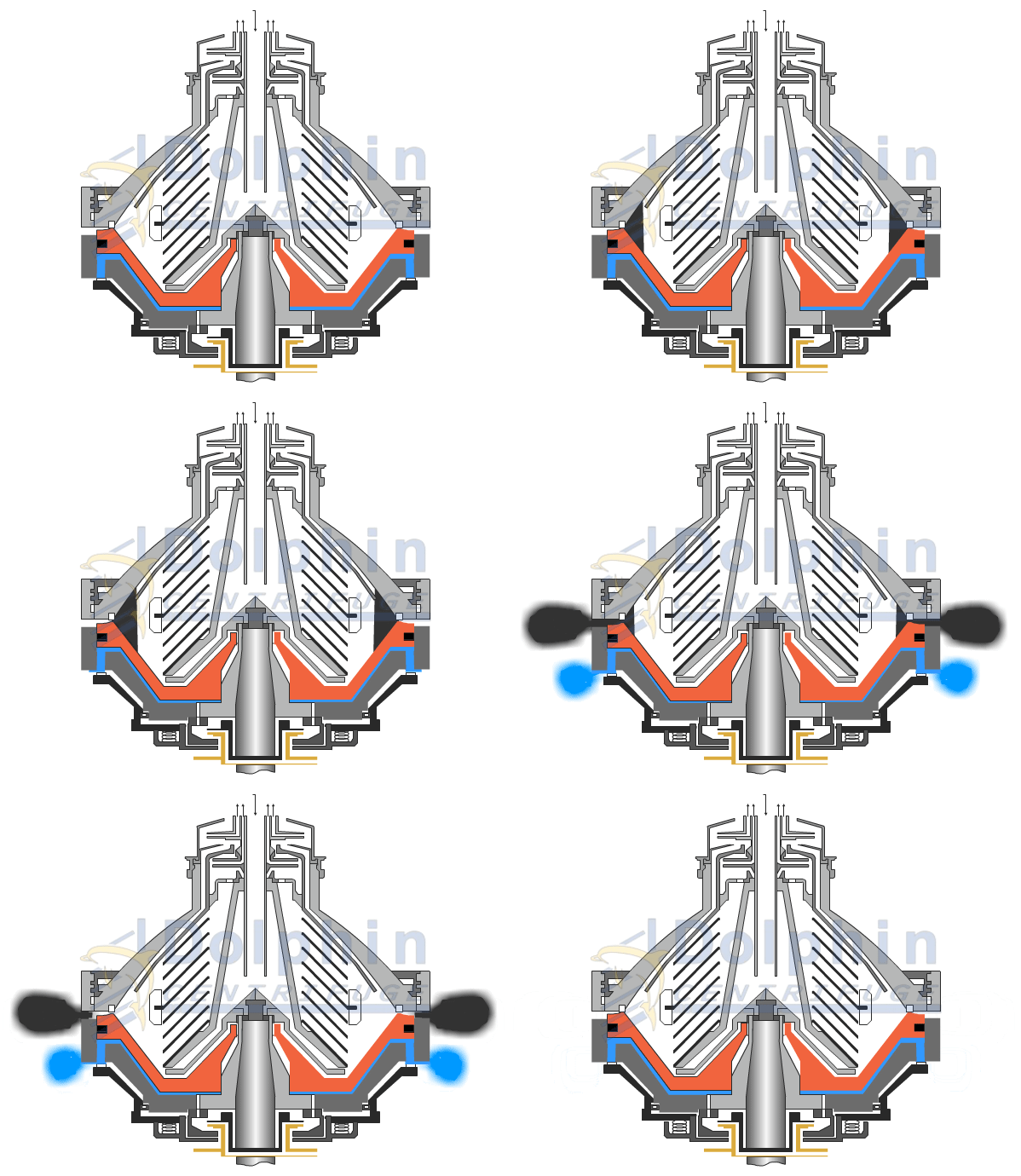
Disc Centrifuge Self-Cleaning Animation
The same centrifugal force also causes the differential settling of two immiscible liquids. In this case, the centrifuge separates all three phases, liquid, liquid, and solid. This separator is known as a 3-phase centrifuge.
Solid bowl centrifuges are further sub-categorized into two types which are decanter centrifuges and disc stack centrifuges.
Difference Between Filtration and Sedimentation Centrifuges
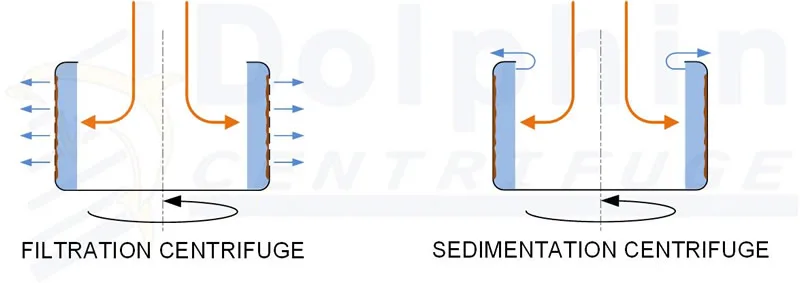
Filtration and Sedimentation Centrifuge Difference
The primary difference between filtration and sedimentation centrifuges is the bowl design. A filtration centrifuge has a pass-through bowl that allows the liquid to pass through and retain the solids. The sedimentation centrifuge has a solid bowl that uses differential settling to separate the solids from the liquid.
The following summarizes the other differences between these two types of centrifuges.
For more information, please read our detailed article on the technical difference between basket (filtration type) and decanter (sedimentation type) centrifuges.
| Feature | Filtration Type | Sedimentation Type |
|---|---|---|
| Separation Efficiency | Limited to media perforation/mesh size | Wide particle range — centrifugal force separates all sizes |
| G-Force | < 2,000 Gs | 3,000–10,000 Gs |
| Solids Extraction | Periodic scraping — blade removes accumulated solids | Continuous — scroll auger pushes solids out during operation |
| Liquid Discharge | Gravity drain through perforated bowl | Pressure discharge via built-in pump |
| Replaceable Media | Yes — adds labor and material costs | None required |
| Moving Parts | Articulated scraper/blade — periodic | Rotating scroll — continuous ejection |
| Bowl Construction | Perforated — perforation size sets particle cutoff | Solid bowl — more durable, longer service life |
| Erosion Protection | Pore wear difficult to protect. Scraper edges need hard coating | Scroll flights coated with tungsten carbide |
Read our article about the difference between RPM and RCF.
Capacity
An industrial centrifuge capacity (throughput) is the volume of fluid the centrifuge can process in a given time. A decanter-type industrial centrifuge can process 5 to 300+ gallons per minute. An industrial disc centrifuge has a capacity range of 1 to 200+ GPM. The actual processing capacity depends on the process fluid and contaminant level.
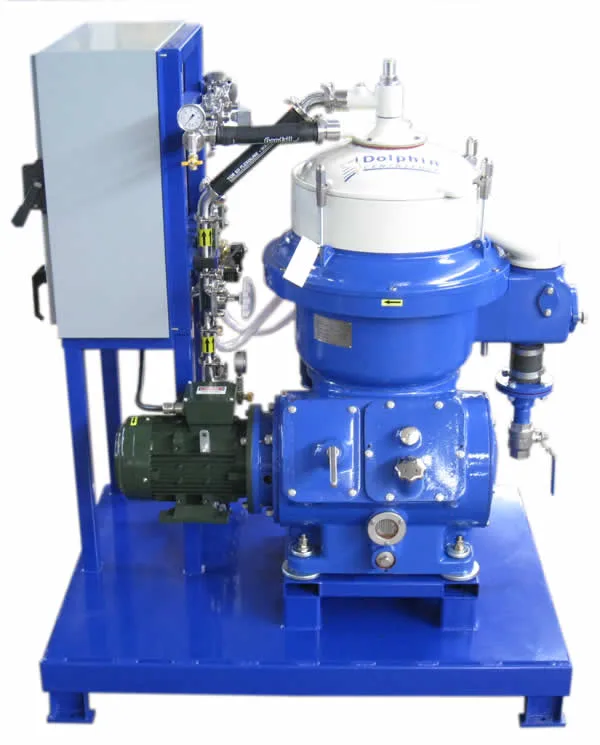
Industrial Centrifuge DMPX-028 for Wastewater
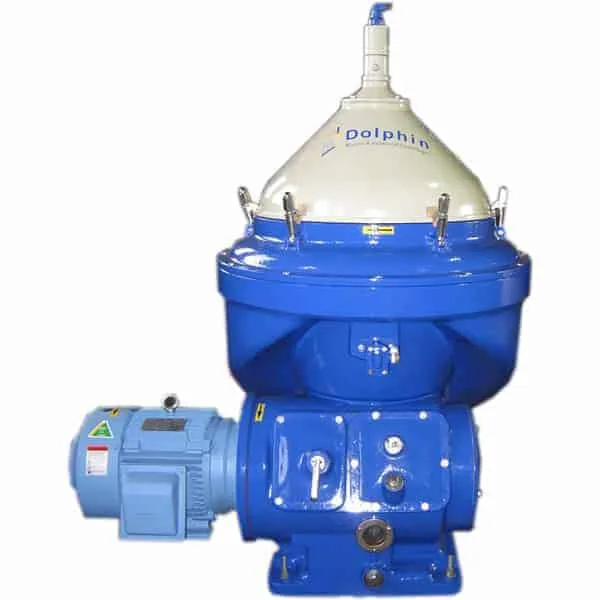
Alfa Laval WHPX-513 Centrifuge for Wastewater
The following table lists the capacities of popular sedimentation centrifuges.
| Centrifuge Type | Model | Rated Capacity (Water) | Capacity for 180 cSt Oil |
|---|---|---|---|
| Disc Centrifuge | DMPX-028 | 30 GPM | 18 GPM |
| Alfa Laval WHPX 513 | 100 GPM | 35 GPM | |
| Decanter Centrifuge | Alfa Laval NX-314 | 80 GPM | 15 GPM |
| Alfa Laval NX-418 | 172 GPM | 40 GPM |
Note: The rated capacity listed above is for water. For viscous fluids such as heavy oils, the effective throughput is significantly lower. The actual processing capacity depends on fluid viscosity, solids concentration, temperature, and desired separation quality. Contact Dolphin Centrifuge for application-specific sizing recommendations.
Size
How big is an industrial centrifuge?
The actual size of an industrial centrifuge depends on the type of centrifuge and its capacity. The following table lists the sizes of industrial centrifuges.
| Centrifuge Type | Minimum Size | Maximum Size |
|---|---|---|
| Filtration Type — Basket Centrifuge | 2' x 3' x 2' (H) | 6' x 8' x 8' (H) |
| Filtration Type — Peeler Centrifuge | 4' x 5' x 6' (H) | 8' x 10' x 8' (H) |
| Sedimentation Type — Decanter Centrifuge | 2' x 4' x 1.5' (H) | 8' x 25' x 10' (H) |
| Sedimentation Type — Disc Stack Centrifuge | 2' x 2' x 2' (H) | 8' x 8' x 12' (H) |
Cost
The cost of an industrial centrifuge is dependent on several factors. The primary factors that determine the cost of industrial centrifuges are as follows.
- Type of Centrifuge, i.e., Filtration or Sedimentation Type
- Processing Capacity or Size, i.e., Product Throughput
- Manufacturer, i.e., High-Quality Name Brand or Generic Centrifuge Copy
- Optional Equipment, i.e., Centrifuge Accessories Required
A small filtration-type centrifuge from an established quality manufacturer starts at approximately $30K, while a high-capacity unit can cost over $300K.
Remanufactured units typically cost 60% of comparable new filtration centrifuges.
Sedimentation-type centrifuges have a wider range of costs. A small decanter centrifuge starts at around $50K, while the high-capacity decanters cost over $1M.
Manufacturers
Industrial centrifuge manufacturers are classified into OEM (Original Equipment Manufacturer) and Clone or Generic Centrifuge Manufacturers.
OEM
The industrial centrifuge OEMs are established brand names that have been designing and manufacturing these separators for 50+ years. These manufacturers produce high-quality, durable centrifuges that are reliable equipment used worldwide.
In addition to being reliable, durable centrifuges, the OEM machines offer spare parts available worldwide.
The following is a list of OEMs in the industrial centrifuge space and their products offered:
| Manufacturer | Country of Origin | Centrifuge Types |
|---|---|---|
| Alfa Laval | Sweden | Decanter & Disc Stack (Sedimentation Type) |
| GEA / Westfalia | Germany | Decanter & Disc Stack (Sedimentation Type) |
| Flottweg | Germany | Decanter (Sedimentation Type) |
| Hiller | Germany | Decanter (Sedimentation Type) |
| Heinkel | Germany | Basket (Filtration Type) |
Clone Manufacturers
Generic or clone centrifuge manufacturers produce copies of OEM centrifuges that are cheaper but less reliable than the OEM centrifuges.
These clone centrifuges are typically manufactured in Asian countries (China, Turkey, etc.) and have limited lifespans and single-source spare parts restrictions.
Read our article 9 Steps to Selecting the Right Industrial Centrifuge for more information.
Need help choosing the right centrifuge type?
Our engineers will evaluate your application and recommend the optimal centrifuge configuration.
Frequently Asked Questions
What is an industrial centrifuge used for? ⌄
How much does an industrial centrifuge cost? ⌄
What is the difference between a decanter and a disc stack centrifuge? ⌄
What centrifugal force (G-force) do industrial centrifuges generate? ⌄
What capacity (GPM) do industrial centrifuges handle? ⌄
Applications
Industrial centrifuges find applications in a range of processing and manufacturing industries. See our comprehensive list of centrifuge applications.
Chemical industries use centrifuges to produce coarse and refined chemicals. Sanitary centrifuges find various pharmaceutical industry applications, from raw ingredients to finished drugs, under hygienic manufacturing processes.
Biotechnology-related companies use disc-stack centrifuges for cell harvesting and reactant recovery methods.
The food industry also has extensive uses for centrifuges. For example, the separation of beer from yeast, orange juice from the pulp, milk from milk fat, wine from must, and flavor extraction all use centrifuges.
Process industries such as waste oil, wastewater, and alternative fuels like biodiesel use centrifuges for multiple applications in their separation processes.
The manufacturing industry has its own set of applications for centrifuges. These include recycling of machining coolants, industrial wastewater treatment, cutting lubricants, quenching fluids, etc.
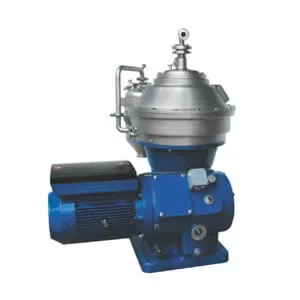
Biotech Clarifier
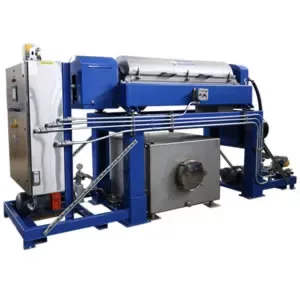
Chemical Thickening
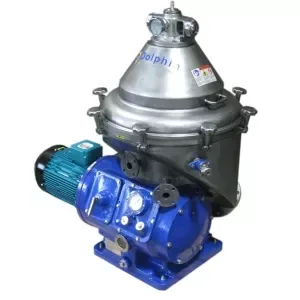
Beverage Clarification
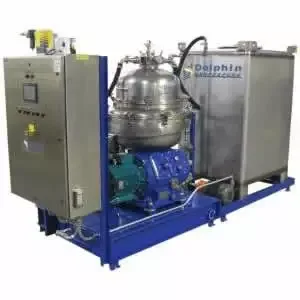
Pharmaceutical
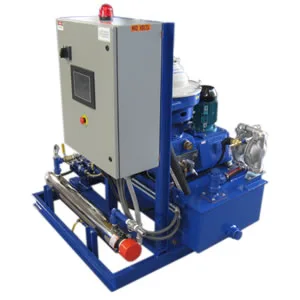
Industrial Lubricant
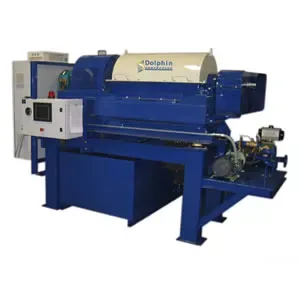
Wastewater Treatment
Benefits
Comparing industrial centrifuges with filters or similar media-based separation methods is quite common. These centrifuges offer several advantages over conventional static separation technologies.
The following is a list of some of the main advantages of industrial centrifuges.
Continuous Operation:
Industrial centrifuges process the fluid continuously for extended periods. They don't require the downtime associated with filter media replacement.
Continuous operation translates into higher production volume, which leads to increased efficiency.
Consistent Throughput:
In the case of filtration, as the filter media accumulates the solid contaminants, the flow-through area (pores) reduces, reducing the flow volume.
The frequent replacement of filter media is necessary to get higher flow volumes, and this cycle continues with varying flow rates.
On the other hand, an industrial centrifuge uses mechanical separation to separate and eject solid contaminants. This purging is a continuous process that allows a centrifuge to process without reducing the flow rate.
Long-Term Reliability:
Industrial centrifuges are heavy-duty machines with an expected life expectancy of 30+ years. Unlike filters requiring constant manual servicing (media replacement), centrifuges are self-operating with fully automatic operation.
The automation practically eliminates service-related downtime, which enhances reliability.
Minimize Product Loss:
The flow-through design feature of industrial centrifuges eliminates the need for manual filtration media replacement.
Therefore, product losses associated with filter or media replacement are not a concern in centrifugation. Minimized product loss leads to higher productivity and profits.
Low Operating Cost:
The only cost of operating an industrial centrifuge is utilities (electricity, water, air). There are no labor or media costs, which are the main costs related to filters.
Based on the above, the cost per gallon of fluid processed with an industrial centrifuge is negligible. This low operating cost helps the centrifuge owners to recuperate the capital cost remarkably sooner than thought.
Summary
Industrial centrifuges are some of the most prolific and understated separation equipment. They have applications in almost all processing industries, as described above.
If any fluid(s) is handled in a specific industry, chances are there is a suitable application for an industrial centrifuge.
The information in this article is based on years of experience we have acquired at Dolphin Centrifuge. Please get to know more about us from our About Us page.
Related Articles
9 Steps to Selecting the Right Industrial Centrifuge
A step-by-step guide to choosing the optimal centrifuge for your application.
Industrial Centrifuge Design
Understanding centrifuge bowl design, disc stack geometry, and engineering principles.
Disc Stack Centrifuge
Complete guide to disc stack centrifuges — how they work, applications, and specifications.
Decanter Centrifuge
Everything about decanter centrifuges — scroll design, dewatering applications, and capacity ranges.
RPM vs RCF — Centrifuge Force Calculation
Understanding the difference between RPM and relative centrifugal force (G-force).
Filter vs Centrifuge Comparison
Side-by-side comparison of filtration and centrifugation for industrial separation.
Three-Phase Decanter (Tricanter)
Simultaneous separation of solids and two immiscible liquid phases in one machine.
DMPX-014 Self-Cleaning Centrifuge
Dolphin's most popular mid-range 3-phase disc stack centrifuge — 13-16 GPM.
Industrial Centrifuge Sample Testing
Ship us your fluid — we test it and report real separation results at no charge.
Disc Stack Centrifuge Applications
Full list of industrial applications for disc stack centrifuge technology.