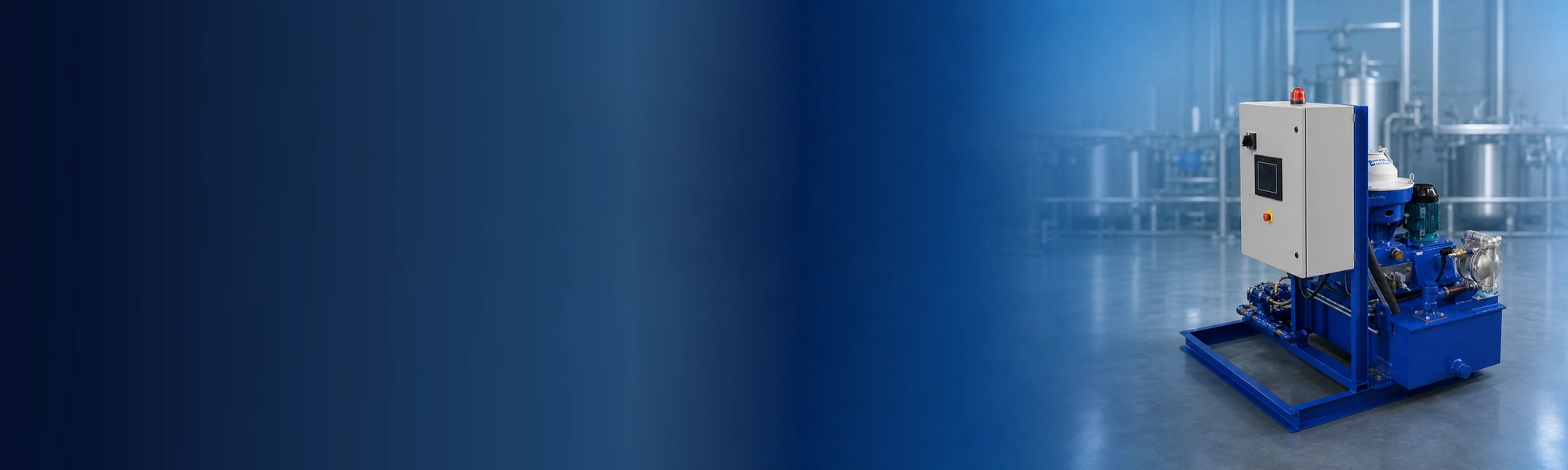
Dolphin Centrifuge, the independent specialist in Alfa Laval centrifuges, supplies self-cleaning Alfa Laval disc stack centrifuges for industrial washer fluid purification. Operating at 7,000+ Gs, these systems remove tramp oil, metal fines, and solids from aqueous wash solutions, extending fluid life up to 20x. Remanufactured, packaged, and test-run in Warren, Michigan.
What is Industrial Washer Fluid?
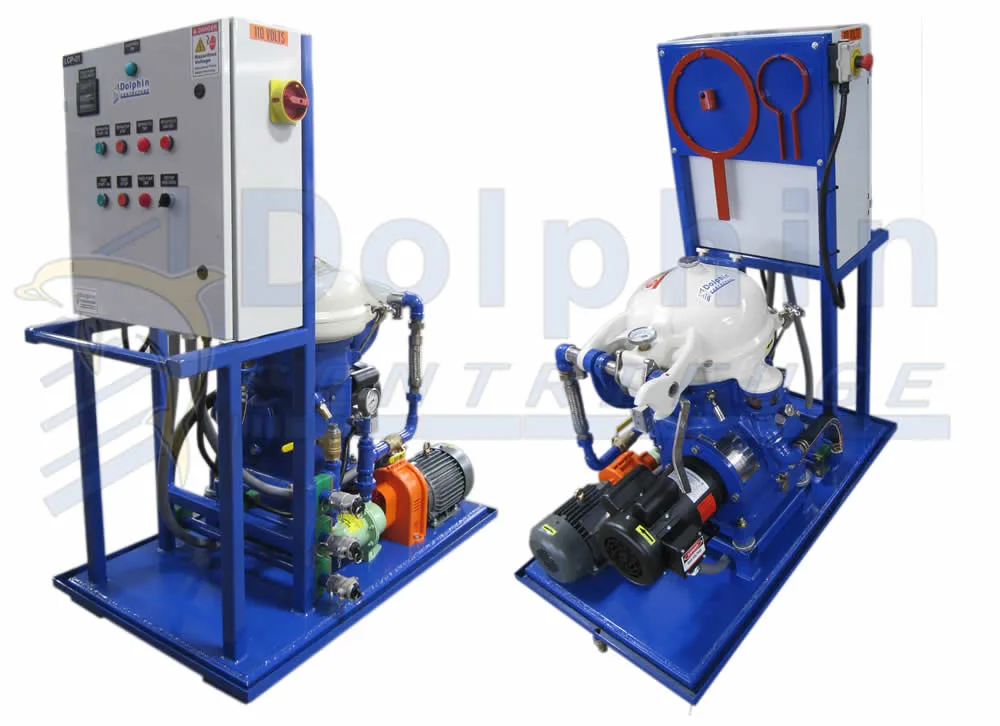
Dolphin Centrifuge, based in Warren, Michigan, supplies purpose-built washer fluid purification systems, each engineered around a remanufactured Alfa Laval disc stack centrifuge operating at 7,000+ Gs. Industrial washer fluid is an aqueous cleaning solution used in parts washing, metal plating pretreatment, paint preparation, surface coating, and degreasing operations. These water-based fluids — typically alkaline cleaners, neutral pH solutions, or specialized detergent blends — are designed to remove oils, greases, metal fines, and surface contaminants from manufactured parts before downstream processing.
During normal operation, washer fluid accumulates a range of contaminants. Tramp oil from machining operations, stamping lubricants, and rust preventatives enters the wash tank on incoming parts. Metal fines and sediment are washed off part surfaces and settle in the tank. Particulate debris — scale, paint chips, and abrasive dust — further degrades the fluid. Over time, this contamination reduces cleaning effectiveness, causes staining or spotting on washed parts, and ultimately forces a costly tank dump-and-refill.
Washer fluid replacement is expensive on multiple fronts: fresh fluid concentrate, lost production during tank changeouts, hazardous waste disposal of the spent solution, and labor for cleaning and recharging the system. For large-volume wash systems, these costs add up quickly — often exceeding tens of thousands of dollars annually.
Washer Fluid Centrifuge
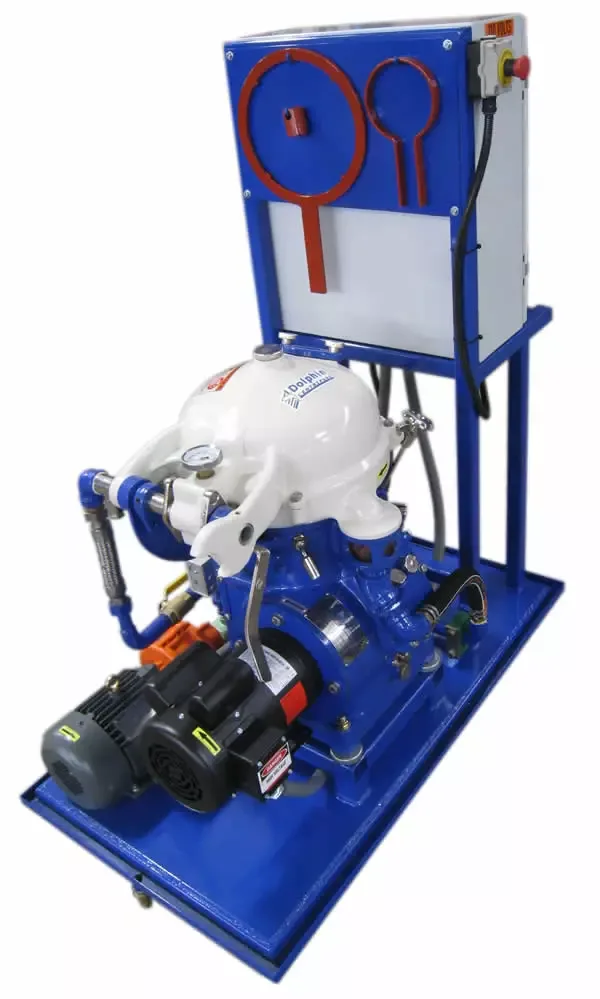
A washer fluid centrifuge is a disc stack centrifuge configured for continuous purification of aqueous wash solutions. The centrifuge performs three-phase separation in a single pass — simultaneously removing floating tramp oil (light phase), clean washer fluid (heavy/water phase), and solid contaminants (sludge phase) from the contaminated feed stream.
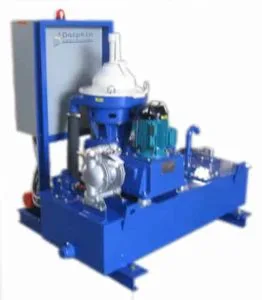
Alfa Laval WSPX-303 Wash Water Centrifuge
This centrifuge maintains oil and particle contamination at a low level continuously without any degradation of fluid quality or cleaning ability. It can also extend the service life of washing liquids up to 20 times compared to untreated liquids.
The centrifuge operates in a kidney-loop configuration, continuously drawing contaminated fluid from the wash tank, separating the contaminants, and returning purified fluid to the system. This arrangement maintains washer fluid at peak cleaning effectiveness without interrupting production. Unlike filters that clog and require replacement, the centrifuge is a purely mechanical separator with no consumable elements.
The result is dramatic: where untreated washer fluid might last 4–8 weeks before requiring a full dump, centrifuge-purified fluid can remain in service for 12 months or longer — extending fluid life by up to 20x.
Dolphin Centrifuge supplies turnkey washer fluid purification systems for individual wash stations and high-volume central wash systems. Call (248) 522-2573 or email sales@dolphincentrifuge.com for a custom recommendation.
Send Us Your Wash Fluid for Testing
Our engineers will evaluate your washer fluid chemistry and recommend the optimal centrifuge configuration before you commit to a purchase.
Request Sample Testing →Benefits
- Reduced Fluid Costs: Extending washer fluid life by 10–20x dramatically reduces concentrate purchases. For large-volume wash systems, annual fluid savings alone can exceed the cost of the centrifuge
- Minimized Hazardous Waste Disposal: Fewer tank dumps means far less spent fluid requiring treatment and disposal — reducing both cost and regulatory burden
- Reduced Equipment Breakdown: Clean washer fluid prevents nozzle clogging, pump seal failures, and heat exchanger fouling that result from contaminated fluid circulating through the wash system
- Improved Product Quality: Parts washed in clean fluid emerge free of oil spots, particulate residue, and staining — critical for downstream painting, plating, and coating operations
- Less Labor: Continuous centrifugal purification eliminates the labor-intensive cycle of draining, cleaning, and recharging wash tanks. Operators focus on production rather than fluid management
- No Consumable Media: Unlike coalescers, bag filters, or cartridge filters, the disc stack centrifuge has no filter elements to clog, replace, or dispose of
Effect of Using a Centrifuge
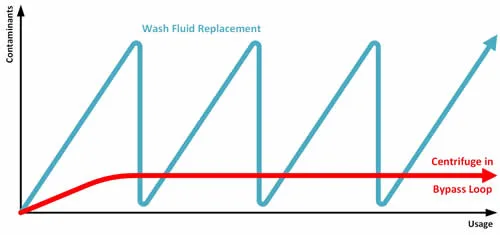
Without centrifugal purification, washer fluid management follows a periodic replacement cycle: fluid is charged, used until contamination degrades performance, then dumped and replaced. Each cycle incurs fluid cost, disposal cost, downtime, and labor. As contamination builds between changeouts, part cleanliness deteriorates — leading to quality rejects and rework.
A centrifuge transforms this into a continuous purification process. By constantly removing oil and solids, the centrifuge maintains fluid quality at a consistent, high level. The benefits are compounding:
- Consistent wash quality — no gradual degradation between changeouts
- Predictable fluid costs — small periodic concentrate additions replace large batch purchases
- Reduced downtime — wash systems run continuously without scheduled tank dumps
- Environmental compliance — significantly less hazardous waste generated per year
- Lower total cost of ownership — centrifuge ROI is typically achieved within 6–12 months
Specifications
The following table shows specifications for the most popular Dolphin Centrifuge washer fluid purification systems, built on the Alfa Laval WSPX 303 and WSPX 207 concentrator centrifuges. All models feature self-cleaning disc stack construction for simultaneous oil and solids removal. Capacities are derated from nominal water capacity to account for the higher viscosity and contaminant loading typical of wash fluids.
| Specification | WSPX-303 | WSPX 207 |
|---|---|---|
| Centrifuge Type | Alfa Laval Self-Cleaning, Disc Stack | |
| Centrifuge Efficiency | Solid Particles > 0.5μ; Free Water > 2μ | |
| Bowl Speed (RPM) | 8,500 | 6,300 |
| Rated Capacity (GPM) | Sized per application | 32 |
| Wash Fluid Capacity (GPM) | Sized per application | 15 |
| Sludge Space (Gal) | 0.31 | 1.03 |
| Motor Power (HP) | 4 | 7.5 |
| Skid Dimensions (ft) | 3' x 4' | 5' x 6' |
| Skid Weight | 1,200 | 3,000 |
* Specifications are for base skids without any options.
Note: Actual throughput depends on wash fluid chemistry, oil loading, solids concentration, and operating temperature. Higher contamination levels or elevated temperatures may require reduced flow rates. Contact our engineering team for application-specific sizing. For general derating guidelines, see our disc stack centrifuge capacity guide.
Features and Sizing
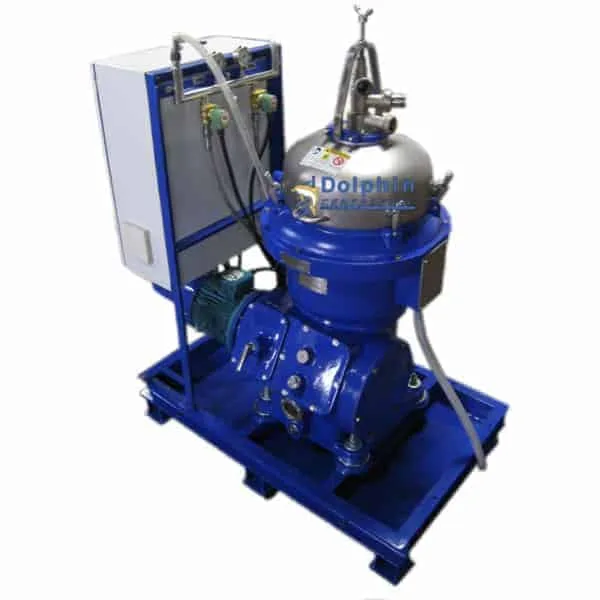
Dolphin washer fluid centrifuges use a concentrator disc stack design optimized for aqueous cleaning solutions. The disc stack geometry and number of discs are selected to maximize separation area while accommodating the higher solids loading typical of wash fluid applications.
Sizing consideration: Wash fluids typically carry significantly more contaminants than machining coolants — including heavy oil loading from incoming parts, metal fines, scale, and particulate debris. As a rule of thumb, washer fluid applications require approximately 50% derating from the centrifuge's nominal water capacity. A centrifuge rated at 16 GPM on clean water, for example, should be sized at approximately 8 GPM for wash fluid service.
This derating ensures adequate residence time in the disc stack for thorough separation of fine contaminants. Under-sizing the centrifuge (running at full nominal capacity) will result in reduced separation efficiency and contaminant carryover into the clean fluid discharge.
Key features of the washer fluid centrifuge system include:
- Self-cleaning bowl: Automatic sludge ejection at timed intervals for continuous, unattended operation
- Three-phase separation: Simultaneous removal of tramp oil and solid contaminants in a single pass
- PLC-based controls: Programmable ejection intervals, feed rate control, and fault monitoring
- Corrosion-resistant construction: Wetted parts in stainless steel for compatibility with alkaline wash chemistries
- Turnkey system: Complete package including centrifuge, feed pump, piping, controls, and instrumentation
Application - Case Study
Background
A southwest-based manufacturer of industrial fittings has a pre-treatment process to remove dirt, oil, and grease from the fittings before the finishing processes. The washing system used an industrial washer fluid to rinse the fittings.
The Problem
Their detergent-based cleaning fluid tank had a capacity of 5,000 gallons. The washing liquid would reach a peak contamination level every three months, where the entire 5,000 gallons of liquid would be replaced. This change of fluid was expensive for three reasons.
Firstly, the replacement cost of the washing liquid was high. Secondly, the disposal cost to haul away the dirty liquid added to operational costs. And finally, the fluid holding tank had to be cleaned before replenishing. This was a time and labor-intensive operation.
The Solution
The company contacted Dolphin Centrifuge to investigate the possibility of using a wash-water centrifuge to address the costs of their washing fluid.
Dolphin tested a small sample of the customer's wash water through a pilot-scale centrifuge. The separation effectively removes all hydrocarbons and dirt to produce clean washer fluid ready for reuse. For similar before-and-after examples, see our sample testing case studies.
The customer decided to install a Dolphin Centrifuge wash-water centrifuge module based on the test results. The service life of the washer fluid immediately went up to 6 months from the previous two months. The disposal costs were almost eliminated due to the sludge separated by the centrifuge being a small fraction of the previous disposal volume.
Additionally, the fluid storage tank had minimal sludge accumulation, which led to additional time and labor savings. In total, the savings generated within the first six months recuperated the manufacturer's cost of the centrifuge system!
Have a similar wash fluid challenge? Contact our engineering team or call (248) 522-2573 for a no-obligation assessment of your application.
Washer Fluid Centrifuge Systems for Sale
Shown below are wash-water centrifuge packages of different capacities, each featuring a remanufactured Alfa Laval centrifuge: the manual-clean WSB 104 and the self-cleaning WSPX 303, WSPX 207, and WSPX 213 concentrators.
Dolphin Centrifuge is the independent specialist in Alfa Laval centrifuges: remanufactured machines, turnkey systems, parts, and service, built on 40+ years of Alfa Laval experience and led by Sanjay Prabhu, M.S.M.E. The skid, pumps, piping, and controls are Dolphin engineering; the centrifuge at the center of every package is Alfa Laval, rebuilt and test-run in Warren, Michigan. Dolphin is an independent remanufacturer and is not affiliated with Alfa Laval.
Alfa Laval WSB 104 Concentrator
Manual Cleaning · Disc Stack Centrifuge
| Technical Specs | |
|---|---|
| Capacity | 3 GPM on Parts Washer Fluid |
| Motor HP | 2 HP |
| Voltages | 110V / 230V / 460V |
| Skid Dim. | ~3' x 4' |
| Skid Wt. | ~600 lbs |
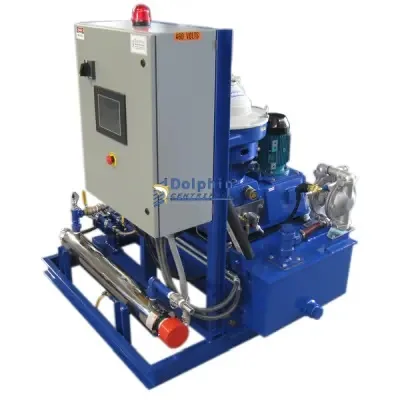
Alfa Laval WSPX 303 Concentrator
Self Cleaning · Disc Stack Centrifuge
| Technical Specs | |
|---|---|
| Capacity | Sized per application on parts washer fluid |
| Motor HP | 4 HP |
| Voltages | 230V / 460V |
| Skid Dim. | ~3' x 4' |
| Skid Wt. | ~1,200 lbs |
Alfa Laval WSPX 207 Self-Cleaning Centrifuge
Self-Cleaning · Disc Stack Centrifuge
| Technical Specs | |
|---|---|
| Capacity | 15 GPM on Wash Water |
| Motor HP | 7.5 HP |
| Voltages | 230V / 460V |
| Skid Dim. | 6' x 5' |
| Skid Wt. | ~3,500 lbs |
Alfa Laval WSPX 213 Concentrator Centrifuge
Self-Cleaning · Disc Stack Centrifuge
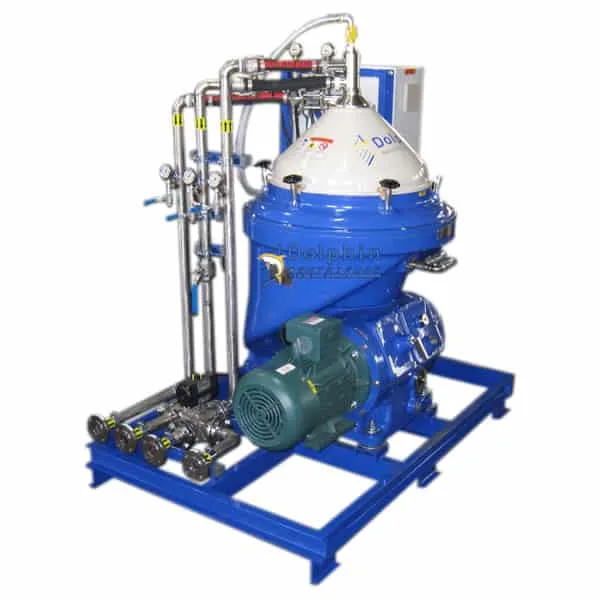
Photo: reconditioned Alfa Laval MOPX 213. The WSPX 213 is the concentrator configuration of the same 213 bowl.
| Technical Specs | |
|---|---|
| Capacity | 40 GPM on Water-Based Fluids |
| Motor HP | 15 HP |
| Voltages | 230V / 460V |
| Skid Dim. | 5' x 6' |
| Skid Wt. | ~4,000 lbs |
Related resources: Machine Coolant Centrifuges | Cutting Oil Centrifuges | Self-Cleaning Disc Stack Centrifuge | Disc Stack Applications | Sample Testing Program